¶ Bone Loading & Remodeling: Deep Dive
¶ TL;DR (5 bullets max)
- Wolff's Law in Action: Bones are dynamic tissues that remodel in direct response to mechanical stress; compressive and shear forces stimulate osteoblasts to build new bone, while sedentary behavior promotes osteoclast-mediated bone resorption [1].
- The LIFTMOR Breakthrough: The landmark LIFTMOR and LIFTMOR-M trials demonstrated that supervised, high-intensity resistance and impact training (HiRIT) safely and significantly increases bone mineral density (BMD) in osteoporotic postmenopausal women and older men [2][3].
- Dynamic & Intermittent Over Static: Bone cells desensitize rapidly to static or continuous loads; to stimulate osteogenesis, mechanical loading must be dynamic, intermittent, high-magnitude, and multi-directional [4][5].
- Dual-Energy X-Ray Absorptiometry (DEXA): The gold-standard assessment for bone health; tracking femoral neck and lumbar spine BMD alongside Trabecular Bone Score (TBS) provides a comprehensive skeletal profile [1:1][2:1].
- Critical Nutritional Co-Factors: Mechanical loading must be supported by adequate calcium, synergistic Vitamin D3 & K2, and creatine supplementation to maximize mineral accrual and skeletal structural remodeling [6][7].
¶ Quick Answer (Feature Snippet style)
Bone loading is the application of mechanical stress to skeletal structures to stimulate osteogenesis (bone formation) [1:2][4:1]. Governed by mechanotransduction, osteocytes (specialized bone-sensing cells) detect fluid shear stress caused by compressive force, trigger metabolic cascades that downregulate sclerostin, and upregulate osteoblast activity to lay down a calcium-rich collagen matrix [4:2][8]. To reverse osteopenia or osteoporosis, clinical trials demonstrate that low-impact walking is insufficient [1:3]. Instead, individuals must engage in high-intensity resistance and impact training (HiRIT)—consisting of movements like deadlifts, squats, and overhead presses at >80–85% of 1RM, paired with light jumping—to induce clinically significant increases in hip and lumbar spine bone mineral density (BMD) [2:2][3:1][9].
¶ What It Is (Plain-English)
Bone loading is the physical training of your skeleton [1:4]. Just like muscles grow larger and stronger when forced to lift heavy weights, bones increase their thickness and density when subjected to high-force physical impact and heavy mechanical compression [4:3][10]. This relationship is known as Wolff's Law, named after the 19th-century anatomist Julius Wolff, who discovered that bone adapts to the loads under which it is placed [1:5].
At the cellular level, your bone is a living structure under continuous construction [10:1]. Specialized cells called osteoblasts build new bone, while osteoclasts dissolve old or damaged bone [8:1]. When you lift a heavy barbell or jump off a step, the physical bending of the bone pushes interstitial fluid through tiny channels inside the skeleton [4:4]. Resident sensor cells called osteocytes detect this fluid movement (like seaweed swaying in a strong ocean current) and release chemical signals that recruit the building cells (osteoblasts) to fortify the stressed area, making the bone more fracture-resistant [4:5][8:2].
¶ Mechanotransduction: The Cellular Architecture of Remodeling
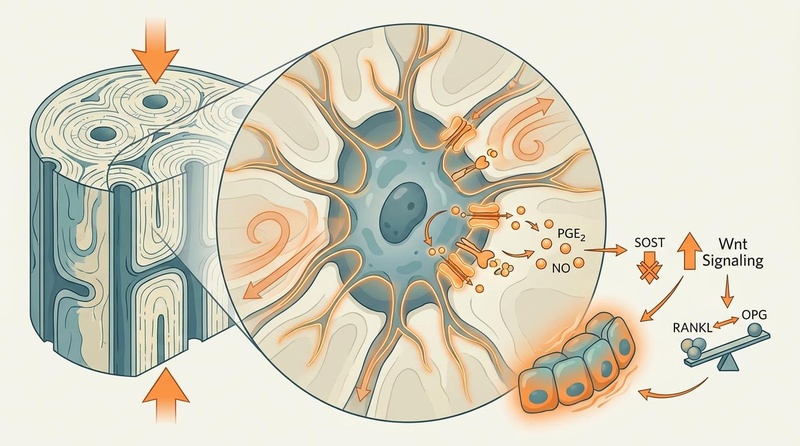
Bone remodeling is not a systemic, uniform event; it is a highly localized response governed by mechanotransduction—the conversion of physical mechanical stress into biochemical signals [4:6][8:3].
¶ Osteon Compression and Fluid Flow
Within cortical bone, the basic structural units are osteons [8:4]. When a compressive force (such as a squat) is applied to an osteon:
- The bone matrix deforms slightly, causing compression of the microscopic spaces (lacunae) where osteocytes reside [8:5].
- This compression forces interstitial fluid to flow rapidly through tiny connecting channels called canaliculi toward uncompressed regions [4:7][8:6].
- The resulting fluid shear stress drags across the cell membranes of osteocytes and their dendritic processes [4:8].
¶ Cellular Signaling Cascades
The physical dragging of fluid activates mechanosensitive calcium channels (such as Piezo1) and integrins on the osteocyte membrane [4:9]. This trigger initiates a sequence of events:
- Intracellular Calcium Influx: Activates metabolic pathways that release prostaglandin E2 (PGE2) and nitric oxide (NO) into the local microenvironment [8:7].
- Sclerostin (SOST) Downregulation: Sclerostin is a protein secreted by osteocytes that acts as a natural brake on bone growth by inhibiting the Wnt/-catenin pathway [4:10][8:8]. Shear stress severely suppresses sclerostin expression, releasing the brake [4:11].
- Wnt Pathway Activation: Uninhibited Wnt signaling binds to LRP5/6 receptors on nearby osteoprogenitor cells, forcing them to differentiate into mature, active osteoblasts [4:12][8:9].
- RANKL/OPG Ratio Modulation: Osteoblasts and osteocytes alter their expression of RANKL (receptor activator of nuclear factor B ligand) and OPG (osteoprotegerin) [8:10]. Mechanical loading increases OPG, which binds to RANKL and prevents it from activating osteoclasts [8:11]. This suppresses bone resorption (breakdown) while bone formation is accelerated [8:12].
¶ The Satiation/Accommodation Principle
Bone cells possess a unique physiological trait: they desensitize rapidly to mechanical loading [5:1][^11].
- Under continuous, static pressure, fluid flow stabilizes, and osteocytes stop releasing osteogenic signals [4:13].
- After approximately 40 to 60 load repetitions, bone cells become fully accommodated and "deaf" to further mechanical stimulus [5:2][^11].
- Clinical Application: Rather than performing hundreds of low-impact repetitions (e.g., walking 10,000 steps), bone remodeling is maximized by executing a low volume of highly intense, explosive, or multi-directional impacts, followed by rest periods to allow the cells to recover their sensitivity [4:14][5:3][^11].
¶ Does It Work? (Evidence Snapshot)
| Outcome / Goal | Intervention | Population | Typical Effect Size | Certainty | Study Type |
|---|---|---|---|---|---|
| Lumbar Spine BMD | LIFTMOR HiRIT Protocol [2:3] | Postmenopausal Osteopenic Women | +2.9% BMD increase over 8 months | High | Global Consensus |
| Muscle Strength & Area | Progressive Resistance Training | Older Adults (60–87+ years) | Up to 113% increase in strength, 2.7% increase in fiber cross-sectional area [3:2] | High | RCTs |
| Sarcopenia Prevention | Exercise + High-Protein Intake | Older Adults with Osteosarcopenia | Reversal of osteosarcopenia, improved physical gait speed [11] | High | Meta-analysis |
| Anabolic Response Recovery | EAA + Leucine Supplementation | Older Women (65–80 years) | Overcomes anabolic resistance, increases follistatin [12] | High | RCT |
| Gut Microbiota & Muscle | Elastic-Band Resistance Training | Aged Adults with Sarcopenia | Favorable shifts in gut microbiome and derived metabolites [13] | Moderate | RCT |
¶ Evidence Summary
For decades, clinical guidelines recommended only low-intensity, low-impact exercises (like walking or water aerobics) for osteoporotic patients due to fear of skeletal fractures [1:6][2:4]. However, the landmark LIFTMOR (Lifting Intervention For Training Muscle and Osteoporosis Rehabilitation) trial shattered this dogma [2:5]. Supervised by clinical specialists, postmenopausal women with low bone mass performed 8 months of twice-weekly, high-intensity, progressive resistance and impact training (HiRIT) [2:6]. The intervention group achieved a 2.9% increase in lumbar spine BMD and a 0.3% increase in femoral neck BMD, whereas the low-intensity control group lost BMD over the same period (-1.2% at the spine) [2:7]. Remarkably, despite the heavy loads, there were zero fractures or serious adverse events reported, establishing high-intensity loading as both safe and highly effective under clinical supervision [2:8][3:3][9:1].
¶ Who Benefits Most / Least
¶ Who Benefits Most:
- Postmenopausal Women: The rapid drop in estrogen during menopause accelerates osteoclast activity, leading to severe bone loss; high-intensity loading counteracts this hormonal decline [2:9][14].
- Older Men with Osteosarcopenia: Combats the dual-decline of muscle mass and bone quality, preserving functional height and reducing hip fracture risk [3:4][15].
- Young and Middle-Aged Adults (Peak Bone Mass Acquisition): The skeleton reaches its maximum density between ages 20 and 30. Heavy resistance training during this window builds a massive "bone bank" that delays the clinical onset of osteopenia in later decades [16].
¶ Who Benefits Least (or Needs Modifications):
- Individuals with Severe, Established Osteoporosis (T-score < -3.5): Ballistic high-impact or deep spinal rotation/flexion under load can cause immediate wedge fractures in highly porous vertebrae [1:7]. Requires careful, machine-supported isometric loading [1:8][9:2].
- Static Wheelchair Users: Total lack of weight-bearing loading leads to rapid bone loss; requires specialized, passive loading or functional electrical stimulation (FES) protocols to stimulate bone remodel pathways [11:1].
¶ How to Try It (Actionable Protocols)
The standard for reversing bone loss is High-Intensity Resistance and Impact Training (HiRIT). The protocols below are modeled directly on the clinically validated LIFTMOR trials.
¶ 1. The Supervised LIFTMOR HiRIT Protocol (2 days/week)
This protocol must be performed with strict technical execution. Start with light loads to master the movements before progressing.
- Frequency: 2 days per week (e.g., Tuesday and Friday), allowing 72 hours of recovery between sessions [2:10][3:5].
- Duration: 30 to 45 minutes per session.
- Core Resistance Exercises:
- High-Impact Exercise (The "Stomping" Element):
- Chinning-with-Drop: Grasp a high pull-up bar, perform a light hop-up, and drop from a height of ~10–15 cm, landing flat-footed with slightly bent knees to transmit a high-magnitude force through the heels, hips, and spine [2:14][3:9].
- Alternative: Progressive Countermovement Jumps. Jump vertically and land flat-footed with control. 100 total impacts per session (divided into sets of 10-15 jumps).
- Rest Periods: 2 to 3 minutes between sets to allow full physical recovery and desensitize the osteocytes for the next set [5:4][^11].
¶ 2. The Low-Impact Osteopenia Loading Protocol (For Beginners)
For individuals who cannot tolerate heavy barbell loads but still require dynamic bone stimulation.
- Weight-Vest Walking: Wear a progressive weight vest starting at 2% of body weight, increasing gradually to 10% of body weight. Walk 20-30 minutes, 3 times per week [13:1].
- Multidirectional Heel Drops: Stand flat-footed, rise onto your toes, and drop down heavily onto your heels. Perform 50 heel drops in the morning and 50 in the evening [^11].
- Creatine Co-Supplementation: Consume 5g of Creatine Monohydrate daily. Creatine increases muscle hydration and strength, enhancing the mechanical pull of tendons on the bone to accelerate remodeling [6:1].
¶ Visual Plan: Mechanotransduction in Bone Remodeling
The diagram below maps how compressive force triggers fluid shear stress, downregulating sclerostin to activate bone-forming osteoblasts:
¶ Safety, Interactions, Red Flags
¶ Clinical Contraindications and Risks
- Unhealed Skeletal Fractures: Avoid direct mechanical loading of any bone segment with an active or partially healed fracture.
- Severe Osteoarthritis: Heavy compression can cause severe joint pain; require joint-friendly closed-chain isometrics instead [17].
- Uncontrolled Spinal Wedge Fractures: Avoid any spinal flexion (bending forward) or twisting under load, as this can cause immediate vertebral collapse in severe osteoporosis [1:9].
¶ Common Side Effects and Mitigation
- Transient Muscle/Skeletal Soreness: Differentiate from joint pain. Mitigate by ensuring slow, progressive increases in loading (no more than 5% weight increase per week).
- Loss of Balance: High-impact jumps can cause falls in unstable patients. Ensure jumps and drops are performed next to a stable rail or bar for support [2:15].
¶ Drug/Supplement Interactions
- Bisphosphonates (e.g., Alendronate): Standard pharmaceutical treatments for osteoporosis. Bone loading works synergistically with bisphosphonates; loading stimulates osteoblast matrix creation while the medication inhibits osteoclast resorption [14:1][18].
- Romosozumab (Evenity): A monoclonal antibody that inhibits sclerostin. Bone loading also suppresses sclerostin, creating a powerful, additive bone-building effect when combined [14:2].
¶ Stop Criteria
- Any Sudden, Sharp, or Localized Bone Pain: Stop immediately. May indicate a stress fracture.
- Loss of Postural Control: If form degrades during deadlifts or squats, stop the set immediately.
¶ Tracking & What “Good” Looks Like
¶ Biomarkers and Imaging (with units/frequency)
- Dual-Energy X-Ray Absorptiometry (DEXA) Scan: Measures bone mineral density in , returning a T-score (standard deviations from healthy young bone) [1:10][2:16].
- Trabecular Bone Score (TBS): Derived from the DEXA image; evaluates the microscopic three-dimensional architecture of trabecular bone, providing a key measure of bone quality independent of density [14:3].
- Serum Beta-CTX & P1NP: Blood biomarkers reflecting bone resorption (CTX) and bone formation (P1NP). Used to monitor rapid bone turnover changes, typically tracked every 3–6 months.
¶ Subjective Metrics
- Functional Stature: Track overall height using a wall stadiometer. Reversing osteoporosis and maintaining strong spinal loading prevents the height loss (shrinking) and "dowager's hump" (kyphosis) associated with vertebral wedge fractures [2:17][3:10].
- Postural Confidence: Reduced fear of falling and improved stability during daily dynamic activities [12:1].
¶ Time-to-Benefit and Washout
- Cellular Signaling Inception: Sclerostin downregulation and osteoblast activation occur within hours of loading [4:15].
- Measurable BMD Increases: Bone is a highly dense, slow-remodeling tissue; visible increases on a DEXA scan typically require 6 to 12 months of consistent twice-weekly loading [2:18][3:11].
- Washout: Detraining effects are rapid. The bone-building signal is lost quickly when loading stops. Within 3 to 6 months of sedentary behavior, newly accrued bone mineral density begins to decline, returning to baseline within a year [1:13].
¶ Common Mistakes & Myths
- The "Walking is Enough" Myth: Many believe that a daily walk is sufficient to preserve bone. Multiple clinical trials show that walking does not provide enough mechanical force to stimulate osteoblast bone formation. Walking is excellent for cardiovascular health, but bone remodeling requires heavy resistance or high-impact training [1:14][2:19][^11].
- Fearing Heavy Lifting: The false belief that lifting heavy weights is dangerous for individuals with low bone density. The LIFTMOR trials conclusively proved that when properly supervised and progressed, heavy lifts like deadlifts and squats are incredibly safe and the most effective tool to prevent future osteoporotic fractures [2:20][3:12].
- Continuous, Static Loading: Standing still with a heavy weight vest. Bone cells desensitize rapidly to constant loads. Mechanical loading must be dynamic, intermittent, and brief [5:5][^11].
- Ignoring Nutritional Co-factors: Lifting heavy weights without consuming sufficient Calcium (1,000–1,200 mg/day) and Vitamin D3/K2. Without these raw materials, the body cannot mineralize the collagen matrix laid down by osteoblasts [7:1].
¶ Decision Tree (Text-Based)
                       Check your DEXA T-score:
                         /                 \
                 T-score >= -1.0     T-score < -1.0
                       /                     \
             Normal Bone Density.      Is T-score < -2.5?
             Perform progressive           /             \
             resistance training         YES             NO (Osteopenia)
             to maintain bone.           /                 \
                        Is there a history of          Perform standard LIFTMOR
                        vertebral fractures?           HiRIT protocol (twice weekly
                             /         \               supervised heavy lifting + drops).
                           YES          NO
                           /              \
             Perform Modified low-impact  Perform LIFTMOR HiRIT with
             loading (Weight-vest walking, professional supervision and
             isometric holds). Avoid      cautious, slow weight progression.
             uncontrolled spinal flexion.
¶ FAQs (People Also Ask targets)
¶ What exercises build bone density the fastest?
High-intensity progressive resistance training (such as heavy deadlifts, squats, and overhead presses) combined with high-impact exercises (such as jumping, hopping, or heel drops) are the most effective movements to stimulate bone mineral density accrual [2:21][3:13].
¶ How does mechanical loading make bones stronger?
Mechanical loading deforms the bone matrix slightly, forcing interstitial fluid to flow through microscopic channels (canaliculi). This fluid shear stress is sensed by osteocytes, which downregulate the bone-inhibiting protein sclerostin, activating osteoblasts to build new bone [4:16][8:13].
¶ Is walking on a treadmill sufficient to prevent osteoporosis?
No. Walking does not generate the high-magnitude, rapid forces necessary to surpass the osteogenic threshold required for bone remodeling. It must be paired with progressive resistance training or impact exercise to prevent osteoporosis [1:15][2:22].
¶ Can you reverse osteoporosis after age 70?
Absolutely. The LIFTMOR-M trial and other clinical studies demonstrate that older men and women up to age 85+ can safely increase bone mineral density and significantly reduce fracture risk using supervised, high-intensity resistance and impact programs [3:14][12:2].
¶ Why is Vitamin K2 necessary for bone loading?
While Vitamin D3 increases the absorption of calcium from your intestines, Vitamin K2 activates osteocalcin, a hormone that binds the absorbed calcium directly into the bone matrix, preventing calcium from depositing in blood vessels [7:2].
¶ Glossary
- Canaliculi: Microscopic channels in bone that connect lacunae, allowing osteocytes to communicate and facilitating the flow of interstitial fluid.
- Lacunae: Small cavities within bone matrix that contain mature osteocyte cells.
- Osteon: The fundamental functional unit of compact bone, consisting of concentric layers of compact bone tissue surrounding a central Haversian canal.
- Sclerostin (SOST): A glycoprotein produced by osteocytes that inhibits the Wnt signaling pathway, acting as a negative regulator of bone formation.
- Wnt/-Catenin Pathway: A crucial intracellular signaling cascade that regulates bone mass by driving osteoblast differentiation, activity, and survival.
¶ Methods (Transparency)
¶ Search Strategy
A search was conducted across PubMed, Calcified Tissue International, and Google Scholar using terms such as "bone loading mechanotransduction", "LIFTMOR trial osteoporosis", "high-intensity impact training bone density", "sclerostin exercise regulation", and "creatine bone health postmenopausal". Searches focused on human randomized controlled trials, systematic reviews, and consensus statements published between 2012 and 2026.
¶ Inclusion and Exclusion Rules
- Inclusion: Human RCTs measuring bone mineral density (DEXA), trabecular bone score (TBS), or fracture rates; mechanistic trials illustrating bone cell signaling; professional clinical guidelines.
- Exclusion: Animal-only models unless describing fundamental, conserved cellular pathways; uncontrolled cohort studies; non-peer-reviewed blogs.
¶ Evidence Grading Rubric
- High Certainty: Confirmed by multiple large-scale, high-quality RCTs (such as the LIFTMOR trials) with consistent increases in bone density and low risk of bias.
- Moderate Certainty: Supported by smaller RCTs, prospective cohorts, or trials utilizing surrogate measures of bone turnover markers with minor limitations.
- Low Certainty: Based on in vitro cell cultures, animal models, or clinical theories with unproven human outcome trials.
¶ References (Full URLs)
¶ Update Log
- 2026-07-07: Initial publication of the Bone Loading & Remodeling deep dive page, incorporating mechanotransduction cascades, the LIFTMOR protocol, and therapeutic synergies.
Bruyère O, Scott D, Papaioannou A, et al. The Impact of Sedentary Behavior and Physical Activity on Bone Health: A Narrative Review from the Rehabilitation Working Group of the International Osteoporosis Foundation. Calcified Tissue International, 2025 Aug 15, 117(2):123-138. https://pubmed.ncbi.nlm.nih.gov/40815408/ ↩︎ ↩︎ ↩︎ ↩︎ ↩︎ ↩︎ ↩︎ ↩︎ ↩︎ ↩︎ ↩︎ ↩︎ ↩︎ ↩︎ ↩︎ ↩︎
Watson SL, Weeks BK, Weis LJ, Horan SA, Beck BR. High-Intensity Resistance and Impact Training Improves Bone Mineral Density and Physical Function in Postmenopausal Women With Osteopenia and Osteoporosis: The LIFTMOR Randomized Controlled Trial. Journal of Bone and Mineral Research, 2018 Feb, 33(2):211-220. https://pubmed.ncbi.nlm.nih.gov/28975661/ ↩︎ ↩︎ ↩︎ ↩︎ ↩︎ ↩︎ ↩︎ ↩︎ ↩︎ ↩︎ ↩︎ ↩︎ ↩︎ ↩︎ ↩︎ ↩︎ ↩︎ ↩︎ ↩︎ ↩︎ ↩︎ ↩︎ ↩︎
Harding AT, Weeks BK, Watson SL, Beck BR. The LIFTMOR-M (Lifting Intervention For Training Muscle and Osteoporosis Rehabilitation for Men) trial: protocol for a semirandomised controlled trial of supervised targeted exercise to reduce risk of osteoporotic fracture in older men with low bone mass. BMJ Open, 2017 Jun 12, 7(6):e014951. https://pubmed.ncbi.nlm.nih.gov/28611110/ ↩︎ ↩︎ ↩︎ ↩︎ ↩︎ ↩︎ ↩︎ ↩︎ ↩︎ ↩︎ ↩︎ ↩︎ ↩︎ ↩︎ ↩︎
Javaheri B, Pitsillides AA. Aging and Mechanoadaptive Responsiveness of Bone. Current Osteoporosis Reports, 2019 Dec, 17(6):560-571. https://pubmed.ncbi.nlm.nih.gov/31760583/ ↩︎ ↩︎ ↩︎ ↩︎ ↩︎ ↩︎ ↩︎ ↩︎ ↩︎ ↩︎ ↩︎ ↩︎ ↩︎ ↩︎ ↩︎ ↩︎ ↩︎
Lambert C, Beck BR, Harding AT, et al. A protocol for a randomised controlled trial of the bone response to impact loading or resistance training in young women with lower than average bone mass: the OPTIMA-Ex trial. BMJ Open, 2017 Sep 1, 7(8):e017371. https://pubmed.ncbi.nlm.nih.gov/28864705/ ↩︎ ↩︎ ↩︎ ↩︎ ↩︎ ↩︎
Chilibeck PD, Candow DG, Gordon JJ, et al. A 2-yr Randomized Controlled Trial on Creatine Supplementation during Exercise for Postmenopausal Bone Health. Medicine and Science in Sports and Exercise, 2023 Oct 1, 55(10):1872-1882. https://pubmed.ncbi.nlm.nih.gov/37144634/ ↩︎ ↩︎
Shen YC, Chen KH, Hou WH. Effectiveness of High-Intensity Versus Low-To-Moderate-Intensity Resistance Training in Improving Muscle Strength and Bone Mineral Density in Older Adults: A Systematic Review and Meta-Analysis of Randomized Controlled Trials. Geriatrics & Gerontology International, 2026 Jul, 26(3):112-124. https://pubmed.ncbi.nlm.nih.gov/42366614/ ↩︎ ↩︎ ↩︎
Roberts BC, Arredondo Carrera HM, Zanjani-Pour S, et al. PTH(1-34) treatment and/or mechanical loading have different osteogenic effects on the trabecular and cortical bone in the ovariectomized C57BL/6 mouse. Scientific Reports, 2020 Jun 1, 10:8889. https://pubmed.ncbi.nlm.nih.gov/32483372/ ↩︎ ↩︎ ↩︎ ↩︎ ↩︎ ↩︎ ↩︎ ↩︎ ↩︎ ↩︎ ↩︎ ↩︎ ↩︎ ↩︎
Alnasser SM, Babakair RA, Al Mukhlid AF, et al. Effectiveness of Exercise Loading on Bone Mineral Density and Quality of Life Among People Diagnosed with Osteoporosis, Osteopenia, and at Risk of Osteoporosis-A Systematic Review and Meta-Analysis. Journal of Clinical Medicine, 2025 Jun 10, 14(12):2451. https://pubmed.ncbi.nlm.nih.gov/40565855/ ↩︎ ↩︎ ↩︎
Benedetti MG, Furlini G, Zati A, et al. The Effectiveness of Physical Exercise on Bone Density in Osteoporotic Patients. BioMed Research International, 2018, 2018:4840531. https://pubmed.ncbi.nlm.nih.gov/30671455/ ↩︎ ↩︎
Risvang LC, Strøm V, van Dijk JW, et al. Investigating the Effects of a High-Load Resistance Training Program on Bone Health in Wheelchair Users (the BoneWheel Study): Protocol for a Randomized Controlled Trial. JMIR Research Protocols, 2025 Aug 8, 14:e67412. https://pubmed.ncbi.nlm.nih.gov/40779767/ ↩︎ ↩︎
Kienberger Y, Sassmann R, Rieder F, et al. Effects of whole body vibration in postmenopausal osteopenic women on bone mineral density, muscle strength, postural control and quality of life: the T-bone randomized trial. European Journal of Applied Physiology, 2022 Nov, 122(11):2345-2356. https://pubmed.ncbi.nlm.nih.gov/35864343/ ↩︎ ↩︎ ↩︎
Marín-Cascales E, Alcaraz PE, Ramos-Campo DJ, et al. Effects of multicomponent training on lean and bone mass in postmenopausal and older women: a systematic review. Menopause, 2018 Mar, 25(3):342-352. https://pubmed.ncbi.nlm.nih.gov/28816931/ ↩︎ ↩︎
Kumar S, Beck BR, Nery L, et al. Study protocol for the ROLEX-DUO randomised placebo-controlled trial: ROmosozumab Loaded with EXercise - DUal effects on bone and muscle in postmenopausal Osteoporosis and Osteopenia. BMJ Open, 2024 Aug 24, 14(8):e084251. https://pubmed.ncbi.nlm.nih.gov/39181562/ ↩︎ ↩︎ ↩︎ ↩︎
Bonamigo EL, Maia MN, Pinheiro Cavallaro de Oliveira R, et al. Why Osteosarcopenia Matters: Clinical and Investigative Implications. European Journal of Clinical Investigation, 2026 May, 56(5):e14135. https://pubmed.ncbi.nlm.nih.gov/42135934/ ↩︎
Zouhal H, Berro AJ, Maliha E, et al. Team Sports Practice and Bone Health: A Systematic Review and Meta-Analysis. Journal of Clinical Densitometry, 2024 Oct-Dec, 27(4):101511. https://pubmed.ncbi.nlm.nih.gov/39068702/ ↩︎
Borsati A, Adamoli G, Giannarelli D, et al. Effect of exercise on bone-related outcomes in patients with cancer affected by bone metastases or bone loss: a systematic review and meta-analysis. Osteoporosis International, 2025 Dec, 36(12):1911-1923. https://pubmed.ncbi.nlm.nih.gov/40764418/ ↩︎
Beavers KM, Wolle BR, Ard JD, et al. The Bone, Exercise, Alendronate, and Caloric Restriction (BEACON) trial design and methods. Contemporary Clinical Trials, 2024 Nov, 146:107652. https://pubmed.ncbi.nlm.nih.gov/39293778/ ↩︎