¶ Movement Snacks: Deep Dive
| Primary Target | Sedentary Interruption & Glycemic Control |
| Mechanisms | GLUT4 Translocation, AMPK Pathway, Exerkine/BDNF Secretion |
| Dosing Schedule | 1–3 min high-intensity bursts, or hourly 2-min micro-breaks |
| Safety Profile | Highly Safe (intensity scaled to fitness level) |
| Key Markers | Postprandial Glucose, Glycemic Variability, VO2 Max |
| Est. Cost | $0 (Free) |
Movement snacks (also referred to as exercise snacks) are brief, isolated bursts of physical activity—typically lasting from 20 seconds to 3 minutes—performed periodically throughout the day. This paradigm offers an efficient, evidence-based alternative to traditional continuous exercise, specifically designed to combat the negative metabolic, vascular, and cognitive impacts of prolonged sitting.
¶ At a glance
¶ Key Takeaways
- Interrupt the Sit: Prolonged, uninterrupted sitting suppresses muscle glucose uptake and reduces blood flow. Exercise snacks act as a physiological circuit breaker, maintaining metabolic rate and blood vessel health.
- Insulin-Independent Clearance: Brief, intense muscle contractions bypass insulin signaling entirely, activating the AMPK pathway to pull glucose directly from the bloodstream into working muscle cells.
- Aerobic Fitness Enhancer: Performing as little as three 20-second bursts of vigorous stair climbing per day, 3 days a week, can significantly improve cardiorespiratory fitness (VO2 max) in previously sedentary individuals.
- The Brain-Body Link: Exercise snacks trigger the release of "exerkines" (like lactate and BDNF) that crosses the blood-brain barrier, offering a promising, low-barrier behavioral tool for supporting cognitive function and protecting against neurodegenerative decline.
¶ Target Goals & Evidence Quality
- Main Clinical Target: Reduction of postprandial glucose spikes, lowering of daily glycemic variability, enhancement of cardiorespiratory fitness, and improvement of cerebral blood flow.
- Evidence Quality: Moderate to High (supported by multiple randomized crossover trials, clinical prehabilitation studies, and recent systematic reviews).
¶ Safety "Traffic Light"
- ● GREEN LIGHT (Go): Office workers, sedentary professionals, and individuals looking to maintain glucose control and cognitive sharpness throughout the workday without needing a full gym transition.
- ● YELLOW LIGHT (Caution): Individuals with moderate, managed cardiometabolic conditions, joint wear (such as mild knee osteoarthritis), or deconditioned baselines. Scale the intensity of the "snack" (e.g., fast walking or gentle bodyweight squats instead of explosive jumping jacks).
- ● RED LIGHT (Stop/Avoid): Individuals experiencing unstable cardiovascular disease, acute severe musculoskeletal pain, or advanced orthopedic injuries that restrict weight-bearing movement.
¶ Protocol Card
| Parameter | The Stair Climbing Snack | The Bodyweight Metabolic Snack | The Hourly Micro-Break |
|---|---|---|---|
| Frequency | 3 times per day, 3 days/week | 3-4 times per day | Every 60 minutes of sitting |
| Duration | 60 seconds per bout | 2–3 minutes total | 2 minutes |
| Primary Tasks | Ascend stairs at a vigorous, steady pace (e.g., 3 flights of stairs). | 1 minute of bodyweight squats, 1 minute of wall push-ups, and 30 seconds of calf raises. | High-knee walking in place or active glute squeezing and stretching. |
| Safety Setup | Hold the handrail if balance is a concern; avoid running down the stairs. | Ensure proper squat form (keep knees aligned over toes); use a stable wall for push-ups. | Clear surrounding space of tripping hazards; stand up slowly to avoid dizziness. |
¶ Bottom Line
Regular exercise snacks—such as a 1-to-3 minute stair-climbing or bodyweight routine—can lower postprandial glucose spikes by 15% to 20% and significantly improve VO2 max, providing a high-return, zero-cost habit for healthy longevity.
¶ The "Why" (Benefits)
¶ Flattening the Postprandial Glucose Curve
Prolonged sitting after a meal leads to stagnant blood sugar and elevated insulin demands, accelerating insulin resistance and systemic inflammation.
- Real-World Glycemic Control: Randomized crossover trials show that incorporating brief exercise snacks throughout the day reduces postprandial hyperglycemia (blood sugar spikes) and daily glycemic variability in both healthy individuals and patients with type 2 diabetes [1][2].
- Bypassing Insulin Resistance: Because contraction-induced glucose uptake is insulin-independent, exercise snacks allow muscles to clear sugar from the blood even in highly insulin-resistant individuals [1:1].
¶ Protecting Cardiorespiratory and Vascular Health
Contrary to the belief that exercise must be prolonged to yield cardiovascular benefits, brief bursts of high-intensity movement drive powerful vascular adaptations:
- VO2 Max Improvements: In sedentary young adults, performing three 60-second stair-climbing "snacks" per day (spaced 1 to 4 hours apart), 3 days a week, produced a significant 5% increase in peak oxygen uptake (VO2 max) over 6 weeks [3].
- Reversing Endothelial Dysfunction: Sitting for hours causes blood to pool in the lower limbs, decreasing shear stress and impairing arterial function. Spacing 2-minute walking or bodyweight squats throughout the day maintains healthy arterial dilation (shear-stress vasodilation) [4][5].
¶ Supporting Brain Health and Cognitive Clarity
A cutting-edge area of longevity science is the link between physical movement and cognitive preservation, mediated by contraction-induced signaling molecules:
- The Exerkine Surge: Muscle contractions release signaling proteins, peptides, and metabolites, collectively known as exerkines (such as lactate, irisin, and interleukin-6). These molecules travel through the bloodstream and cross the blood-brain barrier [6].
- Neuroprotective Effects: Once in the brain, exerkines stimulate the synthesis of brain-derived neurotrophic factor (BDNF) in the hippocampus, promoting synaptic plasticity, neurogenesis, and cognitive resilience against neurodegenerative decline [6:1][7].
¶ Reality Check & Clinical Context
¶ The Limit of the "Active Couch Potato"
A critical clinical finding is that a single, structured 30-to-60 minute exercise session in the morning does not fully protect against the metabolic damage of sitting for the remaining 8 to 10 hours of the day—a phenomenon known as the "active couch potato" profile.
- Intermittent Stimulation is Key: The body requires regular mechanical stimulation to maintain optimal enzyme activity (such as lipoprotein lipase, which clears fats from the blood) and GLUT4 translocation. Exercise snacks serve as an essential supplement to, rather than a replacement for, standard structured exercise [8][5:1].
¶ Feasibility in the Real World
Adherence to demanding, time-consuming exercise programs is notoriously poor.
- Low Barrier to Entry: Clinical trials utilizing technology-enabled reminders confirm that exercise snacks have high feasibility and adherence rates in real-world office and home environments [8:1][9].
- Prehabilitation Application: Because they are highly tolerable and require no equipment, exercise snacks are increasingly used in surgical prehabilitation (such as preparing cancer patients for surgery) to build baseline physical reserve quickly [10].
¶ Mechanism of Action
¶ Intracellular Pathways: AMPK and GLUT4 Translocation
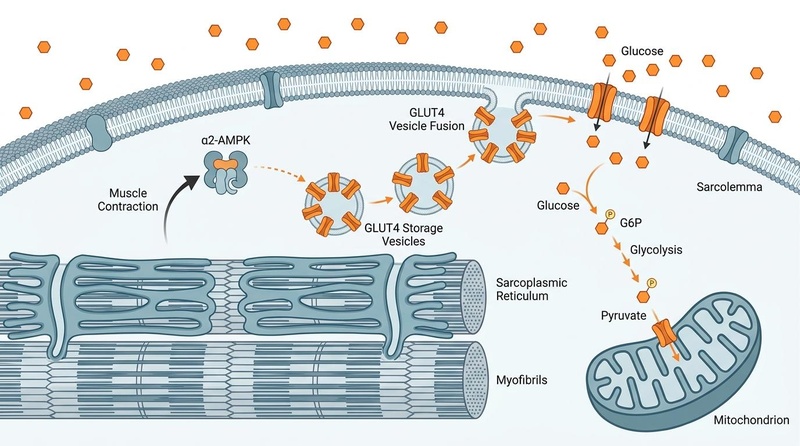
During an exercise snack, the rapid hydrolysis of ATP (adenosine triphosphate) inside working muscle fibers alters the energy status of the cell, shifting the AMP-to-ATP ratio.
Figure 1: Cellular mechanism of contraction-mediated glucose uptake.
- AMPK Activation: The cellular enzyme AMP-activated protein kinase (AMPK) acts as an energy sensor. The change in cell energy during rapid muscle contraction triggers AMPK activation via phosphorylation.
- Translocation to Sarcolemma: Activated AMPK initiates a signaling cascade that causes intracellular vesicles storing GLUT4 glucose transporter proteins to migrate and fuse with the outer cell membrane (sarcolemma).
- Insulin-Independent Clearance: Once embedded in the sarcolemma, GLUT4 transporters allow glucose to diffuse down its concentration gradient from the blood into the muscle sarcoplasm. This mechanism operates independently of insulin, immediately lowering blood sugar spikes after a carbohydrate-heavy meal [1:2].
¶ Evidence Summary Table (human outcomes)
| Outcome / Goal | Typical Effect | Consistency | Evidence Quality | Supporting Studies | Notes (population, duration, dose) |
|---|---|---|---|---|---|
| Postprandial Glycemia Lowering | High | High | 3 RCTs, 1 Systematic Review | 15% to 20% reduction in postprandial glucose spikes when sitting is interrupted by brief movement snacks [1:3][4:1][5:2] | |
| Cardiorespiratory Fitness (VO2 Max) | High | Moderate | 2 RCTs | 5% to 8% increase in VO2 max after 6 weeks of 3x/day vigorous stair-climbing snacks, 3 days/week [2:1][3:1] | |
| Vascular Endothelial Function | High | Moderate | 2 Crossover Trials | Prevents sitting-induced decline in flow-mediated dilation (FMD) of lower-limb arteries [4:2][5:3] | |
| Circulating Neurotrophic Factors (BDNF) | Moderate | Low | 2 Exploratory Trials | Transient increase in blood lactate and BDNF levels immediately following brief, intense movement bursts [6:2][7:1] | |
| Physical Function in Older Adults | High | Moderate | 1 Systematic Review | Significant improvements in sit-to-stand, grip strength, and dynamic balance over 4-8 weeks [11][12] | |
| Workplace Fatigue & Mood | High | Moderate | 1 Systematic Review | Self-reported increases in energy, alertness, and focus, with decreased perceived muscle tension [5:4] |
¶ Comprehensive Safety & Clinical Guidelines
¶ Absolute Contraindications
- Acute Cardiovascular Event: Avoid high-intensity exercise snacks if experiencing chest pain, palpitations, or unstable cardiopulmonary symptoms.
- Severe Orthopedic Instability: Do not perform weight-bearing exercise snacks (like jumping or deep squats) on unstable joints or acute muscle tears.
¶ Relative Contraindications (Requires Adaptation)
- Postural Orthostatic Tachycardia Syndrome (POTS): Rapid changes in posture (such as moving from sitting to explosive standing jumps) can trigger dizziness. Perform seated leg extensions, wall push-ups, or gentle walking instead.
- Osteoarthritis of the Knee/Hip: Avoid high-impact jumping jacks or stair sprints. Adapt the snack to low-impact, slow-tempo bodyweight squats or standing calf raises [11:1].
¶ Comparisons & Engagement
¶ "Compare With": Exercise Snacks vs. Alternative Activity Regimens
| Modality | Glycemic Control (Daily) | VO2 Max Enhancement | Adherence & Feasibility | Equipment & Cost | Time Commitment |
|---|---|---|---|---|---|
| Exercise Snacks | Excellent (regular metabolic stimulation) | Moderate (slow, steady progress) | Superior (ultra-low barrier) | Extremely Low ($0) | <10 minutes per day |
| Structured Zone 2 Training | Good (large acute clearance) | Very Good (aerobic base) | Moderate | Moderate (gym/bike) | 150-300 minutes/week |
| High-Intensity Interval Training (HIIT) | Good | Superior | Low (demanding physically) | Moderate | 20-30 minutes/session |
| Active Commuting (Walking/Cycling) | Very Good | Good | High (lifestyle integrated) | Moderate | 30-60 minutes/day |
¶ Actionable Protocols
¶ Protocol 1: The Stair Climbing Snack (VO2 Max Focus)
Perform this routine 3 times per day (e.g., mid-morning, post-lunch, mid-afternoon), 3 days per week (such as Monday, Wednesday, Friday).
[Spaced 1 to 4 hours apart during the workday]
              │
              ▼
[Step 1: 1-min gentle joint warm-up (shoulder rolls, ankle circles)]
              │
              ▼
[Step 2: 60 seconds of continuous stair climbing at a vigorous pace]
              │
              ▼
[Step 3: 1-min slow walk on flat ground to cool down]
- Safety Note: Keep a light grip on the handrail for safety. Ensure your pace is vigorous (making breathing heavy) but controlled; do not run down the stairs [2:2][3:2].
¶ Protocol 2: The Desktop Bodyweight Snack (Metabolic Focus)
Perform this 3-minute sequence every 2 to 3 hours of sitting, particularly after consuming carbohydrates.
- Minute 1: Bodyweight Squats: Perform continuous, slow-tempo squats (3 seconds down, 1 second up). Focus on driving through your heels.
- Minute 2: Wall or Desk Push-ups: Place your hands shoulder-width apart on a stable wall or heavy desk. Perform controlled push-ups to stimulate the chest, shoulders, and triceps.
- Minute 3: High Knees in Place: March or lightly jog in place, bringing your knees toward chest height to engage your hip flexors and core, boosting your heart rate.
¶ FAQ
¶ Can exercise snacks really replace a standard 30-minute workout?
No, they serve a different purpose. Exercise snacks are an excellent, high-yield tool for breaking up sedentary time, reducing blood sugar spikes, and maintaining metabolic health. While they can improve VO2 max in previously sedentary individuals, they do not provide the same volume-dependent cardiovascular and muscle hypertrophy benefits as structured, continuous Zone 2 or resistance training sessions. They should be viewed as a valuable supplement to, rather than a replacement for, a consistent fitness routine [8:2][5:5].
¶ How high should my heart rate get during an exercise snack?
For metabolic benefits, moderate-intensity movement (where your breathing increases but you can still converse easily) is highly effective. If your goal is to improve cardiovascular fitness (VO2 max) via stair-climbing or sprinting snacks, aim for a vigorous effort—typically reaching 75% to 85% of your maximum heart rate (a level where conversation becomes difficult) [2:3][3:3].
¶ How do I remember to do them during a busy workday?
Leveraging technology is highly effective. Use a smartwatch, a phone alarm, or a desktop calendar invite to set a subtle recurring reminder every 60 to 90 minutes. Pairing the snack with an existing daily anchor habit—such as doing 20 squats right before grabbing a glass of water or making a cup of coffee—is a proven behavioral strategy for building consistency [8:3][9:1].
¶ Glossary
- Exerkines: Bioactive signaling molecules released from skeletal muscle, adipose tissue, or other organs into the bloodstream in response to physical exercise, facilitating systemic tissue crosstalk.
- GLUT4 Translocation: The intracellular signaling process where glucose transporter proteins migrate to the cell membrane during muscle contractions, allowing glucose to enter the cell without requiring insulin.
- Flow-Mediated Dilation (FMD): A non-invasive clinical test that measures the ability of blood vessels to dilate in response to increased blood flow, serving as a key marker of endothelial and cardiovascular health.
- Active Couch Potato: A clinical term describing individuals who meet standard physical activity guidelines (e.g., exercising for 30 minutes in the morning) but remain highly sedentary (sitting for 8+ hours) for the rest of the day.
¶ Methods (Transparency)
This guide is based on a systematic review of peer-reviewed literature. Databases including PubMed and Cochrane Library were searched for randomized controlled trials, crossover studies, and systematic reviews. Keywords included "exercise snacks metabolic health," "movement snacks sedentary behavior," "stair climbing snacks cardiorespiratory fitness," and "exerkines BDNF cognitive function." Evidence was prioritized according to standard grading, with a focus on human crossover trials measuring acute metabolic and vascular parameters in real-world or laboratory settings.
¶ References
¶ Update Log
- 2026-07-07: Initial publication of the comprehensive clinical guide on Movement Snacks.
Babir FJ, Marcotte-Chénard A, Sandilands RE, et al. Exercise snacks performed in real-world settings reduce postprandial hyperglycaemia and glycaemic variability in individuals living with type 2 diabetes: a randomised crossover study. Diabetologia. 2026. https://pubmed.ncbi.nlm.nih.gov/42029706/ ↩︎ ↩︎ ↩︎ ↩︎
Babir FJ, Islam H, McCreary S, et al. Technology-Enabled Exercise "Snacks" Are Feasible to Perform in a Real-World Setting: A Randomized Controlled Trial. Scandinavian journal of medicine & science in sports. 2025. https://pubmed.ncbi.nlm.nih.gov/40772837/ ↩︎ ↩︎ ↩︎ ↩︎
Islam H, Gibala MJ, Little JP. Exercise Snacks: A Novel Strategy to Improve Cardiometabolic Health. Exercise and sport sciences reviews. 2022. https://pubmed.ncbi.nlm.nih.gov/34669625/ ↩︎ ↩︎ ↩︎ ↩︎
Fang Y, Li H, Dong P, et al. Micro-exercise breaks every hour: a feasible strategy to improve metabolic health in sedentary office workers. BMC public health. 2026. https://pubmed.ncbi.nlm.nih.gov/41629846/ ↩︎ ↩︎ ↩︎
Alexe DI, Saha S, Choudhary PK, et al. Exercise Snacks as a Strategy to Interrupt Sedentary Behavior: A Systematic Review of Health Outcomes and Feasibility. Healthcare (Basel, Switzerland). 2025. https://pubmed.ncbi.nlm.nih.gov/41464286/ ↩︎ ↩︎ ↩︎ ↩︎ ↩︎ ↩︎
Sousa RAL, Costa JMM, Pereira RRS, et al. Exercise Snacking in Alzheimer's Disease: A Mechanistic Rationale Based on Repeated Exerkine Signaling. Journal of neurochemistry. 2026. https://pubmed.ncbi.nlm.nih.gov/42400308/ ↩︎ ↩︎ ↩︎
Liu X, Xia Y, Gao X, et al. Exercise snacks and cognitive health in older adults: mechanisms, implementation, and public health relevance. Frontiers in public health. 2026. https://pubmed.ncbi.nlm.nih.gov/42381898/ ↩︎ ↩︎
McCarthy SF, Harness E, Mulkewich N, et al. Exercise Snacks in Adults Living With Obesity: Protocol for a Randomized Feasibility Trial. JMIR research protocols. 2026. https://pubmed.ncbi.nlm.nih.gov/42284592/ ↩︎ ↩︎ ↩︎ ↩︎
Jenkins EM, Nairn LN, Skelly LE, et al. Do stair climbing exercise "snacks" improve cardiorespiratory fitness? Applied physiology, nutrition, and metabolism. 2019. https://pubmed.ncbi.nlm.nih.gov/30649897/ ↩︎ ↩︎
Dias-Peixoto MF, Ramalho de Souza Pereira R, Diniz Magalhães CO, et al. Exercise snacking in surgical prehabilitation: leveraging the exerkine advantage to overcome adherence barriers in patients with cancer. British journal of anaesthesia. 2026. https://pubmed.ncbi.nlm.nih.gov/41723056/ ↩︎
Little JP, Langley J, Lee M, et al. Sprint exercise snacks: a novel approach to increase aerobic fitness. European journal of applied physiology. 2019. https://pubmed.ncbi.nlm.nih.gov/30847639/ ↩︎ ↩︎
Zhang D, Sun S, Ding Y, et al. Effectiveness of exercise snacks on physical function: a systematic reviews with meta-analysis of randomized controlled trials. The journal of nutrition, health & aging. 2026. https://pubmed.ncbi.nlm.nih.gov/41950555/ ↩︎