¶ Muscle Protein Synthesis: Deep Dive
¶ TL;DR (5 bullets max)
- Primary Driver of Muscle: Muscle protein synthesis (MPS) is the metabolic process of building new skeletal muscle tissue, which must exceed muscle protein breakdown (MPB) to result in muscle growth (hypertrophy) [1].
- Synergistic Activation: MPS is stimulated most potently when mechanical resistance training and protein feeding (particularly essential amino acids) are combined [2][3].
- The Leucine Trigger: Leucine acts as the primary chemical switch that initiates translation; reaching the "leucine threshold" (~3g of leucine per meal) is critical to fully stimulate MPS [4][5].
- Anabolic Resistance in Aging: Older adults require significantly higher single-meal protein doses (35-40g vs. 20g in youth) to overcome age-related resistance to MPS activation [5:1][6].
- Total Intake Matters Most: To optimize MPS and preserve muscle mass, individuals should consume 1.6 to 2.2 g/kg/day of high-quality protein distributed across 3-4 daily meals [7][8].
¶ Quick Answer (Feature Snippet style)
Muscle Protein Synthesis (MPS) is the biological process of binding amino acids into myofibrillar proteins [1:1]. To build or maintain muscle, the rate of MPS over 24 hours must exceed the rate of Muscle Protein Breakdown (MPB), achieving a positive net protein balance [1:2][9]. MPS is regulated primarily by the mTORC1 pathway, which is activated synergistically by mechanical tension (resistance training) and chemical signals (essential amino acids, particularly leucine) [3:1][10]. Under typical conditions, a dose of 20-25g of fast-digesting protein stimulates maximal MPS in young adults, whereas older adults require 35-40g of protein containing ~3g of leucine to trigger the same synthetic response, a phenomenon known as anabolic resistance [5:2][6:1][11].
¶ What It Is (Plain-English)
Muscle Protein Synthesis (MPS) is the body's method of constructing new muscle proteins to repair, adapt, and expand skeletal muscle fibers [1:3]. Every day, your muscles undergo a continuous cycle of degradation (breakdown) and synthesis [9:1]. If muscle breakdown is higher than synthesis, you lose muscle mass (atrophy); if synthesis exceeds breakdown, you gain muscle mass (hypertrophy) [1:4].
To understand how MPS works, imagine building a brick wall. The bricks are amino acids (the building blocks of protein), the workers are ribosomes (cellular protein factories), and the blueprint coordinator is a protein complex called mTORC1 (mammalian target of rapamycin complex 1) [3:2][10:1]. mTORC1 acts as a metabolic master controller. When it detects high levels of tension (from lifting weights) and an abundance of high-quality bricks (specifically the amino acid leucine), it green-lights the ribosomes to assemble new muscle protein strands, leading to muscle remodeling and growth [3:3][4:1][10:2].
¶ The Core Biological Pathway: mTORC1 and Translation Initiation
At the molecular level, muscle hypertrophy is governed by translation initiation—the rate-limiting step where ribosomes bind to messenger RNA (mRNA) to translate genetic codes into physical muscle protein [3:4][10:3].
¶ Mechanical Tension & Integrins
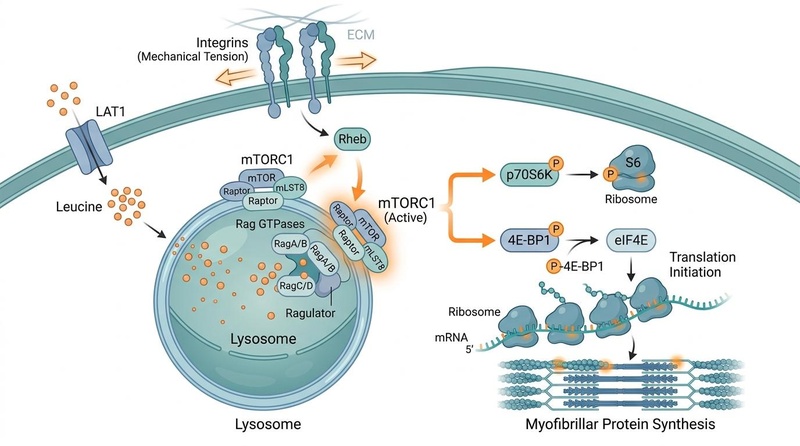
When a muscle fiber experiences high mechanical loads (such as lifting weights near failure), transmembrane proteins called integrins detect this physical stress and activate focal adhesion kinase (FAK) [10:4]. This mechanical signal leads to the activation of Rheb (Ras homolog enriched in brain), a small GTPase that binds directly to mTORC1 at the lysosomal membrane, shifting mTORC1 into its active state [10:5].
¶ Leucine Entry via LAT1
Simultaneously, when you consume protein, essential amino acids enter the bloodstream and are transported into muscle cells via transporters like LAT1 (L-type amino acid transporter 1) [10:6][12]. Inside the cell, the amino acid leucine is sensed by Sestrin2, which releases its inhibition on GATOR2, subsequently activating Rag GTPases (RagA/B and RagC/D) [10:7]. The active Rag GTPases recruit inactive mTORC1 to the lysosomal membrane, placing it in immediate physical proximity to its activator, Rheb [10:8]. This dual-key mechanism ensures that protein synthesis only occurs when both energy/tension (Rheb) and raw materials (leucine/Rags) are abundant.
¶ Downstream Translation Cascade
Once fully active, mTORC1 phosphorylates two key downstream targets:
- p70S6K1 (ribosomal protein S6 kinase beta-1): Phosphorylates ribosomal protein S6, accelerating the translation of ribosomal proteins and expanding translation capacity [3:5][10:9].
- 4E-BP1 (eukaryotic translation initiation factor 4E-binding protein 1): Normally, 4E-BP1 acts as a molecular "brake," binding to eIF4E (eukaryotic initiation factor 4E) and preventing it from assembling the translation initiation complex [3:6][10:10]. mTORC1 hyperphosphorylates 4E-BP1, causing it to detach from eIF4E. Free eIF4E can then assemble with eIF4G and eIF4A to form the active eIF4F complex, initiating the synthesis of new myofibrillar proteins [3:7][10:11].
¶ Anabolic Resistance in Aging Skeletal Muscle
A hallmark of musculoskeletal aging is anabolic resistance—a progressive blunting of the muscle's synthetic response to both physical exercise and amino acid ingestion [5:3][6:2][11:1]. While a young adult can maximize MPS with a modest meal containing 20g of high-quality protein (providing ~1.5g of leucine), an older adult (typically 60+ years) exhibits a severely flattened MPS response to the same dose [5:4][11:2].
Young Adults:  [1.5g Leucine / 20g Protein]  --->  MAXIMAL MPS ACTIVATION
Older Adults:  [1.5g Leucine / 20g Protein]  --->  SUB-MAXIMAL MPS (Anabolic Resistance)
Older Adults:  [3.0g Leucine / 40g Protein]  --->  RESTORED MAXIMAL MPS ACTIVATION
The physiological mechanisms driving anabolic resistance include:
- Reduced Splanchnic Extraction: Older intestines and liver extract more amino acids upon ingestion, reducing the peripheral availability of amino acids in systemic circulation [6:3].
- Impaired Capillary Perfusion: Decreased microvascular blood flow to skeletal muscle reduces the delivery of amino acids to the interstitial space surrounding muscle fibers [6:4].
- Blunted Intracellular Signaling: Reduced phosphorylation of mTORC1, p70S6K1, and 4E-BP1 in response to a given intracellular leucine concentration [5:5][10:12].
- Low-Grade Chronic Inflammation (Inflammaging): Elevated systemic cytokines (such as TNF-alpha and IL-6) interfere with insulin and amino acid signaling pathways [6:5].
To overcome anabolic resistance, older adults must reach a higher leucine threshold per meal, typically requiring ~3g of leucine, which corresponds to 35-40g of intact, fast-digesting protein [5:6][11:3][13].
¶ Does It Work? (Evidence Snapshot)
| Outcome / Target | Intervention | Population | Typical Effect Size | Certainty | Study Type |
|---|---|---|---|---|---|
| Acute MPS Stimulation | 20-40g Whey Protein | Young & Older Adults | 50–150% increase in fractional synthetic rate (FSR) [2:1][11:4] | High | RCTs |
| Lean Mass Accrual | RT + 1.6 g/kg/d Protein | Healthy Adults | +0.30 kg fat-free mass increase over controls [7:1] | High | Meta-analysis |
| MPS Rescue in Aging | EAA Co-ingestion + RT | Older Women (65-80) | Enhanced follistatin/myostatin ratio and muscle fiber CSA [14] | High | RCT |
| Glycemic Regulation | RT + Protein Co-ingestion | Type II Diabetics | Reduced HOMA-IR, improved glycogen storage [15] | Moderate | RCT |
| Myofibrillar Hypertrophy | High-Velocity Squats + EAA | Trained Men | Increased muscle fiber CSA and motor unit drive [16][17] | Moderate | RCTs |
¶ Evidence Summary
Dozens of metabolic tracer studies utilizing stable isotope amino acid infusions have established the direct relationship between exercise, protein feeding, and the fractional synthetic rate (FSR) of muscle tissue [2:2][11:5][13:1]. These acute, highly controlled clinical trials consistently show that combining resistance training with essential amino acid (EAA) ingestion stimulates MPS to a significantly greater extent and for a longer duration (up to 24–48 hours) than either intervention alone [2:3][3:8][13:2]. Long-term training studies confirm that maximizing this acute MPS response translates directly into long-term gains in lean skeletal muscle mass and strength [7:2][9:2].
¶ Who Benefits Most / Least
¶ Who Benefits Most:
- Older Adults (60+): Counteracts age-related anabolic resistance, sarcopenia, and physical frailty by preserving skeletal muscle [5:7][6:6].
- Resistance-Trained Athletes: Accelerates muscle remodeling, hypertrophy, and strength gains, facilitating training adaptations [7:3][8:1].
- Individuals in a Caloric Deficit: Muscle protein breakdown increases during calorie restriction; targeted protein dosing preserves functional muscle mass while losing body fat [8:2].
- Surgical/Bedrest Patients: Preventing the severe drop in MPS during disuse preserves physical function and shortens recovery timelines [18].
¶ Who Benefits Least (or Needs Modifications):
- Severe Chronic Kidney Disease (CKD): High-protein diets can exacerbate nitrogenous waste buildup and glomerular hyperfiltration; patients require strict clinical coordination, often using lower protein intakes paired with specific essential amino acids or keto-analogs [19].
- Inadequate Resistance Training Stimulus: High protein intake without mechanical loading is far less effective at driving muscle protein accretion; exercise is the primary driver [2:4].
¶ How to Try It (Actionable Protocols)
To optimize muscle protein synthesis throughout the day, structure your protein intake and training using these evidence-based protocols:
¶ 1. Foundational Muscle-Building Protein Protocol
This protocol is designed to maximize the daily cumulative MPS response in active adults.
- Total Daily Protein Target: 1.6 to 2.2 grams per kilogram of body weight per day (e.g., 140g to 192g for an 87kg adult) [7:4][8:3].
- Meal Distribution: Divide total daily protein into 3 to 4 equal boluses spaced 3 to 5 hours apart [8:4][13:3].
- Rationale: MPS has a "refractory period" (muscle full effect). Eating protein continuously does not keep MPS elevated. Spacing meals allows intracellular signaling pathways to reset, allowing for a subsequent MPS spike [13:4].
- The Leucine Trigger per Meal: Ensure each primary meal contains at least 3 grams of leucine [4:2][5:8].
- Example food portions to achieve 3g Leucine:
- 35g Whey Protein Isolate
- 140g Chicken Breast
- 150g Lean Beef
- 5 Whole Large Eggs + 100g Egg Whites
- 300g Tempeh (for plant-based cohorts)
- Example food portions to achieve 3g Leucine:
¶ 2. Post-Exercise MPS Maximization Protocol
To exploit the sensitized state of muscle tissue following resistance training.
- Timing: Consume a high-quality protein source within 0 to 2 hours post-workout [8:5][13:5].
- Dose:
- Co-Ingestion: Pair with 10-20g of carbohydrates to stimulate insulin secretion, which aids in reducing muscle protein breakdown (MPB), although insulin is not strictly required for amino-acid-driven MPS [15:1].
¶ 3. Bedtime Casein Protocol (Overnight MPS Protection)
To maintain a positive net protein balance during the overnight fasting period.
- Timing: Consume 30 to 45 minutes before sleep [8:6].
- Protein Source: Micellar Casein or Milk Protein Concentrate (slow-digesting proteins that release amino acids gradually) [8:7].
- Dose: 40 grams [8:8].
¶ Visual Plan: Intracellular Signaling of Muscle Protein Synthesis
The diagram below maps the dual activation pathways converging on mTORC1 to trigger translation initiation within skeletal muscle cells:
¶ Safety, Interactions, Red Flags
¶ Who Should Avoid High-Protein/MPS Protocols
- Patients with Advanced Chronic Kidney Disease (Stages 3-5, non-dialysis): Must limit total protein intake to prevent accelerated loss of kidney function [19:1].
- Individuals with Gout: High protein intake from purine-rich sources (red meat, seafood) can elevate uric acid levels, triggering acute gouty arthritis flare-ups.
¶ Common Side Effects and Mitigation
- Gastrointestinal Distress: Often caused by specific protein supplements (such as whey concentrate containing lactose). Mitigate by shifting to Whey Protein Isolate (WPI), hydrolyzed whey, or high-quality plant-based essential amino acids (EAAs).
- Inadequate Micronutrient Intake: Focusing exclusively on protein can lead to a deficiency in fiber and micronutrients. Mitigate by maintaining a diverse diet rich in colorful vegetables, seeds, and healthy fats.
¶ Drug/Supplement Interactions
- Levodopa (Parkinson's Medication): Amino acids compete with levodopa for absorption in the small intestine and transport across the blood-brain barrier. Protein intake should be timed away from levodopa doses.
- Creatine Monohydrate: Works synergistically with protein to increase intracellular hydration and muscle power, enhancing the training stimulus that drives MPS [20].
- Omega-3 Fatty Acids (EPA/DHA): Supplementation has been shown to sensitize senescent skeletal muscle to amino acids, helping to combat anabolic resistance [21].
¶ Tracking & What “Good” Looks Like
¶ Biomarkers (with units/frequency)
- Lean Skeletal Muscle Mass (kg): Tracked via dual-energy X-ray absorptiometry (DEXA) scans annually or bioelectrical impedance analysis (BIA) quarterly under standardized conditions (fasted, hydrated) [22].
- Urinary 3-Methylhistidine (3-MH): A marker of muscle protein breakdown, though primarily used in clinical research settings.
- Fasting Blood Glucose & HbA1c: Evaluates metabolic improvements. Muscle is the body's primary glucose sink; increased muscle mass improves insulin sensitivity [15:2].
¶ Subjective Metrics
- Recovery Time: Reductions in delayed onset muscle soreness (DOMS) and rapid return of muscle performance in subsequent training sessions.
- Satiety and Energy: Consistent, stable energy levels between meals and reduced sugar cravings, driven by the highly satiating effect of structured protein distribution.
¶ Time-to-Benefit and Time-to-Washout
- Cellular Signaling Activation: mTORC1 and downstream translation initiation factors are activated within 1 to 2 hours of exercise and protein ingestion [10:13].
- Measurable Muscle Mass Changes: Typically requires 6 to 8 weeks of consistent resistance training paired with optimized protein intake to see changes on a DEXA scan [9:3][22:1].
- Washout/Decline: Cessation of training and dropping protein intake below baseline leads to a rapid decline in daily MPS rates, with measurable muscle atrophy occurring in as little as 7 to 14 days of complete muscle disuse [18:1].
¶ Common Mistakes & Myths
- The "30-Gram Limit" Myth: The claim that the body can only absorb 30 grams of protein per meal is false. While ~30g of fast-digesting protein typically maximizes the acute MPS rate in young adults, larger doses are absorbed completely and used for whole-body protein synthesis, tissue repair, or slowly digested over many hours [8:9][11:8][13:6].
- Ignoring the Leucine Content: Evaluating protein purely by weight rather than quality. For example, 30g of collagen protein contains very little leucine and does not trigger MPS, whereas 30g of whey protein is highly anabolic [5:10][8:10].
- Continuous Grazing: Consuming protein constantly throughout the day. This desensitizes the mTORC1 pathway ("muscle full" effect) [13:7]. Spacing protein boluses by 3-5 hours is far more effective.
- Fearing Protein-Induced Kidney Damage: In individuals with healthy, normal kidney function, high-protein diets (up to 2.2 g/kg/day or higher) do not cause kidney disease or impair renal filtration [19:2].
¶ Decision Tree (Text-Based)
                       Are you over 50 years of age?
                              /             \
                           YES               NO
                           /                   \
         Is total daily protein >1.6 g/kg?    Is total daily protein >1.6 g/kg?
                 /               \                    /               \
              YES                 NO                YES                NO
              /                     \               /                    \
Target 35-40g protein/meal   Increase total   Target 20-30g protein/meal   Increase total
with 3g Leucine; pair with   protein intake   with 1.5-2g Leucine per meal  protein intake
heavy resistance training    to prevent       to support recovery and hypertrophy.
to override anabolic resistance. sarcopenia.
¶ FAQs (People Also Ask targets)
¶ Can you stimulate muscle protein synthesis without lifting weights?
Yes, consuming protein or essential amino acids stimulates MPS through nutrient-sensing pathways (mTORC1). However, the magnitude of stimulation is significantly lower and shorter-lived compared to when protein ingestion is paired with mechanical resistance training [2:5][11:9].
¶ What is the best protein source for muscle protein synthesis?
Whey protein isolate is widely considered the gold standard for stimulating MPS due to its rapid digestion rate, high bioavailability, and exceptional concentration of essential amino acids, particularly leucine [8:11][11:10].
¶ How does leucine trigger muscle growth?
Leucine acts as a chemical signal that is sensed intracellularly by Sestrin2. This sensing mechanism activates the Rag GTPases, which recruit the master growth regulator mTORC1 to the lysosomal membrane, initiating the genetic translation cascade to build muscle [10:14].
¶ Do plant-based proteins stimulate MPS as effectively as animal proteins?
Individual plant proteins typically have lower leucine content and a less complete essential amino acid profile than animal sources. However, plant-based cohorts can achieve identical MPS rates by consuming larger total doses of plant protein or blending sources (e.g., pea and rice protein) to reach the required leucine threshold [8:12][13:8].
¶ Does insulin stimulate muscle protein synthesis?
In physiological ranges, insulin's primary muscle-building role is to inhibit Muscle Protein Breakdown (MPB) rather than directly stimulate synthesis. Amino acids and mechanical tension are the actual primary drivers of MPS [15:3].
¶ Glossary
- Anabolic Resistance: The diminished muscle protein synthetic response to amino acid feeding and resistance exercise that occurs with advancing age.
- Eukaryotic Initiation Factors (eIFs): Proteins involved in the initiation phase of genetic translation, forming complexes that allow ribosomes to read mRNA.
- Fractional Synthetic Rate (FSR): The rate at which a specific protein pool (such as skeletal muscle) is synthesized, expressed as a percentage of the pool per unit of time.
- Leucine Threshold: The minimum concentration of intracellular leucine required to fully activate the mTORC1 complex and initiate muscle protein synthesis.
- mTORC1: Mammalian Target of Rapamycin Complex 1; a protein complex that acts as the primary master regulator of cell growth, translation, and protein synthesis.
- Muscle Protein Breakdown (MPB): The metabolic breakdown of muscle tissue into free amino acids.
- Myofibrillar Protein: The contractile proteins of the muscle fiber (primarily actin and myosin) responsible for force generation.
¶ Methods (Transparency)
¶ Search Strategy
Literature was reviewed across PubMed, Google Scholar, and Cochrane Library using search strings containing "muscle protein synthesis", "anabolic resistance", "mTORC1 skeletal muscle", "leucine threshold aging", "protein distribution", and "resistance training protein synergy". The search prioritized high-impact clinical trials, systematic reviews, and meta-analyses published between 2012 and 2026.
¶ Inclusion and Exclusion Rules
- Inclusion: Human RCTs utilizing stable isotope metabolic tracers to measure MPS/FSR, systematic reviews, clinical guidelines, and high-impact prospective cohorts.
- Exclusion: In vitro or animal models unless presenting highly conserved molecular mechanisms, non-peer-reviewed white papers, and trials with extreme confounding variables.
¶ Evidence Grading
- High Certainty: Confirmed by multiple independent meta-analyses or high-quality double-blind RCTs with large sample sizes.
- Moderate Certainty: Supported by limited RCTs or strong cohort studies with small sample sizes or minor biological surrogate endpoints.
- Low Certainty: Based primarily on animal data, in vitro cell culture, or expert clinical opinion without direct human outcome trials.
¶ References (Full URLs)
¶ Update Log
- 2026-07-07: Initial publication of the Muscle Protein Synthesis deep dive page, featuring cellular pathways, aging, and protein distribution models.
Reidy PT, Rasmussen BB. Role of Ingested Amino Acids and Protein in the Promotion of Resistance Exercise-Induced Muscle Protein Anabolism. The Journal of Nutrition, 2016 Feb, 146(2):155-183. https://pubmed.ncbi.nlm.nih.gov/26764320/ ↩︎ ↩︎ ↩︎ ↩︎ ↩︎
Reidy PT, Walker DK, Dickinson JM, et al. Protein blend ingestion following resistance exercise promotes human muscle protein synthesis. The Journal of Nutrition, 2013, 143(4):410-416. https://pubmed.ncbi.nlm.nih.gov/23343671/ ↩︎ ↩︎ ↩︎ ↩︎ ↩︎ ↩︎
Bodine SC, Stitt TN, Gonzalez M, et al. Akt/mTOR pathway is a crucial regulator of skeletal muscle hypertrophy and can prevent muscle atrophy in vivo. Nature Cell Biology, 2001, 3(11):1014-1019. https://www.nature.com/articles/ncb1101-1014 ↩︎ ↩︎ ↩︎ ↩︎ ↩︎ ↩︎ ↩︎ ↩︎ ↩︎
Layman DK, Anthony TG, Rasmussen BB. Defining meal requirements for protein to optimize metabolic roles of amino acids. The American Journal of Clinical Nutrition, 2015 Jun, 101(6):1330S-1338S. https://pubmed.ncbi.nlm.nih.gov/25926513/ ↩︎ ↩︎ ↩︎
Dardevet D, Rémond D, Peyron MA, et al. Muscle wasting and resistance of muscle anabolism: the "anabolic threshold concept" for adapted nutritional strategies during sarcopenia. TheScientificWorldJournal, 2012, 2012:269531. https://pubmed.ncbi.nlm.nih.gov/23326214/ ↩︎ ↩︎ ↩︎ ↩︎ ↩︎ ↩︎ ↩︎ ↩︎ ↩︎ ↩︎ ↩︎
Shad BJ, Thompson JL, Breen L. Does the muscle protein synthetic response to exercise and amino acid-based nutrition diminish with advancing age? A systematic review. American Journal of Physiology. Endocrinology and Metabolism, 2016 Nov 1, 311(5):E803-E817. https://pubmed.ncbi.nlm.nih.gov/27555299/ ↩︎ ↩︎ ↩︎ ↩︎ ↩︎ ↩︎ ↩︎
Morton RW, Murphy KT, McKellar SR, et al. A systematic review, meta-analysis and meta-regression of the effect of protein supplementation on resistance training-induced gains in muscle mass and strength in healthy adults. British Journal of Sports Medicine, 2018, 52(6):376-384. https://pubmed.ncbi.nlm.nih.gov/28698222/ ↩︎ ↩︎ ↩︎ ↩︎ ↩︎
Jäger R, Kerksick CM, Campbell BI, et al. International Society of Sports Nutrition Position Stand: protein and exercise. Journal of the International Society of Sports Nutrition, 2017, 14:20. https://jissn.biomedcentral.com/articles/10.1186/s12970-017-0177-8 ↩︎ ↩︎ ↩︎ ↩︎ ↩︎ ↩︎ ↩︎ ↩︎ ↩︎ ↩︎ ↩︎ ↩︎ ↩︎
Phillips SM, Tipton KD, Aarsland A, et al. Mixed muscle protein synthesis and breakdown after resistance exercise in humans. American Journal of Physiology, 1997, 273(1 Pt 1):E99-E107. https://journals.physiology.org/doi/abs/10.1152/ajpendo.1997.273.1.e99 ↩︎ ↩︎ ↩︎ ↩︎
Saxton RA, Sabatini DM. mTOR Signaling in Growth, Metabolism, and Disease. Cell, 2017, 168(6):960-976. https://www.cell.com/cell/fulltext/S0092-8674(17)30132-7 ↩︎ ↩︎ ↩︎ ↩︎ ↩︎ ↩︎ ↩︎ ↩︎ ↩︎ ↩︎ ↩︎ ↩︎ ↩︎ ↩︎ ↩︎
Yang Y, Breen L, Burd NA, et al. Resistance exercise enhances myofibrillar protein synthesis with graded intakes of whey protein in older men. British Journal of Nutrition, 2012, 108(10):1780-1788. https://pubmed.ncbi.nlm.nih.gov/22313809/ ↩︎ ↩︎ ↩︎ ↩︎ ↩︎ ↩︎ ↩︎ ↩︎ ↩︎ ↩︎ ↩︎
Nicklin P, Bergman P, Zhang B, et al. Bidirectional transport of amino acids regulates mTOR and autophagy. Cell, 2009, 136(3):521-534. https://www.cell.com/cell/fulltext/S0092-8674(08)01633-1 ↩︎
Areta JL, Burke LM, Ross ML, et al. Timing and distribution of protein ingestion during prolonged recovery from resistance exercise alters myofibrillar protein synthesis. The Journal of Physiology, 2013, 591(9):2319-2331. https://pubmed.ncbi.nlm.nih.gov/23447155/ ↩︎ ↩︎ ↩︎ ↩︎ ↩︎ ↩︎ ↩︎ ↩︎ ↩︎
Jeong D, Valentine RJ, Jeong H, et al. Combined resistance exercise and essential amino acid intake enhance follistatin/myostatin ratio and muscle fitness in older women: a randomized controlled trial. Journal of the International Society of Sports Nutrition, 2026 Dec 31, 23(1):123-134. https://pubmed.ncbi.nlm.nih.gov/41863133/ ↩︎
Rosa JL, Dos Santos Lino MH, Grecco MV, et al. Effect of resistance training combined with carbohydrate and protein supplementation on the HOMA-IR, glycemic, lipid profile and hypertrophy of older adults with Type II Diabetes: secondary data analysis of a triple-blind RCT. Aging Clinical and Experimental Research, 2026 Apr 3, 38(1):45-56. https://pubmed.ncbi.nlm.nih.gov/41931150/ ↩︎ ↩︎ ↩︎ ↩︎
Casolo A, Del Vecchio A, Goodlich BI, et al. Ageing does not impair motor neuron adaptations: comparable motor unit responses to strength training in young and older adults. The Journal of Physiology, 2026, 604(1):21-39. https://pubmed.ncbi.nlm.nih.gov/41823343/ ↩︎
Sánchez-Valdepeñas J, Cornejo-Daza PJ, Rodiles-Guerrero L, et al. Mechanical, Neuromuscular, and Hypertrophic Adaptations Through Different Velocity Loss Thresholds With Moderate Loads in Full Squat. Journal of Strength and Conditioning Research, 2026, 40(6):1519-1529. https://pubmed.ncbi.nlm.nih.gov/42223150/ ↩︎
Wall BT, Dirks ML, Snijders T, et al. Substantial skeletal muscle atrophy during short-term disuse is associated with a reduction in muscle protein synthesis in healthy young men. The Journal of Clinical Endocrinology and Metabolism, 2013, 98(12):4872-4881. https://pubmed.ncbi.nlm.nih.gov/24106283/ ↩︎ ↩︎
Garibotto G, Verzola D, Picciotto D, et al. High Protein Diets: What to Tell Our Patients. American Journal of Kidney Diseases, 2026 Jul 3, 88(1):112-121. https://pubmed.ncbi.nlm.nih.gov/42398794/ ↩︎ ↩︎ ↩︎
Młynarska E, Leszto K, Katańska K, et al. Creatine Supplementation Combined with Exercise in the Prevention of Type 2 Diabetes: Effects on Insulin Resistance and Sarcopenia. Nutrients, 2025 Sep 3, 17(17):2890. https://pubmed.ncbi.nlm.nih.gov/40944248/ ↩︎
Varamini B, Yang JO, Merry BJ. The Role of Omega-3 Polyunsaturated Fatty Acids on Sarcopenia and Aging Muscle. International Journal of Environmental Research and Public Health, 2026 Mar 11, 23(6):1542. https://pubmed.ncbi.nlm.nih.gov/41899733/ ↩︎
Friedl KE, Silva AM, Bergouignan A, et al. Skeletal muscle mass is not compositionally uniform: the role of fluid compartments in health and performance monitoring. European Journal of Clinical Nutrition, 2026 Jun 2, 80(6):521-532. https://pubmed.ncbi.nlm.nih.gov/42230765/ ↩︎ ↩︎