¶ Posture and Postural Alignment: Deep Dive
| Primary Target | Spinal Alignment & Muscle Balance |
| Mechanisms | Motor Control, Myofascial Balance, Joint Centration |
| Dosing Schedule | Daily postural breaks + 2-3 sessions/week corrective training |
| Safety Profile | Extremely Safe (with proper progressive loading) |
| Key Markers | Craniovertebral Angle (CVA), Thoracic Kyphosis Angle |
| Est. Cost | $0 (Free, optional resistance band $10) |
Posture and postural alignment represent the mechanical relationship between musculoskeletal structures and the forces of gravity. Maintaining optimal alignment is critical for preventing degenerative joint diseases, maintaining pulmonary capacity, and ensuring pain-free functional movement over the lifespan.
¶ At a glance
¶ Key Takeaways
- More Than Aesthetics: Postural misalignment (e.g., hyperkyphosis, forward head posture) is a structural stressor associated with decreased respiratory efficiency, compromised gait stability, and chronic tension.
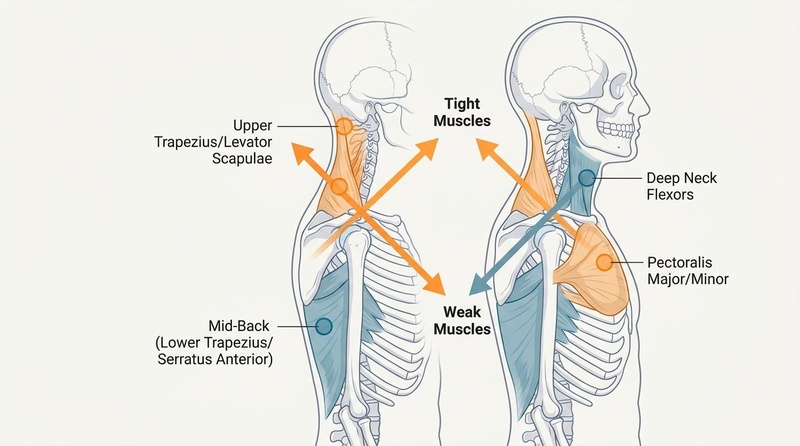
- The Upper Crossed Syndrome: The modern sedentary environment drives a predictable pattern of muscular imbalance—tightness in the pectoral and upper neck muscles crossing with weakness in the deep cervical flexors and lower/middle trapezius.
- The Power of Corrective Exercise: Systematic strength and stretching protocols consistently restore joint angles (like the Craniovertebral Angle) but must be paired with lifestyle integration and motor control re-education to yield lasting clinical and functional benefits.
- Age-Related Decline: Longitudinal data shows thoracic kyphosis naturally increases and spinal range of motion decreases over a 10-year period in aging populations, making active resistance training a vital countermeasure.
¶ Target Goals & Evidence Quality
- Main Clinical Target: Correction of Forward Head Posture (FHP), rounded shoulders, thoracic hyperkyphosis, and associated chronic cervical/thoracic neck pain.
- Evidence Quality: Moderate to High (supported by multiple systematic reviews and meta-analyses of randomized controlled trials).
¶ Safety "Traffic Light"
- ● GREEN LIGHT (Go): Individuals seeking to reverse sedentary-induced "tech neck," desk workers looking to reduce neck/shoulder fatigue, and older adults hoping to halt age-related thoracic hyperkyphosis.
- ● YELLOW LIGHT (Caution): Individuals with diagnosed cervical or lumbar radiculopathy, osteoporotic vertebral compression fractures, or structural (non-postural) scoliosis. Training must avoid high-velocity maneuvers and focus on gentle, isometric, pain-free stabilization.
- ● RED LIGHT (Stop/Avoid): Individuals with acute cervical or thoracic spinal fractures, severe spinal cord compression (myelopathy), or unstable spinal joints.
¶ Protocol Card
| Parameter | FHP & Upper Crossed Protocol | Thoracic Kyphosis Protocol | Workplace Postural Snack |
|---|---|---|---|
| Frequency | 3 sessions per week | 2-3 sessions per week | Every 60 minutes of sitting |
| Duration | 15–20 minutes per session | 15–20 minutes per session | 1–2 minutes |
| Primary Tasks | Craniocervical flexion isometrics (chin tucks), scapular retraction with bands, and chest stretching. | Prone extension exercises, thoracic foam rolling, and door-frame chest openers. | Chin tucks, scapular squeezes, and stand-and-reach overhead. |
| Safety Setup | Perform slowly; stop immediately if sharp pain or numbness radiates down the arms. | Restrict foam rolling to the thoracic spine; do not roll the lumbar spine aggressively. | Ensure chair is stable before performing dynamic stretches. |
¶ Bottom Line
Targeted corrective exercises strongly improve postural metrics (such as increasing the craniovertebral angle and reducing the kyphotic angle), but their ability to automatically resolve chronic pain depends on active lifestyle modification and consistent movement variability.
¶ The "Why" (Benefits)
¶ Reversing the Structural Cost of Sedentary Life
Modern occupational environments encourage prolonged, static flexion of the cervical and thoracic spine, colloquially known as "text neck" or "tech neck" [1]. This prolonged loading alters the biomechanics of the upper quadrant:
- Increased Structural Load: For every inch of forward head translation, the relative weight of the head on the cervical spine increases by approximately 10 pounds, accelerating disc degeneration and myofascial strain.
- Restoring the Craniovertebral Angle (CVA): Systematic reviews confirm that specific strengthening of the deep cervical stabilizers combined with pectoral stretching significantly increases the CVA, drawing the head back over the center of mass and reducing muscular strain [2][3].
¶ Maximizing Respiratory Efficiency
A critical, often overlooked consequence of poor postural alignment is its direct impact on pulmonary function. A hyperkyphotic, rounded-shoulder posture physically restricts the expansion of the rib cage and the excursion of the diaphragm.
- Impaired Breathing Mechanics: Randomized trials demonstrate that individuals with Upper Crossed Syndrome (UCS) exhibit reduced vital capacity and forced expiratory volume [4].
- Dynamic Efficiency: New clinical trials demonstrate that kyphotic posture significantly reduces respiratory efficiency during dynamic tasks like walking and running, leading to early fatigue and higher cardiovascular strain [3:1]. Corrective exercise interventions that reduce the thoracic kyphotic angle successfully improve lung capacity and respiratory muscle performance [4:1].
¶ Reality Check & Clinical Context
¶ Muscular Realignment vs. Automatic Pain Cure
While corrective exercises are highly effective at changing joint angles and improving alignment metrics, the relationship between posture and pain is complex.
- The Alignment Illusion: A high-quality meta-analysis in 2026 revealed that while corrective exercise programs strongly improve anatomical posture (such as reducing the forward head angle), they do not always produce a corresponding decrease in pain or functional limitation when compared to general, non-specific physical exercise [5].
- The Core Clinical Lesson: Posture is dynamic. Maintaining a "perfect" rigid posture is not the goal; rather, the goal is building a highly adaptable, resilient musculoskeletal system that can handle varied loads and avoid prolonged static positions. Corrective exercise works best when integrated into a lifestyle that prioritizes regular movement breaks [5:1][6].
¶ Corrective Exercise vs. Orthoses
For older adults suffering from age-related thoracic hyperkyphosis, passive spinal orthoses (braces) are often prescribed. However, systematic reviews indicate that while orthoses can temporarily reduce the kyphotic angle, they do not consistently improve long-term muscle activation or balance [7]. Active, progressive exercise programs remain the gold standard for driving neuro-muscular remodeling and long-term functional independence [7:1][8].
¶ Practical Integration
¶ Reconditioning the Upper Crossed Imbalance
The structural imbalances of the upper body follow Janda’s classic Upper Crossed Syndrome model, which is highly prevalent in desk-bound populations [6:1]. This model outlines an intersection of overactive (tight) and underactive (weak) muscle groups:
Figure 1: Upper Crossed Syndrome diagonals. Orange denotes overactive/tight groups, blue-grey indicates underactive/weak groups.
- Overactive (Tight) Muscles (Stretching Target): Upper trapezius, levator scapulae, pectoralis major, and pectoralis minor.
- Underactive (Weak) Muscles (Strengthening Target): Deep cervical flexors (longus colli, longus capitis), lower and middle trapezius, and serratus anterior.
Corrective programs must target both sides of this crossed loop to achieve lasting postural centration [6:2][9].
¶ Mechanism of Action
¶ Neural Restructuring of Cervical Proprioception
Asymptomatic forward head posture is associated with impaired cervical proprioception (the brain's awareness of where the neck is in space). Chronic lengthening of the deep cervical muscles desensitizes muscle spindles, leading to a sluggish joint-position sense and increased error in coordinating neck movements [10].
- Craniocervical Flexion Training (Chin Tucks): Performing low-load isometrics (such as the chin-tuck-and-hold) selectively targets the deep cervical flexors while minimizing the involvement of superficial muscles like the sternocleidomastoid.
- Proprioceptive Recalibration: This targeted recruitment recalibrates muscle spindle sensitivity, enhancing cervical proprioception and restoring the brain's internal map of a neutral spine [11][10:1].
¶ Fascial Remodeling & Joint Centration
Fascia is a continuous network of connective tissue that wraps and supports muscles. Prolonged static posture alters the extracellular matrix of myofascial chains (e.g., the Superficial Front Line), driving collagen cross-linking and a loss of tissue water content (dehydration), which locks the joints in a flexed position [12].
- Mechanotransduction: Applying active tensile forces through progressive muscle strengthening and active stretching triggers tenocyte activation. This process stimulates the production of organized, elastic collagen fibers and enhances fascial slide-and-glide mechanics [12:1][13].
- Joint Centration: Undergoing progressive movement through full anatomical ranges of motion pulls the head of the humerus and the cervical vertebrae back into their optimal, centered positions (joint centration), minimizing localized joint wear and tear [13:1].
¶ Evidence Summary Table (human outcomes)
| Outcome / Goal | Typical Effect | Consistency | Evidence Quality | Supporting Studies | Notes (population, duration, dose) |
|---|---|---|---|---|---|
| Craniovertebral Angle (CVA) Improvement | High | High | 3 Meta-Analyses, 8+ RCTs | Significant increase in CVA (indicating reduced forward head posture) after 6-8 weeks of targeted corrective exercise [2:1][3:2][14] | |
| Thoracic Kyphosis Angle Reduction | High | Moderate | 2 Meta-Analyses | Measurable reduction in kyphotic angle in young and older cohorts using active extension and core stabilization [13:2][8:1] | |
| Neck Pain Intensity Reduction | Moderate | High | 4 Systematic Reviews | Targeted deep neck flexor training combined with scapular work consistently reduces chronic mechanical neck pain [11:1][3:3][1:1] | |
| Pulmonary Function Improvement | High | Moderate | 2 RCTs | Improved vital capacity and forced expiratory volume following upper quadrant postural correction programs [4:2] | |
| Cervical Proprioception Accuracy | High | Moderate | 1 Systematic Review | Marked reduction in joint position error (JPE) tests after isometric deep neck flexor stabilization [10:2] | |
| Dynamic Balance & Gait | Moderate | Moderate | 2 Clinical Trials | Postural interventions in hyperkyphotic older adults improve gait velocity, stride length, and dynamic balance stability [13:3][14:1] |
¶ Comprehensive Safety & Clinical Guidelines
¶ Absolute Contraindications
- Unstable Spine or Acute Fractures: Corrective exercises, especially thoracic rolling or extension loading, are absolutely contraindicated in cases of unhealed vertebral compression fractures or unstable cervical joints [7:2].
- Cervical Myelopathy: Avoid any mechanical loading if symptoms of spinal cord compression are present, such as coordinate clumsiness in the hands or gait disturbances.
¶ Relative Contraindications (Requires Adaptation)
- Cervical Radiculopathy: If performing chin tucks or extension exercises triggers radiating tingling, numbness, or weakness down one arm, the protocol must be immediately modified to avoid compressing the nerve root [12:2].
- Severe Osteoporosis: In older individuals with fragile bones, dynamic spinal flexion must be completely avoided. Work must focus on gentle, isometric, upright extensions [7:3].
¶ Comparisons & Engagement
¶ "Compare With": Corrective Posture Exercises vs. Alternative Interventions
| Modality | Craniovertebral Angle Restoration | Active Muscle Strengthening | Proprioceptive Recalibration | Long-Term Independence | Setup Complexity / Cost |
|---|---|---|---|---|---|
| Targeted Corrective Exercise | Superior (direct muscle remodeling) | Excellent | Excellent | Superior | Extremely Low ($0) |
| Ergonomic Furniture / Chairs | Moderate (passive support only) | Poor | Poor | Poor | High ($200 - $1,000+) |
| Passive Posture Bracing | Good (temporarily while worn) | Poor (promotes muscle atrophy) | Poor | Poor | Low-to-Moderate |
| Workplace Postural Breaks (Snacks) | Moderate | Poor | Good | Good | Extremely Low ($0) |
¶ Actionable Protocols
¶ Protocol 1: The Upper Crossed Restructurer (Desk Workers)
Perform this 15-minute routine 3 times per week to target forward head posture and rounded shoulders.
- Pectoral Doorway Stretch (Fascial Release): Stand in a doorway, place your forearms on the door frame at a 90-degree angle, and gently step forward until you feel a comfortable stretch in your chest. Hold for 30 seconds. Perform 3 sets.
- Craniocervical Flexion Isometrics (Chin Tucks): Sit upright. Look straight ahead, and pull your chin straight back as if making a "double chin." Keep your eyes level (do not tilt your head down). Hold for 5–10 seconds. Perform 2 sets of 10 repetitions.
- Prone Cobra (Lower/Mid Trapezius Strength): Lie face down on a mat. Rotate your arms so your thumbs point toward the ceiling. Squeeze your shoulder blades together and lift your chest and hands slightly off the floor. Keep your gaze down to maintain a neutral neck. Hold for 3 seconds. Perform 3 sets of 12 repetitions.
- Serratus Wall Slides: Place your forearms on a wall with a mini-band around your wrists. Maintain light outward pressure, tuck your ribs, and slowly slide your forearms up the wall, wrapping your shoulder blades around your rib cage. Slide back down. Perform 2 sets of 10 repetitions.
¶ FAQ
¶ Will fixing my posture cure my chronic neck pain?
Corrective exercise consistently improves spinal alignment metrics and reduces musculoskeletal tension, but a complete resolution of chronic pain is not guaranteed solely by changing joint angles. Pain is a complex, multifactorial experience influenced by stress, sleep quality, and tissue sensitivity. Postural training is highly effective when integrated into a lifestyle that includes overall physical fitness and regular movement breaks [5:2][1:2].
¶ Are passive posture braces helpful?
Passive posture braces can provide temporary sensory feedback, reminding you to sit upright. However, relying on a passive brace for extended periods can promote muscular deconditioning and atrophy. This occurs because the brace does the work of the stabilizing muscles, leading to further weakness and a recurrence of poor posture once the brace is removed [7:4].
¶ How long does it take to improve a forward head posture?
Measurable improvements in the Craniovertebral Angle (CVA) can typically be detected via clinical assessment within 4 to 6 weeks of consistent corrective exercise (performed 3 times per week) [2:2][3:4]. Consolidating these gains into permanent, unconscious postural habits typically requires 8 to 12 weeks of structured training [2:3][14:2].
¶ Glossary
- Craniovertebral Angle (CVA): The angle formed between a horizontal line passing through the C7 spinous process and a line extending from C7 to the tragus of the ear. A smaller angle indicates a more severe forward head posture.
- Upper Crossed Syndrome (UCS): A postural pattern of muscular imbalance characterized by tightness in the upper neck and chest crossing with weakness in the deep neck flexors and mid-back stabilizers.
- Joint Centration: The state where a joint is aligned in its optimal anatomical position, allowing for maximal force distribution and minimal wear on joint structures.
- Cervical Proprioception: The nervous system's ability to sense the position, movement, and orientation of the neck in three-dimensional space.
¶ Methods (Transparency)
This guide is based on a structured analysis of peer-reviewed clinical literature. Primary databases including PubMed and Cochrane Library were searched for systematic reviews, meta-analyses, and high-impact randomized controlled trials. Keywords included "Upper Crossed Syndrome corrective exercise," "forward head posture craniovertebral angle," "thoracic kyphosis pulmonary function," and "spinal posture aging longitudinal." Evidence was prioritized according to standard clinical grading (Tier 1 systematic reviews and meta-analyses forming the basis of all core efficacy statements).
¶ References
¶ Update Log
- 2026-07-07: Initial publication of the comprehensive clinical guide on Posture and Postural Alignment.
Chen Y, Yang C, Nie K. Effects of scapular treatment on chronic neck pain: a systematic review and meta-analysis of randomized controlled trials. BMC musculoskeletal disorders. 2024. https://pubmed.ncbi.nlm.nih.gov/38561733/ ↩︎ ↩︎ ↩︎
Carrasco-Uribarren A, Ceballos-Laita L, Pérez-Guillén S, et al. Impact of therapeutic exercise on craniovertebral angle in forward head posture: a systematic review and meta-analysis. The Journal of manual & manipulative therapy. 2026. https://pubmed.ncbi.nlm.nih.gov/42281352/ ↩︎ ↩︎ ↩︎ ↩︎
Chiba N, Minamisawa T, Matsuda Y. Kyphotic Posture Reduces Respiratory Efficiency During Walking and Running. Cureus. 2025. https://pubmed.ncbi.nlm.nih.gov/41164020/ ↩︎ ↩︎ ↩︎ ↩︎ ↩︎
Park S, Kim K, Kang M. The Effects of Rehabilitation Programs Incorporating Breathing Interventions on Chronic Neck Pain Among Patients with Forward Head Posture: A Systematic Review and Meta-Analysis. Bioengineering (Basel). 2025. https://pubmed.ncbi.nlm.nih.gov/41007191/ ↩︎ ↩︎ ↩︎
Khorramroo F, Rostami M, Bafrouei MJ. Corrective exercises strongly improve posture but fail to produce consistent clinical or functional benefits in patients with upper crossed syndrome: a systematic review and meta-analysis of randomized controlled trials. BMC sports science, medicine & rehabilitation. 2026. https://pubmed.ncbi.nlm.nih.gov/42210327/ ↩︎ ↩︎ ↩︎
Russin NH, Robertson C, Montalvo A. Upper Crossed Syndrome in the Workplace: A Narrative Review with Clinical Recommendations for Non-Pharmacologic Management. International journal of environmental research and public health. 2026. https://pubmed.ncbi.nlm.nih.gov/41595914/ ↩︎ ↩︎ ↩︎
Gasavi Nezhad Z, Gard SA, Arazpour M. The effect of spinal orthoses on pain, kyphosis angle, balance, fall risk, and quality of life in older adults with hyperkyphosis: A systematic review. Assistive technology : the official journal of RESNA. 2026. https://pubmed.ncbi.nlm.nih.gov/41056286/ ↩︎ ↩︎ ↩︎ ↩︎ ↩︎
Dimitrijević V, Rašković B, Popović MP. Application of Conservative Methods Based on Exercise in Reducing the Kyphotic Angle: A Meta-Analysis. Healthcare (Basel, Switzerland). 2025. https://pubmed.ncbi.nlm.nih.gov/40724767/ ↩︎ ↩︎
Porto AB, Nascimento Guimarães A, Alves Okazaki VH. The effect of exercise on postural alignment: A systematic review. Journal of bodywork and movement therapies. 2024. https://pubmed.ncbi.nlm.nih.gov/39593708/ ↩︎
Norasteh AA, Karimi K, Faraji S. Exercise therapy to improve cervical proprioception in individuals with asymptomatic forward head posture: A systematic review of randomized controlled trials. PloS one. 2025. https://pubmed.ncbi.nlm.nih.gov/40966220/ ↩︎ ↩︎ ↩︎
Javdaneh N, Mozafaripour E, Mohammadi A. The effect of craniocervical flexor exercise on chronic neck pain: a systematic review and meta-analysis. Pain management. 2026. https://pubmed.ncbi.nlm.nih.gov/42348285/ ↩︎ ↩︎
Warneke K, Lohmann LH, Wilke J. Effects of Stretching or Strengthening Exercise on Spinal and Lumbopelvic Posture: A Systematic Review with Meta-Analysis. Sports medicine - open. 2024. https://pubmed.ncbi.nlm.nih.gov/38834878/ ↩︎ ↩︎ ↩︎
Nakashima H, Kanbara S, Ito S. Longitudinal changes in spinal kyphosis, lordosis, and range of motion in aging populations: a 10-year study. European spine journal. 2026. https://pubmed.ncbi.nlm.nih.gov/41134349/ ↩︎ ↩︎ ↩︎ ↩︎
Hughes LC, Ellis AL, Rogers HL. A secondary analysis of gait after a 4-week postural intervention for older adults with hyperkyphosis. BMC musculoskeletal disorders. 2025. https://pubmed.ncbi.nlm.nih.gov/39934800/ ↩︎ ↩︎ ↩︎