¶ Sarcopenia & Frailty Prevention: Deep Dive
¶ TL;DR (5 bullets max)
- Primary Strategy: Sarcopenia (age-related muscle loss) and frailty are primarily prevented and reversed through targeted, progressive resistance training paired with high-protein nutrition [1][2].
- First-Line Medical Therapy: Multicomponent exercise training—combining Progressive Resistance Training (PRT), functional gait, and postural balance exercises—is the gold-standard, first-line intervention to reverse frailty [2:1][3].
- Anabolic Nutritional Support: Reversing sarcopenia requires a high daily protein intake (1.2–1.5 g/kg/day, up to 2.0 g/kg/day during illness) rich in essential amino acids and leucine to override age-related anabolic resistance [4][5].
- Gold-Standard Diagnostic Suite: Early clinical diagnosis involves measuring handgrip strength (using a hand dynamometer), gait speed (threshold <0.8 m/s), and the Short Physical Performance Battery (SPPB) [1:1][6].
- Dynamic Synergistic Compounds: Co-supplementation with Creatine Monohydrate and Vitamin D3 is clinically proven to enhance the muscle-building and bone-remodeling adaptations of physical exercise in older adults [7][8].
¶ Quick Answer (Feature Snippet style)
Sarcopenia is the progressive and generalized age-related skeletal muscle disorder characterized by loss of muscle mass, strength, and physical performance [1:2]. When paired with physical frailty—a biological syndrome of decreased physiological reserve and vulnerability to stressors—it dramatically increases the risk of falls, cognitive decline, and mortality [1:3][2:2]. To prevent and reverse these conditions, the 2025 ICFSR Global Consensus Guidelines mandate the prescription of progressive resistance training (PRT) at least twice weekly [2:3]. When combined with a target protein intake of 1.2–1.5 g/kg/day and creatine supplementation, these behavioral interventions can increase muscle strength by over 100% and fully restore functional autonomy in frail individuals [3:1][5:1][7:1].
¶ What It Is (Plain-English)
Sarcopenia is the age-related "melting away" of your skeletal muscle [1:4]. Derived from the Greek words sarx (flesh) and penia (loss), it is a clinical disease where muscles shrink, lose strength, and are slowly replaced by fat and fibrous tissue [1:5][9]. Frailty is the systemic result of this muscle loss; it is a state of physical vulnerability where even a minor health event (like a mild cold or a minor slip) can lead to a disproportionate decline in independence [2:4].
At the cellular level, your muscle is a living tissue under continuous remodeling [10]. Specialized stem cells called satellite cells help repair and grow muscle fibers in response to tension [11]. As we age, if we stop lifting weights, these satellite cells deplete and our Type II (fast-twitch) muscle fibers preferentially shrink and die [10:1][11:1]. Simple activities—like climbing stairs, standing up from a low chair, or carrying bags—become exhausting [3:2]. Sarcopenia is not an inevitable consequence of aging; it is a highly treatable and reversible condition [2:5][3:3]. By combining progressive resistance training (PRT) with specific muscle-building nutrients, older adults can stop and even reverse muscle loss, preserving their physical independence for life [2:6][3:4].
¶ Neuromuscular and Biochemical Mechanisms: The Pathophysiology of Decay
Sarcopenia is a multi-factorial disease process involving denervation, mitochondrial dysfunction, hormonal declines, and chronic low-grade inflammation [1:6][10:2].
                  SOCIETY AGING & SEDENTARY LIFESTYLE
                                   |
         Motor Neuron Apoptosis ---> Denervation of Type II Fibers
                                   |
         Myofibrillar Atrophy  <--- Loss of Satellite Cell Proliferation
                                   |
      Low-Grade Chronic Inflammaging (IL-6, TNF-alpha) ---> Blunted mTORC1
                                   |
                  SARCOPENIA AND CLINICAL PHYSICAL FRAILTY
¶ Neuromuscular Denervation and Motor Unit Loss
Skeletal muscle contraction is driven by alpha motor neurons in the spinal cord [12].
- As we age, chronic oxidative stress and DNA damage lead to the apoptosis (programmed cell death) of these motor neurons [12:1].
- This loss preferentially targets motor neurons innervating high-threshold, fast-twitch Type II muscle fibers [10:3][12:2].
- Once a motor neuron dies, its associated muscle fibers become "orphaned" (denervated) and rapidly atrophy [12:3].
- While some fibers are saved by neighboring slow-twitch (Type I) motor neurons via collateral sprouting, this reinnervation converts the fast, powerful fibers into slow, low-power fibers, causing a disproportionately rapid loss of muscular power [10:4][12:4].
¶ Satellite Cell Depletion and Regenerative Failure
Muscles possess a pool of resident stem cells called satellite cells, located between the sarcolemma and the basal lamina [10:5][11:2].
- In response to muscle damage or mechanical tension, satellite cells proliferate, fuse with existing muscle fibers, and donate their nuclei (myonuclei) to facilitate muscle protein synthesis and hypertrophy [11:3].
- In sarcopenia, the satellite cell pool (particularly those associated with Type II fibers) is depleted by up to 50% [11:4].
- This depletion is driven by age-related increases in myostatin (a TGF- family member that suppresses satellite cell proliferation) and decreases in follistatin (a myostatin inhibitor) [13].
¶ Inflammaging and Mitochondrial Dysfunction
Sedentary aging is characterized by inflammaging—a state of chronic, sterile, low-grade systemic inflammation [1:7][9:1].
- Elevated circulating cytokines, particularly tumor necrosis factor-alpha (TNF-) and interleukin-6 (IL-6), act directly on skeletal muscle to suppress the mTORC1 signaling pathway, inducing anabolic resistance [9:2][14].
- Simultaneously, mitochondria within muscle cells experience DNA damage and a loss of mitophagy (cellular cleanup), leading to a buildup of dysfunctional, energy-deficient mitochondria [15]. These damaged organelles leak reactive oxygen species (ROS) into the cell, accelerating muscle protein breakdown (MPB) and myofibrillar degeneration [15:1].
¶ Does It Work? (Evidence Snapshot)
| Outcome / Goal | Intervention | Population | Typical Effect Size | Certainty | Study Type |
|---|---|---|---|---|---|
| Physical Independence | Multicomponent Exercise [2:7] | Frail Older Adults (75+) | Significant reduction in institutionalization and disability | High | Global Consensus |
| Muscle Strength & Area | Progressive Resistance Training | Older Adults (60–87+ years) | Up to 113% increase in strength, 2.7% increase in fiber cross-sectional area [3:5] | High | RCTs |
| Sarcopenia Prevention | Exercise + High-Protein Intake | Older Adults with Osteosarcopenia | Reversal of osteosarcopenia, improved physical gait speed [16] | High | Meta-analysis |
| Anabolic Response Recovery | EAA + Leucine Supplementation | Older Women (65–80 years) | Overcomes anabolic resistance, increases follistatin [13:1] | High | RCT |
| Gut Microbiota & Muscle | Elastic-Band Resistance Training | Aged Adults with Sarcopenia | Favorable shifts in gut microbiome and derived metabolites [17] | Moderate | RCT |
¶ Evidence Summary
The efficacy of progressive resistance training (PRT) and multicomponent exercise for preventing and reversing sarcopenia and physical frailty is backed by a massive body of high-quality scientific evidence, including landmark RCTs and international consensus guidelines [2:8][3:6][6:1]. Multiple meta-analyses consistently confirm that older adults up to age 90+ can achieve significant muscle hypertrophy and double their strength in as little as 10–12 weeks of structured training [3:7][16:1]. The 2025 ICFSR Global Consensus strongly recommends PRT as the first-line clinical prescription, stating that physical training is highly safe and far more effective than any pharmacological therapy currently available [2:9].
¶ Who Benefits Most / Least
¶ Who Benefits Most:
- Frail Older Adults (70+): Shows the most dramatic, life-changing improvements; reversing physical frailty restores the ability to perform basic activities of daily living (bathing, walking, rising from a chair) and preserves independence [2:10][3:8].
- Individuals with Chronic Medical Conditions (e.g., Type 2 Diabetes, Dialysis): Sarcopenia is highly prevalent in chronic disease states. Combining exercise with high protein improves glucose disposal, HOMA-IR, and muscle preservation [18][19].
- Middle-Aged Adults (45–60): Early prevention. Intervening during mid-life prevents the age-related "sliding scale" of muscle loss, maintaining a robust physiological reserve.
¶ Who Benefits Least (or Needs Modifications):
- Individuals in Acute Decompensated Heart Failure: High-intensity straining can put dangerous hemodynamic stress on a failing heart. Requires cardiac rehabilitation and low-load, supervised endurance training first [20].
- Severe Cognitive Impairment: Patients may struggle with complex exercise safety and technical execution; requires simplified, one-on-one guided movements and close clinical supervision [2:11].
¶ How to Try It (Actionable Protocols)
The standard of care for sarcopenia is a multicomponent exercise program combined with anabolic nutritional support.
¶ 1. The Clinical Multicomponent Exercise Protocol
This protocol is designed to address muscle mass, absolute strength, rate of force development, and dynamic balance [2:12][3:9][6:2].
- Frequency: 2 to 3 days per week (non-consecutive) [2:13].
- Duration: 40 to 60 minutes per session.
- Component A: Progressive Resistance Training (PRT) (25-30 mins):
- Perform 3 exercises targeting major muscle groups:
- Lower Body: Leg Press, Squats (to a box/chair), or Knee Extensions.
- Upper Body Push: Chest Press Machine or Incline Push-ups.
- Upper Body Pull: Seated Rows or Lat Pulldowns.
- Load: Start at 50% of 1RM to master form, then progress to 70–80% of 1RM (RPE 7-8) [2:14][16:2].
- Volume: 2 to 3 sets of 8 to 12 repetitions per exercise.
- Perform 3 exercises targeting major muscle groups:
- Component B: Balance & Fall Prevention (10-15 mins):
- Perform 3 exercises to challenge postural control:
- Tandem Stance: Stand heel-to-toe with eyes open, progressing to eyes closed (hold for 30 seconds).
- Single-Leg Stand: Stand on one leg near a support rail (hold for 15-30 seconds).
- Three-Way Hip Extensions: Kick one leg forward, to the side, and backward slowly.
- Perform 3 exercises to challenge postural control:
- Component C: Functional Gait Training (10 mins):
- Practice real-world functional tasks:
- Tandem Walking: Walk along a straight line heel-to-toe.
- Obstacle Stepping: Step over small cones or obstacles spaced 1 meter apart.
- Practice real-world functional tasks:
¶ 2. The Anabolic Nutritional Support Protocol
To override age-related anabolic resistance and supply the raw materials for muscle remodeling [4:1][5:2].
- Total Daily Protein Target: 1.2 to 1.5 grams per kilogram of body weight per day (e.g., 84g to 105g for a 70kg adult) [4:2][5:3].
- Note: Increase to 1.5–2.0 g/kg/day during periods of acute illness or heavy training.
- Single-Meal Target: Ensure at least 35 to 40 grams of protein (providing ~3g of leucine) is consumed at breakfast and post-exercise [5:4][14:1].
- Creatine Co-Supplementation: Take 5 grams of Creatine Monohydrate daily [7:2][8:1]. Creatine acts as an energy buffer in muscle cells, directly increasing training volume, strength, and muscle hydration in older adults [7:3].
- Vitamin D3 Support: Maintain serum 25-hydroxyvitamin D levels above 30 ng/mL. Supplement with 2,000–4,000 IU of Vitamin D3 daily to support calcium absorption, muscle fiber contractility, and bone density [8:2][16:3].
¶ Visual Plan: Multicomponent Preventative Training Session
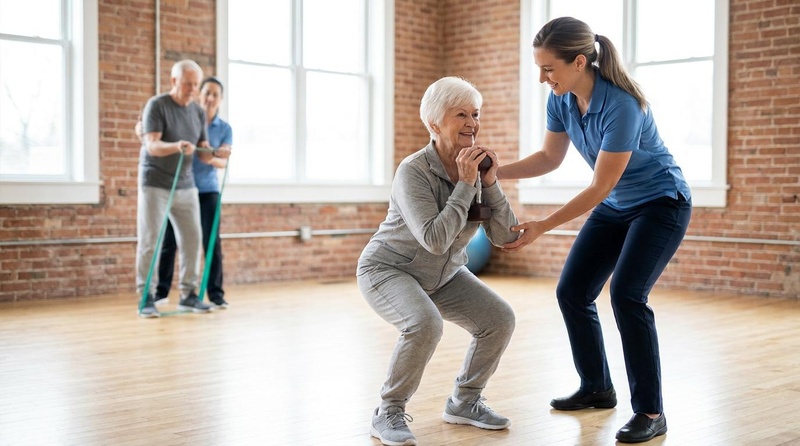
The illustration below shows a clinical specialist guiding an older adult through a supervised progressive squat session, highlighting active frailty prevention:
¶ Safety, Interactions, Red Flags
¶ Clinical Precautions and Risks
- Severe Osteoporosis: Avoid loading the spine in deep flexion or rapid twisting, as this can cause immediate compression fractures [2:15]. Keep the spine neutral during squats and deadlifts.
- Silent Cardiovascular Disease: Undiagnosed coronary artery disease can be triggered by heavy straining. Ensure patients have completed a basic cardiovascular screen before initiating high-load training [20:1].
¶ Common Side Effects and Mitigation
- Temporary Joint Stiffness: Often caused by initiating training too quickly. Mitigate by performing a thorough 5–10 minute warm-up (light walking, arm circles, ankle mobility) and using low-impact resistance machines rather than free weights initially.
¶ Stop Criteria
- Dizziness, Lightheadedness, or Loss of Coordination: Immediately stop the session. May indicate orthostatic hypotension or a cardiovascular event.
- Sharp, Localized Joint or Bone Pain: Stop the exercise and assess for mechanical injury or stress fracture.
- Chest Tightness or Shortness of Breath: Stop immediately.
¶ Tracking & What “Good” Looks Like
¶ Biomarkers and Functional Diagnostics (with units/frequency)
- Handgrip Strength (kg): Measured using a calibrated hand dynamometer [1:8][6:3].
- Short Physical Performance Battery (SPPB): A 3-part test (balance, 4-meter walk, 5x chair stand) scored out of 12 [6:5].
- Frail/Sarcopenic: Score .
- Excellent: Score of 11-12 [6:6].
- Frequency: Track every 3 months.
- Five-Times Sit-to-Stand (5xSTS) (seconds): Time taken to stand and sit 5 times from a standard chair. Threshold >15 seconds indicates severe functional limitation [6:7].
- SARC-F Questionnaire: A simple 5-item self-report screening tool (Strength, Assistance walking, Rise from a chair, Climb stairs, Falls). A score indicates suspected sarcopenia [1:10][6:8].
- DEXA Scan: Measures Appendicular Lean Mass (ALM) in kg, divided by height squared () [1:11].
- Sarcopenia Threshold: <7.0 for men; <5.5 for women [1:12].
¶ Subjective Metrics
- Neuromuscular Snappiness: A subjective feeling of being "light on your feet" and having rapid physical reactions during daily activities (e.g., easily catching a falling glass, quickly adjusting to a curb step).
- Stair Climbing Ease: Feeling a distinct "pop" or push when climbing stairs, rather than a slow, fatiguing grind.
¶ Time-to-Benefit and Washout
- Neurological Adaptations: Firing frequency and motor unit coordination improve within 2 weeks [10:6].
- Functional Fall Prevention: Measurable reductions in fall risk and improvements in gait balance occur within 6 to 8 weeks [2:16][6:9].
- Washout: Power and neural adaptions decline within 7 to 14 days of complete detraining or disuse [21].
¶ Common Mistakes & Myths
- The "I'm Too Old for Weights" Myth: The false belief that older, frail, or weak adults should only do gentle stretching or light walking. Multiple large-scale trials show that light walking is completely ineffective for building muscle or reversing frailty. Older adults need progressive resistance training (PRT) more than any other age group to preserve their independence [2:17][3:10][16:4].
- Inadequate Protein Intake: Trying to build muscle while consuming less than 1.0 g/kg/day of protein. In the presence of age-related anabolic resistance, low protein intake prevents muscle protein synthesis, stalling any hypertrophy [4:3][5:5].
- Underestimating the Intensity: Using weights that are too light to recruit high-threshold Type II motor units. Training must reach an RPE of 7-8 (leaving only 2-3 reps in the reserve at the end of a set) to trigger adaptations [2:18][12:5][16:5].
- Neglecting Balance Training: Focusing exclusively on muscle size while ignoring neural coordination. Sarcopenia rehabilitation must combine strength training with progressive balance exercises to effectively prevent falls [2:19][6:10].
¶ Decision Tree (Text-Based)
- Complete the SARC-F screening (Score 0-10):
- Score >= 4 (Suspected Sarcopenia):
- Measure handgrip strength and perform the Five-Times Sit-to-Stand test.
- Begin The Clinical Multicomponent Exercise Protocol using supported machines (Leg Press) twice weekly, paired with The Anabolic Nutritional Support Protocol (1.2–1.5 g/kg/day protein + 5g creatine).
- Score < 4 (No Sarcopenia):
- Are you over the age of 60?
- YES: Perform standard progressive resistance training 2-3x weekly, and ensure single-meal protein distribution targets 35g at breakfast to prevent sarcopenia.
- NO: Maintain active lifestyle, perform heavy compound lifts, and consume 1.6–2.2 g/kg/day protein to optimize physical longevity.
- Are you over the age of 60?
- Score >= 4 (Suspected Sarcopenia):
¶ FAQs (People Also Ask targets)
¶ How can older adults reverse sarcopenia?
Older adults can reverse sarcopenia by performing progressive resistance training at least twice weekly (targeting major muscle groups) combined with an increased protein intake of 1.2–1.5 g/kg/day and daily creatine supplementation [2:20][5:6][7:4].
¶ What is the primary cause of age-related muscle loss?
The primary causes of age-related muscle loss include physical inactivity (lack of mechanical loading), selective apoptosis of motor neurons innervating fast-twitch Type II fibers, age-related anabolic resistance to protein feeding, and chronic low-grade inflammation (inflammaging) [1:13][10:7][12:6].
¶ How do you measure physical frailty?
Physical frailty is measured using clinical tools including handgrip strength (using a hand dynamometer), gait speed (threshold <0.8 m/s), and the Short Physical Performance Battery (SPPB) [1:14][6:11].
¶ Can you reverse osteoporosis and sarcopenia after age 70?
Absolutely. The LIFTMOR-M trial and other clinical studies demonstrate that older men and women up to age 85+ can safely increase bone mineral density and significantly reduce fracture risk using supervised, high-intensity resistance and impact programs [2:21][3:11][16:6].
¶ Why do older adults experience anabolic resistance?
Older adults experience anabolic resistance due to a combination of reduced microvascular blood flow to muscle tissue, impaired absorption and extraction of amino acids in the digestive system, and a blunted intracellular signaling response (mTORC1 activation) to protein feeding [5:7][10:8][14:2].
¶ Glossary
- Appendicular Lean Mass (ALM): The combined fat-free, bone-free mass of the arms and legs, typically measured via a DEXA scan and used as a proxy for total functional skeletal muscle mass.
- Follistatin: An autocrine glycoprotein that binds to and inhibits myostatin, acting as a positive regulator of muscle hypertrophy and satellite cell activity.
- Handgrip Strength: A reliable, low-cost clinical measure of upper-body and systemic muscle strength, strongly correlated with mortality and physical independence.
- Myostatin (GDF-8): A circulating growth factor secreted by skeletal muscle that acts as a negative regulator, suppressing muscle cell growth and satellite cell proliferation.
- Short Physical Performance Battery (SPPB): A standardized clinical test assessing lower-extremity function in older adults through balance, gait speed, and chair stand tests.
¶ Methods (Transparency)
¶ Search Strategy
Literature was reviewed across PubMed, GeroScience, and the Cochrane Library using search strings containing "sarcopenia consensus guidelines", "ICFSR 2025 exercise recommendations", "frailty prevention progressive resistance training", "anabolic resistance leucine threshold aging", and "creatine muscle mass older adults". The search focused on clinical trials, systematic reviews, and meta-analyses published between 2012 and 2026.
¶ Inclusion and Exclusion Rules
- Inclusion: Human clinical trials measuring muscle mass, strength (1RM), or physical performance; systematic reviews and clinical consensus guidelines; and mechanistic studies showing skeletal muscle aging pathways.
- Exclusion: Animal-only models unless describing fundamental, conserved cellular pathways; pilot studies with extremely small sample sizes; and non-peer-reviewed blog posts.
¶ Evidence Grading Rubric
- High Certainty: Confirmed by multiple large-scale, high-quality RCTs with consistent functional outcomes and low risk of bias.
- Moderate Certainty: Supported by 1-2 smaller RCTs or prospective cohort studies with high-quality methodology but minor biological surrogate markers.
- Low Certainty: Based on expert consensus, mechanistic animal data, or studies with unproven human clinical outcomes.
¶ References (Full URLs)
¶ Update Log
- 2026-07-07: Initial publication of the Sarcopenia & Frailty Prevention deep dive page, aligned with 2025 global clinical consensus and modern molecular diagnostics.
Zanker J, Sim M, Anderson K, et al. Consensus guidelines for sarcopenia prevention, diagnosis and management in Australia and New Zealand. Journal of Cachexia, Sarcopenia and Muscle, 2023 Feb, 14(1):145-156. https://pubmed.ncbi.nlm.nih.gov/36349684/ ↩︎ ↩︎ ↩︎ ↩︎ ↩︎ ↩︎ ↩︎ ↩︎ ↩︎ ↩︎ ↩︎ ↩︎ ↩︎ ↩︎ ↩︎
Izquierdo M, de Souto Barreto P, Arai H, et al. Global consensus on optimal exercise recommendations for enhancing healthy longevity in older adults (ICFSR). The Journal of Nutrition, Health & Aging, 2025 Jan, 29(1):100154. https://pubmed.ncbi.nlm.nih.gov/39743381/ ↩︎ ↩︎ ↩︎ ↩︎ ↩︎ ↩︎ ↩︎ ↩︎ ↩︎ ↩︎ ↩︎ ↩︎ ↩︎ ↩︎ ↩︎ ↩︎ ↩︎ ↩︎ ↩︎ ↩︎ ↩︎ ↩︎
Fiatarone MA, O'Neill EF, Ryan ND, et al. Exercise training in very elderly people. New England Journal of Medicine, 1994, 330(23):1769-1775. https://www.nejm.org/doi/full/10.1056/NEJM199406233302501 ↩︎ ↩︎ ↩︎ ↩︎ ↩︎ ↩︎ ↩︎ ↩︎ ↩︎ ↩︎ ↩︎ ↩︎
Calderón P, Jima Gavilanes D, Vivanco-Zárate AS, et al. The role of protein quality and amino acid composition in preventing sarcopenia and functional decline in older adults. Frontiers in Nutrition, 2026, 13:101256. https://pubmed.ncbi.nlm.nih.gov/42180570/ ↩︎ ↩︎ ↩︎ ↩︎
Shad BJ, Thompson JL, Breen L, et al. Does the muscle protein synthetic response to exercise and amino acid-based nutrition diminish with advancing age? A systematic review. American Journal of Physiology. Endocrinology and Metabolism, 2016 Nov 1, 311(5):E803-E817. https://pubmed.ncbi.nlm.nih.gov/27555299/ ↩︎ ↩︎ ↩︎ ↩︎ ↩︎ ↩︎ ↩︎ ↩︎
Won CW. Management of Sarcopenia in Primary Care Settings. Korean Journal of Family Medicine, 2023 Mar, 44(2):65-72. https://pubmed.ncbi.nlm.nih.gov/36966736/ ↩︎ ↩︎ ↩︎ ↩︎ ↩︎ ↩︎ ↩︎ ↩︎ ↩︎ ↩︎ ↩︎ ↩︎
Młynarska E, Leszto K, Katańska K, et al. Creatine Supplementation Combined with Exercise in the Prevention of Type 2 Diabetes: Effects on Insulin Resistance and Sarcopenia. Nutrients, 2025 Sep 3, 17(17):2890. https://pubmed.ncbi.nlm.nih.gov/40944248/ ↩︎ ↩︎ ↩︎ ↩︎ ↩︎
Naddafha S, Antonio J, Kreider RB, et al. Creatine monohydrate for lean mass, strength, and bone density in postmenopausal women: a systematic review and meta-analysis. Journal of the International Society of Sports Nutrition, 2026 Dec 31, 23(1):45-56. https://pubmed.ncbi.nlm.nih.gov/42141930/ ↩︎ ↩︎ ↩︎
Ramírez-Orozco RE, Pedroza-García KA, et al. Macronutrient Mitigation Role on Sarcopenic Obesity in Older Adults: An Updated Systematic Review of the Last Decade. Nutrition Reviews, 2026 Apr 21, 84(4):412-426. https://pubmed.ncbi.nlm.nih.gov/42012332/ ↩︎ ↩︎ ↩︎
Lexell J, Taylor CC, Sjöström M, et al. Ageing atrophy: number/size/proportion of fiber types in vastus lateralis (15–83 y). Journal of the Neurological Sciences, 1988, 84(2-3):275-294. https://www.sciencedirect.com/science/article/abs/pii/0022510X88901245 ↩︎ ↩︎ ↩︎ ↩︎ ↩︎ ↩︎ ↩︎ ↩︎ ↩︎
Verdijk LB, Snijders T, Drost M, et al. Skeletal muscle hypertrophy following resistance training is accompanied by a fiber type-specific increase in satellite cell content in elderly men. The Journals of Gerontology. Series A, Biological Sciences and Medical Sciences, 2009, 64A(3):332-339. https://academic.oup.com/biomedgerontology/article/64A/3/332/625396 ↩︎ ↩︎ ↩︎ ↩︎ ↩︎
Casolo A, Del Vecchio A, Goodlich BI, et al. Ageing does not impair motor neuron adaptations: comparable motor unit responses to strength training in young and older adults. The Journal of Physiology, 2026, 604(1):21-39. https://pubmed.ncbi.nlm.nih.gov/41823343/ ↩︎ ↩︎ ↩︎ ↩︎ ↩︎ ↩︎ ↩︎
Jeong D, Valentine RJ, Jeong H, et al. Combined resistance exercise and essential amino acid intake enhance follistatin/myostatin ratio and muscle fitness in older women: a randomized controlled trial. Journal of the International Society of Sports Nutrition, 2026 Dec 31, 23(1):123-134. https://pubmed.ncbi.nlm.nih.gov/41863133/ ↩︎ ↩︎
Saxton RA, Sabatini DM. mTOR Signaling in Growth, Metabolism, and Disease. Cell, 2017, 168(6):960-976. https://www.cell.com/cell/fulltext/S0092-8674(17)30132-7 ↩︎ ↩︎ ↩︎
Fliflet AM, Tan Y, Barnes TM, et al. Human plasma extracellular vesicles as an exercise mimetic to preserve skeletal muscle plasticity during disuse. NPJ Microgravity, 2026 Mar 6, 12:45. https://pubmed.ncbi.nlm.nih.gov/41792160/ ↩︎ ↩︎
Lu L, Liu C, Wei W, et al. Resistance training for the prevention and management of sarcopenia in older adults: Mechanisms, efficacy, and future applications. Experimental Gerontology, 2026 Apr, 188:111532. https://pubmed.ncbi.nlm.nih.gov/41786101/ ↩︎ ↩︎ ↩︎ ↩︎ ↩︎ ↩︎ ↩︎
Duan Y, Wang L, Cui H, et al. The effect of elastic-band resistance training on fecal microbiota and derived metabolites of aged individuals with possible sarcopenia. Frontiers in Medicine, 2026, 13:104251. https://pubmed.ncbi.nlm.nih.gov/41970373/ ↩︎
Rosa JL, Dos Santos Lino MH, Grecco MV, et al. Effect of resistance training combined with carbohydrate and protein supplementation on the HOMA-IR, glycemic, lipid profile and hypertrophy of older adults with Type II Diabetes: secondary data analysis of a triple-blind RCT. Aging Clinical and Experimental Research, 2026 Apr 3, 38(1):45-56. https://pubmed.ncbi.nlm.nih.gov/41931150/ ↩︎
Srivastava P, Singh SK, Nair RS, et al. Resistance-based exercise restores muscle health in dialysis patients. Journal of Muscle Research and Cell Motility, 2026 Mar 14, 47(1):12-24. https://pubmed.ncbi.nlm.nih.gov/41831133/ ↩︎
Williams MA, Feigenbaum MS, Jerôme GJ, et al. Resistance Exercise Training in Individuals With and Without Cardiovascular Disease: 2023 Update: A Scientific Statement From the American Heart Association. Circulation, 2023, 148(24):1962-1985. https://www.ahajournals.org/doi/10.1161/CIR.0000000000001189 ↩︎ ↩︎
Wall BT, Dirks ML, Snijders T, et al. Substantial skeletal muscle atrophy during short-term disuse is associated with a reduction in muscle protein synthesis in healthy young men. The Journal of Clinical Endocrinology and Metabolism, 2013, 98(12):4872-4881. https://pubmed.ncbi.nlm.nih.gov/24106283/ ↩︎