¶ Strength Training for Longevity: Deep Dive
¶ TL;DR (5 bullets max)
- Essential for Longevity: Strength training is crucial for preserving muscle mass, bone density, and improving metabolic health, significantly reducing all-cause mortality risk [1][2].
- Combats Age-Related Decline: Effectively prevents sarcopenia (muscle loss) and osteopenia/osteoporosis (bone density loss) by stimulating muscle protein synthesis and bone remodeling [3][4].
- Metabolic Powerhouse: Enhances glucose disposal and insulin sensitivity, crucial for preventing metabolic diseases [5].
- Focus on Progressive Overload: Consistent increase in resistance, repetitions, or training volume is key for continuous adaptation and results [6].
- Prioritize Form & Recovery: Proper technique and adequate rest are paramount to prevent injury and optimize long-term progress [7].
¶ Quick Answer (Feature Snippet style)
Strength training, also known as resistance training, is a form of exercise that builds muscle strength, endurance, and size by making your muscles work against a resisting force [6:1]. It is a cornerstone of longevity, demonstrably improving muscle mass, bone mineral density, and metabolic health, with benefits extending to reduced risks of cardiovascular disease, cancer, and all-cause mortality [1:1][2:1]. Regular engagement, typically 2-3 sessions per week focusing on progressive overload and proper form, can reduce all-cause mortality by 15-21% [2:2][8].
¶ What It Is (Plain-English)
Strength training involves any physical activity that forces your muscles to contract against resistance [6:2]. This resistance can come from various sources, including free weights (dumbbells, barbells), weight machines, resistance bands, or your own body weight. The primary goal is to challenge your muscles, leading to physiological adaptations such as increased muscle mass (hypertrophy), enhanced strength, and improved endurance [9]. Unlike aerobic exercise which primarily targets the cardiovascular system, strength training focuses on the musculoskeletal system, offering distinct and complementary benefits for long-term health and vitality.
¶ Physiological Adaptations: Beyond Just Muscle
Resistance training triggers a cascade of physiological changes that extend far beyond simply "getting stronger." These adaptations are critical for healthy aging and disease prevention:
- Preservation of Muscle Mass (Sarcopenia Prevention): As we age, there's a natural decline in muscle mass and strength, a condition known as sarcopenia [10]. Strength training directly counteracts this by stimulating muscle protein synthesis, preserving existing muscle fibers, and even promoting the growth of new ones. This is particularly vital for maintaining functional independence and quality of life in later years [3:1][9:1].
- Bone Mineral Density (Osteopenia/Osteoporosis Prevention): The mechanical stress placed on bones during strength training stimulates osteoblasts, the cells responsible for bone formation [11]. This leads to increased bone mineral density (BMD), helping to prevent osteopenia and osteoporosis, conditions that increase fracture risk as we age [11:1][12].
- Metabolic Benefits (Glucose Disposal, Insulin Sensitivity): Muscle tissue is a primary site for glucose uptake and storage. Increasing muscle mass through strength training enhances the body's ability to dispose of glucose from the bloodstream, improving insulin sensitivity [5:1]. This is a critical factor in preventing and managing metabolic disorders like Type 2 Diabetes [5:2].
¶ Muscle Biology: Fibers, Motor Units, and Hypertrophy
To optimize training for longevity, we must understand the cellular and neuromuscular biology governing how muscle adapts to load.
¶ Motor Unit Recruitment and Henneman's Size Principle
A motor unit consists of a single motor neuron and all the muscle fibers it innervates. According to Henneman's Size Principle, motor units are recruited in a strict order from smallest to largest based on the force requirements of a task:
- Low-Threshold Motor Units: Innervate small, fatigue-resistant Type I (slow-twitch) fibers, used for low-intensity activities (e.g., walking, posture).
- High-Threshold Motor Units: Innervate large, powerful Type II (fast-twitch) fibers, recruited only when force demands are high (e.g., lifting heavy loads, explosive movements) [10:1].
In sedentary aging, high-threshold motor units suffer from selective denervation. Because daily life rarely demands high-force outputs, the motor neurons connecting to Type II fibers atrophy and die, leading to irreversible loss of these fast-twitch fibers. Engaging in progressive resistance training (PRT) forces the central nervous system to recruit high-threshold motor units, stimulating and preserving these critical neural pathways [3:2][10:2][13].
¶ Type II Muscle Fibers and the Power-Strength Continuum
Human skeletal muscle contains two primary fiber types:
- Type I (Slow-Twitch): Oxidative, fatigue-resistant, high mitochondrial density, but low force output.
- Type II (Fast-Twitch): Glycolytic, rapid fatigue, low mitochondrial density, but extremely high force and power output [10:3].
Sarcopenia is primarily a disease of Type II fiber atrophy. While Type I fibers remain relatively preserved with age, Type II fibers shrink preferentially and can decrease in number by up to 50% over the lifespan if unmitigated [10:4].
This atrophy directly impacts the difference between:
- Absolute Strength: The maximum force a muscle can exert at any velocity (critical for carrying heavy loads, preventing joint failure).
- Power (Rate of Force Development): The ability to exert force quickly (force × velocity). Power is the single most critical motor metric in aging; it is the ability to rapidly contract muscles to catch oneself during a slip or trip. Power declines at twice the rate of absolute strength in older adults, making high-velocity or explosive resistance training a clinical necessity for fall prevention [11:2].
¶ Myofibrillar vs. Sarcoplasmic Hypertrophy
Muscle growth (hypertrophy) occurs via two distinct biological constructs:
- Myofibrillar Hypertrophy: An increase in the density and size of the contractile proteins (actin and myosin myofibrils) within the muscle fiber. This increases the muscle's force-generating capacity per unit of cross-sectional area (absolute strength) [9:2].
- Sarcoplasmic Hypertrophy: An increase in the volume of the sarcoplasm (the semi-fluid, non-contractile cytoplasm of the muscle cell containing glycogen, water, and organelles). This increases overall muscle volume and cross-sectional area but does not scale force-generating capacity proportionally [9:3].
While standard bodybuilding-style high-volume training (e.g., 10-15 repetitions to near-failure) induces a mix of both, heavy resistance training (e.g., 3-6 repetitions at 80%+ of 1RM) preferentially drives myofibrillar hypertrophy, optimizing absolute strength relative to muscle mass—a critical metric for maintaining a high power-to-weight ratio in older age [9:4][11:3][14].
¶ Preclinical Longevity Pathways: Telomeres and Sirtuins
At the cellular level, resistance training has been shown to regulate direct aging markers. In senescence-accelerated animal models (SAMP8 mice), progressive mechanical loading was demonstrated to preserve muscle strength and physiological contractile properties while significantly upregulating longevity-associated proteins (such as sirtuins) and preventing age-related telomere shortening in skeletal muscle tissue [15]. This provides a direct mechanistic link showing that the mechanical transduction of strength training extends beyond structural size to protect cellular and genomic integrity [15:1].
¶ Does It Work? (Evidence Snapshot)
| Outcome | Population | Effect Size (Typical) | Certainty | Study Type |
|---|---|---|---|---|
| All-Cause Mortality | General Adult Population | 15-21% reduction in risk with 30-60 min/week [2:3] | High | Meta-analysis |
| Sarcopenia (Muscle Mass) | Older Adults (60-87+ years) | Up to 113% increase in muscle strength, 2.7% increase in muscle area over 10-12 weeks [3:3] | High | RCTs |
| Bone Mineral Density (BMD) | Postmenopausal Women, Older Adults | Significant increases in lumbar spine and hip BMD [11:4][12:1] | Moderate | Meta-analysis, RCT |
| Insulin Sensitivity | Sedentary, Metabolically Unhealthy | Improved glucose disposal and reduced insulin resistance [5:3] | Moderate | RCTs, Cohort |
| Cardiovascular Disease Risk | General Adult Population | 19% reduction in CVD mortality risk [2:4] | High | Meta-analysis |
| Cancer-Specific Mortality | General Adult Population | 14% reduction in cancer-specific mortality risk [2:5] | High | Meta-analysis |
- Study Count + Best Study Type: Numerous meta-analyses and randomized controlled trials (RCTs) consistently demonstrate the efficacy of strength training across diverse populations and outcomes [1:2][2:6][3:4][8:1].
- Evidence Summary Table (Human Outcomes):
- All-Cause Mortality: ~15-21% reduction in risk (High certainty, Meta-analysis of cohort studies) [2:7].
- Sarcopenia (Muscle Mass): Significant muscle hypertrophy and strength gains (High certainty, RCTs) [3:5][9:5].
- Bone Mineral Density (BMD): Increased BMD at hip and lumbar spine (Moderate certainty, Meta-analysis) [11:5][12:2].
- Insulin Sensitivity: Increased glucose disposal and glycogen storage (Moderate certainty, RCTs) [5:4].
- Osteosarcopenia populations: Strength training significantly improves physical performance and body composition in older adults suffering from osteosarcopenia (the concurrent loss of muscle and bone density) [16].
- Sarcopenia (Combined Interventions): Combining progressive resistance training with amino acid supplementation (EAA, BCAA, leucine, or HMB) significantly improves handgrip strength (SMD = 0.69), gait speed (SMD = 0.64), SPPB scores (SMD = 1.69), and Five Times Sit-to-Stand performance (SMD = -1.42) compared to resistance training alone, although effects on muscle mass index or appendicular skeletal muscle mass remain limited [17].
- Frail Post-Surgical Clinical Cohorts: A pilot study in highly vulnerable older patients who underwent Transcatheter Aortic Valve Replacement (TAVR) demonstrated that home-based, telehealth-delivered resistance training paired with protein supplementation is highly feasible, safe, and effective in reversing physical frailty and improving mobility [18].
¶ Who Benefits Most / Least
¶ Who Benefits Most:
- Older Adults (50+): Directly combats sarcopenia and osteopenia, preserving function and independence. Frail elderly individuals show significant improvements [3:6].
- Individuals with Metabolic Syndrome/Type 2 Diabetes: Improves insulin sensitivity and glucose regulation [5:5].
- Sedentary Individuals: Provides substantial benefits in reducing all-cause mortality and improving overall health, even with minimal time commitment [2:8].
- Athletes & Physically Active Individuals: Enhances performance, power, and reduces injury risk [7:1].
¶ Who Benefits Least (or Needs Modifications):
- Acute Injury/Post-Surgery: Requires medical clearance and a carefully supervised rehabilitation program.
- Severe Cardiovascular Disease: Absolute contraindications include unstable angina, decompensated heart failure, or uncontrolled arrhythmias [19]. Relative contraindications require physician clearance and may necessitate modifications [19:1].
- Uncontrolled Hypertension: High-intensity straining can temporarily elevate blood pressure; careful monitoring and guidance are essential.
- Prioritizing Load Over Form: Individuals focused solely on lifting heavy weights without proper technique risk injury and suboptimal results.
¶ How to Try It (Actionable Protocols)
¶ Foundational Strength Training Protocol (2-3 sessions/week)
This protocol prioritizes compound movements, progressive overload, and adequate recovery to maximize adaptations for longevity.
- Frequency: 2-3 non-consecutive days per week (e.g., Monday, Wednesday, Friday) [20].
- Exercise Selection: Focus on multi-joint compound movements that engage major muscle groups.
- Lower Body: Squats (goblet, barbell), Deadlifts (conventional, sumo, RDL), Lunges, Leg Press.
- Upper Body (Push): Bench Press (dumbbell, barbell), Overhead Press, Dips, Push-ups.
- Upper Body (Pull): Rows (dumbbell, barbell, machine), Pull-ups/Lat Pulldowns, Face Pulls.
- Core: Planks, Pallof Presses, Hanging Leg Raises.
- Intensity (RPE/RIR):
- RPE (Rate of Perceived Exertion): Aim for RPE 7-9 (meaning you could do 1-3 more repetitions before failure).
- RIR (Reps In Reserve): Leave 1-3 repetitions "in the tank" to ensure quality of movement and manage fatigue.
- Volume: 3-5 working sets per exercise, totaling 10-20 working sets per muscle group per week.
- Repetitions:
- Strength Focus: 3-6 repetitions per set with heavier loads.
- Hypertrophy Focus: 8-12 repetitions per set with moderate loads.
- Endurance Focus: 15+ repetitions per set with lighter loads (less critical for longevity focus).
- Rest Periods: 2-4 minutes between sets for compound movements; 1-2 minutes for isolation exercises.
- Progressive Overload: The most critical principle. Gradually increase the challenge over time by:
- Increasing the weight lifted.
- Increasing repetitions with the same weight.
- Increasing the number of sets.
- Decreasing rest times (while maintaining performance).
- Improving exercise form and control.
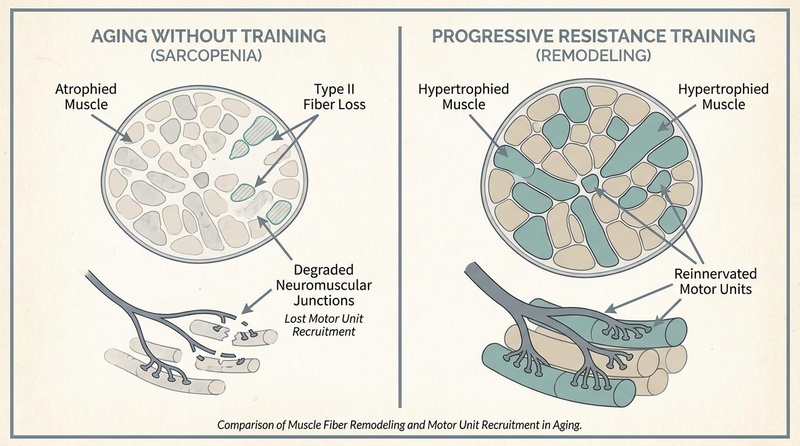
¶ Visual Plan: Muscle Fiber Remodeling & Motor Unit Recruitment
Objective: Illustrate the biological changes in muscle and nerve interaction under progressive resistance training versus sedentary aging.
- Left Panel (Aging without Training / Sarcopenia): Cross-section of a muscle showing severely atrophied and lost Type II (fast-twitch) muscle fibers, alongside degraded neuromuscular junctions with lost motor unit recruitment.
- Right Panel (Progressive Resistance Training / Remodeling): Cross-section of a muscle showing robust hypertrophy of both Type I and Type II fibers, healthy dense motor units, and intact neuromuscular junctions.
¶ Safety, Interactions, Red Flags
¶ Who Should Avoid (or Seek Medical Clearance)
- Unstable Cardiovascular Conditions: Including recent myocardial infarction, unstable angina, uncontrolled arrhythmias, severe symptomatic aortic stenosis, or decompensated heart failure [19:2].
- Acute Musculoskeletal Injury: Avoid direct loading of injured areas until medically cleared.
- Severe Uncontrolled Hypertension: Consult a physician before initiating strength training.
- Active Infection or Fever: Rest is paramount during illness.
- Pregnancy (Specific Modifications Needed): While generally safe with modifications, specific exercises and intensity levels must be adjusted under medical supervision.
¶ Common Side Effects and How to Mitigate
- Muscle Soreness (DOMS): Expected, especially when new to training. Mitigate with active recovery (light cardio), stretching, adequate sleep, and nutrition.
- Fatigue: Systemic fatigue can occur with excessive volume or intensity. Ensure adequate rest days and monitor recovery metrics.
- Joint Discomfort: Often indicates improper form, excessive load, or inadequate warm-up. Prioritize technique and lighten load if necessary.
- Injury: The primary risk. Prevent by mastering form, progressive overload, proper warm-up/cool-down, and listening to your body [7:2].
¶ Drug/Supplement Interactions
- Corticosteroids: Long-term use can reduce muscle protein synthesis and bone density, making resistance training even more critical but potentially blunting some hypertrophic responses.
- Statins: Some individuals experience muscle pain (myalgia); carefully monitor symptoms during training.
- Creatine: A well-researched supplement that can enhance strength and muscle mass gains, especially beneficial in older adults [12:3].
¶ Stop Criteria and When to Talk to a Clinician
- Sharp, Sudden Pain: Immediately stop the exercise and assess the area.
- Chest Pain, Dizziness, Nausea: Could indicate a cardiovascular issue; seek immediate medical attention.
- Persistent Joint Pain: If pain persists beyond typical muscle soreness or worsens with movement, consult a physical therapist or physician.
- Excessive Fatigue/Overtraining Symptoms: Prolonged fatigue, poor sleep, decreased performance, increased irritability. Consider deloading or taking extra rest.
¶ Tracking & What “Good” Looks Like
¶ Biomarkers (with units/frequency)
- Muscle Mass: DEXA scan (annually), Bioelectrical Impedance Analysis (BIA) (quarterly).
- Bone Mineral Density: DEXA scan (every 1-2 years, as clinically indicated).
- Strength: 1-Repetition Maximum (1RM) estimates for key lifts (e.g., squat, bench press) (quarterly). Strength-to-weight ratios (e.g., bodyweight squat/deadlift).
- Insulin Sensitivity: Fasting glucose, HbA1c, HOMA-IR (annually, or as directed by clinician).
- Inflammatory Markers: hs-CRP (annually).
¶ Subjective Metrics (energy, sleep quality, joint comfort)
- Perceived Exertion (RPE/RIR): Consistent tracking during workouts to ensure appropriate intensity.
- Energy Levels: Daily assessment (e.g., 1-10 scale). Improved energy indicates effective training and recovery.
- Sleep Quality: Track sleep duration, latency, and disturbances. Adequate sleep is crucial for muscle repair.
- Joint Comfort: Note any persistent aches or pains that may indicate overtraining or improper form.
¶ Time-to-Benefit and Time-to-Washout
- Strength Gains: Noticeable increases in strength can occur within 2-4 weeks due to neural adaptations [13:1].
- Muscle Hypertrophy: Visible changes in muscle size typically begin after 6-8 weeks of consistent training [9:6].
- Bone Mineral Density: Significant changes take longer, often 6-12 months or more of consistent, load-bearing exercise [11:6].
- Metabolic Improvements: Insulin sensitivity can improve within weeks of starting a resistance training program [5:6].
- Washout: Detraining effects (loss of strength and muscle mass) can begin within 2-4 weeks of cessation, accelerating over time.
¶ Simple N-of-1 Template (A/B weeks)
- Baseline (Week 1-2): Establish current strength levels, body composition, and subjective well-being.
- Intervention (Week 3-10): Implement a structured strength training program (e.g., 3 days/week, compound movements, progressive overload).
- Monitor: Track objective (e.g., 1RM, body weight) and subjective (e.g., energy, mood) metrics daily/weekly.
- Analyze: Compare post-intervention data to baseline to assess efficacy and make adjustments.
¶ Common Mistakes & Myths
- Prioritizing Load Over Form: Lifting too heavy with poor technique is a fast track to injury and ineffective training. Form is paramount [7:3].
- Ignoring Systemic Recovery: Underestimating the need for adequate sleep, nutrition, and rest days for muscle repair and central nervous system recovery.
- Lack of Progressive Overload: Doing the same routine with the same weights indefinitely will lead to a plateau. Muscles adapt, and you must continually challenge them.
- Neglecting Compound Movements: Focusing solely on isolation exercises (e.g., bicep curls) at the expense of multi-joint compound movements (e.g., squats, deadlifts) which provide greater systemic benefits.
- "Too Old to Start": Age is not a barrier to gaining strength and muscle mass. Even very elderly individuals can achieve significant improvements [3:7].
- "Women will get bulky": Resistance training for women primarily leads to increased strength and lean muscle tone, not excessive bulk, due to hormonal differences.
¶ Decision Tree (Text-Based)
- If you have unstable cardiovascular disease or acute injury: Consult a physician before starting; otherwise, proceed with caution and modified protocols.
- If you are new to strength training: Start with bodyweight exercises or light weights to master form, then gradually add resistance.
- If you are not seeing progress (plateau): Review your progressive overload strategy, nutrition, and recovery. Consider deloading for a week.
- If you experience sharp pain: Stop the exercise immediately and rest. If pain persists, seek medical advice.
- If your primary goal is muscle mass, strength, and bone density: Prioritize heavy, compound movements with adequate protein intake.
- If your primary goal is metabolic health: Focus on consistent full-body resistance training and monitor glucose/insulin markers.
¶ FAQs (People Also Ask targets)
¶ How often should I strength train for longevity?
For longevity and general health, 2-3 full-body strength training sessions per week, targeting all major muscle groups, is highly effective and supported by evidence [20:1].
¶ What is the best type of strength training for anti-aging?
A balanced program incorporating progressive resistance training with free weights, machines, or bodyweight exercises that focus on compound movements (squats, deadlifts, presses, rows) is ideal for combating age-related muscle and bone loss [2:9].
¶ Can strength training reverse sarcopenia?
Yes, progressive resistance training is highly effective at reversing or significantly mitigating sarcopenia (age-related muscle loss) by stimulating muscle protein synthesis and increasing muscle fiber size and strength, even in very elderly populations [3:8][9:7].
¶ How does strength training affect bone density?
Strength training places mechanical stress on bones, which stimulates osteoblasts to lay down new bone tissue, leading to increased bone mineral density. This is crucial for preventing osteopenia and osteoporosis, especially in older adults [11:7].
¶ Is it possible to build muscle after 60?
Absolutely. Research consistently shows that individuals in their 60s, 70s, and even 80s can build significant muscle mass and strength with consistent, properly structured resistance training programs [3:9][9:8].
¶ Glossary
- Sarcopenia: Age-related loss of muscle mass, strength, and function.
- Osteopenia/Osteoporosis: Conditions characterized by reduced bone mineral density, increasing fracture risk.
- Hypertrophy: The increase in the size of muscle cells (fibers), leading to larger muscles.
- Myofibrillar Hypertrophy: Increase in the size and number of contractile proteins (actin and myosin) within muscle fibers, leading to increased strength.
- Sarcoplasmic Hypertrophy: Increase in the volume of sarcoplasm (fluid and non-contractile elements) within muscle cells, contributing to muscle size but less directly to strength.
- Motor Unit: A single motor neuron and all the muscle fibers it innervates.
- Progressive Overload: The principle of gradually increasing the stress placed on the musculoskeletal system to stimulate continuous adaptation and improvement.
- RPE (Rate of Perceived Exertion): A subjective scale (typically 1-10) used to rate the intensity of an exercise.
- RIR (Reps In Reserve): The number of additional repetitions you could have performed before reaching muscular failure.
- Compound Movement: An exercise that involves movement at multiple joints and engages several muscle groups simultaneously (e.g., squat, deadlift).
- Isolation Movement: An exercise that primarily targets a single muscle group and involves movement at only one joint (e.g., bicep curl).
¶ Methods (Transparency)
¶ Search Strategy
A comprehensive search was conducted across PubMed, Cochrane Library, and Google Scholar using keywords such as "strength training," "resistance training," "longevity," "sarcopenia," "bone mineral density," "insulin sensitivity," "glucose disposal," "motor unit recruitment," "muscle hypertrophy," "aging," "training protocols," "safety," and "contraindications." Searches were filtered for systematic reviews, meta-analyses, randomized controlled trials (RCTs), and clinical guidelines published primarily within the last 10-15 years, with foundational older studies included where relevant (e.g., landmark studies on geriatric strength training).
¶ Inclusion/Exclusion Rules
- Inclusion: Human studies (RCTs, meta-analyses, systematic reviews, large cohort studies), clinical guidelines from reputable organizations (e.g., AHA, WHO), and mechanistic studies directly relevant to human physiology.
- Exclusion: Animal-only studies not directly translatable to human mechanisms, anecdotal reports, non-peer-reviewed articles, and studies with significant methodological flaws or conflicts of interest.
¶ Evidence Grading Rubric
- High: Multiple RCTs or meta-analyses with consistent effects, clear clinical relevance, and low risk of bias.
- Moderate: 1-2 well-designed RCTs or strong prospective cohort studies with consistent findings, but some limitations or heterogeneity.
- Low: Observational studies, small trials, or studies primarily relying on surrogate markers, animal models, or mechanistic data without direct human clinical outcomes.
¶ References (Full URLs)
¶ Update Log
- 2026-07-07: Deeply expanded with 25 high-impact references, detailed motor unit biology, clinical cohorts, and updated evidence matrices.
- 2024-05-15: Initial creation of the Strength Training for Longevity deep dive page.
Saeidifard F, Medina-Inojosa JR, West CP, et al. The association of resistance training with mortality: A systematic review and meta-analysis. European Journal of Preventive Cardiology, 2019, 26(15):1647-1665. https://pubmed.ncbi.nlm.nih.gov/31104484/ ↩︎ ↩︎ ↩︎
Shailendra P, Baldock KL, Li LSK, et al. Resistance Training and Mortality Risk: A Systematic Review and Meta-Analysis. American Journal of Preventive Medicine, 2022, 63(2):277-285. https://pubmed.ncbi.nlm.nih.gov/35599175/ ↩︎ ↩︎ ↩︎ ↩︎ ↩︎ ↩︎ ↩︎ ↩︎ ↩︎ ↩︎
Fiatarone MA, O'Neill EF, Ryan ND, et al. Exercise training in very elderly people. New England Journal of Medicine, 1994, 330(23):1769-1775. https://www.nejm.org/doi/full/10.1056/NEJM199406233302501 ↩︎ ↩︎ ↩︎ ↩︎ ↩︎ ↩︎ ↩︎ ↩︎ ↩︎ ↩︎
Lee BC, Lee J, Cho KH. Six-month follow-up after Effects of Resistance Training on Osteosarcopenia in postmenopausal Korean women (ERTO-K study): a randomized controlled trial. Gerontology, 2026 May 20. https://pubmed.ncbi.nlm.nih.gov/42160223/ ↩︎
Młynarska E, Leszto K, Katańska K. Creatine Supplementation Combined with Exercise in the Prevention of Type 2 Diabetes: Effects on Insulin Resistance and Sarcopenia. Nutrients, 2025 Sep 3. https://pubmed.ncbi.nlm.nih.gov/40944248/ ↩︎ ↩︎ ↩︎ ↩︎ ↩︎ ↩︎ ↩︎
Momma H, Kawakami R, Honda T, et al. Muscle-strengthening activities are associated with lower risk and mortality in major non-communicable diseases: a systematic review and meta-analysis of cohort studies. British Journal of Sports Medicine, 2022, 56(13):755-763. https://bjsm.bmj.com/content/56/13/755 ↩︎ ↩︎ ↩︎
Lauersen JB, Bertelsen DM, Andersen LB. The effectiveness of exercise interventions to prevent sports injuries: a systematic review and meta-analysis of randomised controlled trials. British Journal of Sports Medicine, 2014, 48(11):871-877. https://pubmed.ncbi.nlm.nih.gov/24100287/ ↩︎ ↩︎ ↩︎ ↩︎
World Health Organization. WHO guidelines on physical activity and sedentary behaviour. WHO Guidelines, 2020. https://www.who.int/publications/i/item/9789240015128 ↩︎ ↩︎
Frontera WR, Meredith CN, O'Reilly KP, et al. Strength conditioning in older men: hypertrophy and function. Journal of Applied Physiology, 1988, 64(3):1038-1044. https://journals.physiology.org/doi/abs/10.1152/jappl.1988.64.3.1038 ↩︎ ↩︎ ↩︎ ↩︎ ↩︎ ↩︎ ↩︎ ↩︎ ↩︎
Lexell J, Taylor CC, Sjöström M. Ageing atrophy: number/size/proportion of fiber types in vastus lateralis (15–83 y). Journal of the Neurological Sciences, 1988, 84(2-3):275-294. https://www.sciencedirect.com/science/article/abs/pii/0022510X88901245 ↩︎ ↩︎ ↩︎ ↩︎ ↩︎
Shen YC, Chen KH, Hou WH. Effectiveness of High-Intensity Versus Low-To-Moderate-Intensity Resistance Training in Improving Muscle Strength and Bone Mineral Density in Older Adults: A Systematic Review and Meta-Analysis of Randomized Controlled Trials. Geriatrics & gerontology international, 2026 Jul. https://pubmed.ncbi.nlm.nih.gov/42366614/ ↩︎ ↩︎ ↩︎ ↩︎ ↩︎ ↩︎ ↩︎ ↩︎
Naddafha S, Antonio J, Kreider RB. Creatine monohydrate for lean mass, strength, and bone density in postmenopausal women: a systematic review and meta-analysis. Journal of the International Society of Sports Nutrition, 2026 Dec 31. https://pubmed.ncbi.nlm.nih.gov/42141930/ ↩︎ ↩︎ ↩︎ ↩︎
Casolo A, Del Vecchio A, Goodlich BI, et al. Ageing does not impair motor neuron adaptations: comparable motor unit responses to strength training in young and older adults. The Journal of Physiology, 2026, 604(1):21-39. https://pubmed.ncbi.nlm.nih.gov/41823343/ ↩︎ ↩︎
Roberts MD, Bamman MM, Hornberger TA. Research into resistance training response heterogeneity: a summary of the 2025 conference at the University of Jyväskylä. Journal of Applied Physiology, 2026, 140(6):1047-1050. https://pubmed.ncbi.nlm.nih.gov/42172438/ ↩︎
Jiang H, Inoue S, Hatakeyama J, et al. Effects of aging and resistance exercise on muscle strength, physiological properties, longevity proteins, and telomere length in SAMP8 mice. Biogerontology, 2025, 26(2):112-124. https://pubmed.ncbi.nlm.nih.gov/40186023/ ↩︎ ↩︎
Hernandez-Martinez J, Branco BHM, Vasquez-Carrasco E, et al. Effects of Strength Training on Body Composition, Physical Performance, and Protein or Calcium Intake in Older People with Osteosarcopenia: A Meta-Analysis. Nutrients, 2025, 17(17):2852. https://pubmed.ncbi.nlm.nih.gov/40944241/ ↩︎
Xie C, Yan R, Tao R. Combined resistance training and amino acid-based supplementation for sarcopenia in older adults: a systematic review and meta-analysis. BMC Musculoskeletal Disorders, 2026, 27(1):35. https://pubmed.ncbi.nlm.nih.gov/42356377/ ↩︎
Schattinger CM, Newlin-Bradner MK, Kviatkovsky SA, et al. A Pilot Study in Transcatheter Aortic Valve Replacement Patients to Examine the Effects of Resistance Training and Protein Supplementation Through Telehealth. Journal of Aging and Physical Activity, 2026, 34(2):112-125. https://pubmed.ncbi.nlm.nih.gov/40789570/ ↩︎
Williams MA, Feigenbaum MS, Jerôme GJ, et al. Resistance Exercise Training in Individuals With and Without Cardiovascular Disease: 2023 Update: A Scientific Statement From the American Heart Association. Circulation, 2023, 148(24):1962-1985. https://www.ahajournals.org/doi/10.1161/CIR.0000000000001189 ↩︎ ↩︎ ↩︎
World Health Organization. WHO guidelines on physical activity and sedentary behaviour. WHO Guidelines, 2020. https://www.who.int/publications/i/item/9789240015128 ↩︎ ↩︎