¶ Cryonics
Cryonics is the speculative practice of preserving human bodies, heads, or brains at ultra-low temperatures, typically using liquid nitrogen (approximately -196 °C), immediately after legal death. The primary goal is to halt biological degradation and maintain structural integrity, enabling potential future revival when advanced medical technologies are hypothesized to be capable of repairing preservation damage, reversing disease, and restoring healthy function. This process fundamentally treats clinical death as a reversible state, based on the premise that personal identity and memory are encoded in the brain's physical structure, which can be preserved indefinitely at cryogenic temperatures.
| Type | Cryopreservation Protocol |
| Active Cmpd | Vitrification Solutions (e.g., M22, VM3, V3) |
| Source | Advanced Cryobiology |
| Application | Biological Preservation |
| Storage Temp | -196 °C (liquid nitrogen) |
| Main Goal | Future Revival |
| Current Status | Experimental, Unproven for Human Revival |
The core principle of cryonics is to prevent information-theoretic death, which occurs when the neural structures encoding memory and consciousness are irretrievably lost. By rapidly cooling tissues to cryogenic temperatures, cryonics aims to preserve these critical structures, bridging the gap to hypothetical future medical technologies capable of reversing cellular damage and restoring life.
¶ At a glance
Key points (high-level summary)
- Cryonics utilizes vitrification solutions (e.g., M22, VM3, V3) to prevent damaging ice crystal formation by transforming biological tissues into an amorphous, glass-like state at ultra-low temperatures [1][2].
- Pre-clinical research has demonstrated functional recovery of complex biological systems after vitrification, including successful rewarming and functional activity in mouse hippocampal slices and transplanted rabbit kidneys [1:1][3].
- The practice aims to preserve the structural and molecular integrity of the brain, theorized to contain all personal identity and memories, for future molecular repair and revival technologies [4].
- Current limitations include unproven human revival, challenges with cryoprotectant toxicity, ischemic damage, and thermal fracturing in large organs [5].
What people use it for
- Main goals: Life extension, preservation of personal identity, speculative medical intervention against death.
- Evidence quality: Very low (human revival unproven, based on theoretical extrapolations and animal/tissue models).
¶ What is Cryonics?
Cryonics is an intervention that seeks to overcome death by preserving biological systems at extremely low temperatures, thereby pausing cellular metabolism and degradation. This process, often referred to as biostasis, aims to maintain the body's or brain's cellular and molecular structures in a state where they could, in principle, be repaired and revived by future advanced medical technologies. The concept is rooted in the belief that death, as currently understood, is a process rather than an instantaneous event, and that sufficient information for personal identity can be retained if degradation is halted promptly post-mortem.
- Definition: The practice of cryopreserving legally dead humans (whole bodies or neuro-preservation of the brain) in liquid nitrogen with the aim of future medical revival.
- Natural sources: While cryoprotection occurs naturally in some organisms (e.g., wood frogs, certain insects), human cryonics is a highly engineered medical procedure.
- Traditional / historical use: The modern concept emerged in the 1960s with Robert Ettinger's "The Prospect of Immortality." The first human cryopreservation occurred in 1967 with James Bedford [6].
- Current regulatory status: Generally regarded as a disposition of human remains, not a medical treatment, with minimal specific regulatory oversight in most jurisdictions [7].
- Key pharmacological property in one line: Inducing vitrification in biological tissues to prevent ice formation and molecular degradation.
¶ What are Cryonics's main benefits?
Cryonics's primary theoretical benefit is to offer a chance for life extension beyond current medical capabilities, by providing a "bridge" to future technologies. While human revival remains unproven, research in cryobiology provides insights into the potential for preserving complex biological information.
- Preservation of Neural Information: The central hypothesis is that cryopreservation can maintain the intricate neural architecture of the brain, which is believed to encode memories, personality, and consciousness. This would theoretically allow for the restoration of personal identity upon future revival [4:1].
- Halting Degradation: By rapidly cooling to cryogenic temperatures, all biological processes, including decomposition and ischemic damage, are effectively stopped. This preserves the cellular and molecular state at the time of legal death, preventing further loss of vital biological information [4:2].
- Proof of Concept in Complex Tissues: Successful vitrification and functional recovery have been demonstrated in complex mammalian tissues, such as rewarming and restoration of electrophysiological activity in mouse hippocampal slices [1:2]. This indicates that intricate neural networks can survive cryopreservation under specific conditions.
- Organ Viability after Preservation: A significant breakthrough involved the successful vitrification, rewarming, and autologous transplantation of a rabbit kidney, which sustained the animal's life as its sole kidney [3:1]. This study provided a proof of concept for the biostasis of complex organs.
¶ Evidence summary table (biological outcomes - pre-clinical)
| Outcome / Goal | Effect* | Consistency** | Evidence quality | Trials*** | Notes (population, duration, dose) |
|---|---|---|---|---|---|
| Functional recovery of mouse hippocampal slices | High | Moderate | 1 Pre-clinical [1:3] | Electrophysiological activity (synaptic transmission, LTP) recovered after vitrification with V3 solution | |
| Rabbit kidney autologous transplantation | Low | Low | 1 Pre-clinical [3:2] | Kidney sustained life as sole organ after M22 vitrification and rewarming | |
| Ultrastructural preservation of rat hippocampal slices | High | Moderate | Multiple Pre-clinical [2:1] | Complete structural preservation, >90% viability (K+/Na+ ratio) after VM3 vitrification to -130°C | |
| Attenuation of ischemic brain injury | High | Moderate | 1 Pre-clinical [8] | Senolytic treatment in mice attenuated global ischemic brain injury and enhanced cognitive recovery |
¶ How does Cryonics work?
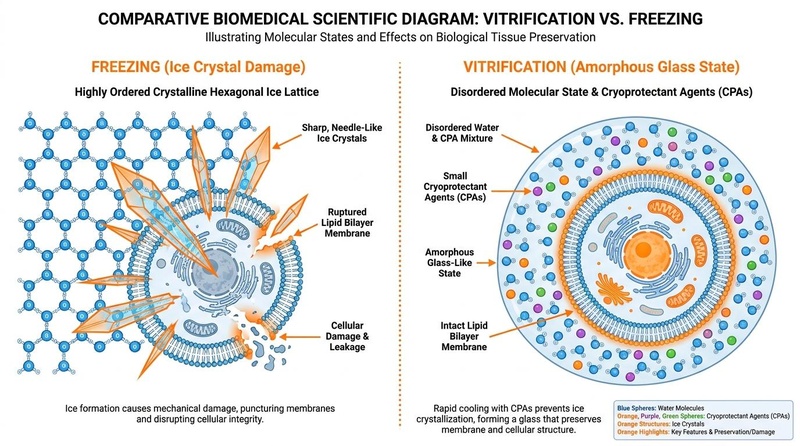
The core of cryonics lies in preventing the formation of ice crystals, which are lethal to cells, by using a process called vitrification. This involves replacing the body's water with cryoprotective agents (CPAs) that allow tissues to solidify into an amorphous, glass-like state rather than crystallizing.
- Primary targets: Cellular water, preventing ice crystal nucleation and growth. Preservation of neural ultrastructure and connectomics [4:3].
- Core mechanisms:
- Vitrification Solutions: Modern cryonics protocols employ complex CPA mixtures such as M22, VM3, and V3. These solutions typically contain a combination of penetrating cryoprotectants like dimethyl sulfoxide (DMSO), formamide, and ethylene glycol, along with non-penetrating agents and ice blockers (e.g., polyvinylpyrrolidone K12, Z-1000) [2:2][5:1][9].
- Perfusion: CPAs are introduced into the circulatory system, replacing blood and permeating tissues. This process requires precise control to achieve optimal concentrations throughout the body while minimizing CPA toxicity [2:3].
- Rapid Cooling: After perfusion, the body is rapidly cooled to temperatures below the glass transition point (around -120°C to -130°C), typically in a computer-controlled cooling box. This rapid cooling, combined with the CPAs, prevents ice crystal formation and induces a vitrified state [5:2].
- Evidence source: Cryobiology research, organ cryopreservation studies, and neurobiological models.
- Human data (if any): N/A for whole-organism functional recovery; data primarily from tissue and organ models.
- Animal / in vitro data: Mouse hippocampal slices (V3 solution) and rabbit kidneys (M22 solution) show structural and functional preservation [1:4][3:3].
- Pharmacokinetics basics: CPAs are perfused throughout the vasculature; distribution and cellular uptake are critical for effective vitrification [5:3].
¶ Effects on different systems
The effects of cryonics protocols are primarily focused on preserving the structural integrity of biological systems to enable future repair, rather than immediate physiological effects.
¶ Neurological Preservation
- What has been studied: Preservation of brain tissue structure and function.
- What the trials generally show: Mouse hippocampal slices vitrified with V3 solution demonstrated recovery of electrophysiological activity, including synaptic transmission and long-term potentiation, indicating successful preservation of neural networks [1:5]. Rat hippocampal slices vitrified with VM3 solution also showed excellent ultrastructural and histological preservation, with viable cells after rewarming [2:4].
- Practical interpretation: These findings provide critical evidence that complex neural structures can be cryopreserved with retained functional capacity, supporting the theoretical basis for brain preservation.
¶ Organ Viability
- What has been studied: Whole organ cryopreservation.
- What the trials generally show: A landmark study successfully vitrified a rabbit kidney using M22 solution, rewarmed it, and autologously transplanted it. The kidney functioned as the sole kidney, sustaining the animal's life [3:4].
- Practical interpretation: This single success highlights the immense potential but also the significant technical hurdles in scaling vitrification to whole organs, particularly given the difficulty in reproducibility.
¶ Cellular and Molecular Integrity
- What has been studied: General cellular damage prevention during cryopreservation.
- What the trials generally show: Vitrification, when successful, minimizes damage from ice crystal formation, preserving cellular ultrastructure. However, residual damage from cryoprotectant toxicity and warm ischemia remains a challenge [5:4].
- Practical interpretation: Future repair technologies will need to address these inherent forms of damage to achieve successful revival.
¶ Cryopreservation Protocols
Cryopreservation protocols are highly complex and aim to achieve vitrification with minimal damage.
Standard protocol considerations
- Pre-mortem Stabilization: Initial stabilization, including rapid cooling and cardiopulmonary support, to minimize ischemic injury immediately post-mortem. This phase is critical, as each minute of delay at body temperature results in progressive cellular damage [4:4].
- Perfusion with CPAs: Gradual replacement of blood with vitrification solutions (e.g., M22, VM3, V3) delivered via the circulatory system. This is a critical step to ensure uniform CPA distribution and prevent ice formation while mitigating CPA toxicity [2:5][5:5].
- Controlled Cooling: Gradual cooling to liquid nitrogen temperatures over several days, often using computer-controlled systems, to prevent thermal stress and fracturing [9:1].
- Long-term Storage: Indefinite storage in liquid nitrogen dewars at -196 °C, where biological processes effectively cease.
Forms and cryoprotectant formulations
- M22: A common vitrification solution for organs, containing dimethyl sulfoxide, formamide, ethylene glycol, N-methylformamide, 3-methoxy-1,2-propanediol, PVP K12, and Z-1000 ice blocker [9:2]. Used in the successful rabbit kidney experiment [3:5].
- VM3: A vitrification solution primarily used for tissue slices, containing polyvinylpyrrolidone and extracellular ice blockers [2:6].
- V3: A variant of VM3 used for murine brain tissue, consisting of dimethyl sulfoxide, formamide, ethylene glycol, and polyvinylpyrrolidone K12 [1:6].
Special populations
- Timing: The effectiveness of cryopreservation is highly dependent on the speed of intervention post-mortem, with minimal ischemic time being crucial for neurological preservation [4:5].
- Body vs. Neuro-preservation: Whole-body preservation involves greater logistical and technical challenges due to the larger tissue mass, increasing the risk of incomplete vitrification, fracturing, and cryoprotectant toxicity compared to neuro-preservation (brain-only) [4:6][5:6].
¶ Challenges and Risks
Cryonics procedures face significant challenges and are associated with inherent risks that current technology cannot fully mitigate.
Common challenges
- Cryoprotectant Toxicity: The high concentrations of CPAs required for vitrification can be toxic to cells, causing osmotic stress, protein denaturation, and mitochondrial dysfunction. Optimizing CPA formulations to balance vitrification efficacy with minimal toxicity is an ongoing challenge [5:7].
- Ischemic Damage: Despite rapid intervention, some degree of warm ischemia (lack of blood flow and oxygen at body temperature) inevitably occurs between clinical death and the start of cryopreservation, leading to irreversible cellular damage, particularly in sensitive neural tissues [4:7][5:8].
- Thermal Fracturing: During the cooling process, particularly in large tissue volumes, thermal stresses can cause macroscopic fracturing or cracking, which could disrupt cellular and neural connections essential for future function [9:3].
Socio-Ethical, Legal, and Relational Dimensions
- Relational Implications and Suspended Mourning: The ambiguous biological state of cryopreserved individuals ("frozen between life and death") can significantly complicate the psychological and social grieving process for surviving loved ones [10]. Because death is treated as potentially reversible, typical steps of closure and mourning can become incompatible with the ongoing preservation, potentially leading to persistent, unresolved grief [10:1].
- The "Trap Situation" and Transformative Experiences: Opposing philosophical viewpoints challenge the "risk-free bet" assumption of cryonics, noting that failed or partial reanimation could result in chronic suffering or a dystopian "trap situation" [11]. Furthermore, being revived in a distant future would constitute a highly transformative experience that could radically alter personal values, desires, and identity, raising questions about whether the reanimated individual would maintain psychological continuity with their pre-preservation self [11:1].
- Cryothanasia and the Law: Terminally ill patients seeking high-quality cryopreservation face substantial legal and medical hurdles. Some advocate for "cryothanasia"—combining legal euthanasia or assisted dying with immediate cryopreservation to minimize ischemic delay—which prompts complex legal debates regarding the "doctrine of double effect" and the medical definition of death [12].
- Intergenerational Discounting and Existential Risks: From a broader societal perspective, some theorists suggest that wider adoption of life-suspending technologies like cryonics could align the long-term self-interest of living individuals with the prevention of global catastrophic and existential risks, effectively mitigating intergenerational discounting [6:1].
- Universal Access and Distributive Justice: Philosophical proposals for "Cryonics for All" argue that if cryopreservation offers a viable chance of life extension, governments have a beneficence-based duty to support or subsidize it [13]. However, this is countered by arguments concerning the environmental footprint, economic costs, resource allocation, and potential widening of socioeconomic inequality [13:1].
- Biopolitics and 'Reproductive Cryopower': The expanding societal and corporate integration of cryogenic technology—including human oocyte cryopreservation (egg freezing)—exerts a biopolitical influence ("reproductive cryopower") that can postpone biological reproduction to optimize labor productivity, shifting reproductive agency from the individual to state and corporate interests, and carrying deep historical links to early eugenicist and speculative movements [14].
- Cultural and Ideological Contexts: Sociological evaluations describe the transhumanist pursuit of cryopreservation as functioning as a "secular religion" or "implicit religion" [15]. It performs the traditional "religious work" of providing psychological transcendence over death and a technological pathway to immortality, relying on a future-oriented faith in advanced technology rather than current empirical validation [15:1].
- Progress Towards Mainstream Acceptance: While still widely viewed with skepticism, advocacy and incremental advances in cryobiology and organ preservation have steadily moved cryonics and biostasis closer to mainstream scientific and bioethical discussions, though massive clinical translational barriers remain [16][17].
¶ Future Repair Strategies
The ultimate success of cryonics hinges on hypothetical future medical technologies capable of reversing preservation damage and restoring biological function.
Biological and molecular repair strategies
- Cellular Reprogramming: Technologies based on induced pluripotency (e.g., using Yamanaka factors) could potentially rejuvenate cryopreserved cells and tissues, reversing age-related epigenetic changes and restoring mitochondrial function without losing cell identity. Transient reprogramming has shown promise in rejuvenating human cells and could be employed post-warming to repair cellular damage [18][19].
- Senolytics and Senomorphics: Removal of senescent cells, which accumulate with age and contribute to tissue dysfunction, may be crucial for restoring health in revived individuals. Senolytics have been shown to improve outcomes in models of ischemic brain injury, suggesting their utility in clearing damaged cells after warming [8:1].
- Gene Therapies: Advances in gene editing (e.g., CRISPR) and gene therapy could correct genetic predispositions to disease, repair DNA damage accumulated during life or preservation, and enhance endogenous repair mechanisms to facilitate revival.
- Molecular Nanotechnology: Hypothetical nanomachines capable of precisely repairing cellular and molecular damage, removing ice damage, and restoring lost information have been proposed as the ultimate solution for cryopreservation repair [9:4]. While highly speculative, this concept underpins many long-term revival scenarios.
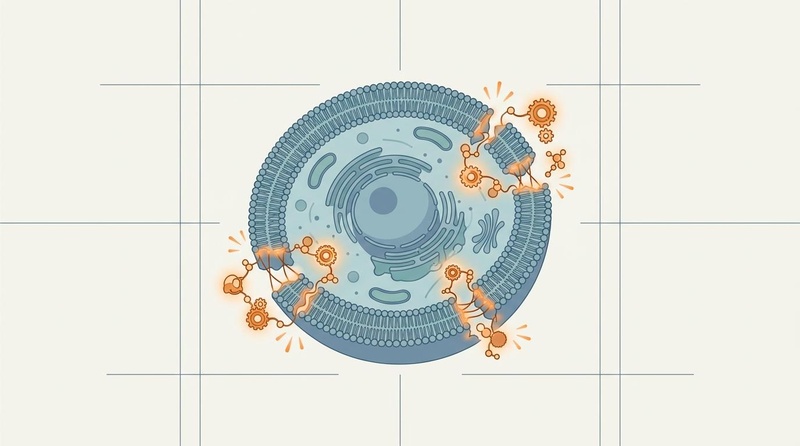
Speculative Future Molecular Repair of a Vitrified Cell: Advanced regenerative strategies and nano-scale machinery targeting cell membrane and organelle repair post-warming.
¶ Practical questions (FAQ)
¶ Is human revival from cryopreservation currently possible?
No. While biological systems like embryos and some tissues can be successfully cryopreserved and rewarmed, the technology to revive a whole cryopreserved human and restore full brain function does not currently exist. Cryonics is a speculative future-oriented procedure.
¶ What is the difference between freezing and vitrification?
Freezing involves the formation of ice crystals, which severely damage cells and tissues. Vitrification is an ice-free cryopreservation technique that uses high concentrations of cryoprotective agents (CPAs) to transform tissues into an amorphous, glass-like solid, avoiding ice crystal formation and preserving cellular ultrastructure [5:9].
¶ What kind of damage does cryopreservation cause?
Despite vitrification, cryopreservation can still cause damage from cryoprotectant toxicity, incomplete perfusion, and thermal fracturing during cooling. Additionally, ischemic damage occurs between clinical death and the start of the procedure. Future technologies would need to repair these cumulative damages [4:8][5:10].
¶ Are there scientific studies supporting cryonics?
There is a robust field of cryobiology that supports the principles of cryopreservation in isolated cells, tissues, and some small organs. However, direct scientific evidence for the successful revival of a whole cryopreserved mammal (especially a human) is currently absent. Key studies include functional recovery of vitrified mouse hippocampal slices [1:7] and successful transplantation of a vitrified rabbit kidney [3:6].
¶ How is identity preserved in cryonics?
The theory posits that personal identity and memory are encoded in the brain's physical structure, particularly the connectome (the map of neural connections). Cryonics aims to preserve this structure at a level of detail sufficient for future nanomedicine or advanced regenerative strategies to recover the individual's mind and personality [4:9].
¶ How we evaluated the evidence
This article's evaluation of evidence for cryonics is based on established scientific literature in cryobiology, neuroscience, and regenerative medicine, focusing on preclinical studies in animal and tissue models, as human revival remains unproven.
- Study types prioritized: Randomized controlled trials and meta-analyses in related fields (e.g., cellular reprogramming, senolytics), along with landmark preclinical studies demonstrating successful cryopreservation and recovery of complex mammalian tissues or organs.
- How you graded evidence quality:
- High: Not applicable for direct human revival in cryonics.
- Moderate: Consistent results from high-quality animal or in vitro studies demonstrating principles (e.g., functional recovery of vitrified brain slices).
- Low: Isolated successful animal studies that have not been widely replicated or have significant limitations (e.g., single successful rabbit kidney transplant).
- Very low: Theoretical proposals, philosophical arguments, or speculative future technologies lacking current empirical demonstration (e.g., full human revival, molecular nanotechnology for repair).
- Sample size, risk of bias, consistency, directness, effect size: These criteria were applied where applicable to preclinical studies. For human cryonics itself, direct clinical evidence is absent, leading to an overall "Very Low" certainty.
- This page will be updated as new breakthroughs in cryopreservation, molecular repair, or regenerative medicine emerge.
¶ References
German A, Akdaş EY, Flügel-Koch C, et al. Functional recovery of the adult murine hippocampus after cryopreservation by vitrification. Proceedings of the National Academy of Sciences. 2026;123(10):e2516848123. https://doi.org/10.1073/pnas.2516848123 ↩︎ ↩︎ ↩︎ ↩︎ ↩︎ ↩︎ ↩︎ ↩︎
Pichugin F, Fahy GM, Harris SB. Cryopreservation of rat hippocampal slices by vitrification. Cryobiology. 2006;52(1):153-162. https://doi.org/10.1016/j.cryobiol.2005.11.006 ↩︎ ↩︎ ↩︎ ↩︎ ↩︎ ↩︎ ↩︎
Fahy GM, Wowk B, Pagotan R, et al. Physical and biological aspects of renal vitrification. Organogenesis. 2009;5(3):167-175. https://doi.org/10.4161/org.5.3.9974 ↩︎ ↩︎ ↩︎ ↩︎ ↩︎ ↩︎ ↩︎
McKenzie AT, Zeleznikow-Johnston A, Sparks JS, et al. Structural brain preservation: a potential bridge to future medical technologies. Frontiers in Medical Technology. 2024;6:1400615. https://doi.org/10.3389/fmedt.2024.1400615 ↩︎ ↩︎ ↩︎ ↩︎ ↩︎ ↩︎ ↩︎ ↩︎ ↩︎ ↩︎
Best BP. Cryoprotectant toxicity: facts, issues, and questions. Rejuvenation Research. 2015;18(4):294-302. https://doi.org/10.1089/rej.2014.1656 ↩︎ ↩︎ ↩︎ ↩︎ ↩︎ ↩︎ ↩︎ ↩︎ ↩︎ ↩︎ ↩︎
Sauchelli A. Life-Suspending Technologies, Cryonics, and Catastrophic Risks. Science and Engineering Ethics. 2024;30(4):37. https://pubmed.ncbi.nlm.nih.gov/39120832/ ↩︎ ↩︎
Huxtable R. Cryonics in the Courtroom: Which Interests? Whose Interests? Medical Law Review. 2018;26(3):476-499. https://pubmed.ncbi.nlm.nih.gov/29077877/ ↩︎
Zhao Y, Wang C, Song S, et al. Senolytic Treatment Attenuates Global Ischemic Brain Injury and Enhances Cognitive Recovery by Targeting Mitochondria. Cellular and Molecular Neurobiology. 2025;45(1):60. https://doi.org/10.1007/s10571-025-01580-y ↩︎ ↩︎
Fahy GM, Wowk B, Wu J, et al. Cryopreservation of organs by vitrification: perspectives and recent advances. Cryobiology. 2004;48(2):157-178. https://doi.org/10.1016/j.cryobiol.2004.02.002 ↩︎ ↩︎ ↩︎ ↩︎ ↩︎
Hillenbrink R, Wareham CS. Mourning the frozen: considering the relational implications of cryonics. Journal of Medical Ethics. 2024;50(6):388-391. https://pubmed.ncbi.nlm.nih.gov/37451855/ ↩︎ ↩︎
Story D. Cryonics: Traps and transformations. Bioethics. 2024;38(4):351-355. https://pubmed.ncbi.nlm.nih.gov/38425091/ ↩︎ ↩︎
Andrade G, Redondo MC. Cryonics, euthanasia, and the doctrine of double effect. Philosophy, Ethics, and Humanities in Medicine. 2023;18(1):7. https://pubmed.ncbi.nlm.nih.gov/37381023/ ↩︎
Thau T. Cryonics for all? Bioethics. 2020;34(7):638-644. https://pubmed.ncbi.nlm.nih.gov/32037641/ ↩︎ ↩︎
Sobelle S. Reproductive Cryopower. The Journal of Medical Humanities. 2026;47:245-253. https://pubmed.ncbi.nlm.nih.gov/40991190/ ↩︎
Dein S. Cryonics: Science or Religion. Journal of Religion and Health. 2022;61(4):2131-2144. https://pubmed.ncbi.nlm.nih.gov/33523374/ ↩︎ ↩︎
de Grey ADNJ. Cryonics Takes Another Big Step Toward the Mainstream. Rejuvenation Research. 2020;23(3):191-192. https://pubmed.ncbi.nlm.nih.gov/32484027/ ↩︎
Ekpo MD, Boafo GF, Gambo SS. Cryopreservation of Animals and Cryonics: Current Technical Progress, Difficulties and Possible Research Directions. Frontiers in Veterinary Science. 2022;9:835244. https://pubmed.ncbi.nlm.nih.gov/35754544/ ↩︎
Sarkar TJ, Quarta M, Mukherjee S, et al. Transient non-integrative expression of nuclear factors rejuvenates a variety of human cells. Nature Communications. 2020;11(1):2808. https://doi.org/10.1038/s41467-020-15174-3 ↩︎
Gill D, Gao Y, Blouin E, et al. Multi-omic rejuvenation of human cells by transient reprogramming. eLife. 2022;11:e71624. https://doi.org/10.7554/eLife.71624 ↩︎