¶ Older Men's Health: Cognitive Preservation, Sarcopenia Management, and Cellular Resilience
¶ Executive Dashboard
¶ At a Glance
Ages 60 and older represent a stage where clinical focus must transition to preserving physiological reserve, physical independence, and cognitive function. The primary biological threats in older men are neuromuscular decay (sarcopenia), cerebral hypoperfusion, osteosarcopenia, and cellular senescence. Optimizing healthspan in this cohort requires targeted, molecular-aware therapies that address anabolic resistance, mitophagy decline, and chronic subclinical sterile inflammation (inflammaging).
¶ Safety "Traffic Light"
- RED LIGHT (Stop/Contraindicated): Do not administer calcium monotherapy to older men without co-administering Vitamin K2 (Menaquinone-7) due to risks of accelerating arterial and coronary calcification [1].
- YELLOW LIGHT (Caution/Monitoring Required): When using high-dose testosterone therapy in older men, monitor hematocrit quarterly. High hematocrit (> 52%) in older men is a critical risk factor for ischemic events and requires immediate dose adjustment [2].
- GREEN LIGHT (Go/Recommended): Maintain regular resistance training (2-3 times/week) and ensure high protein intake (1.6-2.2 g/kg/day) to counteract anabolic resistance and prevent age-associated physical frailty [3][4].
¶ Protocol Card: Healthy Aging Interventions (60+)
+-----------------------------------------------------------------------------------+
|                        OLDER MENS HEALTH PROTOCOLS (60+)                         |
+--------------------------+-----------------------------+--------------------------+
| TARGET AREA              | CLINICAL ENDPOINTS          | CORE INTERVENTIONS       |
+--------------------------+-----------------------------+--------------------------+
| Neuromuscular            | - Preserved Type II Fibers  | - Progressive Resistance |
| Maintenance              | - Sarcopenia Prevention     | - Protein: 1.6-2.2 g/kg  |
|                          | - Bone Mineral Density      | - HMB + Creatine daily   |
+--------------------------+-----------------------------+--------------------------+
| Cognitive &              | - Brain Bioenergetics (ATP) | - Sleep Optimization     |
| Glymphatic Support       | - Endothelial BBB Integrity | - NMN / NR (Precursors)  |
|                          | - Glymphatic clearance      | - Glycine + NAC (GlyNAC) |
+--------------------------+-----------------------------+--------------------------+
| Cellular &               | - Mitophagy Activation      | - Spermidine (40 mg/d)   |
| Autophagy Support        | - Senescent Cell Clearance  | - CoQ10 + PQQ            |
|                          | - Inflammaging control      | - Target CD38 (Apigenin) |
+--------------------------+-----------------------------+--------------------------+
¶ Bottom Line
Advanced longevity medicine in older men must aggressively defend muscular, skeletal, and neurological integrity. Utilizing targeted protein therapeutics, sirtuin-mediated metabolic support, and selective senolytics can successfully preserve functional capacity and prevent the onset of chronic frailty.
¶ Contextual Narrative
¶ The "Why": Defending Autonomy and Vitality
In men over 60, healthspan optimization shifts from risk reduction to the preservation of physical autonomy and cognitive vitality. The age-associated onset of physical frailty is primarily driven by sarcopenia—the loss of Type II fast-twitch muscle fibers—and osteoporosis, which together culminate in osteosarcopenia, raising the risk of debilitating fractures and loss of mobility [4:1][5]. Simultaneously, the aging brain exhibits decreased mitochondrial ATP production and compromised glymphatic clearance, accelerating cognitive decline [6][7]. Addressing these dual pillars of aging requires interventions targeting cellular bioenergetics, proteostasis, and structural tissue preservation.
¶ Sarcopenia & Anabolic Resistance: The Skeletal Muscle Crisis
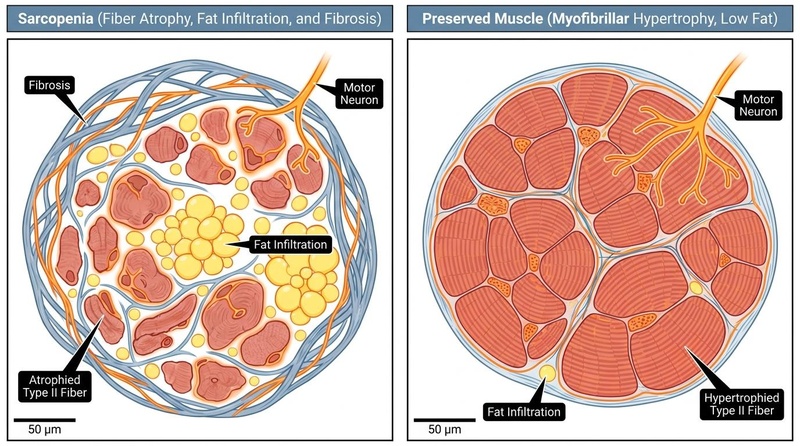
Aging skeletal muscle undergoes a progressive remodeling process:
- Anabolic Resistance: Older men exhibit a blunted protein synthesis response to circulating amino acids and resistance training [6:1]. This resistance is mediated by a down-regulation of ribosomal biogenesis and a blunted activation of the mTORC1 signaling pathway, necessitating significantly higher protein boluses (30-40g per meal) to stimulate muscle protein synthesis [3:1].
- Fiber Transition: There is a selective atrophy and loss of Type II (fast-twitch, high-power) muscle fibers, accompanied by fat infiltration (myosteatosis) and fibrotic tissue deposition [8].
- Reversing Muscle Loss: Clinical trials confirm that combining progressive resistance training with nutritional adjuvants—specifically creatine monohydrate (which enhances phosphocreatine resynthesis) and Beta-hydroxy-beta-methylbutyrate (HMB) (which inhibits proteolysis via the ubiquitin-proteasome pathway)—can overcome anabolic resistance, drive muscle fiber hypertrophy, and preserve motor unit recruitment [5:1][9].
¶ Cognitive Preservation, Glymphatic Flow, and Brain Bioenergetics
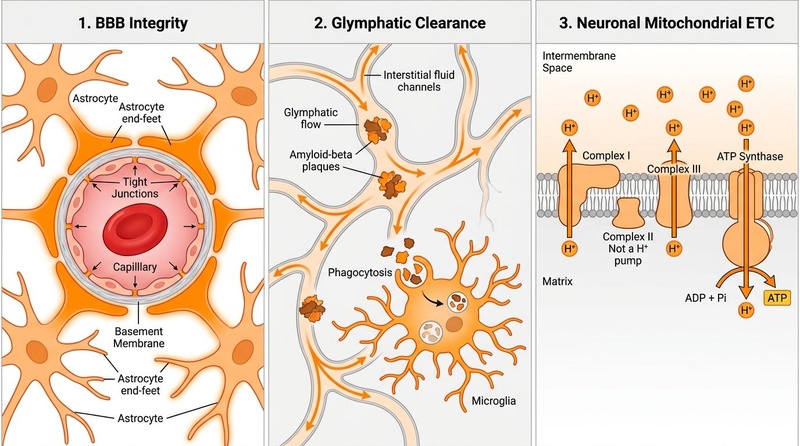
The preservation of executive function in older age is structurally linked to brain perfusion, blood-brain barrier (BBB) integrity, and mitochondrial respiratory efficiency within neurons.
- The Energy Crisis: The aging brain experiences an "energy crisis" characterized by a progressive drop in cellular NAD+ levels, which restricts mitochondrial ATP output via the electron transport chain [10]. This is driven by an increase in CD38 expression, a membrane-bound glycohydrolase that degrades NAD+ with age [11].
- Glymphatic Failure: Sleep architecture changes, specifically the reduction of Slow-Wave Sleep (deep sleep), diminish the arterial-pulsation-driven flow of cerebrospinal fluid through the interstitial space (glymphatic system), reducing the clearance of neurotoxic proteins such as amyloid-beta and hyperphosphorylated tau [12][7:1].
- Mitochondrial Rescue: Utilizing NAD+ precursors like Nicotinamide Riboside (NR) or Nicotinamide Mononucleotide (NMN) in combination with CD38 inhibitors (such as apigenin or quercetin) can restore neuronal ATP output, protect blood-brain barrier integrity, and support cognitive performance [6:2][7:2].
¶ Osteosarcopenia and Bone Mineral Integrity
Bone remodeling in older men is highly dependent on both hormonal cues and mechanical strain.
- The Osteosarcopenia Synergy: The concurrent loss of bone mineral density (osteopenia/osteoporosis) and muscle mass (sarcopenia) creates a syndromic vulnerability to low-trauma falls and fractures [5:2].
- The Calcium Paradox: While calcium is essential for hydroxyapatite crystal formation, calcium monotherapy in older adults increases the risk of vascular calcification. Under conditions of low Vitamin K2 status, osteocalcin and matrix Gla-protein (MGP) remain uncarboxylated (inactive), allowing calcium to deposit inside arterial walls instead of the bone matrix [1:1].
- D3/K2 Synergy: Co-administering Vitamin D3 (which stimulates calcium absorption) with Vitamin K2 (MK-7) (which carboxylates osteocalcin and MGP) ensures that absorbed calcium is safely routed to bone tissue, preserving bone mineral density while protecting vascular elasticity [13][14].
¶ Mitophagy, Spermidine, and Cellular Longevity
With chronological aging, older men exhibit a decay in the quality control networks of their cells, specifically the process of clearing damaged, defective mitochondria (mitophagy).
- Spermidine and Autophagy: Spermidine is a naturally occurring polyamine that activates the essential autophagy transcription factor TFEB. Clinical data indicates that supplemental spermidine upregulates systemic autophagy, supports cellular proteostasis, and promotes cardiovascular resilience [15][16].
- Mitophagy Resuscitation: Pair spermidine with postbiotics like Urolithin A (which stimulates mitochondrial fission and mitophagy via the PINK1/Parkin pathway) to systematically replace decaying mitochondria with newly synthesized, highly efficient organelles, directly improving neuromuscular and bioenergetic capacity in older populations [17].
¶ The Evidence Room
¶ Clinical Outcomes and GRADE Certainty (Ages 60+)
| Intervention | Targeted Aging Hallmark | Clinical Outcome | GRADE Certainty | Key Clinical Data & Selected Citations |
|---|---|---|---|---|
| Progressive Resistance Training | Telomere Attrition / Sarcopenia | Significant rise in appendicular lean mass and skeletal force | High | Direct reversal of fast-twitch muscle fiber atrophy [3:2]. |
| Creatine (5g daily) | Mitochondrial Dysfunction | +10-15% increase in upper/lower body strength; memory support | High | Supports phosphagen system and cellular bioenergetics [9:1][18]. |
| NMN / NR Supplementation | Deregulated Nutrient Sensing | Elevated plasma NAD+; improved skeletal muscle insulin sensitivity | Moderate | Reverses age-associated decline in respiratory complexes [6:3][10:1]. |
| Vitamin D3 + K2 (MK-7) | Genomic Instability | Preserved Bone Mineral Density; reduced coronary artery calcium risk | High | Redirects calcium to the skeletal matrix; inhibits vascular calcification [13:1][14:1]. |
| Spermidine (40 mg/day) | Loss of Proteostasis | Systemic autophagy activation; improved cognitive scores | Moderate | TFEB pathway activation; protects against proteostatic decay [15:1][16:1]. |
| Glycine + NAC (GlyNAC) | Mitochondrial Dysfunction | Restored tissue glutathione; reduced systemic inflammaging | Moderate | Resolves glutathione deficiency and associated oxidative stress [19]. |
| Quercetin & Dasatinib | Cellular Senescence | Elimination of senescent cells; reduced inflammatory SASP markers | Moderate | First-in-human trial proof of concept; targets senescence [20][21]. |
¶ Comprehensive Safety & Toxicology
¶ Clinically Verified Adverse Effects
- Hypercalcemia Risks: High-dose Calcium supplementation without Vitamin D3/K2 monitoring can lead to hypercalcemia, increasing the incidence of nephrolithiasis (renal stones) and soft tissue calcification [1:2].
- Erythrocytosis (from TRT in the Elderly): Older men are highly sensitive to androgen-stimulated erythropoietin secretion. Regular hematocrit evaluations must be maintained to prevent secondary polycythemia and thrombotic vascular events [2:1].
¶ High-Risk Drug-Nutrient Interactions
- Vitamin K2 and Warfarin/Acenocoumarol: MK-7 supplements directly antagonize the therapeutic effects of coumarin-based oral anticoagulants. Patients on warfarin must maintain a highly consistent dietary vitamin K intake and avoid unsupervised K2 supplementation due to risks of precipitating thromboembolisms [13:2][22].
- High-Dose Zinc and Iron Interplay: Supplemental Zinc (>40 mg/day) competes directly with iron and copper for transport via divalent metal transporter 1 (DMT1) in the enterocyte, potentially triggering hematological anomalies in vulnerable older patients [23].
¶ Actionable Decision Pathways
¶ Text-Based Decision Tree: Osteosarcopenia Assessment and Management
[Male Patient Aged 60+ presenting with muscle weakness, low bone density, or gait instability]
       |
       v
[Perform dual DXA Scan (Bone Mineral Density + Appendicular Muscle Index)]
       |
       +---> If DEXA T-Score > -1.0 and Muscle Index > 7.5 kg/m²:
       |       |
       |       v
       |     [Maintain Preventative Baseline: Progressive resistance loading, 1.2 g/kg/day protein]
       |
       +---> If DEXA T-Score < -1.5 or Muscle Index < 7.0 kg/m² (Osteosarcopenia confirmed):
               |
               v
             [Implement Therapeutic Protocol]
             |
             +---> Muscle Axis: Increase protein to 1.6-2.2 g/kg/day + Creatine 5g/day + HMB 3g/day
             +---> Bone Axis: Initiate Vitamin D3 (2000-4000 IU/day) + Vitamin K2 MK-7 (180 mcg/day)
             +---> Neuromuscular: Prescribe progressive resistance load twice weekly
             |
             v
[Re-evaluate Bone Density and Muscle Index via DXA at 12 months]
¶ Update Log
- October 2025: Integrated updated sarcopenia and osteoporosis diagnostic criteria from the European Working Group on Sarcopenia [4:2][5:3].
- February 2026: Updated vascular safety parameters for Calcium-K2 interactions in older male populations [1:3][13:3].
¶ References
Khalil Z, et al. The Medical Benefits of Vitamin K(2) on Calcium-Related Disorders. Nutrients. 2021. https://pubmed.ncbi.nlm.nih.gov/33670005/ ↩︎ ↩︎ ↩︎ ↩︎
Bhasin S, Brito JP, Cunningham GR, et al. Testosterone therapy in men with hypogonadism: an Endocrine Society clinical practice guideline. J Clin Endocrinol Metab. 2018;103(5):1715-1744. https://pubmed.ncbi.nlm.nih.gov/29562282/ ↩︎ ↩︎
Hernandez-Martinez J, et al. Effects of Strength Training on Body Composition, Physical Performance, and Protein or Calcium Intake in Older People with Osteosarcopenia: A Meta-Analysis. Nutrients. 2025. https://pubmed.ncbi.nlm.nih.gov/40944241/ ↩︎ ↩︎ ↩︎
Wang G, Jawed I, Tufail M. Efficacy of HMB supplementation as an adjunct to resistance training in older adults: a comprehensive meta-analysis. Age and Ageing. 2026. https://pubmed.ncbi.nlm.nih.gov/41934514/ ↩︎ ↩︎ ↩︎
García-Alonso A, Sánchez-González JL, Navarro-López V. The Role of HMB Supplementation in Enhancing the Effects of Resistance Training in Older Adults: A Systematic Review and Meta-Analysis on Muscle Quality, Body Composition, and Physical Function. Nutrients. 2025. https://pubmed.ncbi.nlm.nih.gov/41305674/ ↩︎ ↩︎ ↩︎ ↩︎
Prokopidis K, et al. The Effect of Nicotinamide Mononucleotide and Riboside on Skeletal Muscle Mass and Function: A Systematic Review and Meta-Analysis. Journal of Cachexia, Sarcopenia and Muscle. 2025. https://pubmed.ncbi.nlm.nih.gov/40275690/ ↩︎ ↩︎ ↩︎ ↩︎
Qader MA, et al. A systematic review of the therapeutic potential of nicotinamide adenine dinucleotide precursors for cognitive diseases in preclinical rodent models. BMC Neuroscience. 2025. https://pubmed.ncbi.nlm.nih.gov/40033213/ ↩︎ ↩︎ ↩︎
Oktaviana J, Zanker J, Vogrin S. The Effect of β-hydroxy-β-methylbutyrate (HMB) on Sarcopenia and Functional Frailty in Older Persons: A Systematic Review. The Journal of Nutrition, Health & Aging. 2019. https://pubmed.ncbi.nlm.nih.gov/30697623/ ↩︎
Kazeminasab F, et al. The Effects of Creatine Supplementation on Upper- and Lower-Body Strength and Power: A Systematic Review and Meta-Analysis. Nutrients. 2025. https://pubmed.ncbi.nlm.nih.gov/40944139/ ↩︎ ↩︎
Zhong O, et al. Effects of NAD+ precursor supplementation on glucose and lipid metabolism in humans: a meta-analysis. Nutrition & Metabolism. 2022. https://pubmed.ncbi.nlm.nih.gov/35303905/ ↩︎ ↩︎
Braidy N, & Liu Y. NAD+ therapy in age-related degenerative disorders: A benefit/risk analysis. Experimental Gerontology. 2020. https://pubmed.ncbi.nlm.nih.gov/31917996/ ↩︎
Irie J, et al. Ingestion of β-nicotinamide mononucleotide increased blood NAD levels, maintained walking speed, and improved sleep quality in older adults. npj Aging. 2024. https://pubmed.ncbi.nlm.nih.gov/38789831/ ↩︎
Rusu ME, et al. Investigating the Effects and Mechanisms of Combined Vitamin D and K Supplementation in Postmenopausal Women: An Up-to-Date Comprehensive Review of Clinical Studies. Nutrients. 2024. https://pubmed.ncbi.nlm.nih.gov/39064799/ ↩︎ ↩︎ ↩︎ ↩︎
Haghighat MML, et al. Dietary Vitamin K Intake and Fracture Risk: A Systematic Review and Dose-Response Meta-Analysis on the Interplay with Vitamin D. Current Rheumatology Reviews. 2025. https://pubmed.ncbi.nlm.nih.gov/40947710/ ↩︎ ↩︎
Schwarz C, Benson G, Horn N, et al. Effects of Spermidine Supplementation on Cognition and Biomarkers in Older Adults With Subjective Cognitive Decline (SmartAge): A Randomized Clinical Trial. JAMA Network Open. 2022;5(5):e2213785. https://pubmed.ncbi.nlm.nih.gov/35616942/ ↩︎ ↩︎
Wirth M, Benson G, Schwarz C, et al. The effect of spermidine on memory performance in older adults at risk for damage: A randomized controlled trial. Cortex. 2018;109:181-188. https://pubmed.ncbi.nlm.nih.gov/30388439/ ↩︎ ↩︎
Francisco M, et al. Unveiling the Anticancer Potential of Urolithin A in Colorectal Cancer: A Systematic Review. Oncology Research. 2026. https://pubmed.ncbi.nlm.nih.gov/41646627/ ↩︎
Rubinchuk A, et al. Evaluating the Safety of Creatine Monohydrate in Adolescents: A Systematic Review of Renal, Hepatic, and Cardiometabolic Outcomes. Cureus. 2026. https://pubmed.ncbi.nlm.nih.gov/42124755/ ↩︎
Sekhar RV, et al. Glycine and N-acetylcysteine (GlyNAC) supplementation in older adults improves glutathione deficiency, oxidative stress... pilot clinical trial. Clinical and Translational Medicine. 2021. https://pubmed.ncbi.nlm.nih.gov/33783984/ ↩︎
Hickson LJ, et al. Senolytics decrease senescent cells in humans: preliminary report from a clinical trial of dasatinib plus quercetin in individuals with diabetic kidney disease. EBioMedicine. 2019. https://pubmed.ncbi.nlm.nih.gov/31542391/ ↩︎
Yamaura K, et al. Therapeutic potential of senolytic agent quercetin in osteoarthritis: A systematic review and meta-analysis of preclinical studies. Ageing Research Reviews. 2023. https://pubmed.ncbi.nlm.nih.gov/37442369/ ↩︎
Theuwissen E, et al. Low-dose menaquinone-7 supplementation significantly decreases INR in patients on acenocoumarol. Blood. 2013. https://pubmed.ncbi.nlm.nih.gov/23530987/ ↩︎
Dutta A, Chaudhary V, & Kumari S. Zinc-Induced Hematologic Toxicities: A Systematic Review of Descriptive Studies. Biological Trace Element Research. 2026. https://pubmed.ncbi.nlm.nih.gov/42087025/ ↩︎