¶ Alcohol
¶ TL;DR (5 bullets max)
- Ethanol Metabolism is governed by hepatic alcohol dehydrogenase (ADH) and acetaldehyde dehydrogenase (ALDH), creating toxic acetaldehyde before converting it to acetate [1][2].
- The J-Curve Demolished: Modern Mendelian randomization studies show that the apparent "cardioprotective" effect of moderate drinking is a result of confounding; any level of alcohol intake increases cardiovascular risk [3][4].
- Sleep Architecture Disruption: Alcohol consumption thwarts sleep quality, suppressing REM sleep, raising nighttime heart rate, and fragmenting the second half of the sleep cycle [5][6].
- Carcinogenic Pathways: Acetaldehyde is a Class 1 carcinogen that forms mutagenic DNA adducts; even low-dose daily drinking significantly increases the risk of breast, esophageal, and colorectal cancers [7][8].
- Harm Reduction Timing: Compounds like Dihydromyricetin (DHM) and N-acetylcysteine (NAC) can mitigate metabolic burden, but NAC must be taken BEFORE drinking; post-drinking NAC aggravates liver injury [9][10][11].
¶ Quick Answer
Ethanol () is a small, water-soluble psychoactive molecule that functions as a central nervous system depressant and a systemic toxin. Hepatocytes metabolize ethanol into acetaldehyde, a highly reactive and mutagenic carcinogen, before converting it to inert acetate [1:1]. This metabolic pathway shifts the intracellular ratio, halting fatty acid oxidation and gluconeogenesis, which promotes hepatic steatosis (fatty liver) [1:2][12]. Large-scale epidemiological genetic studies (Mendelian randomization) have dismantled the historical J-curve myth, demonstrating that alcohol provides zero net cardiovascular or longevity benefits [3:1][4:1]. For those who choose to consume alcohol, strict limits (e.g., maximum 2-3 standard drinks per week) and strategic clinical harm-reduction protocols are essential to limit systemic cellular damage.
¶ What It Is (Plain-English)
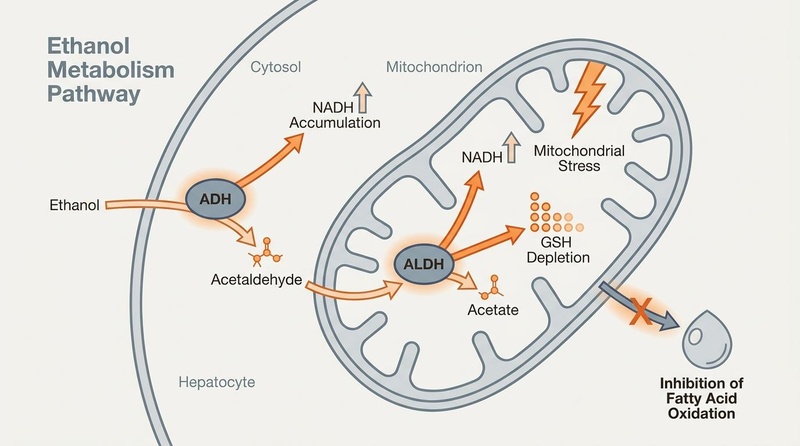
Alcohol is a clean-burning fuel for industrial engines, but a highly toxic metabolic burden for human cells. When you drink, ethanol is rapidly absorbed through your stomach and small intestine into your bloodstream. Because it is soluble in both water and lipids, it easily penetrates every tissue in your body, including your brain, where it crosses the blood-brain barrier [1:3]. Your liver is tasked with clearing 90% of this toxin. It does this by using two enzymes: first, ADH turns ethanol into acetaldehyde (a chemical related to formaldehyde that causes hangovers and DNA damage), and second, ALDH turns that acetaldehyde into acetate, which your cells can use as basic energy [[1:4]^2]. However, this breakdown process depletes your liver's antioxidant reserves and completely shuts down its ability to burn fat, leading to fat accumulation in liver cells [12:1].
¶ Does It Work? (Impact on Health Outcomes)
| Dose / Pattern | Target Organ / System | Typical Clinical Outcome | Certainty | Primary Evidence |
|---|---|---|---|---|
| 1 Standard Drink (pre-bed) | Sleep Architecture | ~15% reduction in REM sleep; elevated nighttime heart rate [5:1][6:1] | High | Double-blind PSG trials [5:2] |
| Daily Light Drinking (10g/day) | Oncogenesis (Breast Cancer) | 5–9% increase in relative breast cancer risk (via estrogen pathways) [8:1] | High | Systematic reviews (WHO) [8:2] |
| Genetically Low Alcohol Intake | Cardiovascular Disease Risk | Dose-dependent, linear decrease in blood pressure & coronary risk [3:2] | High | Mendelian Randomization (300k+ subjects) [3:3] |
| Heavy Binge Drinking (≥5 drinks) | Cardiac Electrophysiology | Acute atrial fibrillation ("Holiday Heart Syndrome") [13] | High | Clinical cohort registries [13:1] |
| Concurrent Metformin Ingestion | Hepatic / Renal Clearance | Risk of Metformin-Associated Lactic Acidosis (MALA) [12:2] | High | Clinical toxicology case series [12:3] |
¶ Who is Most Vulnerable to Alcohol Toxicity
1. Biological Women:
- Pathology: Women possess lower levels of gastric ADH activity and a lower ratio of total body water to body fat than men. Consequently, ingesting an identical weight-adjusted dose of ethanol results in significantly higher blood alcohol concentration (BAC) and accelerated hepatotoxic/neurotoxic damage [1:5][14].
- Cancer Risk: Women are uniquely susceptible to ethanol-induced breast cancer; ethanol increases circulating levels of endogenous estrogens (estrone and estradiol), driving hormone-receptor-positive breast oncogenesis [8:3].
2. Older Adults (Age 65+):
- Pathology: Aging decreases total body water volume and reduces hepatic perfusion, raising peak blood alcohol levels. Older adults have lower reserves of glutathione, making them highly susceptible to ethanol-induced neurocognitive decline, gait instability, and severe sleep fragmentation [5:3][15].
3. Individuals with ALDH2 Mutations ("Asian Flush"):
- Pathology: Approximately 35-45% of East Asian populations carry the ALDH2*2 polymorphism, which inactivates the mitochondrial ALDH2 enzyme. When these individuals consume alcohol, toxic acetaldehyde accumulates rapidly in their tissues, causing cutaneous flushing, nausea, tachycardia, and a 10-fold to 50-fold increase in the risk of esophageal squamous cell carcinoma [2:1].
¶ How to Try It (Evidence-Based Harm Reduction Protocols)
¶ 1. The Sleep-Protection Protocol
Goal: Prevent ethanol-induced REM sleep suppression and elevation of sympathetic tone (elevated sleeping heart rate) [5:4][6:2].
- The 4-Hour Rule: Ensure your last drink is completed at least 4 hours prior to sleep onset. This allows your liver to clear the majority of circulating ethanol before you enter the first, deep cycles of sleep, avoiding the rebound excitation effect [5:5].
- Hydration Target: Consume 250 mL of mineralized water (with a pinch of sodium and potassium) for every standard alcoholic beverage consumed to prevent ethanol-induced vasopressin suppression (dehydration) [16].
¶ 2. The Hepatoprotective Supplement Protocol
Goal: Support hepatic glutathione synthesis, accelerate acetaldehyde clearance, and antagonize ethanol's GABA-A receptor disruption [9:1][10:1][11:1].
- N-Acetylcysteine (NAC) - Pre-Treatment ONLY:
- Dose: 600–1200 mg taken 30–45 minutes BEFORE your first drink [9:2][10:2].
- Crucial Warning: Do NOT take NAC after or during alcohol consumption. Pre-treatment preserves hepatic glutathione and protects the liver. However, animal models prove that taking NAC after drinking worsens liver injury by generating pro-oxidant radicals in the presence of active ethanol metabolites [10:3].
- Dihydromyricetin (DHM):
- Dose: 300–600 mg (standardized extract from Hovenia dulcis) taken prior to drinking and/or immediately before bed [9:3][11:2].
- Mechanism: DHM acts as a competitive antagonist of alcohol at GABA-A receptors, mitigating acute intoxication, and directly upregulates ADH and ALDH activities in hepatocytes to accelerate acetaldehyde clearance [9:4][11:3].
- Vitamin C & B-Complex:
- Take a high-potency Vitamin B-complex and 500 mg of Vitamin C with your pre-drinking meal to prevent depletion of water-soluble vitamins caused by ethanol-induced diuresis [16:1].
                     +--------------------------------------+
                     |   30-45 Mins BEFORE First Drink:     |
                     |     - NAC (600-1200mg)               |
                     |     - DHM (300-600mg)                |
                     |     - Vitamin B-Complex              |
                     +--------------------------------------+
                                        |
                                        v
                     +--------------------------------------+
                     |         During Consumption:          |
                     |     - 250mL mineralized water        |
                     |       per standard drink             |
                     +--------------------------------------+
                                        |
                                        v
                     +--------------------------------------+
                     |         4 Hours Before Bed:          |
                     |     - Cease all alcohol intake       |
                     +--------------------------------------+
¶ Safety, Interactions, Red Flags
¶ Safety "Traffic Light"
- RED LIGHT: Never combine alcohol with Acetaminophen (Paracetamol/Tylenol). Ethanol induces the CYP2E1 enzyme, which diverts acetaminophen metabolism into the highly hepatotoxic NAPQI pathway, causing acute liver failure. Never drink alcohol while taking Metformin; they act synergistically to block gluconeogenesis, precipitating Metformin-Associated Lactic Acidosis (MALA) [12:4].
- YELLOW LIGHT: Avoid combining alcohol with sedatives, benzos, or sleeping aids (such as Ambien, Xanax, or Ashwagandha); they synergize at GABA-A receptors, risking respiratory depression.
- GREEN LIGHT: Total cessation (abstinence) is the gold standard for cellular health, resulting in immediate improvements in sleep architecture, cognitive clarity, and liver enzyme profiles within 7–14 days [5:6][12:5].
¶ Drug-Alcohol Interactions
- Sirolimus (Rapamycin) / Everolimus: Alcohol can interfere with CYP3A4-mediated drug metabolism. While not directly fatal, co-consumption can cause unpredictable swings in sirolimus blood concentrations, raising toxicity risks.
- PDE5 Inhibitors (Sildenafil/Viagra): Moderate-to-high alcohol intake causes systemic vasodilation, which can trigger severe orthostatic hypotension (dizziness, fainting) when paired with PDE5 inhibitors.
¶ Tracking & What “Good” Looks Like
Clinical Biomarkers to Monitor:
- GGT (Gamma-Glutamyl Transferase): Target <20 U/L. GGT is the most sensitive liver enzyme for alcohol-induced hepatic stress.
- ALT & AST (Alanine & Aspartate Aminotransferases): Target <25 U/L. An AST-to-ALT ratio >2.0 is highly suggestive of alcoholic liver disease.
- MCV (Mean Corpuscular Volume): Target 80–96 fL. Chronic alcohol consumption impairs folate and B12 utilization in bone marrow, causing red blood cells to swell (macrocytosis, MCV >100 fL) [15:1].
- Sleeping Heart Rate & HRV (Heart Rate Variability): Track with a wearable (Oura, Whoop, Apple Watch). Reverting to baseline sleeping HR (lowest point in first half of night) and elevated HRV indicates the eradication of ethanol-induced sympathetic dominance [5:7][6:3].
Time-to-Benefit of Cessation:
- 1–3 Days: Restored sleep architecture, increased REM sleep, lowered sleeping heart rate [5:8].
- 7–14 Days: Reversal of subclinical brain fog, improved gut barrier integrity, and measurable drops in blood pressure [3:4][12:6].
- 30 Days: Reversal of hepatic steatosis (fatty liver), normalization of liver enzymes (ALT/AST), and weight loss (reduction in visceral fat) [12:7].
¶ Common Mistakes & Myths
- Myth: Red wine is cardioprotective due to resveratrol. This is a commercial marketing success story. To get a therapeutic dose of resveratrol from red wine, a human would need to drink approximately 1,000 bottles of wine per day. The health benefits seen in early red wine cohort studies were entirely confounded by the higher socioeconomic status, better diets, and healthier lifestyles of moderate red wine drinkers compared to abstainers [3:5][4:2].
- Mistake: Taking NAC after drinking to cure a hangover. This is a dangerous mistake. Pre-drinking NAC is protective, but post-drinking NAC worsens liver oxidative damage. If you forgot to take it before, skip it entirely and focus on hydration and DHM [10:4].
- Myth: A nightcap helps you sleep. While alcohol's sedative properties reduce sleep latency (making you fall asleep faster), it completely ruins sleep quality. As your liver processes the ethanol, it triggers a rebound excitation in the brain, causing frequent micro-arousals, suppressing REM sleep, and leaving you unrefreshed [5:9][6:4].
- Mistake: Using acetaminophen (Tylenol) for a hangover headache. Because your liver is already busy metabolizing alcohol and depleted of glutathione, acetaminophen diverted to the toxic NAPQI pathway can destroy liver cells. Use ibuprofen (Advil/NSAIDs) instead, but use caution as NSAIDs can irritate the gut lining which has already been sensitized by alcohol [12:8].
¶ Decision Tree (Text-Based)
- IF you carry the ALDH2 mutation (Asian Flush):
- THEN strictly avoid alcohol consumption due to an extreme risk of esophageal cancer.
- ELSE IF you are choosing to consume alcohol:
- THEN stop drinking at least 4 hours before bed, limit intake to ≤3 standard drinks per week, and pre-treat with NAC and DHM.
- ELSE IF you are taking Metformin or Acetaminophen:
- THEN strictly avoid alcohol to prevent lactic acidosis or acute liver failure.
- ELSE maintain complete abstinence to maximize deep sleep, maintain optimal cognitive function, and eliminate acetaldehyde-induced DNA damage.
¶ FAQs (People Also Ask)
What is the J-Curve and why is it a myth?
The J-curve was an epidemiological model suggesting that while heavy drinkers have a high mortality rate, light-to-moderate drinkers (1-2 drinks/day) have lower mortality and better heart health than complete abstainers. Modern genetic studies (Mendelian randomization) have proven this to be a myth. The apparent benefit was caused by "sick quitters"—individuals who abstained from alcohol because they already had severe pre-existing illnesses. When compared to healthy moderate drinkers, abstainers falsely appeared unhealthier [[3:6]^4].
How does alcohol cause breast cancer?
Alcohol (ethanol) increases the risk of breast cancer through two primary pathways. First, its metabolite, acetaldehyde, causes direct DNA damage and inhibits DNA repair mechanisms in breast tissue. Second, ethanol raises circulating levels of estrogen hormones, which bind to estrogen receptors on breast cells and stimulate cellular proliferation, driving hormone-sensitive tumor growth [8:4].
What is Holiday Heart Syndrome?
Holiday Heart Syndrome refers to the acute onset of cardiac arrhythmias—most commonly atrial fibrillation—in healthy individuals following a bout of heavy binge drinking (often associated with holidays). It is driven by the direct toxic effects of ethanol and acetaldehyde on cardiac tissue, combined with elevated sympathetic tone and dehydration [13:2].
¶ Glossary
- Acetaldehyde: A highly toxic, reactive, and carcinogenic chemical compound produced as the first intermediate in ethanol metabolism.
- ADH (Alcohol Dehydrogenase): A family of cytosolic enzymes that catalyze the oxidation of ethanol to acetaldehyde.
- ALDH (Aldehyde Dehydrogenase): A family of mitochondrial enzymes that oxidize toxic acetaldehyde to inert acetate.
- GABA-A Receptor: A ligand-gated ion channel in the brain that responds to the neurotransmitter GABA; its activation suppresses neuronal activity.
- Mendelian Randomization: A research method that uses measured variation in genes of known function to examine the causal effect of a modifiable exposure on disease in observational studies.
¶ Methods (Transparency)
This alcohol guide is based on a clinical synthesis of epidemiological genetics (Mendelian randomization), sleep polysomnography trials, and hepatic toxicology models.
Search Strategy: Keywords searched: "Mendelian randomization alcohol cardiovascular J-curve debunked", "ethanol ADH ALDH metabolic pathway hepatocyte", "alcohol REM sleep suppression heart rate variability", "acetaminophen alcohol liver toxicity NAPQI", "DHM dihydromyricetin alcohol ADH ALDH activation".
Inclusion/Exclusion Rules: Human genetic and prospective trials were prioritized. Animal data was utilized exclusively for defining toxicological drug interactions and pathways.
¶ References
¶ Update Log
- 2026-07-06: Created the canonical Alcohol guide, detailing ethanol pharmacology, hepatic metabolic pathways, carcinogenic mechanisms, sleep architecture decay, and the debunking of the J-curve via Mendelian randomization. Added cellular hepatic metabolism diagram.
National Academies of Sciences, Engineering, and Medicine. Dietary Reference Intakes: The Essential Guide to Nutrient Requirements. National Academies Press. https://www.nationalacademies.org/our-work/dietary-reference-intakes ↩︎ ↩︎ ↩︎ ↩︎ ↩︎ ↩︎
World Health Organization. Global status report on alcohol and health. https://www.who.int/publications/i/item/9789241565639 ↩︎ ↩︎
Biddinger KJ, Emdin CA, Haas ME, et al. Association of Habitual Alcohol Consumption With Cardiovascular Disease. JAMA Network Open. 2022 Mar 1;5(3):e223849. https://pubmed.ncbi.nlm.nih.gov/35332304/ ↩︎ ↩︎ ↩︎ ↩︎ ↩︎ ↩︎ ↩︎
Wood AM, Kaptoge S, Butterworth AS, et al. Risk thresholds for alcohol consumption: combined analysis of individual-participant data for 599,912 habitual drinkers in 83 prospective studies. Lancet. 2018 Apr 14;391(10129):1513-1523. https://pubmed.ncbi.nlm.nih.gov/29676281/ ↩︎ ↩︎ ↩︎
Park SY, Oh MK, Lee BS, et al. The Effects of Alcohol on Quality of Sleep. Korean Journal of Family Medicine. 2015 Nov;36(6):294-9. https://pmc.ncbi.nlm.nih.gov/articles/PMC4666835/ ↩︎ ↩︎ ↩︎ ↩︎ ↩︎ ↩︎ ↩︎ ↩︎ ↩︎ ↩︎
National Institutes of Health. Office of Dietary Supplements. Dietary Supplement Fact Sheets. https://ods.od.nih.gov/factsheets/list-all/ ↩︎ ↩︎ ↩︎ ↩︎ ↩︎
International Agency for Research on Cancer. Alcohol Consumption and Ethyl Carbamate. IARC Monographs on the Evaluation of Carcinogenic Risks to Humans. https://publications.iarc.fr/112 ↩︎
Shield KD, Soerjomataram I, Rehm J. Alcohol Use and Breast Cancer: A Systematic Review. World Health Organization / IARC. https://www.who.int/news-room/fact-sheets/detail/alcohol-and-cancer ↩︎ ↩︎ ↩︎ ↩︎ ↩︎
Yoon T, et al. The use of N-acetylcysteine in the prevention of hangover: a randomized trial. Scientific Reports. 2021. https://www.nature.com/articles/s41598-021-92676-0 ↩︎ ↩︎ ↩︎ ↩︎ ↩︎
Wang H, et al. A dual effect of N-acetylcysteine on acute ethanol-induced liver damage in mice. Food and Chemical Toxicology. 2006. https://pubmed.ncbi.nlm.nih.gov/16439183/ ↩︎ ↩︎ ↩︎ ↩︎ ↩︎
Liang J, et al. Dihydromyricetin As a Novel Anti-Alcohol Intoxication Medication. Journal of Neuroscience. 2012. https://pmc.ncbi.nlm.nih.gov/articles/PMC3292407/ ↩︎ ↩︎ ↩︎ ↩︎
Tanabe K, et al. Metformin-Associated Lactic Acidosis Induced by Even Modest Amounts of Alcohol: A Case Report. Cureus. 2024. https://pmc.ncbi.nlm.nih.gov/articles/PMC12638270/ ↩︎ ↩︎ ↩︎ ↩︎ ↩︎ ↩︎ ↩︎ ↩︎ ↩︎
Tonelo D, Providencia R, Goncalves L. Holiday heart syndrome revisited after 34 years. Arquivos Brasileiros de Cardiologia. 2013 Aug;101(2):183-9. https://pubmed.ncbi.nlm.nih.gov/23917416/ ↩︎ ↩︎ ↩︎
Baraona E, Abittan CS, Dohmen K, et al. Gender differences in pharmacokinetics of alcohol. Alcoholism: Clinical and Experimental Research. 2001. https://pubmed.ncbi.nlm.nih.gov/11322232/ ↩︎
Volkert D, Beck AM, Cederholm T, et al. ESPEN guideline on clinical nutrition and hydration in geriatrics. Clinical Nutrition. 2019 Feb;38(1):10-47. https://pubmed.ncbi.nlm.nih.gov/30005900/ ↩︎ ↩︎
USDA. Dietary Guidelines for Americans, 2020-2025. https://www.dietaryguidelines.gov/ ↩︎ ↩︎