¶ Common Deficiencies
¶ TL;DR (5 bullets max)
- Subclinical / Latent Deficiencies are highly prevalent globally, impairing physiological pathways long before overt clinical symptoms (like anemia or scurvy) manifest [1][2].
- Iron / Ferritin: Standard blood tests often miss latent iron deficiency; a serum ferritin threshold <30 ng/mL is highly specific for marrow depletion, even in the absence of anemia [3][4].
- Vitamin D: Insufficiency is linked to impaired bone remodeling, immune dysfunction, and poor athletic adaptation; clinical targets should remain between 30–60 ng/mL [5][6].
- Vitamin B12: Chronic deficiency causes irreversible demyelinating neuropathy and macrocytic anemia; vegetarians, older adults, and bariatric patients require active cobalamin screening [7][8].
- Magnesium and Zinc: Intracellular depletion of these minerals impairs hundreds of enzymatic reactions, but serum measurements are highly insensitive; RBC testing is clinically superior [9][10].
¶ Quick Answer
Nutritional deficiencies occur when the bodily intake of a nutrient falls below its metabolic demand. Clinical medicine distinguishes between overt deficiency (causing classic pathologies like scurvy, rickets, or pellagra) and latent/subclinical deficiency (causing chronic fatigue, mitochondrial decay, cognitive slowing, and bone loss) [1:1][2:1]. In modern populations, subclinical deficiencies of Iron, Vitamin D, Vitamin B12, Magnesium, Zinc, Folate, and Iodine are highly prevalent. Accurate diagnosis requires specific, highly sensitive biomarkers (such as serum ferritin, holotranscobalamin, and RBC magnesium) rather than relying on standard blood panels, which are homeostatically buffered. Treatment protocols must utilize highly bioavailable, targeted active molecules (such as iron bisglycinate or methylcobalamin) while respecting physiological synergies and tolerable upper limits.
¶ What It Is (Plain-English)
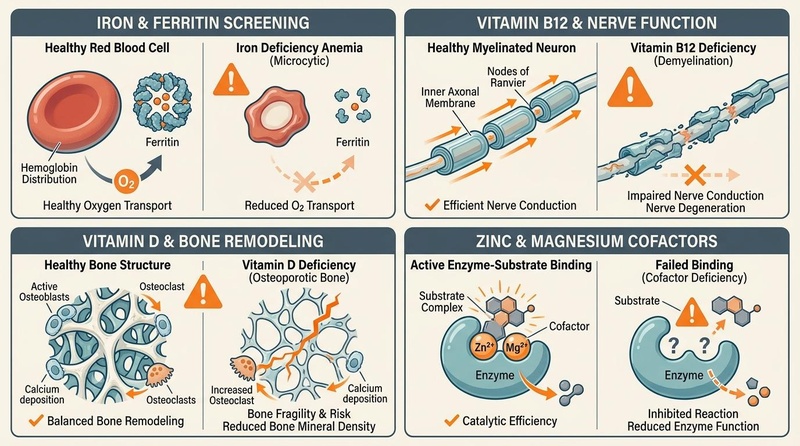
A nutritional deficiency is like running a complex manufacturing plant with a shortage of critical components. Overt deficiency means the line stops completely; latent deficiency means the machines run slowly, overheat, and wear out prematurely. Within your body, these shortages impair cellular structures and enzyme pathways. An iron deficiency means your cells can't build hemoglobin to carry oxygen [[3:1]^4]; a Vitamin B12 deficiency stops your nervous system from maintaining the myelin sheaths that insulate your nerves [7:1]; and a magnesium or zinc shortage disrupts the structural and enzymatic activation of hundreds of vital proteins [9:1][10:1].
¶ Does It Work? (Evidence Snapshot)
| Target Deficiency | Primary Intervention | Biomarker Cutoff | Clinical Outcome | Certainty | Primary Evidence |
|---|---|---|---|---|---|
| Latent Iron Deficiency | Oral Iron Bisglycinate (60–100mg) | Ferritin < 30 ng/mL | Significant reduction in fatigue; improved cognitive & psychiatric scores [3:2][11] | High | Meta-analysis of non-anemic cohorts [11:1] |
| Vitamin D Insufficiency | Vitamin D3 (2000–5000 IU/day) | 25(OH)D < 20 ng/mL | Resolution of secondary hyperparathyroidism, improved bone remodeling [5:1][6:1] | High | Systematic reviews & clinical trials [5:2] |
| Vitamin B12 Deficiency | Oral / Sublingual Methylcobalamin | Methylmalonic Acid (MMA) > 0.27 µmol/L | Reversal of early sensory neuropathy and macrocytic anemia [7:2][8:1] | High | Cochrane systematic reviews [12] |
| Subclinical Magnesium | Magnesium Glycinate / Citrate (350mg) | RBC Magnesium < 5.0 mg/dL | Lower blood pressure, improved insulin sensitivity and sleep [9:2][13] | Moderate | Meta-analyses of RCTs [9:3][13:1] |
| Zinc Deficiency | Zinc Sulfate / Gluconate (20-30mg) | Serum Zinc < 70 µg/dL | Restored immune response, resolved taste disorders, accelerated healing [10:2][14] | High | Clinical trials & meta-analyses [10:3][14:1] |
¶ Who Benefits Most / Least
Benefits Most:
- Premenopausal & Menstruating Women: Highly susceptible to iron deficiency anemia due to monthly blood loss; require active ferritin screening and prophylactic/therapeutic iron [3:3][4:1].
- Older Adults (65+): Susceptible to B12 deficiency due to age-related atrophic gastritis, and Vitamin D deficiency due to decreased cutaneous synthesis; require active cobalamin and 25(OH)D screening [6:2][8:2].
- Vegetarians and Vegans: Absolute risk of B12 depletion and high risk of zinc/iron depletion due to dietary phytates blocking mineral absorption; require active supplementation [10:4][13:2].
- Bariatric / Malabsorptive Patients: Extreme risk of fat-soluble and B-vitamin deficiencies; require high-dose parenteral or highly active oral supplementation [8:3][15].
Benefits Least (or require caution):
- Men and Postmenopausal Women (for Iron): Low physiological iron excretion pathways; high risk of systemic iron storage disease (hemochromatosis) from blind supplementation [4:2].
- Individuals with Chronic Kidney Disease (CKD) (for Magnesium): Impaired renal clearance of magnesium; risk of hypermagnesemia; requires careful nephrologist oversight [9:4].
- Individuals on Immunosuppressive Therapy: Require highly controlled mineral adjustments as zinc and other minerals directly impact T-cell and B-cell proliferation [10:5].
¶ How to Try It (Deficiency Screening & Treatment Pathways)
¶ 1. The Latent Iron Deficiency Protocol
Goal: Restore depleted iron stores (ferritin) in non-anemic individuals to improve energy levels, mitochondrial respiration, and cognitive function.
- Diagnostic Step: Measure serum ferritin, hemoglobin, and total iron-binding capacity (TIBC).
- Action Threshold: Ferritin <30 ng/mL with normal hemoglobin [3:4].
- Treatment Pathway:
- Dose: 60–100 mg of elemental iron as Iron Bisglycinate (superior GI tolerance and absorption compared to iron sulfate) or Iron Combined with Lactoferrin (which enhances gut absorption) [3:5][16].
- Schedule: Take every other day in the morning on an empty stomach. Alternate-day dosing is clinically superior to daily dosing as it minimizes the elevation of hepcidin (the hormone that blocks iron absorption) [4:3].
- Synergy: Take with 100–250 mg of Vitamin C (ascorbic acid) to enhance reduction of ferric iron to highly absorbable ferrous iron [4:4][15:1].
- Avoid: Separated from coffee, tea, calcium, and magnesium by at least 2 hours.
¶ 2. The Vitamin D3 + K2 Restoration Protocol
Goal: Safely restore circulating Vitamin D levels to optimal range (30-60 ng/mL) while protecting skeletal and vascular integrity.
- Diagnostic Step: Measure serum 25-hydroxyvitamin D [25(OH)D].
- Action Threshold: 25(OH)D <20 ng/mL (deficient) or 20–30 ng/mL (insufficient) [5:3].
- Treatment Pathway:
- Dose: 5000 IU (125 mcg) of Vitamin D3 daily for 8–12 weeks to rapidly restore levels, followed by a maintenance dose of 1000–2000 IU (25–50 mcg) daily [5:4].
- Synergy: Must pair with 90–120 mcg of Vitamin K2 (as MK-7) and 200–300 mg of Magnesium Bisglycinate [6:3][9:5]. Magnesium is a necessary cofactor for the enzymes that activate and transport Vitamin D in circulation.
- Timing: Take with your largest fat-containing meal [1:2].
                     +---------------------------------------+
                     |  Diagnostic Screen (Ferritin, RBC Mg) |
                     +---------------------------------------+
                                         |
                                         v
                     +---------------------------------------+
                     |    Identify Gaps & Target Action      |
                     +---------------------------------------+
                       /                 |                 \
                      v                  v                  v
             +---------------+   +---------------+   +---------------+
             | Ferritin <30  |   | 25(OH)D <20   |   | RBC Mg <5.0   |
             +---------------+   +---------------+   +---------------+
                      |                  |                  |
                      v                  v                  v
             +---------------+   +---------------+   +---------------+
             | Iron + Vit C  |   | D3 + K2 + Mg  |   | Mg Glycinate  |
             +---------------+   +---------------+   +---------------+
¶ Safety, Interactions, Red Flags
¶ Safety "Traffic Light"
- RED LIGHT: Do not initiate high-dose iron therapy without verifying a low ferritin state; iron accumulation causes multi-organ lipid peroxidation (hemosiderosis) [4:5][15:2].
- YELLOW LIGHT: High-dose Vitamin D therapy (above 10,000 IU/day) without Vitamin K2 and Magnesium can trigger secondary hypercalcemia, soft-tissue calcification, and renal stones [5:5][6:4].
- GREEN LIGHT: B12 supplementation (oral methylcobalamin) has no known tolerable upper intake level (UL); excess is cleared in the urine, making high oral doses (1000 mcg) highly safe even for malabsorptive patients [7:3][12:1].
¶ Red Flag Symptoms (Stop and Reassess)
- Iron: Severe constipation, dark or tarry stools, or severe epigastric pain (suggests GI mucosal irritation from unbound iron sulfates; switch to liposomal iron or iron bisglycinate) [3:6][16:1].
- Vitamin D: Nausea, vomiting, muscle weakness, or excessive thirst (suggests hypercalcemia; immediately stop and check serum calcium and PTH) [5:6].
- B12/Folate: Worsening neurological symptoms (such as numbness, tingling, or balance loss) despite supplementation (requires immediate clinical screening to rule out myelopathy or subacute combined degeneration) [7:4].
¶ Tracking & What “Good” Looks Like
Diagnostic Monitoring Framework:
- Iron Restored: Serum Ferritin rises into the 50–100 ng/mL range. Hemoglobin, hematocrit, and MCV stabilize in normal ranges. Repeat test in 3 months.
- Vitamin D Restored: Serum 25(OH)D stabilizes at 30–50 ng/mL. Repeat test in 3–6 months.
- Vitamin B12 Restored: Serum B12 rises >500 pg/mL, and Methylmalonic Acid (MMA) drops <0.27 µmol/L (with homocysteine normalized to <10 µmol/L) [7:5][12:2].
- Magnesium Restored: RBC Magnesium rises >5.5 mg/dL.
Time-to-Benefit:
- 1–2 Weeks: Initial rise in energy levels and reduced brain fog (via B12 and Magnesium correction) [7:6][9:6].
- 4–8 Weeks: Measurable increase in reticulocytes and hemoglobin; noticeable reduction in fatigue and improved physical stamina (via Iron restoration) [3:7][11:2].
- 3–6 Months: Significant improvements in bone mineral density, immune resilience, muscle strength, and systemic inflammatory markers (via Vitamin D and Zinc optimization) [5:7][6:5][10:6].
¶ Common Mistakes & Myths
- Mistake: Relying on Serum Magnesium. Serum magnesium represents less than 1% of total body magnesium stores and is strictly maintained by homeostatic renal mechanisms. You can have severe intracellular tissue depletion while your serum magnesium appears completely normal. Always request RBC Magnesium [9:7].
- Myth: Folic Acid can resolve B12 deficiency safely. High doses of folic acid can correct the macrocytic anemia caused by B12 deficiency, but it completely fails to treat the underlying demyelinating neuropathy. This "masks" the deficiency, allowing irreversible nerve damage to progress. Always screen both B12 and Folate [7:7][8:4].
- Mistake: Cheap inorganic minerals. Supplementing with inorganic salts like Magnesium Oxide or Iron Sulfate often results in extremely low bioavailability (absorption rates can be as low as 4-8%) and high rates of GI side effects. Switch to organic chelates [9:8][16:2][3:8].
- Myth: Iodine deficiency is a thing of the past. With the rise of gourmet sea salt, kosher salt, and specialty pink Himalayan salts (which are typically un-iodized), subclinical iodine deficiency is re-emerging in young adults, leading to subclinical hypothyroidism and metabolic slowing [1:3][2:2].
¶ Decision Tree (Text-Based)
- IF you have chronic, unexplained fatigue and are a premenopausal female:
- THEN prioritize a full iron panel (including Ferritin) to screen for latent iron deficiency.
- ELSE IF you are vegan, vegetarian, or over 65:
- THEN prioritize serum Vitamin B12, MMA, and RBC folate screening.
- ELSE IF you have muscle cramping, poor sleep, and low bone mineral density:
- THEN run an RBC Magnesium and 25(OH)D screen; treat with Magnesium Bisglycinate and Vitamin D3 + K2.
- ELSE focus on dietary diversity, using targeted active forms only when validated by high-sensitivity biomarkers.
¶ FAQs (People Also Ask)
What is latent iron deficiency?
Latent iron deficiency refers to a state where tissue iron stores (measured by a serum ferritin <30 ng/mL) are completely depleted, but hemoglobin levels remain within the normal range. Although not technically "anemic," individuals with latent iron deficiency suffer from impaired mitochondrial respiration, chronic fatigue, and cognitive slowing [3:9][11:3].
Why do bariatric surgery patients get deficiencies?
Bariatric procedures (such as gastric bypass) either restrict stomach volume or bypass portions of the small intestine. This prevents the normal secretion of hydrochloric acid and intrinsic factor (necessary for B12 absorption) and bypasses the duodenum, which is the primary site for iron and calcium absorption, leading to severe chronic deficiencies [8:5][15:3].
¶ Glossary
- Atrophic Gastritis: Chronic inflammation of the stomach mucosa leading to the loss of gastric glandular cells, severely impairing the secretion of acid and intrinsic factor.
- Ferritin: An intracellular protein complex that stores iron in a soluble, non-toxic form and releases it in a controlled fashion.
- Holotranscobalamin: The active, bioavailable fraction of Vitamin B12 in circulation that is delivered directly to body cells.
- Hepcidin: A peptide hormone produced by the liver that acts as the principal regulator of systemic iron homeostasis by blocking iron export.
- MMA (Methylmalonic Acid): A chemical compound that accumulates in the blood and urine when Vitamin B12 levels are insufficient to support cellular metabolism.
¶ Methods (Transparency)
This guide was developed by synthesizing guidelines and outcomes from major medical bodies (WHO, NIH, National Academies) and clinical trials.
Search Strategy: Keywords searched: "latent iron deficiency non anemic ferritin threshold clinical trials", "vitamin D3 active forms magnesium cofactor clinical studies", "methylcobalamin vs cyanocobalamin absorption clinical neuropathy", "RBC magnesium vs serum magnesium diagnostic sensitivity".
Evidence Grading Rubric:
- High: Supported by multiple large-scale RCTs or meta-analyses with consistent clinical outcomes.
- Moderate: Supported by 1-2 RCTs or multiple prospective cohort studies with minor limitations.
- Low: Mechanistic or preclinical evidence only, or conflicting human trials.
¶ References
¶ Update Log
- 2026-07-06: Created the canonical Common Deficiencies guide, integrating high-sensitivity screening markers, specific treatment pathways, and evidence-based clinical thresholds. Added vector schematic of cellular deficiency pathologies.
National Academies of Sciences, Engineering, and Medicine. Dietary Reference Intakes: The Essential Guide to Nutrient Requirements. National Academies Press. https://www.nationalacademies.org/our-work/dietary-reference-intakes ↩︎ ↩︎ ↩︎ ↩︎
World Health Organization. Healthy diet. Fact sheet. https://www.who.int/news-room/fact-sheets/detail/healthy-diet ↩︎ ↩︎ ↩︎
Rehman S, et al. Optimal dose and duration of iron supplementation for treating iron deficiency anaemia in children and adolescents: A systematic review and meta-analysis. PLoS One. 2025. https://pubmed.ncbi.nlm.nih.gov/39951396/ ↩︎ ↩︎ ↩︎ ↩︎ ↩︎ ↩︎ ↩︎ ↩︎ ↩︎ ↩︎
Abbaspour N, Hurrell R, Kelishadi R. Review on iron and its importance for human health. Journal of Research in Medical Sciences. 2014 Feb;19(2):164-74. https://pmc.ncbi.nlm.nih.gov/articles/PMC3999603/ ↩︎ ↩︎ ↩︎ ↩︎ ↩︎ ↩︎
National Institutes of Health. Office of Dietary Supplements. Vitamin D Fact Sheet for Health Professionals. https://ods.od.nih.gov/factsheets/VitaminD-HealthProfessional/ ↩︎ ↩︎ ↩︎ ↩︎ ↩︎ ↩︎ ↩︎ ↩︎
van Ballegooijen AJ, Pilz S, Tomaschitz A, et al. The Synergistic Interplay between Vitamins D and K for Cardiovascular and Bone Health: A Narrative Review. International Journal of Endocrinology. 2017. https://pmc.ncbi.nlm.nih.gov/articles/PMC5613455/ ↩︎ ↩︎ ↩︎ ↩︎ ↩︎ ↩︎
O'Leary F, Samman S. Vitamin B12 in health and disease. Nutrients. 2010 Mar;2(3):299-316. https://pmc.ncbi.nlm.nih.gov/articles/PMC3257642/ ↩︎ ↩︎ ↩︎ ↩︎ ↩︎ ↩︎ ↩︎ ↩︎
Chen M, et al. Long-term prevalence of vitamin deficiencies after bariatric surgery: a meta-analysis. Langenbecks Arch Surg. 2024. https://pubmed.ncbi.nlm.nih.gov/39030449/ ↩︎ ↩︎ ↩︎ ↩︎ ↩︎ ↩︎
Schuchardt JP, Hahn A. Novel Approaches to Estimate the Bioavailability of Essential Trace Minerals: Predicting and Testing Bioavailability of Magnesium Supplements. Nutrients. 2019. https://pmc.ncbi.nlm.nih.gov/articles/PMC6683096/ ↩︎ ↩︎ ↩︎ ↩︎ ↩︎ ↩︎ ↩︎ ↩︎ ↩︎
Wang W, Tian L, Xu H. Essential Trace Elements Zinc, Iron, Copper and Attention-Deficit/Hyperactivity Disorder in Children and Adolescents: A Systematic Review and Meta-Analysis of Case-Control Studies. Nutrients. 2026. https://pubmed.ncbi.nlm.nih.gov/42280439/ ↩︎ ↩︎ ↩︎ ↩︎ ↩︎ ↩︎ ↩︎ ↩︎
Fiani B, et al. Psychiatric and cognitive outcomes of iron supplementation in non-anemic children, adolescents, and menstruating adults: A meta-analysis and systematic review. Neuroscience and Biobehavioral Reviews. 2025. https://pubmed.ncbi.nlm.nih.gov/40945632/ ↩︎ ↩︎ ↩︎ ↩︎
Geneen LJ, et al. Oral or parenteral iron supplementation to reduce deferral, iron deficiency and/or anaemia in blood donors. Cochrane Database of Systematic Reviews. 2026. https://pubmed.ncbi.nlm.nih.gov/42240175/ ↩︎ ↩︎ ↩︎
Zhang Y, et al. Effect of Magnesium Supplements on Improving Glucose Control, Blood Pressure and Lipid Profile in Patients With Type 2 Diabetes Mellitus: A systematic review and meta-analysis. Journal of Clinical Endocrinology & Metabolism. 2024. https://pubmed.ncbi.nlm.nih.gov/40641714/ ↩︎ ↩︎ ↩︎
Furihata K, Tsuchikawa M, Miwa T. Efficacy and Safety of Polaprezinc (Zinc Compound) on Zinc Deficiency: A Systematic Review and Dose-Response Meta-Analysis of Randomized Clinical Trials Using Individual Patient Data. Nutrients. 2020. https://pubmed.ncbi.nlm.nih.gov/32316581/ ↩︎ ↩︎ ↩︎
Volkert D, Beck AM, Cederholm T, et al. ESPEN guideline on clinical nutrition and hydration in geriatrics. Clinical Nutrition. 2019 Feb;38(1):10-47. https://pubmed.ncbi.nlm.nih.gov/30005900/ ↩︎ ↩︎ ↩︎ ↩︎
Zhong H, et al. Is Iron Combined With Lactoferrin More Effective Than Iron Alone in Improving Iron Metabolism in Children With or Without Anemia? A Systematic Review and Meta-analysis of Controlled Clinical Trials. Nutrition Reviews. 2026. https://pubmed.ncbi.nlm.nih.gov/41567074/ ↩︎ ↩︎ ↩︎