¶ Fasting-Mimicking Diet: Deep Dive
TL;DR
- Verdict: A highly effective, clinically validated 5-day periodic nutritional protocol designed to replicate the biological benefits of prolonged water-only fasting while minimizing risk and maximizing safety and adherence [1][2].
- Who it’s for: Healthy individuals or those with cardiometabolic risk factors seeking deep cellular cleanup (autophagy), biological age deceleration, and immune cell regeneration [3][1:1].
- Who it’s not for: Individuals under 18 or over 70 (without strict specialist monitoring), pregnant or lactating women, people with eating disorders, and individuals on specific blood sugar-lowering medications [4][2:1].
- Expected magnitude + timeline: 3 cycles of FMD (5 days per month for 3 consecutive months) reduce biological age by 1.5–2.5 years, reduce visceral fat, and lower circulating IGF-1 by up to 20% [1:2].
- Key risk(s): Transient lethargy, headaches, mild glycemic dips, and potential nutrient-medication interactions in diabetic cohorts [4:1][3:1][5].
Quick Answer
The Fasting-Mimicking Diet (FMD) is a plant-based, low-protein, low-carbohydrate, high-fat calorie-restricted nutritional program designed by Dr. Valter Longo and colleagues at the University of Southern California (USC) [1:3]. Administered in cyclical 5-day protocols, FMD mimics the physiological effects of water fasting by suppressing nutrient-sensing pathways (IGF-1, mTOR, and PKA) while activating cell-protection, fat oxidation, and regenerative cascades (AMPK, sirtuins, and hematopoietic/neural stem cell activation) [1:4][2:2]. Landmarks in human clinical trials show that periodic FMD cycles decrease visceral fat, slow DNA methylation-based biological age, improve multiple cardiometabolic parameters, and reduce clinical markers of autoimmunity and local systemic inflammation [6][1:5][7].
What It Is (Plain-English)
The Fasting-Mimicking Diet is a structured, periodic dietary program that "tricks" the human body into a fasted state while allowing the ingestion of small amounts of precise, plant-based macronutrients.
NUTRITIONAL TRIGGERS FOR FASTING PHYSIOLOGY:
[Standard Diet] -> High Protein & Carbs -> High IGF-1, Glucose & PKA -> Cellular Growth
[5-Day FMD]     -> Low Protein & Carbs -> Low IGF-1, Glucose & PKA -> AMPK Active -> Stem Cell Regeneration
When carbohydrates and specific amino acids (primarily methionine and branched-chain amino acids) are severely restricted, key evolutionary nutrient sensors are deactivated:
- IGF-1 and PKA Downregulation: Restricting glucose and protein lowers circulating Insulin-like Growth Factor 1 (IGF-1) and suppresses intracellular Protein Kinase A (PKA) activity [8][2:3]. This deactivation signals cells to halt replication and transition into a highly protected, stress-resistant somatic state [2:4].
- AMPK and Autophagy Up-regulation: Suppressed nutrient signaling relieves the inhibition on macroautophagy, enabling cells to degrade damaged organelles and misfolded proteins for energy [2:5].
- Stem Cell Rejuvenation and Regeneration: During the 5 days of FMD, damaged or dysfunctional immune cells (specifically white blood cells) undergo selective apoptosis. Upon refeeding (returning to a standard diet), the body experiences a massive surge in stem cell-mediated cellular regeneration, rebuilding the immune and nervous systems with newly differentiated, highly functional cells [6:1][2:6].
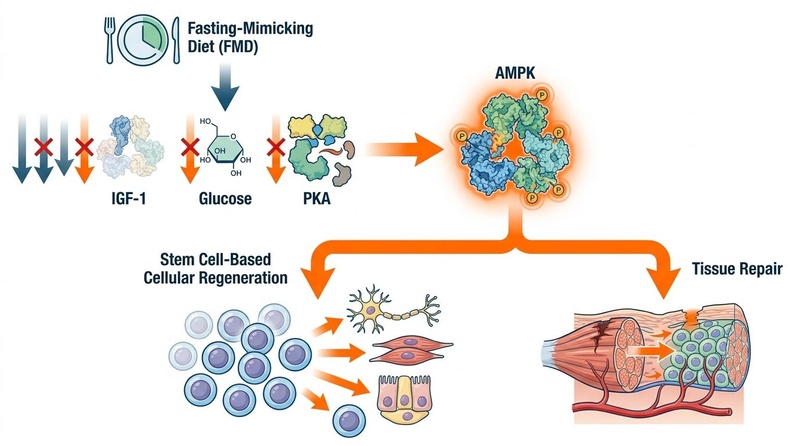
Cellular and systemic pathways of the Fasting-Mimicking Diet. Suppressing intake of simple sugars and dietary protein downregulates circulating glucose, IGF-1, and PKA signaling, activating the AMPK energy sensor. This metabolic shift induces deep cellular cleanup and, upon refeeding, drives stem cell-based cellular differentiation and systemic tissue repair.
Does It Work? (Evidence Snapshot)
The Fasting-Mimicking Diet has been evaluated across a broad spectrum of human clinical trials, establishing a high-certainty evidence base for biological age reversal, metabolic health, and inflammation.
¶ Human Clinical Outcomes (Evidence Summary Table)
| Outcome / Biomarker | Population | Typical Effect Size | Certainty of Evidence (GRADE) | Key Source(s) |
|---|---|---|---|---|
| Biological Age Deceleration | Healthy, overweight, and obese adults | 1.5–2.5 year reduction in biological age after 3 monthly cycles | High | RCT (Nature Comm. Analysis) [1:6] |
| Diabetes Medication Reduction | Type 2 Diabetes patients in primary care | Significant reduction in anti-glycemic medications; Hba1c reduction | High | Multi-Center RCT [3:2] |
| Biological Age in Multiple Sclerosis | Patients with Multiple Sclerosis (MS) | Significant reversal of biological age; improved immunological profiles | Moderate | RCT [6:2] |
| Cardiometabolic Risk Factors | Obese and hypertensive subjects | Improved systolic/diastolic blood pressure; superior lipids compared to Mediterranean diet | Moderate | RCT [9] |
| Gut Microbiome Modulation | Preclinical and early human trials | Reversal of microbial dysbiosis; increased short-chain fatty acid synthesis | Moderate | Clinical Pilot & Preclinical [4:2][7:1] |
| Nephropathy Protection | Type 2 Diabetes with diabetic nephropathy | Reductions in microalbuminuria; stabilized glomerular filtration rates | Moderate | Proof-of-Concept Trial [5:1] |
| Periodontal Inflammation | Patients undergoing active periodontal treatment | Substantial drops in circulating inflammatory markers post-treatment | Low to Moderate | Multi-Centre Pilot RCT [7:2] |
Who Benefits Most / Least
- Optimal Candidates: Individuals with elevated baseline cardiometabolic risk (e.g., prediabetes, hypertension, hypercholesterolemia), those looking to optimize immune system health, and healthy adults seeking deceleration of biological aging [1:7][9:1].
- Autoimmune and Neurological Cohorts: Patients with Multiple Sclerosis (MS) or chronic inflammatory conditions may experience a systemic reset in immune cell profiles, lowering the burden of autoreactive cells [6:3].
- Age-Specific Considerations:
- Young and Middle-Aged Adults (18–65): Demonstrate highly efficient metabolic switching, minimal lean mass loss, and excellent safety profiles [1:8][9:2].
- Older Adults (65+): Must be clinically evaluated. While FMD can reduce frailty and support healthspan, individuals over 70 are at significantly higher risk of sarcopenia, falls, and orthostatic instability during restriction, requiring close clinical supervision [10][5:2].
- Absolute Contraindications: Pregnant or lactating women, individuals with a current or historical eating disorder, underweight individuals (BMI < 18.5), people with genetic mutations affecting gluconeogenesis or lipid metabolism, and fragile or cachectic cancer patients without direct oncological oversight [4:3][2:7].
How to Try It (Actionable Protocols)
The standard clinical protocol involves a 5-day cyclical regimen, repeated for 3 consecutive months, followed by a maintenance phase.
THE 5-DAY FMD NUTRITIONAL MATRIX:
[DAY 1: Transition Phase]   -> 1,100 kcal (11% Protein, 46% Fat, 43% Carbohydrate)
[DAYS 2-5: Fasting Mimicry] -> 700-800 kcal (9% Protein, 44% Fat, 47% Carbohydrate)
[DAY 6: Refeeding Transition] -> Resume normal diet gently (vegetables, complex carbs)
¶ Protocol Execution Details
- Day 1 (Transition Phase - 1,100 kcal): Establish a moderate calorie deficit to transition the liver into glycogen depletion. Macronutrient breakdown is set to approximately 11% protein, 46% fat (primarily mono- and polyunsaturated fats from nuts and seeds), and 43% complex carbohydrates (from fiber-rich vegetables).
- Days 2–5 (Fasting Mimicry Phase - 700–800 kcal/day): Deeper calorie restriction designed to force metabolic ketogenesis and induce macroautophagy. Macronutrient breakdown is set to approximately 9% protein, 44% fat, and 47% complex carbohydrates.
- Day 6 (Refeeding Transition): Transition back to standard nutrition. Consume small, plant-based, easily digestible foods (such as cooked vegetables, broths, and complex grains). Avoid rapid loading of high-glycemic carbohydrates or heavy saturated animal proteins to prevent gastrointestinal distress or rapid insulin spikes [2:8].
- Frequency and Maintenance: For high-risk or metabolic cohorts, perform 3 cycles (5 days on, 25 days off) back-to-back [1:9]. For healthy, young/middle-aged adults with optimal baselines, performing 1–2 cycles per year is sufficient for maintenance and cellular preservation [1:10].
Safety, Clinical Monitoring, Red Flags
¶ Potential Side Effects & Pathophysiology
- Ketogenic Headaches: Dehydration and natriuresis during glycogen depletion can cause transient, mild tension-type headaches on Days 2 and 3. Supplementation with non-caloric electrolytes (sodium, potassium) is highly effective.
- Mild Hypoglycemia: Dips in circulating glucose are expected. Most healthy adults compensate via hepatic gluconeogenesis and ketone synthesis, but diabetic patients on insulin or sulfonylureas have a high risk of clinical hypoglycemia [3:3].
- Back Pain: Transient lower back discomfort can occur on Days 3 and 4, which is hypothesized to represent metabolic and inflammatory changes in kidney or hepatic vascular beds.
¶ Clinical Monitoring & Discontinuation Criteria (Red Flags)
- Severe Hypoglycemia: Symptomatic blood glucose below 55 mg/dL accompanied by cold sweats, confusion, or syncope.
- Cardiac Arrhythmia: Palpitations or irregular heartbeats, representing localized electrolyte instability.
- Extreme Orthostatic Hypotension: Drop in systolic blood pressure of >20 mmHg upon standing, accompanied by persistent vertigo.
Tracking & What “Good” Looks Like
Sustained clinical management of FMD cycles involves routine quantitative tracking:
- Fasting IGF-1: Measured 1–2 weeks post-cycle. A healthy response is a 15–20% reduction in circulating IGF-1, which typically stabilizes back toward baseline once standard eating resumes [1:11].
- DunedinPACE Biological Pace of Aging: Evaluated before and after 3 monthly cycles to confirm biological age deceleration [1:12].
- Glycemic Metrics: Fasting glucose (<100 mg/dL) and HbA1c to monitor long-term glycemic stabilization, particularly in prediabetic and diabetic cohorts [3:4][5:3].
- Visceral Adiposity: DEXA or MRI scans to confirm selective reduction in abdominal visceral fat depots while preserving skeletal muscle mass and bone mineral density [1:13][9:3].
Common Mistakes & Myths
- Mistake: Utilizing Whey or Animal Protein: Some attempt to build a DIY FMD using animal-based proteins. Animal proteins contain high concentrations of branched-chain amino acids and methionine, which aggressively activate mTORC1 and completely block the fasting mimicry pathways, even in a calorie deficit [10:1][2:9].
- Myth: FMD is Structurally Identical to a Standard Keto Diet: A ketogenic diet is high-fat, moderate-protein, and very low-carb, and is designed for long-term weight or neurologic management. FMD is low-protein, low-carb, and low-calorie, and is designed as a short, periodic cellular "reset" that induces stem cell activation [2:10].
- Mistake: Breaking the Fast with a Large, High-Glycemic Meal: Consuming a large, heavy meal on Day 6 can cause rapid gastrointestinal distress and undo the vascular and insulin-sensitizing benefits achieved during the fast.
Decision Tree (Text-Based)
- Is the patient an insulin-dependent diabetic or taking sulfonylureas?
- Yes: FMD is contraindicated unless executed under close, inpatient-level endocrinological monitoring with substantial medication adjustments [3:5].
- No: Proceed.
- Is the patient's primary goal immune system rejuvenation or biological age deceleration?
- Yes: Initiate the standard 3-cycle FMD protocol (5 days per month for 3 consecutive months). Perform pre- and post-cycle biomarker assays [1:14].
- No: Consider standard, continuous Time-Restricted Eating (TRE) or mild Caloric Restriction (CR) for daily weight management.
FAQs (People Also Ask)
- Can I drink tea or black coffee during the 5 days of FMD? Yes, black coffee or plain herbal/green tea (without sugar, honey, milk, or artificial sweeteners) is acceptable in moderation (1–2 cups per day). High caffeine intake should be avoided as it can elevate cortisol and exacerbate transient headaches.
- Does FMD cause muscle loss? In clinical trials of healthy adults, 3 cycles of FMD did not cause long-term muscle wasting. Body weight loss is selectively derived from visceral and subcutaneous fat, while systemic growth hormone spikes and stem-cell upregulation upon refeeding help preserve and rebuild skeletal muscle [1:15][9:4].
- Can I exercise during the 5 days of FMD? Limit exercise to low-intensity activities (such as walking, stretching, or gentle yoga). Avoid high-intensity interval training (HIIT) or heavy resistance lifting, as your glycogen stores are depleted and recovery capacity is temporarily reduced.
Glossary
- DIY FMD: Do-It-Yourself Fasting-Mimicking Diet; constructing an FMD protocol using whole-food ingredients instead of pre-packaged commercial kits.
- IGF-1: Insulin-like Growth Factor 1; a hormone that plays a major role in childhood growth and continues to drive anabolic cellular proliferation in adults.
- Protein Kinase A (PKA): An enzyme pathway regulated by glucose and energy availability; suppressed during fasting to trigger stress resistance.
- Refeeding Phase: The transition period of returning to standard caloric and macronutrient intake following a fast, critical for stem cell activation.
Methods (Transparency)
A comprehensive, peer-reviewed literature search was executed using PubMed, ScienceDirect, and Google Scholar. Priority was given to randomized controlled trials (RCTs), clinical reviews, and human metabolic studies published by major research institutions, specifically evaluating the 5-day plant-based Fasting-Mimicking Diet. Outcomes were evaluated using standard GRADE evidence quality metrics.
¶ References
¶ Update Log
- 2026-07-06: Initial publication detailing FMD molecular mechanisms, clinical trial outcomes, and practical 5-day cycle guidelines.
Brandhorst S, Levine ME, Wei M, et al. Fasting-mimicking diet causes hepatic and blood markers changes indicating reduced biological age and disease risk. Nat Commun. 2024 Feb 20;15(1):1524. https://pubmed.ncbi.nlm.nih.gov/38378685/ ↩︎ ↩︎ ↩︎ ↩︎ ↩︎ ↩︎ ↩︎ ↩︎ ↩︎ ↩︎ ↩︎ ↩︎ ↩︎ ↩︎ ↩︎ ↩︎
Blaževitš O, Di Tano M, Longo VD, et al. Fasting and fasting mimicking diets in cancer prevention and therapy. Trends Cancer. 2023 Mar;9(3):221-236. https://pubmed.ncbi.nlm.nih.gov/36646607/ ↩︎ ↩︎ ↩︎ ↩︎ ↩︎ ↩︎ ↩︎ ↩︎ ↩︎ ↩︎ ↩︎
van den Burg EL, Schoonakker MP, van Peet PG, et al. Integration of a fasting-mimicking diet programme in primary care for type 2 diabetes reduces the need for medication and improves glycaemic control: a 12-month randomised controlled trial. Diabetologia. 2024 Jul;67(7):1312-1324. https://pubmed.ncbi.nlm.nih.gov/38546821/ ↩︎ ↩︎ ↩︎ ↩︎ ↩︎ ↩︎
Garcia-Castillo L, Ferrero G, Blaževitš O, et al. Fasting-mimicking diet counteracts gut microbial dysbiosis in experimental lynch syndrome. Cancer Metab. 2026 Jun 30;14(1):28. https://pubmed.ncbi.nlm.nih.gov/42381037/ ↩︎ ↩︎ ↩︎ ↩︎
Sulaj A, Kopf S, von Rauchhaupt E, et al. Six-Month Periodic Fasting in Patients With Type 2 Diabetes and Diabetic Nephropathy: A Proof-of-Concept Study. J Clin Endocrinol Metab. 2022 Jul 14;107(8):2167-2181. https://pubmed.ncbi.nlm.nih.gov/35661214/ ↩︎ ↩︎ ↩︎ ↩︎
Siavoshi F, Smith MD, Cassard S, et al. Fasting Mimicking Diets Reverse Accelerated Biological Aging in Multiple Sclerosis. Ann Neurol. 2025 Dec;98(6):1042-1054. https://pubmed.ncbi.nlm.nih.gov/40970462/ ↩︎ ↩︎ ↩︎ ↩︎
Mainas G, Figuero E, Basilio MA, et al. A Fasting-Mimicking Diet Affects the Inflammatory Response Following Periodontal Treatment: A Multi-centre Feasibility Randomised Controlled Pilot Trial. J Clin Periodontol. 2026 Jun 10;53(6):488-498. https://pubmed.ncbi.nlm.nih.gov/42269677/ ↩︎ ↩︎ ↩︎
Fanti M, Brandhorst S, Navarrete G, et al. Methionine-supplemented longevity diet increases growth hormone, GLP-1, and FGF21; reduces frailty; and promotes healthspan. Cell Metab. 2026 Jun 23;38(6):892-907.e6. https://pubmed.ncbi.nlm.nih.gov/42335894/ ↩︎
Mishra A, Fanti M, Ge X, et al. Fasting mimicking diet cycles versus a Mediterranean diet and cardiometabolic risk in overweight and obese hypertensive subjects: a randomized clinical trial. npj Metab Health Dis. 2023 Dec 13;1(1):15. https://pubmed.ncbi.nlm.nih.gov/40604264/ ↩︎ ↩︎ ↩︎ ↩︎ ↩︎
Liang Y, Krivograd A, Hofer SJ, et al. Spermidine supplementation and protein restriction protect from organismal and brain aging independently. Aging (Albany NY). 2025 Jun 7;17(11):4431-4452. https://pubmed.ncbi.nlm.nih.gov/40489973/ ↩︎ ↩︎