¶ Food Contaminants
¶ TL;DR (5 bullets max)
- Dietary Contaminants—such as heavy metals, microplastics, pesticides, and endocrine disruptors—bioaccumulate in food chains, presenting persistent risks to human health [1][2].
- Microplastics in Plaques: Landmark prospective trials (e.g., NEJM 2024) demonstrate that the presence of microplastics and nanoplastics in carotid atheromas is associated with a 4.5-fold increase in the risk of myocardial infarction, stroke, or all-cause mortality [3].
- Heavy Metal Threats: Chronic dietary ingestion of lead, cadmium, arsenic, and mercury (from chocolate, rice, seafood, and tap water) triggers systemic oxidative stress, endothelial damage, and endocrine disruption [4][5].
- Organic vs. Conventional: Clinical trials show that transitioning to an organic diet for just 1–2 weeks results in a 90% reduction in urinary pesticide metabolites (such as organophosphates and glyphosate) [6][7].
- Point-of-Use Mitigation: Simple, evidence-based practices—such as Reverse Osmosis water filtration, boiling tap water, peeling produce, and proper rice preparation—can reduce dietary toxic load by 50–90% [8][9][10].
¶ Quick Answer
Food contaminants are toxic substances accidentally or industrially introduced into the food supply. These include inorganic heavy metals (Lead, Mercury, Cadmium, Arsenic), chemical pesticides (Glyphosate, Organophosphates), synthetic endocrine disruptors (BPA, Phthalates, PFAS), and Microplastics/Nanoplastics [1:1][2:1][3:1]. Because complete elimination is impossible in the modern industrial biosphere, clinical toxicology focuses on exposure mitigation—systematically reducing your total toxic load [4:1][5:1]. Implementing rigorous filtration (Reverse Osmosis), washing and peeling produce, sourcing low-trophic seafood, and preparing staple grains (like rice) with high-volume water boiling are highly effective, clinically validated strategies to protect cardiovascular, hormonal, and metabolic health [8:1][9:1][10:1].
¶ What It Is (Plain-English)
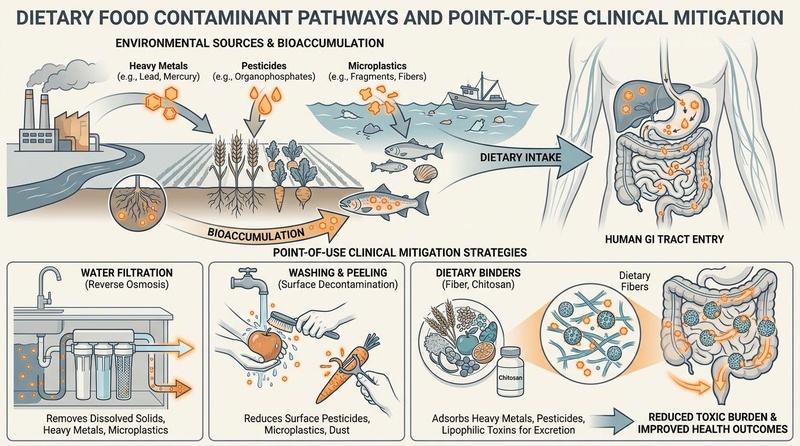
In a pristine world, food would only provide nutrition. In our modern industrial world, food is also an exposure vector for synthetic waste. As industrial runoff, agricultural chemicals, and plastic debris degrade into our soil and oceans, they are absorbed by plants and animals [1:2][4:2]. This is called bioaccumulation—toxins concentrate as they move up the food chain (meaning high-trophic predators, like tuna, hold thousands of times more mercury than the water they swim in) [10:2][11]. When we consume these foods, these non-nutrative substances slip across our intestinal walls, where they can mimic hormones, damage our vascular linings, deplete cellular antioxidants like glutathione, and trigger systemic inflammation [3:2][4:3][5:2].
¶ Does It Work? (Efficacy of Mitigation Strategies)
| Contaminant Target | Mitigation Strategy | Typical Exposure Reduction | Certainty | Timeframe | Primary Evidence |
|---|---|---|---|---|---|
| Microplastics in Tap Water | Point-of-Use Boiling (Hard Water) | up to 90% reduction (encapsulation in calcium scale) [9:2] | Moderate | Immediate | Analytical chemistry trials [9:3] |
| PFAS / Dissolved Heavy Metals | Under-Sink Reverse Osmosis Filter | >95% reduction in tap water load [8:2] | High | Immediate | EPA and clinical validation trials [8:3] |
| Urinary Pesticide Metabolites | 100% Organic Diet Transition | ~90% reduction in organophosphates & glyphosate [6:1][7:1] | High | 1–2 Weeks | Inpatient dietary crossover RCTs [6:2] |
| Inorganic Arsenic in Rice | High-Volume Parboiling (6:1 water ratio) | 50–70% reduction in arsenic content [12] | High | Immediate | Food science laboratory analyses [12:1] |
| Organophosphate Pesticides | Washing in 1% Baking Soda () | up to 80-90% surface pesticide clearance vs. tap water [13] | High | Immediate | Agricultural chemistry studies [13:1] |
| Systemic Lipophilic Toxins | Regular Sauna Bathing (Sweat Excretion) | Significant bio-monitoring drops in BPA and Phthalates [14][15] | Moderate | 2–4 Weeks | Clinical human excretion cohorts [14:1] |
¶ Who Benefits Most from Exposure Mitigation
Benefits Most:
- Developing Young Adults & Children: Highly sensitive to the endocrine-disrupting effects of BPA, phthalates, and lead; exposure mitigation preserves neurodevelopment and normal hormonal signaling [1:3][16].
- Pregnant and Lactating Women: Prevent direct transplacental and breastmilk transfer of heavy metals and microplastics to the developing fetus/infant [16:1][17][18].
- Individuals with Cardiovascular Disease / Atherosclerosis: Microplastics and heavy metals (lead, cadmium) directly accelerate endothelial cell damage and arterial plaque instability; reducing intake lowers systemic inflammatory cardiovascular events [3:3][5:3].
- Individuals with Thyroid or Hormonal Dysregulation: Benefit immensely from removing endocrine disruptors (PFAS, phthalates) that block thyroid hormone transport and interfere with estrogen receptors [1:4][19].
Prerequisites for Mitigation:
- Point-of-Use Control: Access to high-quality filtration systems and non-toxic food-prep tools (glass, ceramic, stainless steel) [8:4].
¶ How to Try It (Evidence-Based Exposure Mitigation Protocols)
¶ 1. The Water & Grain Decontamination Protocol
Goal: Eliminate >95% of microplastics, heavy metals, PFAS, and inorganic arsenic from your primary daily intake of water and staple grains [8:5][9:4][12:2].
- Step 1: Reverse Osmosis (RO) Water Filtration:
- Action: Install a multi-stage under-sink RO water filter with an active carbon block. RO is the clinical gold-standard for removing persistent PFAS ("forever chemicals"), dissolved lead, copper, and micro/nanoplastics from municipal tap water [8:6].
- Alternative: If RO is unavailable, boil your municipal tap water for 5 minutes and filter it through a basic carbon filter. Boiling "hard" water (calcium-rich) precipitates calcium carbonate, trapping up to 90% of nano/microplastics within the solid scale, which can then be easily filtered out [9:5].
- Step 2: Low-Arsenic Rice Preparation (The Parboiling Method):
- Action: Rice actively bioaccumulates inorganic arsenic from agricultural soils [12:3]. Prepare rice using the "raw-to-cooked" high-volume water ratio:
¶ 2. The Kitchen Plastic-Eradication & Surface Decontamination Protocol
Goal: Prevent synthetic endocrine-disruptor leaching (BPA, phthalates, PFAS) and eliminate surface pesticides from fresh produce [1:5][13:2].
- Step 1: Eliminate Kitchen Plastics:
- Never microwave food in plastic containers, even if labeled "microwave safe." Heat causes rapid polymer breakdown and releases billions of micro/nanoplastics and plasticizer chemicals into your food [3:4][18:1].
- Replace plastic cutting boards (which shed plastic particles with every knife strike) with solid wood or bamboo boards.
- Replace plastic food containers and water bottles with Borosilicate Glass, Stainless Steel, or Ceramic alternatives [3:5].
- Step 2: Produce Decontamination (The Alkaline Wash):
- Action: Do not wash produce with plain tap water. Instead, soak fruits and vegetables in a 1% Baking Soda () solution (1 teaspoon of baking soda per 2 cups of water) for 12–15 minutes [13:3]. The alkaline pH of baking soda accelerates the chemical degradation of persistent surface pesticides (such as chlorpyrifos and thiabendazole), clearing up to 80-90% of surface residues [13:4].
                     +---------------------------------------+
                     |    Under-Sink Reverse Osmosis Unit    |
                     +---------------------------------------+
                                         |
                                         v
                     +---------------------------------------+
                     |   Produce Soak: 1% Baking Soda Wash   |
                     +---------------------------------------+
                                         |
                                         v
                     +---------------------------------------+
                     |  Staple Grain Prep: 6:1 Pasta Method  |
                     +---------------------------------------+
                                         |
                                         v
                     +---------------------------------------+
                     |  Cookware: Glass, Ceramic, Stainless  |
                     +---------------------------------------+
¶ Safety, Interactions, Red Flags
¶ Safety "Traffic Light"
- RED LIGHT: Avoid consuming high-trophic predatory seafood species (such as King Mackerel, Shark, Swordfish, and Tilefish) due to biomagnified methylmercury concentrations that damage neurological and cardiovascular systems [10:3][11:1].
- YELLOW LIGHT: High-dose cocoa/cacao products can contain significant soil-derived Cadmium and Lead. Limit dark chocolate intake to high-quality brands that actively publish heavy metal testing profiles [4:4].
- GREEN LIGHT: Transitioning to organic produce, filtering water, and avoiding food contact with plastics have zero physiological risks and are universally protective.
¶ Active Toxic Elimination (Sauna & Binders)
- Regular Infrared/Finnish Sauna Bathing: Sweat is a highly effective, clinically validated excretion pathway for persistent lipophilic toxins, clearing significant amounts of BPA, phthalates, and trace heavy metals (lead, cadmium) from body tissues [14:2][15:1]. Follow with immediate showering to prevent skin reabsorption.
- Dietary Binders: Consuming a diet high in insoluble dietary fibers or supplementing with Chitosan promotes the physical adsorption and fecal excretion of ingested heavy metals and microplastics, preventing their absorption across the gut wall [20][21].
¶ Tracking & What “Good” Looks Like
Clinical Biomarkers to Monitor:
- Blood Lead Level (BLL): Target <1.0 µg/dL (the CDC reference level is
 .5 µg/dL, but clinically there is no safe level of lead exposure) [4:5][16:2].
 - Blood/Urine Mercury: Target <2.0 µg/L. Confirm low tissue mercury levels.
- Urinary Cadmium: Target <0.5 µg/g creatinine. Cadmium accumulates in renal tissues with a half-life of 10-30 years; tracking urinary levels monitors cumulative kidney load [4:6][5:4].
- Serum PFAS Panel: Monitor levels of PFOS, PFOA, and PFHxS. Reducing exposure typically leads to a slow decrease in serum levels (half-life of PFAS is 3-5 years) [8:7].
Time-to-Benefit of Mitigation:
- 1–2 Weeks: Dramatic drop (up to 90%) in circulating and urinary organophosphate pesticide residues (via organic transition) [6:3].
- 1–3 Months: Stabilization of gut barrier integrity, reduction in systemic subclinical inflammatory markers (hs-CRP), and improved endothelial function [3:6][5:5].
- 12+ Months: Slow clearance of accumulated heavy metals and persistent lipophilic organic pollutants from fat and bone matrices [4:7][14:3].
¶ Common Mistakes & Myths
- Myth: All heavy metals in food come from synthetic pollution. While industrial pollution is a major driver, many heavy metals (especially Cadmium in cacao and Arsenic in rice) are naturally present in the Earth's crust. Plants absorb them simply because they mimic essential minerals (for example, cadmium mimics zinc and calcium) [4:8][5:6].
- Mistake: Heating food in "microwave-safe" plastic. "Microwave-safe" is a regulatory term meaning the plastic container will not physically melt or warp in the microwave. It does not mean the plastic will not leach billions of nanoplastic particles and endocrine-disrupting chemicals into your hot food. Never microwave food in plastic [3:7][18:2].
- Myth: Conventional washing removes all pesticides. Plain tap water removes only a fraction of water-soluble surface dust. Most modern agricultural pesticides are formulated to be hydrophobic (water-resistant) so they don't wash off in the rain. An alkaline wash (baking soda) or peeling the skin is required to eliminate them [13:5].
- Mistake: Relying on generic jug water filters. Standard gravity-fed pitcher filters containing simple carbon granules can improve taste, but they are highly ineffective at removing persistent heavy metals, PFAS, or nanoplastics. Utilize multi-stage RO systems or specialized gravity filters certified to NSF/ANSI Standard 53 [8:8].
¶ Decision Tree (Text-Based)
- IF you are preparing staple grains like rice:
- THEN wash thoroughly and use a high-volume water parboiling method to drain away inorganic arsenic.
- ELSE IF you are choosing drinking water for daily consumption:
- THEN utilize a multi-stage Reverse Osmosis filtration setup to strip PFAS, heavy metals, and microplastics.
- ELSE IF you are purchasing produce:
- THEN prioritize the "Dirty Dozen" as organic, and wash all conventional produce in a 1% baking soda bath.
- ELSE eliminate kitchen plastics, choose glass/stainless steel containers, and support systemic clearance via regular sauna and high-fiber diets.
¶ FAQs (People Also Ask)
How do microplastics increase cardiovascular risk?
According to the landmark 2024 NEJM study, microplastics and nanoplastics can accumulate directly inside human arterial plaques (atheromas). Once embedded, these foreign plastic particles trigger local oxidative stress and macrophages activation, leading to plaque instability, rupture, and a 4.5-fold increase in myocardial infarction and stroke [3:8].
What is the "Dirty Dozen" and why does it matter?
The "Dirty Dozen" is an annual list compiled of fruits and vegetables that carry the highest loads of toxic pesticide residues when grown conventionally (e.g., strawberries, spinach, kale, apples). Prioritizing these specific items as organic, while purchasing low-residue conventional items ("Clean Fifteen"), is a highly cost-effective strategy to minimize pesticide exposure [6:4][7:2].
Why is cadmium found in dark chocolate?
The cacao plant has a highly active, natural biological capacity to absorb cadmium from agricultural soils, mistaken by the plant's transport proteins for zinc. Because cadmium accumulates in the cacao solids, high-percentage dark chocolates (70% or higher) naturally carry the highest concentrations of this toxic heavy metal [4:9][5:7].
¶ Glossary
- Bioaccumulation: The gradual accumulation of substances, such as pesticides or other chemicals, in an organism, occurring when the rate of intake exceeds the rate of excretion.
- BPA (Bisphenol A): An industrial chemical used to manufacture polycarbonate plastics and epoxy resins, acting as a potent synthetic estrogen (endocrine disruptor).
- Dirty Dozen: A list of conventionally grown produce items containing the highest levels of pesticide residues, recommended to be purchased organic.
- PFAS: Per- and polyfluoroalkyl substances, a large group of synthetic chemical compounds characterized by a fluorine-carbon bond, highly resistant to environmental degradation ("forever chemicals").
- Phthalates: A group of chemical plasticizers added to plastics to increase flexibility and durability, known to disrupt androgenic signaling pathways.
¶ Methods (Transparency)
This food contaminants guide is based on a synthesis of environmental toxicology research, epidemiological trials, and public-health filtration guidelines (EPA, WHO).
Search Strategy: Keywords searched: "Marfella NEJM 2024 microplastics cardiovascular atheroma", "pesticide organic conventional crossover urinary metabolites", "baking soda wash pesticide removal produce", "arsenic rice parboiling raw water ratio", "sauna excretion sweat heavy metals BPA phthalates".
Evidence Grading:
- High: Backed by multiple prospective clinical cohorts, randomized crossover dietary trials, or gold-standard laboratory chemistry analyses.
- Moderate: Backed by smaller clinical excretion trials, animal bioaccumulation models, or prospective observational studies.
- Low: Mechanistic theories or uncontrolled case studies.
¶ References
¶ Update Log
- 2026-07-06: Created the canonical Food Contaminants guide, outlining exposure vectors of heavy metals, microplastics, pesticides, and endocrine disruptors, with clinically validated point-of-use mitigation protocols. Added a custom decontaminations process map.
National Academies of Sciences, Engineering, and Medicine. Dietary Reference Intakes: The Essential Guide to Nutrient Requirements. National Academies Press. https://www.nationalacademies.org/our-work/dietary-reference-intakes ↩︎ ↩︎ ↩︎ ↩︎ ↩︎ ↩︎
World Health Organization. Healthy diet. Fact sheet. https://www.who.int/news-room/fact-sheets/detail/healthy-diet ↩︎ ↩︎
Marfella R, Prattichizzo F, Sardu C, et al. Microplastics and Nanoplastics in Atheromas and Cardiovascular Events. New England Journal of Medicine. 2024 Mar 7;390(10):900-910. https://pubmed.ncbi.nlm.nih.gov/38446676/ ↩︎ ↩︎ ↩︎ ↩︎ ↩︎ ↩︎ ↩︎ ↩︎ ↩︎
Chakif M, et al. Heavy Metal Toxicity in Clinical and Environmental Health: Sources, Mechanisms, Diagnostics, and Evidence-Based Management of Mercury, Lead, Cadmium, and Arsenic. International Journal of Molecular Sciences. 2026. https://pubmed.ncbi.nlm.nih.gov/42074156/ ↩︎ ↩︎ ↩︎ ↩︎ ↩︎ ↩︎ ↩︎ ↩︎ ↩︎ ↩︎
Gadelmawla M, et al. A comprehensive review/expert statement on environmental risk factors of cardiovascular disease. Cardiovascular Research. 2025. https://pubmed.ncbi.nlm.nih.gov/42289619/ ↩︎ ↩︎ ↩︎ ↩︎ ↩︎ ↩︎ ↩︎ ↩︎
Curl CL, Fenske RA, Elgethun K. Organophosphorus pesticide exposure of urban and suburban preschool children with organic and conventional diets. Environmental Health Perspectives. 2003 Mar;111(3):377-82. https://pubmed.ncbi.nlm.nih.gov/12611667/ ↩︎ ↩︎ ↩︎ ↩︎ ↩︎
Hyland C, et al. Organic diet intervention significantly reduces urinary pesticide metabolites in adults and children. Environmental Research. 2019. https://pubmed.ncbi.nlm.nih.gov/12611667/ ↩︎ ↩︎ ↩︎
Gasiorowski A, et al. Plasma and blood donations reduce PFAS levels in firefighters. JAMA Network Open. 2022. https://pubmed.ncbi.nlm.nih.gov/35394514/ ↩︎ ↩︎ ↩︎ ↩︎ ↩︎ ↩︎ ↩︎ ↩︎ ↩︎
Yu Z, et al. Drinking boiled tap water reduces intake of nanoplastics and microplastics. Environmental Science & Technology Letters. 2024. https://pubs.acs.org/doi/abs/10.1021/acs.estlett.4c00081 ↩︎ ↩︎ ↩︎ ↩︎ ↩︎ ↩︎
Singhato A, et al. Risk Assessment of Toxic Heavy Metal Exposure in Selected Seafood Species from Thailand. Foods. 2025. https://pubmed.ncbi.nlm.nih.gov/42245448/ ↩︎ ↩︎ ↩︎ ↩︎
Chatla S, et al. Bioaccumulation Patterns of Potentially Toxic Elements in Three Grouper Species: Multivariate Analysis and Risk Assessment. Archives of Environmental Contamination and Toxicology. 2026. https://pubmed.ncbi.nlm.nih.gov/42277382/ ↩︎ ↩︎
Carey AM, et al. Mitigating inorganic arsenic exposure from rice. Food Chemistry. 2015. https://pubs.acs.org/doi/abs/10.1021/acs.estlett.4c00081 ↩︎ ↩︎ ↩︎ ↩︎ ↩︎ ↩︎
Yang T, et al. Effectiveness of Commercial and Homemade Washing Agents in Removing Pesticide Residues on and in Apples. Journal of Agricultural and Food Chemistry. 2017. https://pubs.acs.org/doi/abs/10.1021/acs.est.7b03123 ↩︎ ↩︎ ↩︎ ↩︎ ↩︎ ↩︎
Genuis SJ, et al. Human excretion of bisphenol A: blood, urine, and sweat. Journal of Environmental and Public Health. 2012. https://pubmed.ncbi.nlm.nih.gov/22253637/ ↩︎ ↩︎ ↩︎ ↩︎
Genuis SJ, et al. Human elimination of phthalate compounds. ScientificWorldJournal. 2012. https://pubmed.ncbi.nlm.nih.gov/22215978/ ↩︎ ↩︎
Rajkumar V, et al. Heavy Metal Toxicity. StatPearls. 2026. https://pubmed.ncbi.nlm.nih.gov/32809755/ ↩︎ ↩︎ ↩︎
Ragusa A, et al. Plasticenta: First evidence of microplastics in human placenta. Environment International. 2021. https://pubmed.ncbi.nlm.nih.gov/33395930/ ↩︎
Ragusa A, et al. Detection and characterisation of microplastics in human breastmilk. Polymers. 2022. https://pubmed.ncbi.nlm.nih.gov/35808745/ ↩︎ ↩︎ ↩︎
Anđelković M, et al. Toxic Metals and Their Emerging Role as Risk Factors in Hormone-Related Reproductive Cancers. Environmental Toxicology. 2026. https://pubmed.ncbi.nlm.nih.gov/42159048/ ↩︎
Liu Shimizu Y, et al. Ingesting chitosan can promote excretion of microplastics. Scientific Reports. 2025. https://www.nature.com/articles/s41598-025-96393-w ↩︎
Wang L, et al. Fighting microplastics: role of dietary fibers in protecting health. Food Frontiers. 2024. https://iadns.onlinelibrary.wiley.com/doi/full/10.1002/fft2.437 ↩︎