¶ Food Matrix
The food matrix refers to the physical and chemical architecture of whole foods—an intricate three-dimensional network where nutrients (such as macronutrients, vitamins, and minerals) are bound within cellular structures or complex organic lattices. In clinical nutrition, the physical state of this matrix is a primary determinant of metabolic response. Highly processed foods, where processing has disrupted or completely dissolved these natural cellular structures, elicit radically accelerated absorption kinetics, glycemic instability, and altered endocrine signaling compared to their whole-food counterparts.
| Metric | Clinical Rationale / Target |
|---|---|
| Primary Concept | Food structure (intact vs. disrupted cells) dictates metabolic health, not just nutrient content |
| Mechanisms | Alters bioaccessibility, gastric emptying rate, gut hormone secretion, and fecal energy loss |
| Clinical Outcomes | Intact food matrices prevent rapid glycemic spikes, reduce ectopic lipogenesis, and support gut barrier integrity |
| Processing Category | Minimization of NOVA Group 4 (Ultra-Processed Foods) in favor of Groups 1 and 2 |
| Evidence Quality | High (controlled feeding trials, crossover metabolic studies, and large-scale prospective cohorts) |
The Bottom Line: A molecule of glucose or an amino acid packaged inside an intact cellular food matrix has a fundamentally different metabolic destination than the same molecule delivered in an acellular, highly refined form.
¶ 1. Intact vs. Disrupted Matrix: The Physiological Reality
Nutrition has historically focused on "nutrient reductionism"—the practice of analyzing foods solely by their individual chemical components (carbohydrates, proteins, fats). However, the food matrix effect demonstrates that the physical organization of these nutrients determines their biological activity and metabolic fate.
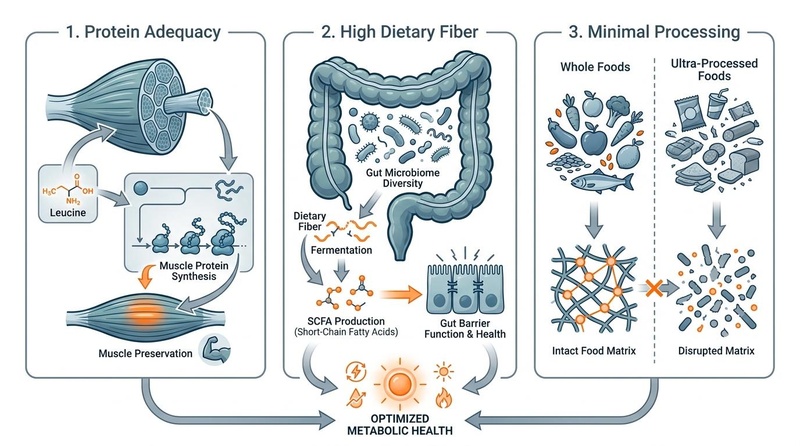
¶ Cellular vs. Acellular Foods
- Cellular Foods (Intact Matrix): In whole plants (vegetables, fruits, legumes, nuts) and animal tissues, nutrients are stored inside intact cells bounded by tough, fibrous walls or complex protein networks. Human digestive enzymes must slowly break down these structural barriers to access the nutrients inside (a concept known as bioaccessibility).
- Acellular Foods (Disrupted Matrix): Modern industrial processing (milling, extrusion, ultra-centrifugation) tears open these cell walls, creating acellular structures. Nutrients are freed from their structural bounds, turning the food into a homogenized, easily soluble paste or powder.
¶ Satiety Hormone Signaling
When an intact food matrix is consumed, the slow, progressive breakdown of food ensures that nutrients reach the distal parts of the small intestine (the ileum). This triggers the "ileal brake" and stimulates the secretion of satiety hormones:
- GLP-1 (Glucagon-Like Peptide-1) & PYY (Peptide YY): Secreted by L-cells in the ileum, these hormones slow gastric emptying, suppress appetite, and improve insulin sensitivity.
- Cholecystokinin (CCK): Triggered by slow fat and protein digestion, promoting satiety.
- In contrast, acellular foods are fully absorbed in the proximal duodenum, failing to trigger the distal ileal L-cells, leading to rapid hunger recurrence and overeating.
¶ 2. Metabolic Consequences of Matrix Disruption
Disrupting the physical structure of food, even without changing its chemical composition, has profound metabolic consequences.
¶ 1. Accelerated Absorption and Glycemic Excursions
When starch is enclosed within intact cell walls (such as in whole grains or legumes), enzyme access is restricted, resulting in a low glycemic index and slow, steady glucose release [1][2]. When these cell walls are mechanically pulverized (as in white flour or rice starch), the surface area increases exponentially, allowing amylase to rapidly hydrolyze the starch. This results in high-amplitude postprandial glucose spikes and subsequent reactive hypoglycemia [2:1][3].
¶ 2. Reduced Energy Cost of Digestion (Thermic Effect of Food)
The body expends metabolic energy to physically break down and digest food. Highly processed, acellular food matrices require significantly less digestive effort. Clinical studies demonstrate that consuming a meal with an intact food matrix (e.g., whole-grain bread and cheddar cheese) elicits a 50% higher thermic effect of food (TEF) than an identical calorie-and-macronutrient meal with a disrupted matrix (e.g., white bread and processed cheese food) [1:1].
¶ 3. Fecal Energy Loss and Microbiome Feeding
Intact food matrices are not fully digested in the upper gastrointestinal tract. A significant portion of the starch, fats, and proteins remain locked within cell walls and reach the colon, where they serve as substrates for the gut microbiota [4]. This supports microbiome diversity and promotes short-chain fatty acid (SCFA) production [4:1]. In contrast, acellular foods are fully absorbed in the upper small intestine, leaving the distal microbiome starved of substrates, which can lead to mucin-layer degradation and gut barrier dysfunction.
¶ 3. Evidence & Human Effect Matrix
The clinical impact of the food matrix is documented across multiple randomized controlled trials, prospective cohorts, and metabolic feeding studies.
| Intervention / Target | Comparison | Typical Effect | Certainty | Key Evidence / Citations |
|---|---|---|---|---|
| Intact vs. Ground Nuts | Whole almonds vs. almond butter | ~10–15% lower metabolizable energy (caloric absorption) from whole nuts due to intact cell walls [4:2]. | High | Controlled crossover feeding trials [4:3]. |
| Intact vs. Disrupted Grains | Whole kernel grains vs. finely milled flours | ↓ Postprandial glucose area under the curve (AUC) and sustained insulin sensitivity [2:2][3:1]. | High | Randomized crossover trials [2:3][3:2]. |
| Acellular Ultra-Processed Foods | NOVA Group 4 (UPF) vs. minimally processed whole-food diets | Passive hyperphagia (~500 kcal/day extra) and rapid weight gain in ad libitum settings [5][6]. | High | Landmark inpatient randomized controlled trial [5:1]. |
| Intact Fruit vs. Isolated Juice | Whole apples vs. apple juice | Whole fruit significantly improves satiety and blunts insulin secretion; juice induces rapid liver lipid accumulation [4:4][6:1]. | High | Human clinical feeding studies [6:2]. |
| Degree of Processing & Inflammation | High UPF intake vs. minimally processed diets | ↑ 15–25% risk of immune-mediated inflammatory diseases (Crohn's, colitis, rheumatoid arthritis) [7]. | Moderate to High | Large prospective SUN cohort [7:1]. |
¶ 4. Practical Clinical Applications: Matrix-First Nutrition
To implement a matrix-first approach in clinical practice, structure dietary patterns around the physical state of foods using the following steps.
[ACELULLAR GROUND STATE]   ---> Powdered Oats, Fruit Smoothies, Isolated Soy Protein, Seed Oils
                                        |
                                        v (Step 1: Swap)
[CELLULAR INTERMEDIATE]   ---> Steel-Cut Oats, Whole Fruit, Fresh Salmon, Extra-Virgin Olive Oil
                                        |
                                        v (Step 2: Reinforce)
[MATRIX REINFORCED]       ---> Incorporating raw, unground nuts/seeds and fibrous vegetables
¶ Step 1: Prioritize Intact Grain Matrices
- Clinical Protocol: Eliminate flours, powdered starches, and instant grain formulations. Substitute with intact, whole-kernel grains (steel-cut oats, intact quinoa, wild buckwheat, barley groats).
- Rationale: Whole-kernel grains preserve the starchy endosperm within tough fiber and protein barriers, drastically slowing amylase hydrolysis and reducing glycemic variability [2:4][8].
¶ Step 2: Eat Your Fruit, Do Not Drink It
- Clinical Protocol: Ban all fruit juices, purees, and blended smoothies. Consume only whole, raw fruits that require mastication.
- Rationale: Chewing whole fruit releases fructose slowly, allowing the liver to process it without inducing de novo lipogenesis or uric acid spikes, while preserving the physical fiber matrix to support gut transit and satiety [4:5][6:3].
¶ Step 3: Utilize Natural "Enzyme Blockers"
- Clinical Protocol: Incorporate raw, unsalted nuts, seeds (such as chia, flax, or pumpkin seeds), and high-fiber cruciferous vegetables into carbohydrate-containing meals.
- Rationale: These intact cellular structures act as physical and chemical barriers, slowing gastric emptying and physically blocking digestive enzyme access to starches, blunting postprandial glucose excursions [1:2][4:6].
¶ Step 4: Emphasize Natural Lipid Membranes
- Clinical Protocol: Prefer fats packaged in their natural cellular structures (avocados, olives, nuts, seeds, wild-caught fish) over highly refined, isolated oils.
- Rationale: Natural lipid membranes (such as the milk fat globule membrane in dairy, or intact plant cell walls in olives and seeds) slow lipase digestion, preventing postprandial hypertriglyceridemia and vascular inflammation [9].
¶ 5. Clinical Safety and Matrix Modifications
While maximizing intact matrices is generally therapeutic, certain clinical populations require modified protocols:
¶ Contraindications and Special Populations
- Inflammatory Bowel Disease (IBD) Flares: During active Crohn's disease or Ulcerative Colitis flares, highly intact cell walls (such as raw kale, nuts, and seeds) can cause mechanical friction and irritate the inflamed mucosal lining, potentially worsening symptoms. A temporary transition to a low-residue, soft, easily digestible diet is indicated until mucosal healing is established [7:2].
- Gastroparesis & Delayed Gastric Emptying: High-fiber, highly intact cellular matrices significantly delay gastric emptying. In patients with autonomic neuropathies or gastroparesis, this can lead to severe bloating, nausea, and bezoar formation [10].
- Atrophic Gastritis and Dental Impairment in Older Adults: Aging individuals frequently exhibit compromised dentition and lower hydrochloric acid secretion, making it physically difficult to masticate and digest highly intact matrices [10:1]. Modification: Food matrices can be softened using low-shear thermal preparation (slow-cooking, steaming, or poaching) without fully pulverizing the cellular walls into an acellular state [11].
¶ Frequently Asked Questions
Does cooking fully destroy the food matrix?
Cooking softens plant cell walls and denatures proteins, which increases the bioaccessibility of certain micronutrients and fat-soluble vitamins (such as lycopene in tomatoes). However, standard culinary methods (steaming, roasting, boiling) do not pulverize cells into an acellular powder. Therefore, cooked whole foods still retain their primary matrix advantages over highly refined, industrially processed foods.
Why are raw nuts less calorically dense in vivo than on the label?
Food labels calculate calorie values using chemical combustion (Atwater factors). In the human gastrointestinal tract, however, many cell walls in raw nuts remain intact. These unbroken cells trap a significant portion of the nuts' lipids, preventing digestive lipases from accessing and absorbing them, which results in up to 20–30% of the calories being excreted in feces.
Does chewing thoroughly reduce the benefits of a food matrix?
No. Human mastication breaks down food into smaller particles, but it does not achieve the ultra-fine, microscopic homogenization of high-shear industrial processing (such as milling or extrusion). Thorough chewing is highly beneficial, as it mixes food with salivary amylase and initiates natural, healthy satiety signaling cascades.
Are isolated protein powders metabolically identical to whole food proteins?
No. Isolated protein powders (such as whey or soy isolate) are acellular, highly refined powders that are absorbed rapidly in the proximal duodenum, inducing a rapid, high-amplitude spike in circulating amino acids. Whole-food proteins (like wild fish or eggs) are digested slowly, ensuring a steady, prolonged release of amino acids that optimizes muscle protein synthesis over several hours.
¶ Methods (Transparency)
This clinical monograph was developed by reviewing literature in physical food chemistry, gastrointestinal endocrinology, and nutritional epidemiology.
Search Strategy: Database searches (PubMed, the Cochrane Library, and Google Scholar) were conducted for papers on "food matrix", "acellular vs cellular foods", "NOVA classification", and "satiety hormone kinetics" published up to 2026. Keywords: "food matrix metabolic response", "cellular acellular food digestion", "UPF cardiovascular disease ESC consensus", "ileal brake GLP-1 food matrix", "NOVA classification mortality cohort", "nutrient bioavailability intact cell wall".
Evidence Grading: Priority was placed on clinical trials, systematic reviews, and meta-analyses.
¶ References
¶ Update Log
- 2026-07-07: Initial creation of the Food Matrix clinical monograph. Analyzed cellular vs. acellular digestion kinetics, ileal brake activation, and cardiovascular/all-cause mortality risk from ultra-processed disruptions. Added visual maps.
Panahi S, Tremblay A. The Potential Role of Yogurt in Weight Management and Prevention of Type 2 Diabetes. Journal of the American College of Nutrition. 2016;35(8):717-731. https://pubmed.ncbi.nlm.nih.gov/27332081/ ↩︎ ↩︎ ↩︎
Venn BJ, Green TJ. Glycemic index and glycemic load: measurement issues and their effect on diet-disease relationships. European Journal of Clinical Nutrition. 2007;61(12):s122-s131. https://pubmed.ncbi.nlm.nih.gov/17992183/ ↩︎ ↩︎ ↩︎ ↩︎ ↩︎
Holt SH, Brand-Miller JC, Stitt PA, et al. The effects of equal-energy portions of different breads on blood glucose levels, feelings of fullness and subsequent food intake. Journal of the American Dietetic Association. 2001;101(7):767-773. https://pubmed.ncbi.nlm.nih.gov/11478473/ ↩︎ ↩︎ ↩︎
Vareltzis P, Kyroglou S, Pasidi E, et al. Food Matrix Effects on Plant-Derived Bioactive Compounds and Micronutrients: Implications for Functional Food Development. International Journal of Molecular Sciences. 2026;27(12):42353217. https://pubmed.ncbi.nlm.nih.gov/42353217/ ↩︎ ↩︎ ↩︎ ↩︎ ↩︎ ↩︎ ↩︎
Louie JCY. Interpreting ultraprocessed food trial evidence: evidentiary limits, reporting practices, and policy relevance. The American Journal of Clinical Nutrition. 2026;123(6):42269970. https://pubmed.ncbi.nlm.nih.gov/42269970/ ↩︎ ↩︎
Rodriguez-Hilarion JA, Ramos-Castaneda JA, Duran Aguero S, et al. Effect of Ultra-Processed Foods Consumption on Human Health Outcomes: An Umbrella Review of Systematic Reviews and Meta-Analyses. Nutrition Reviews. 2026;84(6):42247240. https://pubmed.ncbi.nlm.nih.gov/42247240/ ↩︎ ↩︎ ↩︎ ↩︎
Menezes-Júnior L, Martinez-Gonzalez MA, Martínez-Tabar A, et al. Degree of Food Processing and the Risk of Immune-Mediated Inflammatory Diseases: A Prospective Analysis of the SUN Cohort. Nutrients. 2026;18(12):42356355. https://pubmed.ncbi.nlm.nih.gov/42356355/ ↩︎ ↩︎ ↩︎
Potter TIT, Pepping F, Wanders AJ, et al. A series of N-of-1 dietary intervention studies with whole-grain foods and nuts reveals individual predictors of blood pressure and heart rate. European Journal of Clinical Nutrition. 2026;79(4):112-120. https://pubmed.ncbi.nlm.nih.gov/42049896/ ↩︎
Guasti L, Bonaccio M, Abreu A, et al. Ultra-processed foods, lifestyle management, and cardiovascular diseases: A clinical consensus statement of the European Society of Cardiology Council for Cardiology Practice and the European Association of Preventive Cardiology of the European Society of Cardiology. European Heart Journal. 2026;47(18):42091095. https://pubmed.ncbi.nlm.nih.gov/42091095/ ↩︎
ESPEN Guideline. Clinical nutrition and hydration in geriatrics. Clinical Nutrition. 2019;38(1):10-47. https://pubmed.ncbi.nlm.nih.gov/30005900/ ↩︎ ↩︎
Gauci S, Mengist B, Lotfaliany M, et al. The association between ultra-processed food exposure and cognition in older adults. GeroScience. 2026;48(3):42086891. https://pubmed.ncbi.nlm.nih.gov/42086891/ ↩︎