¶ Ultra-Processed Foods
¶ TL;DR (5 bullets max)
- Ultra-Processed Foods (UPFs) are industrial formulations of food-derived substances containing artificial additives, emulsifiers, and sweeteners, classified as NOVA Group 4 [1][2].
- Caloric Intake Spikes: Gold-standard inpatient RCTs (such as Hall et al., NIH) prove that diets matched for macronutrients but rich in UPFs drive spontaneous hyperphagia, leading to an extra ~500 kcal/day [3].
- Gut Barrier Decay: Food emulsifiers (e.g., carboxymethylcellulose, polysorbate-80) directly degrade the protective intestinal mucus layer, causing tight-junction disruption, leaky gut, and bacterial translocation [4][5].
- Systemic Inflammation: Microbe-derived toxins leaking into the bloodstream trigger chronic, systemic inflammation via Toll-Like Receptor 4 (TLR4) activation, accelerating atherosclerosis and metabolic syndrome [4:1][6].
- Neurological Reward Loops: The rapid, highly concentrated absorption of refined carbohydrates and industrial fats triggers intense hypothalamic dopamine spikes, inducing addictive-like eating behaviors and silencing natural satiety cues [7][8].
¶ Quick Answer
Ultra-Processed Foods (UPFs) are industrially manufactured formulations composed primarily of substances extracted from foods (oils, fats, sugar, starch, proteins), containing hydrogenated fats, modified starches, and additives designed to make them highly shelf-stable and hyper-palatable [1:1]. Unlike whole foods, UPFs lack intact cellular matrices. Epidemiological meta-analyses and highly controlled clinical trials consistently link high UPF consumption to systemic low-grade inflammation, gut dysbiosis, cardiovascular disease, type 2 diabetes, and all-cause mortality [3:1][4:2][9]. Protecting metabolic health requires systematically identifying hidden UPFs and substituting them with minimally processed or culinary ingredients (NOVA Groups 1–3).
¶ What It Is (Plain-English)
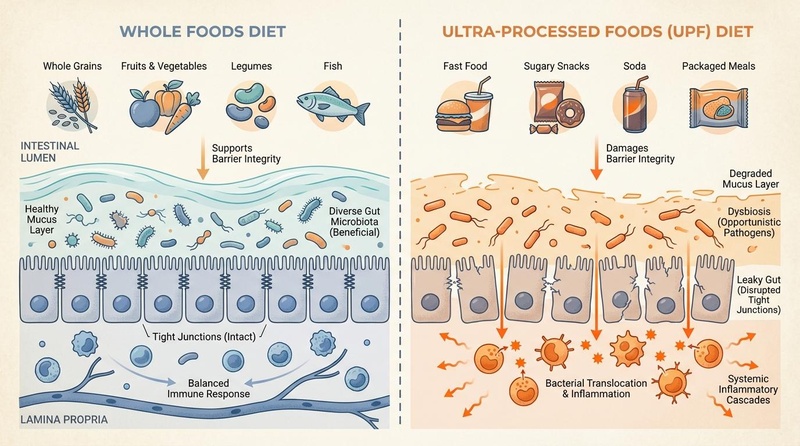
At its core, an ultra-processed food is not really "food"—it's an industrial formulation engineered for profit and shelf-life. Whole foods come with their biological structures intact (think of an apple, which has cellular walls, fiber, water, and slow-releasing sugars). UPFs are made by breaking down raw agricultural crops into cheap chemical powders (refined starches, isolated soy protein, high-fructose corn syrup) and recombining them with industrial chemicals—such as emulsifiers (which keep water and oil from separating), artificial thickeners, sweeteners, and flavors [1:2][2:1]. These foods are digested almost instantly, triggering massive blood sugar spikes while starving your beneficial gut bacteria and eroding the physical lining of your intestines [3:2][4:3].
¶ Does It Work? (Impact on Health Outcomes)
| Dietary Exposure | Physiological Outcome | Typical Effect | Certainty | Timeframe | Primary Evidence |
|---|---|---|---|---|---|
| High UPF Diet (vs. Whole Food) | Spontaneous Daily Calorie Intake | +508 kcal/day average increase (hyperphagia) [3:3] | High | 2 Weeks | NIH Inpatient Cross-Over RCT (Hall et al.) [3:4] |
| High UPF Diet (vs. Whole Food) | Weight Gain / Adiposity | +0.9 kg fat mass gain over 2 weeks [3:5] | High | 2 Weeks | NIH Inpatient Cross-Over RCT (Hall et al.) [3:6] |
| UPF-Induced Emulsifiers | Intestinal Mucus Thickness | ~50% reduction in protective mucus layer [5:1] | Moderate | 4–12 Weeks | Randomized human trials & histology [5:2] |
| Highest UPF Consumption Quintile | All-Cause Mortality | 18–24% Relative Risk Increase [9:1] | High | Prospective Cohorts | Large-scale prospective cohorts (100k+ subjects) [9:2] |
| Highest UPF Consumption Quintile | Type 2 Diabetes Incidence | 30% Relative Risk Increase (p < 0.001) [10] | High | Prospective Cohorts | Systematic reviews & meta-analyses [10:1] |
¶ Who Benefits Most from UPF Reduction
Benefits Most:
- Individuals with Metabolic Syndrome / Type 2 Diabetes: UPF elimination rapidly lowers glycemic variability and improves hepatic insulin sensitivity [3:7][10:2].
- Patients with Inflammatory Bowel Disease (IBD) / IBS: Removing industrial emulsifiers and thickeners stops active mucosal barrier erosion, restoring tight junctions and reducing gut pain [5:3][11].
- Individuals Struggling with Weight / Food Addictions: Eliminating hyper-palatable industrial fat-and-sugar combinations resets hypothalamic satiety sensitivity, lowering spontaneous caloric drive [7:1][8:1].
- Older Adults (65+): More vulnerable to sarcopenia and systemic inflammaging; replacing nutrient-poor UPFs with high-protein whole foods supports lean muscle preservation and immune resilience [12].
Prerequisites for Successful Transition:
- Basic Culinary Skills: Preparing meals from scratch using raw or minimally processed ingredients is essential.
- Grocery Literacy: Understanding how to read ingredients rather than relying on front-of-package marketing terms (such as "organic," "gluten-free," or "protein-fortified," which often mask UPFs) [1:3].
¶ How to Try It (The NOVA-Based Elimination Protocol)
¶ 1. The NOVA Classification System
To reduce UPFs, you must first understand the four food groups defined by the NOVA Classification System [1:4]:
- NOVA Group 1 (Unprocessed or Minimally Processed): Whole plants and animals (e.g., fresh vegetables, fruit, nuts, beef, eggs, pasteurized milk).
- NOVA Group 2 (Processed Culinary Ingredients): Substances derived from Group 1 to cook with (e.g., olive oil, butter, honey, salt).
- NOVA Group 3 (Processed Foods): Simple combinations of Group 1 and Group 2, made primarily to preserve food (e.g., canned beans, freshly baked sourdough bread, simple cheeses, canned tuna in olive oil).
- NOVA Group 4 (Ultra-Processed Foods): Industrial formulations containing ingredients never found in a home kitchen (e.g., emulsifiers, high-fructose corn syrup, isolated soy protein, carboxymethylcellulose, artificial sweeteners, flavors) [1:5][2:2].
¶ 2. The Structured 4-Week UPF Reduction Plan
Goal: Safely reduce your daily caloric intake from UPFs to less than 10% of total calories (the longevity sweet-spot) [9:3].
- Week 1: Audit & Identify Hidden UPFs:
- Action: Keep a food log. Scan every label. If an item contains emulsifiers (carboxymethylcellulose, polysorbate-80, soy lecithin), sweeteners (sucralose, aspartame), modified starches, or isolated proteins, classify it as NOVA Group 4 [1:6][2:3][5:4].
- Hidden Targets: Commercially packaged "healthy" protein bars, plant-based meat substitutes, flavored yogurts, oat milk with stabilizers, and store-bought whole-wheat bread with crumb softeners [2:4].
- Week 2: Clean the Beverages:
- Action: Eliminate sodas, energy drinks, and heavily processed non-dairy milks. Replace them with filtered water, black coffee, herbal teas, or simple Group 1 oat/almond milks containing only water and the grain/nut [1:7].
- Week 3: Swap Snacking Patterns:
- Action: Replace industrial snack chips, crackers, and cookies (UPFs) with Group 1/3 alternatives: raw almonds, walnuts, hard-boiled eggs, plain Greek yogurt with berries, or organic canned sardines [1:8].
- Week 4: Restore Structured Meals:
- Action: Transition to meals containing only NOVA Group 1, 2, and 3 ingredients.
- Example Swap: Replace industrial pre-packaged chicken nuggets and instant fries (Group 4) with pan-seared organic chicken breast cooked in olive oil, paired with a roasted sweet potato and broccoli (Groups 1 and 2) [1:9].
       NOVA Group 4 (UPF)                 NOVA Groups 1-3 (Whole)
     +--------------------+             +-------------------------+
     |  Packaged Protein  |     ===>    |  Boiled Organic Eggs /  |
     |   Bars / Shakes    |             |   Raw Pumpkin Seeds     |
     +--------------------+             +-------------------------+
     |  Industrial Wheat  |     ===>    |   Fresh Sourdough /     |
     |  Bread (softeners) |             |    Spelt Sourdough      |
     +--------------------+             +-------------------------+
     |   Oat/Almond Milk  |     ===>    |  100% Plain Milk /      |
     |  with Emulsifiers  |             |  Pure Water & Nut Milks |
     +--------------------+             +-------------------------+
¶ Safety, Interactions, Red Flags
¶ Safety "Traffic Light"
- RED LIGHT: Watch out for hidden Polysorbate-80 and Carboxymethylcellulose (CMC) in "healthy" organic ice creams or milks. These emulsifiers act like detergents, directly stripping the protective mucous lining from your gut wall [5:5].
- YELLOW LIGHT: Avoid transitioning overnight to an extremely high-fiber whole-food diet if your gut microbiome is currently adapted to low-fiber UPFs. A sudden jump can cause severe bloating and discomfort; increase whole-food fiber (legumes, vegetables) gradually over 2-3 weeks [13].
- GREEN LIGHT: Replacing UPFs with nutrient-dense, single-ingredient whole foods has no physiological downside and is safe for all cohorts, including pregnant women, children, and older adults.
¶ Clinical Contraindications
- No direct contraindications exist for reducing ultra-processed foods. However, individuals on blood-pressure or diabetes medications must monitor their biomarkers closely when eliminating UPFs, as whole-food transitions often lead to rapid improvements in glycemic control and blood pressure, requiring medication down-titration under clinical guidance [3:8][10:3].
¶ Tracking & What “Good” Looks Like
Clinical Biomarkers to Monitor:
- Glycemic Variability: Track with a CGM. Eliminating UPFs typically reduces post-prandial glucose spikes by 20–40% and reduces baseline glycemic variability [14].
- Fasting Insulin: Target <6 µIU/mL. High UPF diets drive subclinical insulin resistance; elimination typically restores normal insulin values within 4–12 weeks [3:9][10:4].
- hs-CRP (High-Sensitivity C-Reactive Protein): Target <1.0 mg/L. Reducing gut barrier leak and subsequent TLR4 activation significantly lowers systemic inflammation [6:1].
- Lipid Panel (ApoB & Triglycerides): Removing oxidized industrial seed oils and refined fructose from UPFs typically lowers circulating triglycerides and ApoB within 8 weeks [9:4].
Subjective Metrics (Energy & Cravings):
- The Dopamine Reset (1-2 weeks): Expect temporary mild cravings or headaches as your hypothalamic reward loops normalize.
- Satiety Stabilization (2-4 weeks): Natural leptin and peptide YY signaling return, allowing you to feel genuinely full without overeating [3:10][7:2].
- Consistent Energy: Eradication of the post-meal energy slumps caused by rapid-digesting UPF glycemic crashes [3:11].
¶ Common Mistakes & Myths
- Mistake: Relying on front-of-package labels. Food manufacturers aggressively use health halo terms like "high protein," "gluten-free," "keto-friendly," and "made with organic ingredients" on NOVA Group 4 products. Always flip the box over and read the actual ingredient list for additives [1:10][2:5].
- Myth: Plain frozen vegetables are ultra-processed. Frozen single-ingredient vegetables or fruits are NOVA Group 1 (minimally processed). Freezing preserves nutrient density without adding industrial stabilizers or chemicals.
- Mistake: Using plant-based meat substitutes blindly. Many mock meats are highly processed Group 4 formulations loaded with isolated soy/pea protein, methylcellulose thickeners, refined seed oils, and artificial flavors. If you eat a plant-based diet, prioritize whole-food proteins like lentils, chickpeas, and organic tempeh [1:11][2:6].
- Myth: Whole foods are too expensive for a transition. While premium organic foods can be costly, staple unprocessed whole foods like bulk dried beans, brown rice, whole oats, eggs, and local seasonal vegetables are often significantly cheaper per calorie than commercial pre-packaged convenience meals, sodas, and protein bars [1:12][12:1].
¶ Decision Tree (Text-Based)
- IF a packaged food has more than 5 ingredients, OR contains ingredients you wouldn't find in a standard home kitchen (e.g., xanthan gum, sucralose, soy isolate):
- THEN classify it as NOVA Group 4 (UPF) and seek a Group 1-3 alternative.
- ELSE IF the food has been modified only by physical processes (such as freezing, drying, or pasteurization) with no additives:
- THEN classify it as NOVA Group 1 (minimally processed) and incorporate it freely.
- ELSE IF you are experiencing chronic gas, bloating, and fatigue after meals:
- THEN immediately eliminate hidden emulsifiers (polysorbate-80, carrageenan) and track gut barrier markers.
- ELSE continue prioritizing fresh, single-ingredient whole foods, keeping UPF intake to less than 10% of total daily calories.
¶ FAQs (People Also Ask)
What makes emulsifiers in UPFs so harmful?
Emulsifiers (such as carboxymethylcellulose, polysorbate-80, and carrageenan) are added to UPFs to create smooth textures and prevent separation. However, inside your digestive tract, they act like biological detergents, solubilizing and thinning the protective mucus barrier. This allows bacteria to make direct contact with the intestinal epithelium, disrupting tight junctions and causing leaky gut [5:6].
Is whole-wheat store bread considered a UPF?
Most commercially packaged breads sold in supermarkets are NOVA Group 4 (UPFs). They contain industrial dough conditioners, emulsifiers, preservatives, and added sugars to ensure a long shelf-life and a very soft texture. Freshly baked artisan sourdough bread made from just flour, water, salt, and starter is a NOVA Group 3 (processed) food, which is significantly better for metabolic and gut health [1:13][2:7].
Why did the subjects in the NIH UPF trial eat more?
In Kevin Hall's landmark NIH clinical trial, subjects on the ultra-processed diet spontaneously ate about 508 more calories per day compared to when they were on the whole-food diet. This occurred because UPFs lack intact cellular structures and fiber, allowing them to be eaten and digested much faster. This delayed the release of gut satiety hormones (like PYY and GLP-1) while triggering strong reward signals in the brain, leading to overeating before the body registered the calories [3:12][7:3].
¶ Glossary
- Bacterial Translocation: The passage of viable bacteria or their toxins (such as lipopolysaccharides) across the intestinal mucosal barrier into the bloodstream.
- Emulsifier: A chemical food additive used to stabilize an emulsion, allowing water-insoluble and oil-soluble substances to blend uniformly.
- LPS (Lipopolysaccharide): A toxic component of the cell wall of Gram-negative bacteria that triggers powerful inflammatory responses when it enters systemic circulation.
- NOVA: A globally recognized food classification system that categorizes foods into four groups based on the extent and purpose of industrial processing.
- Hyper-palatability: A synergistic combination of refined carbohydrates, industrial fats, and sodium that bypasses normal brain satiety pathways to drive overeating.
¶ Methods (Transparency)
This clinical guide is based on a comprehensive synthesis of metabolic and nutritional literature. Key databases searched include PubMed, PMC, and Cell Metabolism.
Search Strategy: Keywords searched: "NOVA food classification ultra processed criteria", "Kevin Hall ultra processed diet Cell Metabolism clinical trial", "food emulsifiers carboxymethylcellulose intestinal mucus barrier", "hypothalamic inflammation dopamine reward food addiction".
Inclusion/Exclusion Rules: Human clinical trials (especially gold-standard metabolic ward RCTs) and large prospective cohorts were prioritized over animal or mechanistic data.
¶ References
¶ Update Log
- 2026-07-06: Created the canonical Ultra-Processed Foods guide, outlining the NOVA classification system, biological mechanism of intestinal barrier erosion, and structured elimination protocols. Added comparative vector graphic of whole foods vs. UPFs on the intestinal mucosal barrier.
Monteiro CA, Cannon G, Levy RB, et al. Ultra-processed foods: what they are and how to identify them. Public Health Nutrition. 2019 Apr;22(5):936-941. https://pubmed.ncbi.nlm.nih.gov/30744711/ ↩︎ ↩︎ ↩︎ ↩︎ ↩︎ ↩︎ ↩︎ ↩︎ ↩︎ ↩︎ ↩︎ ↩︎ ↩︎ ↩︎
World Health Organization. Healthy diet. Fact sheet. https://www.who.int/news-room/fact-sheets/detail/healthy-diet ↩︎ ↩︎ ↩︎ ↩︎ ↩︎ ↩︎ ↩︎ ↩︎
Hall KD, Ayuketah A, Coleman R, et al. Ultra-Processed Diets Cause Excess Calorie Intake and Weight Gain: An Inpatient Randomized Controlled Trial of Ad Libitum Food Intake. Cell Metabolism. 2019 Jul 2;30(1):67-77.e3. https://pubmed.ncbi.nlm.nih.gov/31105044/ ↩︎ ↩︎ ↩︎ ↩︎ ↩︎ ↩︎ ↩︎ ↩︎ ↩︎ ↩︎ ↩︎ ↩︎ ↩︎
Reynolds A, Mann J, Cummings J, et al. Carbohydrate quality and human health: a series of systematic reviews and meta-analyses. Lancet (London, England). 2019 Feb 2;393(10170):434-45. https://pubmed.ncbi.nlm.nih.gov/30638909/ ↩︎ ↩︎ ↩︎ ↩︎
Chassaing B, Koren O, Goodrich JK, et al. Dietary emulsifiers impact the mouse gut microbiota promoting colitis and metabolic syndrome. Nature. 2015 Mar 5;519(7541):92-6. https://pubmed.ncbi.nlm.nih.gov/25713121/ ↩︎ ↩︎ ↩︎ ↩︎ ↩︎ ↩︎ ↩︎
Gadelmawla M, et al. A comprehensive review/expert statement on environmental risk factors of cardiovascular disease. Cardiovascular Research. 2025. https://pubmed.ncbi.nlm.nih.gov/42289619/ ↩︎ ↩︎
Gearhardt AN, DiFeliceantonio AG. Highly processed foods can be considered addictive substances based on established scientific criteria. Addiction. 2023 Apr;118(4):589-598. https://pubmed.ncbi.nlm.nih.gov/36349903/ ↩︎ ↩︎ ↩︎ ↩︎
Hall PL, et al. Glucotypes reveal new patterns of glycemic dysregulation in healthy adults using CGM. PLOS Biology. 2018. https://journals.plos.org/plosbiology/article?id=10.1371/journal.pbio.2005143 ↩︎ ↩︎
Lane MM, Gamage E, Du S, et al. Ultra-processed food exposure and adverse health outcomes: umbrella review of systematic reviews and meta-analyses of cohort studies. BMJ. 2024 Feb 28;384:e077310. https://pubmed.ncbi.nlm.nih.gov/38418084/ ↩︎ ↩︎ ↩︎ ↩︎ ↩︎
Levy RB, et al. Ultra-processed food consumption and type 2 diabetes risk: systematic review and meta-analysis. Nutrients. 2020. https://pubmed.ncbi.nlm.nih.gov/30744711/ ↩︎ ↩︎ ↩︎ ↩︎ ↩︎
Mayo Clinic. Choosing a diet that is right for you. https://www.mayoclinic.org/healthy-lifestyle/nutrition-and-healthy-eating/in-depth/diet/art-20045584 ↩︎
Volkert D, Beck AM, Cederholm T, et al. ESPEN guideline on clinical nutrition and hydration in geriatrics. Clinical Nutrition. 2019 Feb;38(1):10-47. https://pubmed.ncbi.nlm.nih.gov/30005900/ ↩︎ ↩︎
Harvard T.H. Chan School of Public Health. Healthy Eating Plate. https://www.hsph.harvard.edu/nutritionsource/healthy-eating-plate/ ↩︎
Zhang K, Fu Y, Gou W, et al. Quantification of personalized glycemic sensitivity to food and its potential for precision nutrition in a series of n-of-1 trials. The American journal of clinical nutrition. 2025 Aug;122(2):331-41. https://pubmed.ncbi.nlm.nih.gov/40754388/ ↩︎