¶ TL;DR
Acne scars are permanent textural changes resulting from severe acne. Effective remodeling requires accurate scar classification and a multi-modal approach combining topical agents, energy-based devices, and surgical techniques. Microneedling, subcision, lasers (CO2, fractional), and Platelet-Rich Plasma (PRP) are primary interventions. Early intervention with topical retinoids like trifarotene can significantly reduce scar formation.
¶ Quick Answer
Addressing acne scars involves a personalized strategy based on scar type. Atrophic (depressed) scars are most common and respond to treatments that induce collagen remodeling and tissue lifting. These include microneedling (with or without PRP), subcision for rolling scars, fractional lasers (ablative and non-ablative), chemical peels (e.g., TCA CROSS for icepick scars), and dermal fillers. Topical retinoids can prevent new scar formation and improve existing texture.
¶ First: Identify the Type
Accurate classification of acne scars is the foundational step for effective treatment, as each type responds best to specific interventions.
| Scar Type | Description | Best Treatment Modalities |
|---|---|---|
| Icepick Scars | Narrow, deep, V-shaped indentations extending into the dermis. Resemble punctures. | TCA CROSS, fractional lasers, excisions, punch grafting [1] |
| Boxcar Scars | Round or oval depressions with sharp, vertical edges. Wider than icepick scars, resembling chickenpox scars. | Fractional lasers (ablative/non-ablative), punch excision/elevation, dermal fillers, subcision [1:1] |
| Rolling Scars | Broad, shallow depressions with sloping edges, giving the skin a wavy, undulating appearance. | Subcision, dermal fillers, microneedling, fractional lasers [2] |
| Atrophic Scars (General) | Depressed scars due to collagen loss during healing. Includes icepick, boxcar, and rolling. | Combination therapy with lasers, microneedling, subcision, fillers [3] |
| Hypertrophic Scars | Raised, firm scars confined to the original wound site. Less common with acne, more with body trauma. | Silicone sheeting, intralesional steroids, 5-FU, cryotherapy, pulsed dye laser (PDL) [4] |
| Keloid Scars | Raised, firm, shiny scars that extend beyond the original wound boundaries. Rare for acne scars, but possible. | Intralesional steroids, surgical excision (with adjunctive therapy), cryotherapy, radiation [4:1] |
¶ Evidence Snapshot
¶ Evidence Summary Table (Human Outcomes)
| Intervention Type | Condition Treated | Outcome Measured | Efficacy | Certainty of Evidence (GRADE) | Key Findings & Caveats | References |
|---|---|---|---|---|---|---|
| Microneedling + PRP | Atrophic acne scars | Clinical improvement (>50% Goodman scale) | Significant improvement (OR 2.97) | Low | Superior to microneedling alone in reducing scar severity and improving patient satisfaction. Heterogeneity in PRP preparation is a limitation [5][6]. | [5:1][6:1] |
| Fractional CO2 Laser + Hyaluronic Acid | Atrophic facial acne scars | Scar severity reduction, patient satisfaction | High | Moderate | Effective for facial atrophic acne scars; combination with hyaluronic acid may enhance results. Ablative lasers require significant downtime and have higher PIH risk in darker skin tones [3:1][1:2]. | [3:2][1:3] |
| Subcision (monotherapy) | Rolling acne scars | Marked improvement (40-75% patients) | Moderate | Moderate | Effective for releasing fibrous bands tethering rolling scars. Often combined with fillers or PRP for enhanced, sustained results [7][2:1]. | [7:1][2:2] |
| TCA CROSS (100% TCA) | Icepick acne scars | Reduction in scar depth (>70%) | High | Moderate | Highly effective for narrow, deep icepick scars. Risk of hyperpigmentation if not performed by experienced clinician, especially in skin of color [8][4:2]. | [8:1][4:3] |
| Trifarotene (Topical Retinoid) | Atrophic acne scars | Reduction in total atrophic scar count | Significant (55.2% vs 29.9% for vehicle) | High | Once-daily application effective in reducing existing atrophic scars and preventing new ones, with results seen as early as 2 weeks [9]. | [9:1] |
| Overall Combination Therapy | Various acne scars | Overall clinical improvement across scar types | High | High | Multi-modal approaches (lasers, microneedling, peels, subcision, fillers) consistently superior to monotherapy for diverse scar patterns [3:3][4:4]. | [3:4][4:5] |
¶ What Causes It
Acne scars arise from the skin's attempt to repair damage caused by severe acne lesions, particularly inflammatory papules, pustules, nodules, and cysts. The depth and duration of inflammation significantly influence scar type and severity.
¶ Collagen Destruction and Dysregulation from Acne Inflammation
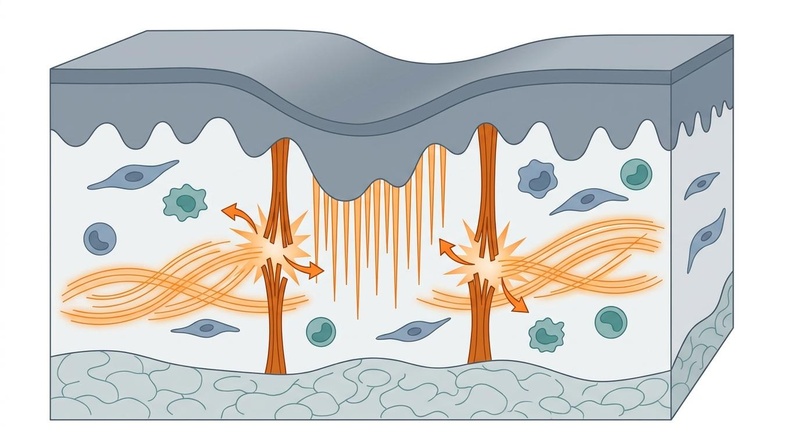
The primary mechanism behind atrophic (depressed) acne scars is a net loss or disorganized deposition of collagen and elastin during the wound healing process.
- Inflammation Cascade: When a severe acne lesion develops, the follicle wall ruptures, releasing bacteria, sebum, and keratinocytes into the surrounding dermis. This triggers a robust inflammatory response involving neutrophils and macrophages.
- Enzyme Release: Inflammatory cells release enzymes like Matrix Metalloproteinases (MMPs) that degrade collagen and elastic fibers. If this degradation is excessive or prolonged, it leads to tissue loss.
- Fibroblast Dysfunction: In normal healing, fibroblasts lay down new collagen to repair the defect. However, in atrophic scarring, there is either insufficient collagen production, or the newly formed collagen is disorganized and inadequate to restore volume. This can also involve myofibroblasts (cells with contractile properties) pulling the tissue down, forming depressed scars, especially rolling scars [1:4].
- Genetic Predisposition: Individual genetic factors influence the immune response to inflammation and the efficiency of collagen remodeling, contributing to varying scar severities and types [4:6].
¶ Starter Protocol (Topical Agents)
For mild atrophic scars, or as a preventative measure and adjunct to clinical procedures, topical agents can significantly improve skin texture and reduce scar visibility.
¶ 1. Topical Retinoids (e.g., Trifarotene, Tretinoin)
- Mechanism: Retinoids normalize keratinocyte differentiation, reduce inflammation, and crucially, stimulate collagen synthesis in the dermis [9:2]. They upregulate various growth factors and components of the extracellular matrix, promoting a more organized collagen structure.
- Protocol: Apply a pea-sized amount to the entire affected area nightly. Start with lower concentrations (e.g., 0.025% tretinoin) and gradually increase as tolerated to minimize irritation. Trifarotene 0.005% cream has shown efficacy in reducing scar count as early as two weeks [9:3].
- Key Benefit: Not only treats existing scars by promoting collagen remodeling but also prevents new scar formation by addressing active acne and normalizing wound healing.
- Caveats: Photosensitivity, dryness, redness, and peeling are common initially. Consistent sunscreen use is mandatory.
¶ 2. Alpha Hydroxy Acids (AHAs) and Beta Hydroxy Acids (BHAs)
- Mechanism: AHAs (e.g., glycolic acid, lactic acid) and BHAs (e.g., salicylic acid) promote exfoliation of the superficial skin layers, improving texture and mild discoloration. BHAs are oil-soluble and can penetrate pores to address residual acne [1:5].
- Protocol: Use 2-5% concentration in cleansers or toners daily. Higher concentrations (10-20%) can be used in weekly leave-on treatments or professional peels.
- Key Benefit: Improves superficial texture, brightens skin, and can help with mild hyperpigmentation associated with scars.
- Caveats: Can cause dryness and irritation. Always patch test and introduce gradually.
¶ Stronger Add-On Path (At-Home Devices & Advanced Topicals)
For moderate scarring or to enhance results from the starter protocol, consider integrating more advanced at-home treatments.
¶ 1. At-Home Microneedling (Dermarollers/Pens)
- Mechanism: Creates controlled micro-injuries, stimulating the skin's natural wound healing response and collagen production. At-home devices use shorter needles (0.25mm - 0.5mm) than professional treatments.
- Protocol: Use 0.25mm dermaroller 2-3 times per week, or 0.5mm dermaroller once weekly. Always sterilize before and after use. Apply a hydrating serum (e.g., hyaluronic acid, GHK-Cu serum) immediately after treatment to enhance absorption.
- Key Benefit: Improves topical product penetration and promotes mild collagen remodeling over time.
- Caveats: Risk of infection or irritation if not sterilized properly. Avoid on active acne or open wounds. Efficacy is significantly less than professional microneedling [10].
¶ 2. GHK-Cu Serums/Creams
- Mechanism: GHK-Cu (Copper Tripeptide-1) is a naturally occurring peptide that acts as a feedback signal for tissue repair. It modulates Matrix Metalloproteinases (MMPs) and Tissue Inhibitors of Metalloproteinases (TIMPs), balancing collagen deposition and breakdown. It promotes Type I and Type III collagen synthesis and resets fibroblast gene expression to a healthier state [11].
- Protocol: Apply a serum or cream with 0.5-2.5% GHK-Cu once or twice daily to the scarred areas.
- Key Benefit: Accelerates skin remodeling, improves elasticity, and reduces inflammation, contributing to smoother skin texture and reduced scar visibility.
- Caveats: Generally well-tolerated; mild irritation is rare.
¶ Clinical/Procedure Path
For moderate to severe atrophic acne scars, in-office clinical procedures offer the most significant improvements, often used in combination.
¶ 1. Professional Microneedling (with or without PRP)
- Mechanism: Uses medical-grade devices with longer needles (up to 2.5mm) to create deeper micro-injuries. This stimulates robust collagen and elastin production. When combined with Platelet-Rich Plasma (PRP), growth factors from the patient's own blood are delivered into the dermis, further enhancing healing and remodeling [5:2].
- Protocol: Typically 3-6 sessions, 4-6 weeks apart. Topical anesthetic is applied beforehand. Post-procedure care involves strict sun avoidance and gentle skincare.
- Key Benefit: Substantial improvement in all atrophic scar types, particularly boxcar and rolling scars. PRP significantly reduces downtime and enhances results [5:3].
- Safety: Generally safe, but requires a sterile environment. Risks include temporary redness, swelling, and rare infection or hyperpigmentation, especially in darker skin types if parameters are too aggressive [12].
¶ 2. Subcision
- Mechanism: A minor surgical procedure performed by a dermatologist, specifically effective for rolling and tethered scars. A needle or cannula is inserted under the scar to manually break the fibrous bands that pull the skin downward, releasing the depression [2:3].
- Protocol: Usually performed as a single session or a few sessions. Often combined with dermal fillers or PRP injections immediately after to prevent re-tethering and provide volume.
- Key Benefit: Immediately lifts depressed rolling scars and allows for new collagen formation in the freed space.
- Safety: Temporary bruising, swelling, and tenderness are common. Risk of hematoma.
¶ 3. Lasers (Fractional Ablative and Non-Ablative)
- Mechanism:
- Fractional Ablative Lasers (e.g., CO2, Er:YAG): Create microscopic columns of thermal injury, vaporizing tissue and stimulating a powerful wound healing response that leads to significant neocollagenesis and scar resurfacing.
- Fractional Non-Ablative Lasers (e.g., Er:Glass 1540nm): Create thermal injury without epidermal vaporization, stimulating collagen remodeling with less downtime but typically require more sessions for comparable results.
- Protocol: Ablative lasers often require 1-2 sessions with significant downtime (1-2 weeks). Non-ablative lasers require 3-5 sessions with minimal downtime. Pre- and post-care are crucial to prevent complications.
- Key Benefit: Highly effective for improving scar texture, depth, and overall skin quality. Ablative lasers offer dramatic results for severe scars [1:6].
- Safety: Ablative lasers carry higher risks of prolonged erythema, infection, and post-inflammatory hyperpigmentation (PIH), especially in Fitzpatrick skin types IV-VI. Careful patient selection and experienced practitioners are essential [12:1].
¶ 4. Chemical Reconstruction of Skin Scars (CROSS) Technique
- Mechanism: Typically uses high-concentration trichloroacetic acid (TCA, 70-100%) applied precisely to the base of icepick scars using a toothpick. This induces focal collagen denaturation and subsequent neocollagenesis, "filling in" the deep, narrow scar [8:2].
- Protocol: 3-5 sessions, 2-4 weeks apart. Requires extreme precision to avoid damage to surrounding skin.
- Key Benefit: Highly effective for icepick scars, which are notoriously difficult to treat with other modalities.
- Safety: Risk of hyperpigmentation (especially in darker skin types), persistent erythema, or widening of scars if applied improperly.
¶ 5. Dermal Fillers
- Mechanism: Injectable hyaluronic acid or other biocompatible fillers are used to physically elevate depressed atrophic scars (especially rolling and superficial boxcar scars) to the level of the surrounding skin [1:7].
- Protocol: Immediate results. Duration of effect varies by filler type (6-18 months for hyaluronic acid). Re-treatment is necessary.
- Key Benefit: Provides immediate aesthetic improvement. Can be combined with subcision to maintain the lifted scar base.
- Safety: Temporary swelling, bruising, and redness. Rare risks include vascular occlusion.
¶ What Usually Fails
Ineffective acne scar remodeling often stems from:
- Incorrect Scar Diagnosis: Treating an icepick scar with microneedling alone, or a rolling scar with just a superficial peel, yields poor results.
- Under-Treatment: Insufficient number of sessions or inadequate depth/intensity of procedures for the severity of scarring.
- Lack of Combination Therapy: Relying on a single modality for complex scar patterns; multi-modal approaches are almost always superior [3:5].
- Ignoring Active Acne: Attempting scar remodeling while active inflammatory acne is still present can worsen scarring. Active acne must be controlled first.
- Poor Post-Procedure Care: Neglecting sun protection or using irritating products can lead to complications like PIH.
- Unrealistic Expectations: Expecting complete eradication of scars is often unrealistic; significant improvement is the goal.
¶ Tracking Plan
Monitoring progress is essential to optimize treatment and manage expectations.
- Photography: Standardized clinical photographs (front, oblique, side views) under consistent lighting every 3 months.
- Scar Assessment Scales: Use validated scales like the Goodman-Baron Global Quantitative Scarring Grading System or Echelle d'Evaluation Clinique des Cicatrices d'Acné (ECCA) scale to objectively track changes in scar number, type, and depth [4:7].
- Patient Satisfaction: Regularly assess patient satisfaction through questionnaires.
- Side Effect Monitoring: Track any adverse events, particularly hyperpigmentation, erythema, or new scar formation.
¶ Safety and Red Flags
¶ General Safety Considerations
- Sun Protection: Strict daily photoprotection with broad-spectrum SPF 30+ is paramount before, during, and after any scar remodeling treatment to prevent post-inflammatory hyperpigmentation (PIH) and protect healing skin [12:2].
- Skin of Color: Patients with Fitzpatrick skin types IV-VI are at higher risk for PIH and keloid formation. Procedures like ablative lasers and deep chemical peels require extreme caution and experienced practitioners [12:3]. Gentler modalities or modified parameters are often necessary.
- Active Acne: Do not perform aggressive scar treatments (e.g., microneedling, lasers) on areas with active inflammatory acne lesions to avoid spreading infection and worsening inflammation.
- Oral Isotretinoin: Avoid ablative laser resurfacing, deep chemical peels, and dermabrasion for at least 6-12 months after discontinuing oral isotretinoin due to impaired wound healing and increased risk of keloids. However, superficial peels and microneedling may be safe after shorter intervals [4:8].
- Rapamycin (mTOR Inhibitors): Patients on Rapamycin (sirolimus) or other mTOR inhibitors should discontinue the medication for 7-14 days pre-surgery and pause for 2-4 weeks post-surgery for any procedure involving significant wound healing due to the risk of dehiscence and lymphocele [13].
¶ Red Flags (When to Talk to a Clinician)
- Signs of Infection: Increasing redness, pain, swelling, warmth, pus, or fever after a procedure.
- Worsening Scarring: Any new or enlarging hypertrophic or keloid scars, especially if painful or itchy.
- Persistent Erythema/Hyperpigmentation: Redness or dark spots that last longer than expected or are worsening.
- Severe Allergic Reactions: Rash, hives, severe itching, or difficulty breathing after topical application or injection.
- Unexpected Pain/Discomfort: Pain that is severe, increasing, or not responding to typical analgesics.
¶ FAQs
¶ Can acne scars go away naturally?
Most true atrophic (depressed) or hypertrophic (raised) acne scars are permanent textural changes that do not resolve naturally without intervention. While post-inflammatory erythema (red marks) and post-inflammatory hyperpigmentation (dark marks) can fade over months to years, clinical treatments significantly accelerate and improve this process.
¶ Is microneedling good for all acne scars?
Microneedling is highly effective for atrophic scars (icepick, boxcar, rolling) by inducing collagen remodeling. However, for deep icepick scars, combination with TCA CROSS or punch techniques is often required. For hypertrophic or keloid scars, microneedling should be approached with caution and may require adjunctive treatments to prevent worsening.
¶ How many microneedling sessions are needed for acne scars?
Typically, 3-6 sessions of professional microneedling are recommended, spaced 4-6 weeks apart, to achieve significant improvement in atrophic acne scars. The exact number depends on the scar severity, individual healing response, and whether adjunctive therapies like PRP are used.
¶ What is the downtime for laser resurfacing of acne scars?
Downtime for laser resurfacing varies significantly by type:
- Ablative Lasers (e.g., CO2, Er:YAG): Typically 7-14 days of significant redness, swelling, and peeling. Full recovery of redness can take several months.
- Non-Ablative Fractional Lasers: Generally 1-3 days of mild redness and swelling, with minimal peeling.
Your clinician will provide specific guidance based on your treatment plan.
¶ References
Zhang M, Liu C, Zhang S, Chu R, Ren X. Advances in the treatment of acne scars. Front Med (Lausanne). 2025 Aug 29;12:1643035. https://pmc.ncbi.nlm.nih.gov/articles/PMC12425707/ ↩︎ ↩︎ ↩︎ ↩︎ ↩︎ ↩︎ ↩︎ ↩︎
Ahramiyanpour N, Khosravi-Shahi M. Subcision in acne scarring: A review of clinical trials. J Cosmet Dermatol. 2023 Dec;22(12):3211-3220. https://pubmed.ncbi.nlm.nih.gov/36315903/ ↩︎ ↩︎ ↩︎ ↩︎
Zhu X, Song X, Zeng Z, Li S, Fu X, Zeng M, Li Z. Optimal treatment options for acne scars in patients with historic acne: a systematic review and network meta-analysis. BMC Med. 2024 Jul 12;22(1):285. https://pmc.ncbi.nlm.nih.gov/articles/PMC12515001/ ↩︎ ↩︎ ↩︎ ↩︎ ↩︎ ↩︎
Garg V, et al. Practical Aspects of Acne Scar Management: ASAP 2024 Consensus Recommendations. J Clin Med. 2024 Mar 28;13(7):1858. https://pmc.ncbi.nlm.nih.gov/articles/PMC11003649/ ↩︎ ↩︎ ↩︎ ↩︎ ↩︎ ↩︎ ↩︎ ↩︎ ↩︎
Kang YJ, et al. Combined Effect of Microneedling and Platelet-Rich Plasma for the Treatment of Acne Scars: A Meta-Analysis. Front Med (Lausanne). 22 Feb 2022;9:788754. https://pmc.ncbi.nlm.nih.gov/articles/PMC8882957/ ↩︎ ↩︎ ↩︎ ↩︎
Juhasz ML, et al. Platelet-rich plasma use for treatment of acne scars: an overview of systematic reviews. Blood Transfusion. 2023. https://pmc.ncbi.nlm.nih.gov/articles/PMC11073618/ ↩︎ ↩︎
Al-Dhalimi MA, Arnoos AA. Subcision for treatment of rolling acne scars in Iraqi patients: a clinical study. J Cosmet Laser Ther. 2012 Jun;14(3):149-53. https://pubmed.ncbi.nlm.nih.gov/22672279/ ↩︎ ↩︎
Bhardwaj D, et al. An Assessment of the Efficacy and Safety of CROSS Technique with 100% TCA in the Management of Ice Pick Acne Scars. J Cutan Aesthet Surg. 2010 May;3(2):87-90. https://pmc.ncbi.nlm.nih.gov/articles/PMC2956965/ ↩︎ ↩︎ ↩︎
Kircik LH, et al. Trifarotene Reduces Risk for Atrophic Acne Scars: Results from A Phase 4 Controlled Study. Dermatol Ther (Heidelb). 2023 Dec;13(12):2757-2769. https://pmc.ncbi.nlm.nih.gov/articles/PMC10689318/ ↩︎ ↩︎ ↩︎ ↩︎
El-Fakahany E, et al. Microneedling in the treatment of atrophic scars: A systematic review of randomised controlled trials. J Cosmet Dermatol. 2021 Sep;20(9):2775-2782. https://pmc.ncbi.nlm.nih.gov/articles/PMC8450803/ ↩︎
Pickart L, et al. GHK peptide as a natural modulator of skin regeneration. Biomed Res Int. 2015;2015:647659. https://pmc.ncbi.nlm.nih.gov/articles/PMC4508379/ ↩︎
Vasquez R, et al. Noninvasive Cosmetic Treatments for Fitzpatrick IV–VI: A Narrative Review of Safety and Efficacy Guidelines. J Clin Aesthet Dermatol. 22 Dec 2023;16(12):19-27. https://pmc.ncbi.nlm.nih.gov/articles/PMC13012588/ ↩︎ ↩︎ ↩︎ ↩︎
Rapamycin News. Rapamycin and Surgery. 2022 Nov 19. https://www.rapamycin.news/t/rapamycin-and-surgery/540 ↩︎