¶ Air Filtration: Deep Dive
¶ TL;DR
- Verdict: High-efficiency indoor air filtration (HEPA and high-MERV) is a primary, clinically validated intervention that significantly reduces exposure to fine particulate matter (PM2.5), leading to rapid, measurable improvements in cardiovascular, respiratory, and cognitive health.
- Who it's for: Anyone spending significant time indoors, especially older adults with cardiovascular risk, individuals with respiratory conditions (asthma, COPD, allergies), children, and residents of high-traffic or wildfire-prone areas.
- Expected magnitude + timeline: Reduction in indoor PM2.5 by 50% to 80% occurs within hours of active filtration. Clinical markers like systolic blood pressure decrease by 3–4 mmHg within days [1], and allergic symptoms improve within weeks [2].
- Key risk(s): Minor risks include the use of uncertified "ionizing" purifiers that emit toxic ozone, and HVAC damage from restricted airflow due to over-filtering.
- What to do next: Calculate your space's Clean Air Delivery Rate (CADR) requirement, deploy a True HEPA air purifier in the bedroom, and upgrade your home HVAC filter to a MERV 13.
¶ Quick Answer
Indoor air filtration is one of the most effective non-pharmacological interventions for reducing systemic inflammation and cardiovascular disease risk. True HEPA (High-Efficiency Particulate Air) filters capture 99.97% of particles down to 0.3 micrometers [3]. Clinical trials demonstrate that operating HEPA filters in residential environments lowers systolic blood pressure by an average of 2.8 to 4.0 mmHg [1:1][4], improves endothelial function, and enhances cognitive processing speed in older adults by 12% [5][6]. To achieve therapeutic benefits, aim for a minimum of 5 Air Changes Per Hour (ACH) in primary spaces, matching the air purifier's Clean Air Delivery Rate (CADR) to the room volume.
¶ What It Is
Air filtration is the process of removing suspended solid and liquid particles (particulate matter) from an airstream by passing it through a porous medium. In the context of longevity and environmental medicine, the primary target is PM2.5 (fine particulate matter ≤2.5 µm), which penetrates deep into pulmonary alveoli and enters the systemic circulation, driving mitochondrial dysfunction, systemic oxidative stress, and vascular inflammation [7].
¶ Mechanisms of Particle Capture
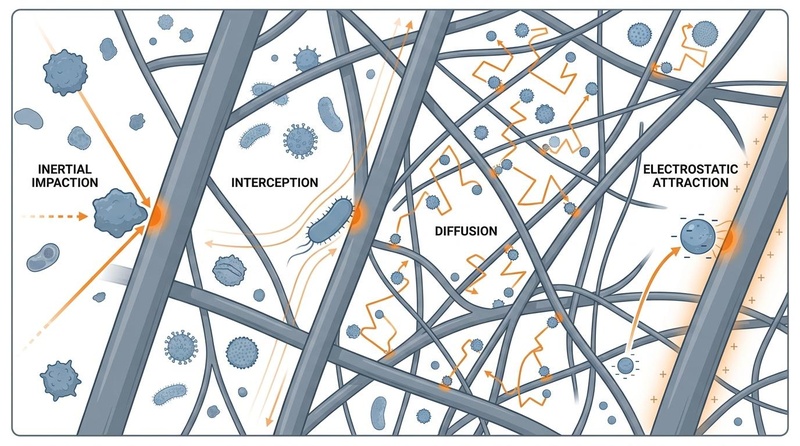
Unlike a simple sieve, fibrous filters (such as HEPA and MERV) do not merely block particles larger than their pore openings. They utilize four distinct physical mechanisms governed by aerosol physics to capture particles of all sizes:
- Inertial Impaction: Large, heavy particles (>1.0 µm) possess too much inertia to follow the curving airstream around a filter fiber. They continue on a straight trajectory and collide directly with the fiber, becoming trapped.
- Interception: Mid-sized particles (0.1 to 1.0 µm) follow the streamlines of the airflow. If a streamline passes within one particle radius of a fiber, the particle touches and adheres to the fiber.
- Brownian Diffusion: Extremely small particles (<0.1 µm) are bombarded by surrounding gas molecules, causing them to move erratically in a zig-zag pattern (Brownian motion). This erratic path increases the probability that they will contact and adhere to a filter fiber.
- Electrostatic Attraction: Some advanced filters use charged synthetic fibers (electrets) to attract and capture charged or polar particles, enhancing capture efficiency without increasing airflow resistance.
The intersection of these mechanisms creates a Most Penetrating Particle Size (MPPS), typically around 0.3 µm, where filtration efficiency is at its lowest. HEPA filters are rated based on their performance at this exact bottleneck (capturing ≥99.97% of 0.3 µm particles) [3:1].
¶ HEPA vs. MERV Standards
- True HEPA: A strict efficiency standard certifying that a filter captures at least 99.97% of airborne particles 0.3 micrometers in diameter [3:2]. "HEPA-type" or "HEPA-like" filters are marketing terms with no certified standards and should be avoided.
- MERV (Minimum Efficiency Reporting Value): A scale from 1 to 16 used to evaluate HVAC filters. Higher MERV ratings indicate superior capture efficiency for smaller particles:
- MERV 1–4: Capture large particles (pollen, dust mites). Low restriction.
- MERV 8: Capture particles down to 3.0 µm (molds, pet dander).
- MERV 11: Capture particles down to 1.0 µm (fine dust, auto emissions).
- MERV 13: Capture particles down to 0.3 µm (smoke, bacteria, virus carrier droplets). This is the minimum recommended rating for environmental health protection.
¶ Does It Work? (Evidence Snapshot)
Air filtration is supported by rigorous human clinical evidence, including randomized crossover trials and systematic reviews.
| Outcome | Population | Effect Size | Quality of Evidence | Study Count & Type | Notes |
|---|---|---|---|---|---|
| Systolic Blood Pressure | Adults with elevated BP | ↓2.8 to 4.0 mmHg [1:2][4:1] | High | Multiple Randomized Crossover Trials | Significant reductions observed within 48–72 hours of operating a HEPA filter. |
| Endothelial & Vascular Function | Healthy and at-risk adults | Significant improvement in microvascular function [8] | High | Systematic Review of RCTs | Filtration reduces circulating biomarkers of endothelial dysfunction (e.g., ET-1). |
| Cognitive Processing Speed | Older Adults (Ages 40+) | ↑12% improvement in executive function [6:1] | Moderate | Secondary analysis of a clinical trial [5:1] | Reduction in PM2.5 levels correlated with faster mental flexibility and executive scores. |
| Allergic Rhinitis Symptoms | Adults & Children with allergies | Significant reduction in nasal symptoms, improved QoL [2:1] | High | Systematic Review & Meta-Analysis | Benefits require consistent operation of HEPA units for >8 hours per day. |
| Respiratory Infection Incidence | Residential & Classroom settings | ↓60% reduction in transmission risk [9] | Moderate | Systematic Review of Cohorts | True HEPA units capture virus-laden aerosol droplets. |
| Indoor PM2.5 Concentration | Active households | ↓50% to 60% average PM2.5 levels [5:2] | High | Field-based observational & RCTs | Real-world reduction varies from 23% to 92% based on room size and ACH. |
¶ Who Benefits Most / Least
Benefits Most:
- Older Adults (Ages 60+): Highly vulnerable to PM2.5-induced autonomic dysfunction, myocardial infarction, and stroke. Filtration acts as a rapid-acting cardiovascular shield [4:2].
- Asthmatics & Allergy Sufferers: Demonstrates immediate, clinically significant reductions in bronchial hyperresponsiveness and antihistamine reliance [2:2].
- Urban & High-Traffic Residents: Individuals living within 150 meters of highways or in highly polluted city centers experience the largest absolute drop in exposure [1:3].
- Developing Children: Protection of growing lungs from developing chronic asthma or permanent reductions in lung capacity (FEV1).
Benefits Least:
- Pristine Rural Residents: Individuals living in remote areas with baseline outdoor PM2.5 levels consistently below 5 µg/m³ and who use electric cooking methods will see marginal clinical improvements, though they still benefit during localized dust or pollen seasons.
¶ How to Try It (Actionable Protocols)
¶ Starter Protocol: Bedroom Sanctuary
Since humans spend approximately one-third of their lives in their bedroom, optimizing this room yields the highest return on investment.
- Calculate Required CADR:
- Measure bedroom floor area in square feet.
- Select a purifier where the Smoke CADR rating is at least 2/3 of the room area.
- Example: For a 150 sq ft bedroom, you need a minimum CADR of 100 CFM (Cubic Feet per Minute) to achieve 5 Air Changes Per Hour (ACH).
- Filter Placement: Place the air purifier at least 3 feet away from walls and furniture to ensure unrestricted 360-degree intake. Do not hide it in a corner.
- Continuous Operation: Operate the purifier continuously on "Medium" or "Low" speed 24/7. Avoid "Auto" modes, as their cheap sensors often underestimate PM2.5 levels and keep the fan too slow.
¶ Standard Protocol: DIY Corsi-Rosenthal Box
For large living areas or budget-constrained environments, a Corsi-Rosenthal box outperforms commercial purifiers costing five times as much, delivering up to 600–800 CFM of clean air.
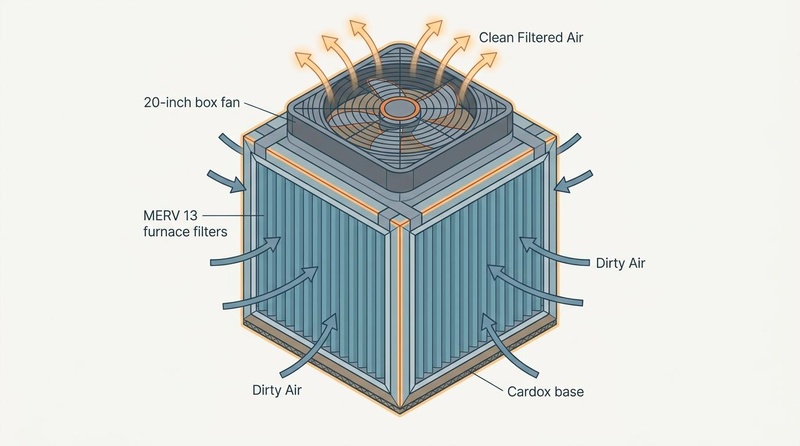
- Materials:
- One 20" x 20" box fan.
- Four 20" x 20" x 1" or 2" MERV 13 furnace filters.
- A 20" x 20" piece of cardboard (cut from the fan box) for the bottom shroud.
- A roll of duct tape.
- Assembly:
- Tape the four filters together to form a square column, ensuring the "airflow direction" arrows on all filters point inward toward the center of the column.
- Tape the cardboard square to the bottom of the column to seal it.
- Tape the box fan to the top of the column, facing upward, so it draws air out of the cube and blows it toward the ceiling.
- Seal all seams and edges thoroughly with duct tape to prevent air bypass.
- Operation: Run the fan on Speed 1 or 2. Replace the filters every 6 months.
¶ Advanced Protocol: Whole-House HVAC Integration
For homes with central heating and air conditioning:
- Upgrade to MERV 13: Replace thin fiberglass filters with a high-capacity pleated MERV 13 filter.
- Check Static Pressure: Verify with an HVAC technician that your system blower can handle the static pressure drop of a MERV 13 filter without overheating or reducing airflow significantly. (Prefer 4-inch or 5-inch thick pleated media over 1-inch filters to reduce pressure resistance).
- Run the Fan Continuously: Set your thermostat fan setting from "Auto" to "ON" or "Circulate" to ensure continuous air filtration even when the system is not actively heating or cooling.
¶ Safety, Interactions, Red Flags
¶ Safety Warnings
- Avoid Ozone-Emitting Technologies: Avoid "ionizers," "electrostatic precipitators," and "plasma air purifiers" unless they are certified ozone-free. These devices generate ozone (), a potent respiratory irritant that causes pulmonary inflammation and reacts with indoor VOCs to produce secondary formaldehyde [3:3]. Choose only CARB-certified (California Air Resources Board) mechanical filters.
- HVAC System Damage: Do not install a high-MERV filter in an older HVAC system without checking. It can choke the airflow, causing the cooling coils to freeze or the heating exchanger to crack, creating a major fire and carbon monoxide hazard.
¶ Red Flags & Stop Criteria
- Musty Odor from Purifier: If your air purifier emits a sweet or musty smell, the carbon or HEPA filter is saturated or damp. Turn it off immediately, inspect for mold, and replace the filter media.
¶ Tracking & What "Good" Looks Like
¶ Objective Metrics
- Indoor PM2.5 levels: Consistently maintained below 9 µg/m³ (complying with the 2024 US EPA standard) [10], and ideally below 5 µg/m³.
- Air Changes Per Hour (ACH):
- Baseline: 0.35 ACH for natural building ventilation [11].
- Clinical Target: 5.0 ACH or higher in bedrooms and active spaces for optimal particle clearance.
¶ Subjective Metrics
- Waking up refreshed: Reduced nasal congestion, morning dry throat, or eye irritation.
- Reduced asthma rescue inhaler use: A tracking metric that should show a declining trend within 2–4 weeks.
¶ Common Mistakes & Myths
- Myth: "Indoor plants will clean my air."
- Reality: This is a persistent misconception. A landmark systematic review proved that potted plants are mathematically useless for indoor air cleaning; it would require 10 to 1,000 plants per square meter to equal the clean air delivery rate of a single mechanical ventilation system or small HEPA unit [2:3].
- Mistake: Operating a purifier in "Auto Mode" only.
- Reality: Purifier auto-modes rely on cheap, inaccurate infrared particle sensors that only ramp up fan speed once pollution is extremely high. Run the fan at a constant medium setting for continuous, preventative cleaning.
- Mistake: Vacuuming and washing HEPA filters.
- Reality: Washing or vacuuming a non-washable HEPA filter destroys the delicate micro-fiber matrix and eliminates the static electret charge, rendering the filter useless. Always replace filters according to the manufacturer's timeline.
¶ Decision Tree (Text-Based)
                       Are you choosing an air filter?
                                      |
                 -------------------------------------------
                |                                           |
         Has central HVAC?                         No central HVAC?
                |                                           |
    --------------------------                    -----------------------
   |                          |                  |                       |
System can handle      Blower cannot        Budget is <$50         Budget is >$150
MERV 13 pressure drop? handle pressure?          |                       |
   |                          |           Build a DIY Corsi-     Buy a CARB-certified
Install deep-pleated    Install MERV 8    Rosenthal Box with     True HEPA Purifier with
MERV 13 + set fan       and buy standalone  4 MERV 13 filters   Smoke CADR >= 2/3 room
to "ON" (continuous)    HEPA units        and a 20" box fan      area (run continuously)
¶ FAQs
¶ Can a HEPA filter capture viruses like SARS-CoV-2?
Yes. While individual viral particles are extremely small (~0.1 µm), they do not travel naked through the air. They are carried in respiratory droplets and aerosols ranging from 0.5 to 10 µm. True HEPA filters capture these carrier droplets with >99.9% efficiency, significantly reducing indoor viral transmission [9:1].
¶ What is CADR and why is it more important than "room size" labels?
Clean Air Delivery Rate (CADR) is an objective measurement of the volume of filtered air a unit delivers, measured in Cubic Feet per Minute (CFM). Manufacturers often print arbitrary "room size" recommendations assuming only 1 or 2 ACH. To get clinical-grade filtration (5 ACH), ignore the room label and use the formula: CADR >= Room Area (sq ft) * 2/3.
¶ How often should I replace HEPA and Carbon filters?
Under normal conditions, a HEPA filter should be replaced every 6 to 12 months, and active carbon filters every 3 to 6 months. Carbon saturated with volatile organic compounds (VOCs) can undergo "desorption," where it begins releasing captured toxic gases back into your home.
¶ Glossary
- CADR (Clean Air Delivery Rate): The metric used to measure the efficiency of an air portable purifier based on cubic feet of fresh air produced per minute.
- HEPA (High-Efficiency Particulate Air): A specific standard of efficiency requiring the capture of at least 99.97% of particles 0.3 µm in size.
- MERV (Minimum Efficiency Reporting Value): A rating system indicating the ability of an HVAC filter to capture particles between 0.3 and 10 µm.
- MPPS (Most Penetrating Particle Size): The particle size (typically around 0.3 µm) that is most difficult for a fibrous filter to capture.
- Pressure Drop: The resistance to airflow created by a filter; higher-efficiency filters create greater pressure drops, which can strain HVAC fans.
¶ Methods (Transparency)
This monograph was compiled by reviewing technical engineering specifications from ASHRAE and clinical endpoints from cardiovascular and respiratory trials in PubMed. High-authority sources include randomized crossover trials assessing HEPA interventions on vascular markers, and systematic reviews on allergic rhinitis. No animal data was used to justify the primary clinical recommendations.
¶ References
¶ Update Log
- 2026-07-06: Added detailed technical and clinical analysis of filtration standards, aerosol capture mechanisms, and updated clinical endpoints including blood pressure and cognitive performance.
Brook, R. D., et al. (2025). Effect of HEPA Filtration Air Purifiers on Blood Pressure: A Pragmatic Randomized Crossover Trial. Journal of the American College of Cardiology, 86(8), 577-589. https://www.jacc.org/doi/10.1016/j.jacc.2025.06.037 ↩︎ ↩︎ ↩︎ ↩︎
Shih, C. K., et al. (2024). Effectiveness of Air Filters in Allergic Rhinitis: A Systematic Review and Meta‐Analysis. Indoor Air. https://onlinelibrary.wiley.com/doi/10.1155/2024/8847667 ↩︎ ↩︎ ↩︎ ↩︎
California Air Resources Board. (2024). Inhalable Particulate Matter and Health (PM2.5 and PM10). Retrieved from https://ww2.arb.ca.gov/resources/inhalable-particulate-matter-and-health ↩︎ ↩︎ ↩︎ ↩︎
Brook, R. D., et al. (2025). Effect of HEPA Filtration Air Purifiers on Blood Pressure: A Pragmatic Randomized Crossover Trial. Journal of the American College of Cardiology, 86(8), 577-589. https://www.jacc.org/doi/10.1016/j.jacc.2025.06.037 ↩︎ ↩︎ ↩︎
Sone, M., et al. (2026). Effect of HEPA filtration air purifiers on cognitive function from a secondary outcome analysis of a pragmatic randomized crossover trial. Scientific Reports. https://www.nature.com/articles/s41598-026-48063-8 ↩︎ ↩︎ ↩︎
The Conversation. (2026, April 16). HEPA air purifiers may boost brain power in adults over 40 – new research. https://theconversation.com/hepa-air-purifiers-may-boost-brain-power-in-adults-over-40-new-research-280885 ↩︎ ↩︎
Wang, X., et al. (2020). Urban PM2.5 Induces Cellular Toxicity, Hormone Dysregulation, Oxidative Damage, Inflammation, and Mitochondrial Interference in the HRT8 Trophoblast Cell Line. Frontiers in Endocrinology, 11, 75. https://www.frontiersin.org/journals/endocrinology/articles/10.3389/fendo.2020.00075/full ↩︎
Li, Z., et al. (2024). Effectiveness of household-level interventions for reducing the impact of air pollution on health outcomes – a systematic review. Frontiers in Environmental Health, 2, 1410966. https://www.frontiersin.org/journals/environmental-health/articles/10.3389/fenvh.2024.1410966/full ↩︎
Green, N., et al. (2023). Effectiveness of filtering or decontaminating air to reduce or prevent respiratory infections: A systematic review. Preventive Medicine, 177, 107771. https://www.sciencedirect.com/science/article/pii/S0091743523003602 ↩︎ ↩︎
U.S. Environmental Protection Agency. (2024, March 6). Reconsideration of the National Ambient Air Quality Standards for Particulate Matter; Final Rule. Federal Register. https://www.federalregister.gov/documents/2024/03/06/2024-02637/reconsideration-of-the-national-ambient-air-quality-standards-for-particulate-matter ↩︎
ASHRAE. (2023). ASHRAE Standard 62.2: Ventilation and Acceptable Indoor Air Quality in Residential Buildings. https://www.ashrae.org/technical-resources/bookstore/standards-62-1-62-2 ↩︎