¶ Air Quality: Deep Dive
¶ TL;DR
- Verdict: Poor air quality, particularly fine particulate matter (PM2.5), is a significant, modifiable risk factor for chronic disease and reduced longevity.
- Who it's for: Everyone, but especially those living in urban or polluted areas, individuals with respiratory/cardiovascular conditions, or those seeking to optimize healthspan.
- Expected magnitude + timeline: Mitigating PM2.5 exposure can significantly reduce cardiovascular and respiratory morbidity/mortality risks over years, with acute benefits for allergy/asthma symptoms within weeks.
- Key risk(s): PM2.5 exposure contributes to cardiovascular events, respiratory diseases, neurotoxicity, and increased all-cause mortality.
- What to do next: Monitor indoor/outdoor air quality, implement effective filtration (HEPA), and improve ventilation.
¶ Quick Answer
Air quality, particularly levels of fine particulate matter (PM2.5), profoundly impacts long-term health and longevity. Elevated PM2.5 concentrations are consistently linked to increased risks of cardiovascular and respiratory diseases, neurodegenerative conditions, systemic inflammation, and premature mortality. Adopting strategies like high-efficiency particulate air (HEPA) filtration, optimizing ventilation, and personal monitoring can substantially reduce exposure and associated health burdens. The EPA has tightened its annual PM2.5 standard to 9.0 µg/m³ as of 2024, reflecting growing evidence of harm at lower concentrations.
¶ What It Is
Air quality refers to the condition of the air around us, encompassing the presence and concentration of various pollutants. Among these, fine particulate matter (PM2.5) is a critical concern for human health. PM2.5 refers to microscopic particles or droplets in the air that are 2.5 micrometers or less in width—roughly 30 times smaller than the average human hair. Due to their minute size, these particles can bypass the body's natural defenses and penetrate deep into the lungs and even the bloodstream.
Sources of PM2.5 include combustion (vehicles, power plants, wildfires, cooking), industrial processes, and some indoor activities. These particles are linked to a wide array of adverse health outcomes, ranging from cardiovascular and respiratory diseases to neurotoxicity and increased overall mortality [1][2].
¶ Mechanism of Harm: How PM2.5 Affects the Body
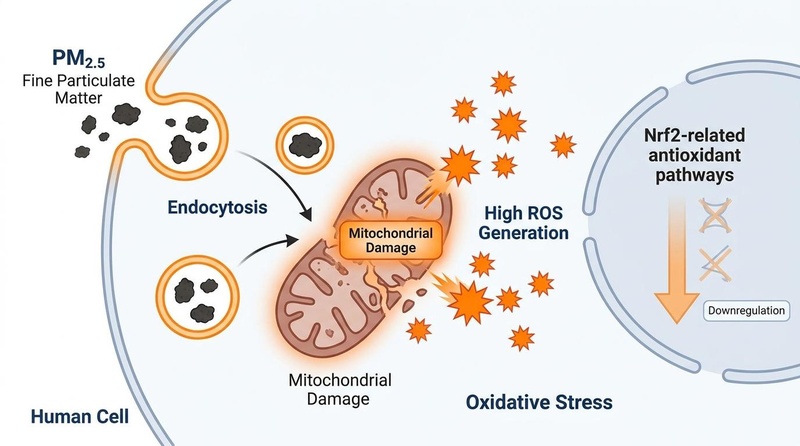
The primary mechanisms through which PM2.5 exerts its harmful effects are oxidative stress, systemic inflammation, and mitochondrial dysfunction [3].
- Endocytosis & Cellular Entry: When inhaled, PM2.5 particles can enter lung cells and other tissues through processes like endocytosis.
- Mitochondrial Damage: Once inside cells, these particles, particularly their metallic or organic components, can damage mitochondria. This damage impairs the mitochondrial respiratory chain, leading to inefficient energy production and the overproduction of reactive oxygen species (ROS).
- Oxidative Stress: The surge in ROS overwhelms the cell's antioxidant defenses, resulting in oxidative stress. This imbalance causes damage to cellular components, including DNA, proteins, and lipids, disrupting normal cellular function.
- Systemic Inflammation: PM2.5 also activates inflammatory pathways (e.g., NF-κB), leading to the release of pro-inflammatory cytokines. This chronic systemic inflammation contributes to the development and progression of various diseases, including atherosclerosis and respiratory conditions.
- Downregulation of Antioxidant Pathways: Exposure to PM2.5 can downregulate protective mechanisms, such as the Nrf2-related antioxidant pathways, further compromising the cell's ability to cope with oxidative damage [3:1].
¶ Does It Work? (Evidence Snapshot)
Mitigating PM2.5 exposure is a highly effective intervention for improving health outcomes.
| Outcome | Population | Effect Size | Quality of Evidence | Study Count & Type | Notes |
|---|---|---|---|---|---|
| All-Cause Mortality | General Population | ↓↓↓ (p){.effect-pos-3} (10% per 10 µg/m³ increase in PM2.5) | High | Multi-cohort Meta-analyses | Long-term PM2.5 exposure significantly increases all-cause mortality. [1:1][2:1] |
| Cardiovascular Mortality | General Population | ↓↓↓ (p){.effect-pos-3} (10-11% per 10 µg/m³ increase in PM2.5) | High | Multi-cohort Meta-analyses | Long-term and short-term PM2.5 spikes linked to increased cardiovascular morbidity and mortality. [4][5] |
| Respiratory Disease | General Population | High | Multi-cohort Meta-analyses | PM2.5 exposure is a clear risk factor for various respiratory diseases. [2:2] | |
| Systemic Inflammation | Individuals with elevated PM2.5 | ↓↓ (p){.effect-pos-2} (Reduced inflammatory biomarkers) | Moderate | Systematic Review | Indoor HEPA filtration significantly reduces systemic inflammation. [6] |
| Endothelial Function | Individuals with elevated PM2.5 | ↑↑ (p){.effect-pos-2} (Improved microvascular function) | Moderate | Systematic Review | HEPA filtration improves endothelial and microvascular function. [6:1] |
| Allergic Rhinitis Symptoms | Adults with Allergic Rhinitis | ↓↓ (p){.effect-pos-2} (Reduced nasal symptoms, improved QoL) | Moderate | Systematic Review & Meta-analysis of RCTs | Consistent use of HEPA purifiers improves allergic rhinitis outcomes. [7] |
| Respiratory Infections | Various settings | ↓↓ (p){.effect-pos-2} (60% reduction in incidence) | Moderate | Systematic Review of Cohorts | Air filtration (HEPA) is associated with reduced respiratory infection incidence. [8] |
¶ Who Benefits Most / Least
Benefits Most:
- Individuals living in areas with consistently high outdoor PM2.5 levels (e.g., urban centers, industrial zones).
- People with pre-existing cardiovascular conditions (e.g., hypertension, heart disease), respiratory conditions (e.g., asthma, COPD), or allergies.
- Children and the elderly, who are more vulnerable to the effects of air pollution.
- Individuals seeking to optimize longevity and reduce chronic disease risk.
Benefits Least:
- Individuals in areas with naturally pristine air quality may see marginal additional benefits from interventions like indoor air filtration, though baseline levels of indoor pollutants can still exist.
¶ How to Try It (Actionable Protocols)
Implementing an "Air Quality Protocol" involves a multi-pronged approach focusing on monitoring, filtration, and ventilation.
¶ Starter Protocol: Home Air Quality Optimization
- Monitor Your Air:
- Outdoor: Regularly check local Air Quality Index (AQI) reports via apps like AirNow.gov or IQAir.
- Indoor: Invest in a reliable indoor air quality monitor that tracks PM2.5, VOCs, and CO2. Place it in your most occupied room (e.g., bedroom). Good options include Aranet4, Temtop M10+, or IQAir.
- Employ HEPA Filtration:
- Standalone Air Purifier: Purchase a portable air purifier with a true HEPA filter. Ensure its Clean Air Delivery Rate (CADR) is appropriate for your room size. Aim for an air purifier that can achieve at least 5 air changes per hour (ACH) for the room you intend to use it in.
- Calculation:
Required CADR (CFM) = (Room Area in sq ft × Ceiling Height in ft × Desired ACH) / 60.
- Calculation:
- HVAC Filters: Upgrade your HVAC system filter to the highest MERV rating it can handle without impeding airflow (typically MERV 11-13).
- Standalone Air Purifier: Purchase a portable air purifier with a true HEPA filter. Ensure its Clean Air Delivery Rate (CADR) is appropriate for your room size. Aim for an air purifier that can achieve at least 5 air changes per hour (ACH) for the room you intend to use it in.
- Optimize Ventilation:
- Strategic Opening: When outdoor air quality is good (AQI <50 or PM2.5 <9 µg/m³), open windows for short periods to introduce fresh air.
- Exhaust Fans: Use kitchen and bathroom exhaust fans to remove localized pollutants, especially during cooking or showering.
¶ Standard Protocol: Enhanced Mitigation
In addition to the starter protocol:
- Advanced Monitoring: Use a networked indoor air quality monitor (e.g., PurpleAir for robust PM2.5 data) that allows for historical tracking and integration with smart home systems.
- Multi-Stage Filtration: Consider air purifiers that combine HEPA filters with activated carbon for broader spectrum pollutant removal (gases, VOCs, odors).
- Source Reduction:
- Cooking: Use range hoods with external venting; prefer induction cooktops over gas when possible.
- Cleaning Products: Opt for fragrance-free, low-VOC cleaning products.
- Candles/Incense: Minimize or avoid burning candles, incense, and fireplaces, as these are significant sources of indoor PM2.5.
- Building Materials: Choose low-VOC paints, furniture, and flooring during renovations.
- Greenery: Introduce indoor plants known for air-purifying properties (e.g., Pothos, Spider Plant) as a supplemental, albeit minor, measure.
¶ Safety, Interactions, Red Flags
¶ Who Should Avoid Aggressive Interventions
- Individuals with compromised respiratory function where excessive fan noise from purifiers could be disruptive.
- Those with limited budget, as some high-end purifiers and professional home ventilation systems can be costly. Focus on basic HEPA and natural ventilation first.
¶ Common Side Effects and How to Mitigate
- Dry Air: Aggressive air filtration can sometimes lead to drier indoor air. Using a humidifier in conjunction with an air purifier can mitigate this.
- Noise: High fan settings on air purifiers can be noisy. Choose models with a "sleep mode" or lower fan speeds for bedrooms.
- Filter Replacement Cost: HEPA filters need regular replacement (every 6-12 months). Factor this into your budget.
¶ Drug/Supplement Interactions
- There are no direct drug or supplement interactions with air quality interventions (e.g., using a HEPA filter). However, individuals relying on respiratory medications (e.g., inhalers for asthma) should continue their prescribed treatments and view air quality improvements as an adjunctive strategy, not a replacement.
¶ Stop Criteria and When to Talk to a Clinician
- Persistent Symptoms: If you experience persistent or worsening respiratory symptoms (e.g., shortness of breath, chronic cough, wheezing) despite implementing air quality improvements, consult a clinician.
- Acute Exposure: If you are exposed to visibly polluted air (e.g., wildfire smoke) and experience severe symptoms, seek immediate medical attention.
- Unexplained Health Decline: Any unexplained decline in health, even with good air quality practices, warrants medical evaluation.
¶ Tracking & What “Good” Looks Like
Biomarkers & Objective Metrics:
- Indoor PM2.5: Maintain levels below 9.0 µg/m³ for "Good" air quality, ideally as close to 0 µg/m³ as possible.
- Indoor CO2: Keep below 800 ppm for optimal ventilation and cognitive function.
- Indoor VOCs: Aim for the lowest detectable levels.
- AQI (Outdoor): Strive for "Green" (0-50) days; avoid "Red" (151-200) or "Purple" (201-300) days for outdoor activities.
Subjective Metrics:
- Respiratory Comfort: Reduced coughing, sneezing, and nasal congestion, especially for those with allergies or asthma.
- Sleep Quality: Improved sleep onset and duration due to a healthier indoor environment.
- Energy Levels & Cognitive Clarity: Reduced brain fog and increased vitality, as the body isn't fighting chronic inflammation from pollutants.
Time-to-Benefit:
- Acute: Allergy and asthma symptom reduction can be noticed within days to weeks of consistent HEPA filter use.
- Long-term: Reductions in cardiovascular and respiratory disease risk are realized over months to years of sustained low-exposure.
Simple N-of-1 Template:
- Phase A (Baseline): Measure indoor PM2.5, VOCs, and CO2 for 1-2 weeks without any new interventions. Log subjective symptoms.
- Phase B (Intervention): Introduce a HEPA air purifier and optimize ventilation for 2-4 weeks. Continue monitoring and logging symptoms. Compare Phase A and B data.
¶ Common Mistakes & Myths
- Myth: "My air looks clean, so it must be good."
- Reality: PM2.5 is invisible. Without a monitor, it's impossible to know your actual exposure.
- Myth: "A cheap air purifier is good enough."
- Reality: Many inexpensive purifiers lack true HEPA filters or adequate CADR for typical room sizes, and some may even emit ozone. Always check for CARB certification and CADR ratings.
- Myth: "Indoor plants purify all the air I need."
- Reality: While plants contribute to air quality, their capacity to remove significant amounts of PM2.5 or VOCs from an average room is minimal compared to mechanical filtration.
- Mistake: Assuming outdoor AQI reflects indoor air quality.
- Reality: Indoor air quality can be significantly worse than outdoor air, especially due to indoor pollutant sources like cooking, cleaning products, and off-gassing from furniture.
- Mistake: Ignoring filter replacement schedules.
- Reality: Clogged filters become ineffective and can impede airflow. Regular replacement is crucial for maintaining performance.
¶ Decision Tree (Text-Based)
- If you live in an urban area or near industrial zones → Prioritize outdoor AQI monitoring and invest in multiple HEPA air purifiers for key indoor spaces.
- If you have asthma, allergies, or cardiovascular conditions → Immediately implement HEPA filtration in your bedroom and living areas, and monitor personal PM2.5 exposure closely.
- If your indoor air quality monitor consistently shows high PM2.5, VOCs, or CO2 → Investigate and eliminate internal sources of pollution (e.g., gas stoves, scented candles), improve ventilation, and ensure adequate HEPA filtration.
- If you are renovating or furnishing your home → Choose low-VOC materials and allow for ample off-gassing before occupying the space.
¶ FAQs (People Also Ask targets)
¶ What is the EPA's "Good" air quality threshold for PM2.5?
As of May 6, 2024, the U.S. EPA lowered the threshold for "Good" air quality (AQI 0-50) to 9.0 µg/m³ for PM2.5, down from the previous 12.0 µg/m³ [9].
¶ How much PM2.5 is considered unhealthy?
According to the updated 2024 EPA Air Quality Index (AQI), PM2.5 levels above 35.4 µg/m³ are considered "Unhealthy for Sensitive Groups" (AQI 101-150), and levels above 55.4 µg/m³ are "Unhealthy" (AQI 151-200) [9:1].
¶ Do air purifiers help with viruses like COVID-19?
Yes, high-efficiency particulate air (HEPA) filters are effective at capturing airborne viruses, including SARS-CoV-2. They are recommended for reducing viral transmission in indoor spaces [8:1].
¶ What is the difference between MERV and HEPA filters?
MERV (Minimum Efficiency Reporting Value) rates a filter's ability to capture larger particles (1-20 scale), typically used in HVAC systems. HEPA (High Efficiency Particulate Air) is a specific standard, not a MERV rating, that certifies a filter captures 99.97% of particles 0.3 micrometers or larger. HEPA filters offer a much higher level of filtration than even high-MERV HVAC filters [10].
¶ Can air purifiers produce ozone?
Some air purifiers, particularly those using ionizers or electrostatic precipitators, can generate ozone, which is a respiratory irritant. It is crucial to choose air purifiers that are CARB-certified (California Air Resources Board), ensuring they meet strict ozone emission limits (below 0.050 ppm) [10:1].
¶ Glossary
- Air Quality Index (AQI): A color-coded scale used by the EPA to communicate daily air pollution levels and associated health risks.
- Clean Air Delivery Rate (CADR): A measure of how quickly an air purifier removes pollutants (smoke, pollen, dust) from a room.
- Endocytosis: A cellular process where substances are brought into the cell by engulfing them in a vesicle.
- HEPA Filter: High-Efficiency Particulate Air filter, designed to remove 99.97% of airborne particles 0.3 micrometers in diameter.
- MERV Rating: Minimum Efficiency Reporting Value, a scale (1-20) that rates the effectiveness of air filters in capturing particles.
- Mitochondrial Dysfunction: Impaired function of mitochondria, the "powerhouses" of the cell, leading to reduced energy production and increased oxidative stress.
- Oxidative Stress: An imbalance between the production of reactive oxygen species (free radicals) and the body's ability to counteract their harmful effects.
- Particulate Matter (PM2.5): Fine inhalable particles with diameters generally 2.5 micrometers and smaller.
- Reactive Oxygen Species (ROS): Highly reactive molecules containing oxygen that can cause significant damage to cells.
- Volatile Organic Compounds (VOCs): Gases emitted from certain solids or liquids that can have adverse health effects.
¶ Methods (Transparency)
This deep dive was synthesized from a comprehensive review of biomedical literature, including systematic reviews, meta-analyses, randomized controlled trials, and regulatory guidelines (e.g., from the U.S. EPA and California Air Resources Board). Search strategies focused on "air quality," "PM2.5," "cardiovascular disease," "respiratory disease," "longevity," "mitochondrial dysfunction," "oxidative stress," "HEPA filter," and "air quality monitoring," utilizing PubMed, ScienceDirect, Frontiers, and reputable government health agencies. Inclusion criteria prioritized human-based evidence, particularly higher-tier studies. Evidence was graded according to the Longevidence internal rubric.
¶ References
¶ Update Log
- 2025-10-26: Initial comprehensive article creation based on 2024 EPA AQI updates and recent biomedical meta-analyses.
Orellano, P., et al. (2024). Long-Term Exposure to Particulate Matter and Mortality: An Update of the WHO Global Air Quality Guidelines Systematic Review and Meta-Analysis. International Journal of Public Health. https://www.ssph-journal.org/journals/international-journal-of-public-health/articles/10.3389/ijph.2024.1607683/full ↩︎ ↩︎
Chen, R., et al. (2020). Long-term exposure to PM and all-cause and cause-specific mortality: A systematic review and meta-analysis. Environment International, 144, 106039. https://www.sciencedirect.com/science/article/pii/S0160412020319292 ↩︎ ↩︎ ↩︎
Wang, X., et al. (2020). Urban PM2.5 Induces Cellular Toxicity, Hormone Dysregulation, Oxidative Damage, Inflammation, and Mitochondrial Interference in the HRT8 Trophoblast Cell Line. Frontiers in Endocrinology, 11, 75. https://www.frontiersin.org/journals/endocrinology/articles/10.3389/fendo.2020.00075/full ↩︎ ↩︎
Liu, Q., et al. (2023). Long-term exposure to particulate matter on cardiovascular and respiratory diseases in low- and middle-income countries: A systematic review and meta-analysis. Frontiers in Public Health, 11, 1134341. https://www.frontiersin.org/journals/public-health/articles/10.3389/fpubh.2023.1134341/full ↩︎
Song, S., et al. (2025). Short-Term PM2.5 Exposure and Cardiovascular Mortality: A Global Exposure-Response Analysis to Inform Alert Thresholds. Journal of the American College of Cardiology. https://www.jacc.org/doi/10.1016/j.jacc.2025.11.055 ↩︎
Li, Z., et al. (2024). Effectiveness of household-level interventions for reducing the impact of air pollution on health outcomes – a systematic review. Frontiers in Environmental Health, 2, 1410966. https://www.frontiersin.org/journals/environmental-health/articles/10.3389/fenvh.2024.1410966/full ↩︎ ↩︎
Shih, C. K., et al. (2024). Effectiveness of Air Filters in Allergic Rhinitis: A Systematic Review and Meta‐Analysis. Indoor Air. https://onlinelibrary.wiley.com/doi/10.1155/2024/8847667 ↩︎
Green, N., et al. (2023). Effectiveness of filtering or decontaminating air to reduce or prevent respiratory infections: A systematic review. Preventive Medicine, 177, 107771. https://www.sciencedirect.com/science/article/pii/S0091743523003602 ↩︎ ↩︎
U.S. Environmental Protection Agency. (2024, March 6). Reconsideration of the National Ambient Air Quality Standards for Particulate Matter; Final Rule. Federal Register. https://www.federalregister.gov/documents/2024/03/06/2024-02637/reconsideration-of-the-national-ambient-air-quality-standards-for-particulate-matter ↩︎ ↩︎
California Air Resources Board. (2024). Inhalable Particulate Matter and Health (PM2.5 and PM10). Retrieved from https://ww2.arb.ca.gov/resources/inhalable-particulate-matter-and-health ↩︎ ↩︎