¶ Balance Training
Balance training refers to targeted physical exercises designed to strengthen the neuromuscular pathways responsible for maintaining an upright posture and managing gravity-induced instability. This training represents a cornerstone of longevity-focused clinical exercise, protecting aging populations from traumatic falls and subsequent loss of functional independence [1][2].
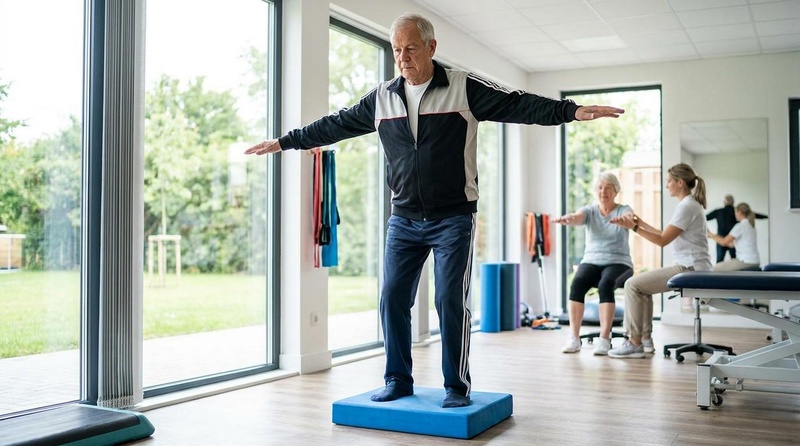
| Primary Target | Postural Control & Fall Prevention |
| Mechanisms | Sensory Reweighting, Motor Remodeling, Cerebellar Synthesis |
| Dosing Schedule | 3 sessions/week (15-30 min) or daily micro-doses |
| Safety Profile | Extremely Safe (with proper stabilization support) |
| Key Markers | Sway Path, Single-Leg Stance, BESTest Score |
| Est. Cost | $0 (Free, optional foam pad $20-$40) |
¶ At a glance
Key points:
- The Ultimate Healthspan Shield: Balance training is the most effective behavioral intervention for mitigating real-world fall incidence, directly reducing the risk of osteoporotic fractures and age-related hospitalization [1:1][3].
- Active Cognitive Loading: Postural stability is not a passive skeletal state; it is an active, cognitively intensive process driven by brainstem-cerebellar synthesis and executive-function pathways [4][5].
- Progressive Challenge Required: Conventional walking or basic strength training does not adequately develop dynamic and reactive balance. High-challenge interventions (unstable surfaces, sensory challenge, and physical perturbations) are required to force neurological adaptation [1:2][6][7].
What people use it for:
- Main goals: Fall prevention, dynamic gait adaptability, vestibular-proprioceptive calibration, and stabilization of functional mobility.
- Evidence quality: High (supported by numerous randomized controlled trials, systematic reviews, and long-term cohort studies).
¶ Safety "Traffic Light"
- ● GREEN LIGHT (Go): Individuals looking to optimize functional healthspan, reverse age-related deconditioning, or enhance athletic/proprioceptive performance.
- ● YELLOW LIGHT (Caution): Individuals with mild-to-moderate peripheral neuropathy, managed vestibulopathies, or history of controlled dizziness. Training must be conducted near a stable handhold or wall [8].
- ● RED LIGHT (Stop/Avoid): Individuals experiencing acute, uncompensated vestibular crises (uncontrolled vertigo), severe orthopedic instability, or profound cognitive impairment [4:1].
¶ Protocol Card
| Parameter | Starter Protocol (Beginner) | Standard Protocol (Intermediate) | Advanced / Perturbation Protocol |
|---|---|---|---|
| Frequency | 3 sessions per week | 3 sessions per week + daily integration | 2-3 sessions per week (highly focused) |
| Duration | 10–15 minutes per session | 15–20 minutes per session | 20–30 minutes per session |
| Primary Tasks | Static single-leg stands, tandem standing, and closed-eye static trials. | Standing on blue foam pad, slow head-shaking, and tandem walking. | Lateral/forward pelvic perturbations, exergaming, and dual-task balance-cognitive challenges. |
| Safety Setup | Stand within arm's reach of a sturdy counter or wall. | Stand near a counter; have a spotter if performing head turns. | Conducted in a designated rehabilitation space or clinic; utilize support rails. |
¶ Bottom Line
Balance training significantly reduces the rate of falls in older adults by 30% to 40% when programmed as a progressive, high-challenge intervention.
¶ The "Why" (Benefits)
¶ Preventing the Traumatic "Longevity Cliff"
As the human body ages, falls represent one of the most abrupt and severe threats to active longevity. A fall resulting in an osteoporotic hip fracture often initiates a downward spiral of rapid muscle wasting (sarcopenia), clinical depression, and loss of independence, carrying a 1-year mortality rate exceeding 20% to 30% in elderly cohorts [1:3]. By systematically training balance, you build a functional safety margin that prevents this trajectory from ever beginning.
¶ Preserving Gait Adaptability and Mobility
A key clinical outcome of aging is the slow, unconscious narrowing of step-recovery limits. Older adults with deconditioned balance strategies exhibit increased gait variability and an intense, self-restricting "fear of falling" (FoF) [9][2:1]. Balance training reverses this deconditioning. It restores confidence, decreases gait variability under challenge, and improves dynamic walking speed across complex, real-world terrains [2:2][10].
¶ Mechanism of Action: The Postural Control Loop
¶ Neural Integration of the Tripartite Loop
Postural control relies on the rapid, real-time integration of three distinct sensory pathways feeding into the brainstem and cerebellum:
- Somatosensory/Proprioceptive System: Mechanoreceptors in the soles of the feet, ankles, and spinal joints detect pressure shifts and joint angles.
- Visual System: Photoreceptors map physical position relative to surrounding spatial horizons and objects.
- Vestibular System: Semicircular canals and otolithic organs in the inner ear measure angular velocity, acceleration, and head position relative to gravity.
The cerebellum acts as the central processor, synthesizing these three inputs to generate a Postural Adjustment Command executed by the motor cortex and spinal reflexes [4:2][11].
¶ The Biology of Sensory Reweighting
When you stand on a firm, well-lit floor, your brain relies heavily on somatosensory inputs (70%) and visual cues (10%), with minimal need for vestibular inputs (20%). However, if you step onto an unstable surface (like a foam pad) or close your eyes, the brain must instantly shift its reliance to the remaining stable senses. This neurological transition is called sensory reweighting [11:1][12].
As we age, sensory reweighting becomes sluggish, leading to a temporary "neurological blackout" when transition states occur (e.g., walking from a well-lit pavement onto a dark, grass path). Balance training forces the central nervous system to accelerate sensory reweighting, drastically reducing latency in correcting unexpected instability [12:1][7:1].
¶ Evidence Summary Table (human outcomes)
| Outcome / Goal | Typical Effect | Consistency | Evidence Quality | Supporting Studies | Notes (population, duration, dose) |
|---|---|---|---|---|---|
| Fall Rate Reduction | High | High | Sharma 2026, Alghosi 2026 | 30% to 40% reduction in rates of falls and fall-related injuries in older adults [1:4][2:3][3:1] | |
| Postural Sway | High | High | Evans 2026, Dyomin 2021 | Significant decrease in mediolateral and anterior-posterior sway path under sensory challenge [7:2][13] | |
| Sensory Reweighting Speed | Moderate | Moderate | Bugnariu 2007, Sápi 2021 | Marked acceleration in adaptation speed to visual and proprioceptive mismatch [11:2][12:2] | |
| Gait Adaptability | High | High | Xie 2026, Swan 2023 | Improved dynamic gait index and better stride time variability under challenge [14][5:1] |
¶ FAQs
¶ Can I improve my balance just by walking?
No. High-quality clinical trials confirm that standard walking on stable, flat pavement does not expose the postural system to sufficient lateral instability or sensory conflict to improve balance [6:1]. Specific balance challenges (such as single-leg standing, tandem walking, and unstable surface trials) are required to force neurological adaptation [1:5][7:3].
¶ How long does it take to see improvements in balance?
Measurable improvements in static balance and postural sway velocity can often be detected via posturography within 4 to 6 weeks of consistent progressive training (3 sessions per week) [7:4][13:1]. Long-term neural remodeling is typically fully consolidated after 10 to 12 weeks of training [1:6][3:2].
¶ References
¶ Update Log
- 2026-07-07: Initial publication of the canonical Balance Training page.
Sharma S, Szabo IZ, Danielsen MB, et al. Perturbation-Based Balance Training Reduces Falls and Fall Injuries in Older People: Insights on Mechanisms and Training Parameters From a Systematic Review. Journal of the American Medical Directors Association. 2026. https://pubmed.ncbi.nlm.nih.gov/42391766/ ↩︎ ↩︎ ↩︎ ↩︎ ↩︎ ↩︎ ↩︎
Alghosi M, Khazanin H, Faraji S. The effect of FallProof exercise programs on balance, fear of falling and quality of life in older adults: a systematic review with meta-analysis. BMC Geriatrics. 2026. https://pubmed.ncbi.nlm.nih.gov/41776466/ ↩︎ ↩︎ ↩︎ ↩︎
Leung WKC, Yau CYC, Chan BCL. Standalone commercial exergame training to improve balance in older adults in care facilities: a systematic review and meta-analysis of recent 10-year randomized controlled trials. BMC Geriatrics. 2026. https://pubmed.ncbi.nlm.nih.gov/41981489/ ↩︎ ↩︎ ↩︎
Horak FB, Wrisley DM, Frank J. The Balance Evaluation Systems Test (BESTest) to Differentiate Balance Deficits. Physical Therapy. 2009. https://pubmed.ncbi.nlm.nih.gov/19329772/ ↩︎ ↩︎ ↩︎
Swan SG, van der Veen SM, Perera RA, et al. Executive function and relation to static balance metrics in chronic mild TBI: A LIMBIC-CENC secondary analysis. Journal of Head Trauma Rehabilitation. 2023. https://pubmed.ncbi.nlm.nih.gov/36712459/ ↩︎ ↩︎
Hausdorff JM. Gait variability: methods, modeling and meaning. Journal of Neuroengineering and Rehabilitation. 2005. https://pubmed.ncbi.nlm.nih.gov/24106864/ ↩︎ ↩︎
Evans JM, Law NY, Ahmed Yahia K, et al. The impact of 14-day head-down bed rest with or without an exercise countermeasure on standing balance control: a randomized controlled trial. Journal of Neuroengineering and Rehabilitation. 2026. https://pubmed.ncbi.nlm.nih.gov/42362567/ ↩︎ ↩︎ ↩︎ ↩︎ ↩︎
Ma R, Xu S, Kang J. Exercise training and balance function in middle-aged and older adults with diabetic peripheral neuropathy: a GRADE-based systematic review and meta-analysis. Frontiers in Public Health. 2026. https://pubmed.ncbi.nlm.nih.gov/41810304/ ↩︎
Smetanova J, Dyomin AV, Ilnitski AN, et al. [Age-related features of postural control among elderly women with fear of falling.]. Advances in Gerontology = Uspekhi Gerontologii. 2026. https://pubmed.ncbi.nlm.nih.gov/42378477/ ↩︎
Guo C, Yin L, Chen P. Effects of Multisensory Integration Training on Postural Stability Characteristics and Fall Risk in Older Adults: Systematic Review and Meta-Analysis. JMIR Aging. 2026. https://pubmed.ncbi.nlm.nih.gov/42096607/ ↩︎
Bugnariu N, Fung J. Aging and selective sensorimotor strategies in the regulation of upright balance. Journal of Neuroengineering and Rehabilitation. 2007. https://pubmed.ncbi.nlm.nih.gov/17584501/ ↩︎ ↩︎ ↩︎
Sápi M, Fehér-Kiss A, Csernák K, et al. The Effects of Exergaming on Sensory Reweighting and Mediolateral Stability of Women Aged Over 60: Usability Study. JMIR Serious Games. 2021. https://www.ncbi.nlm.nih.gov/pmc/articles/PMC8339979/ ↩︎ ↩︎ ↩︎
Dyomin AV, Zashikhina IM, Rukavishnikov AS. [Characteristics of equilibrium function and the sensory organization of postural balance in women 85-95 years old.]. Advances in Gerontology = Uspekhi Gerontologii. 2021. https://pubmed.ncbi.nlm.nih.gov/34998018/ ↩︎ ↩︎
Xie Q, Xiong X, Liu M, et al. Effects of multi-sensory virtual reality training on gait adaptability and somatomotor network remodeling in patients with stroke: a randomized controlled trial. Journal of Neuroengineering and Rehabilitation. 2026. https://pubmed.ncbi.nlm.nih.gov/42069628/ ↩︎