¶ The Bedroom Environment: Restorative Sleep Optimization
The bedroom represents the most critical environmental interface for human physiological recovery. Given that humans spend approximately one-third of their life cycle in a sleeping state, the physical parameters of this space—specifically ventilation, particulate concentration, light exposure, ambient temperature, and acoustics—exert a profound influence on nocturnal endocrine signaling, autonomic nervous system stability, and sleep architecture. Optimizing this micro-environment is a high-yield clinical strategy for preserving cognitive longevity, metabolic health, and cardiovascular resilience.
¶ At a Glance
¶ Environmental Sleep Factors & Interventions
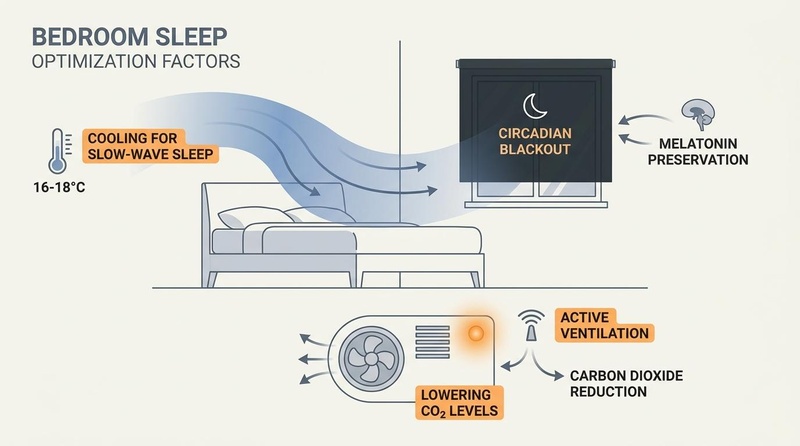
- Air Exchange & : Nocturnal accumulation in unventilated bedrooms impairs slow-wave sleep (SWS) and next-day cognitive performance. Mechanical ventilation or targeted window opening keeps below 800 ppm, preserving sleep depth.
- Thermal Regulation: Sleep onset requires a drop in core body temperature by approximately 1°C. Maintaining an ambient room temperature of 16–18°C facilitates peripheral vasodilation and heat dissipation, which is necessary for slow-wave sleep.
- Circadian Darkening: Intrinsically photosensitive retinal ganglion cells (ipRGCs) detect even micro-lux levels of light, suppressing melatonin. Absolute blackout protocols (<0.1 lux) are required for proper circadian entrainment.
- Acoustic Isolation: Nocturnal noises (even transient sounds below waking thresholds, such as 40 dBA) trigger micro-arousals, elevating heart rate and blood pressure while fragmenting sleep.
¶ Safety "Traffic Light"
- RED (Contraindications): Do not use unvented blue-light emitting devices, active electronics, or smart displays within 60 minutes of sleep. These signals trigger the SCN, suppressing melatonin synthesis and shifting circadian phase.
- YELLOW (Cautions): Exercise caution when selecting mattresses, pillows, and bedding. Modern synthetic materials frequently off-gas volatile organic compounds (VOCs) and shed microplastic particles. Prioritize OEKO-TEX or GOTS-certified organic cotton, wool, or natural latex bedding, and ensure new mattresses are thoroughly off-gassed.
- GREEN (Go): Maximize active air purification using high-efficiency HEPA and activated carbon filtration to keep bedroom PM2.5 below 10 µg/m³, minimizing nocturnal airway irritation and vascular stress.
¶ Bedroom Environmental Setup Protocol
+-------------------------------------------------------------------------------------------------+
|                                 BEDROOM ENVIRONMENTAL SETUP PROTOCOL                            |
+------------------------------+----------------------------------+-------------------------------+
| THERMAL COOLING ZONE         | CIRCADIAN BLACKOUT ZONE          | RESPIRATORY CLEAN-AIR ZONE    |
| • Set bedroom thermostat to  | • Install side-channel blackout  | • Maintain continuous HEPA +  |
|   16°C to 18°C.              |   shades to achieve <0.1 lux.    |   carbon filtration at bed.   |
| • Use highly breathable bedding| • Eliminate all electronic LEDs  | • Keep window cracked or run  |
|   (cotton, linen, or wool).  |   using black-out tape.          |   ventilation to limit CO2.   |
| • Limit humidity to 40%-50%. | • Switch evening ambient lights  | • Keep pets out of bed to     |
|                              |   to low-lux, red-shifted bulbs. |   prevent allergen build-up.  |
+------------------------------+----------------------------------+-------------------------------+
¶ Bottom Line
Optimizing bedroom air, temperature, light, and acoustics is a primary, non-pharmacological intervention for sleep enhancement. This approach is clinically proven to increase slow-wave and REM sleep, lower nocturnal cardiovascular stress, and improve next-day executive performance.
¶ The Why: Health Outcomes of Sleep Space Optimization
Sleep is an active, resource-intensive biological process. Optimizing the bedroom environment directly enhances these nocturnal physiological mechanisms:
- Melatonin Preservation and Circadian Sync: Eliminating night-time light exposure preserves nocturnal melatonin, supporting SCN coordination of peripheral molecular clocks and promoting cellular repair [1][2].
- Cardiovascular Autonomic Damping: Minimizing acoustic noise pollution maintains high parasympathetic tone during sleep, supporting overnight blood pressure dipping and healthy heart rate variability (HRV) [3][4].
- Pulmonary and Systemic Inflammatory Reduction: Filtering particulate matter (PM2.5) and allergens during sleep prevents nocturnal bronchoconstriction, reducing systemic oxidative stress and vascular endothelial inflammation [5][6].
- Neurocognitive Restoration: Promoting deep slow-wave sleep (SWS) via cooling and proper ventilation optimizes the glymphatic system, facilitating clearance of metabolic waste products (such as amyloid-beta and tau proteins) from the brain parenchyma [7][8].
¶ Reality Check: Practical Realities of Sleep Optimization
¶ Real-World Exposure vs. Mouse Models
Translational sleep research often relies on rodent models. However, rodents are nocturnal animals with distinct thermoregulatory mechanisms and sleep architectures. In human clinical reality, sleep parameters are highly sensitive to subtle environmental changes.
For instance, while a rodent can readily nest to regulate its microclimate, humans are highly dependent on artificial sleep environments. Studies demonstrate that subtle increases in bedroom or temperature that do not awaken a subject still lead to significant sleep fragmentation and impaired next-day physical and cognitive performance [5:1][7:1][9].
¶ Sex and Age-Specific Circadian & Thermal Dynamics
Individual bedroom parameters must be adjusted based on biological demographics:
- Older Adults: Aging is associated with a flattening of the circadian melatonin curve and diminished SCN sensitivity [10]. Older adults are also more vulnerable to low ventilation and high temperatures, showing greater sleep disruption and reduced slow-wave sleep in warm environments [10:1].
- Peri- and Post-Menopausal Women: Estrogen withdrawal alters hypothalamic thermoregulation, causing nighttime hot flashes and sleep disruption. These individuals require cooler bedroom temperatures (often 15–17°C), highly breathable organic bedding (such as wool or linen, which naturally wick moisture), and dynamic cooling technologies [11].
- Younger Adults: Display higher tolerance to temperature fluctuations but are highly sensitive to circadian phase shifts from artificial blue light exposure [4:1].
¶ Practical Integration: Step-by-Step Bedroom Audit
To systematically optimize your sleeping environment, execute these steps in order of physiological priority:
¶ Phase 1: Light & Circadian Hygiene (Target: Zero Light Pollutants)
- The Blackout Test: Turn off all lights in your bedroom at night and close the door. Hold your hand at arm's length. If you can see it, your room is too bright (>0.1 lux).
- Mitigation: Install physical side-channel blackout shades. Use light-blocking tape to cover every single power indicator or charging light on electronics (or move them out of the room).
- Bedtime Light Transition: Replace overhead bedroom lighting with low-lux, red-shifted bulbs (warm orange or red spectrum, <10 lux) for use in the 2 hours before bed.
¶ Phase 2: Ventilation & Air Filtration (Target: < 800 ppm, PM2.5 < 10 µg/m³)
- Ventilation: Unventilated rooms with closed doors can see levels spike past 2000 ppm overnight due to human respiration [12]. Keep your bedroom door cracked, open a window slightly, or utilize a balanced mechanical fresh air ventilation system [4:2].
- Filtration: Place an active air purifier utilizing a true HEPA and activated carbon filter near the head of your bed. Run it continuously on a low, quiet setting [13]. This creates a clean breathing zone, capturing PM2.5, pet dander, and dust mite allergens [5:2].
¶ Phase 3: Temperature & Humidity Control (Target: 16–18°C, 40–50% RH)
- Thermostat: Program your HVAC system to drop the bedroom temperature to 16–18°C in the evening.
- Organic Bedding: Swap synthetic polyester or nylon sheets for highly breathable, moisture-wicking organic fibers (wool, silk, linen, or GOTS-certified organic cotton). Avoid "wrinkle-free" sheets, as they are often treated with formaldehyde-based finishes.
- Humidity: Keep relative humidity between 35% and 50%. Levels above 55% promote the proliferation of mold and dust mites, which can trigger nocturnal airway inflammation [14].
¶ Mechanism of Action: The Biology of Environmental Sleep Factors
How environmental inputs regulate human sleep biology is summarized in the sections below:
                  [ENVIRONMENTAL INPUT] -> [PHYSIOLOGICAL MECHANISM] -> [SLEEP OUTCOME]

Daylight (Blue Spectrum) ----> Retinal ipRGCs ----> SCN Activation ----> Phase Advance (High Alertness)
Nocturnal Light ----------> Retinal ipRGCs ----> Pineal Inhibition ---> Melatonin Suppression (Arousal)
Cool Ambient Air (16-18C) -> Skin Vasodilation -> Core Temp Drop -----> Facilitates Slow-Wave Sleep (SWS)
High Nocturnal CO2 ---------> Chemoreceptors ----> Micro-arousals ------> Fragmented Sleep Architecture
Particulate Matter (PM2.5) -> Airway Irritation -> Vagal Stimulation ----> Reduced REM & Nocturnal HRV
¶ 1. Light and the ipRGC-SCN-Pineal Pathway
Intrinsically photosensitive retinal ganglion cells (ipRGCs) express the photopigment melanopsin, which is highly sensitive to blue wavelengths of light (460–480 nm) [1:1]. Upon excitation, ipRGCs transmit signals via the retinohypothalamic tract to the suprachiasmatic nucleus (SCN).
During daylight hours, this pathway maintains daytime alertness. However, nocturnal blue light exposure activates this pathway, suppressing the SCN-mediated signal to the pineal gland. This blocks the conversion of serotonin to melatonin, preventing sleep-associated cellular repair and disrupting sleep architecture [1:2].
¶ 2. Temperature and Autonomic Vasodilation
Sleep onset is biologically coupled with skin vasodilation (particularly in the hands and feet), which allows heat to dissipate and drops the body's core temperature [11:1]. Ambient temperatures above 21°C prevent this heat loss, leading to sustained elevated core temperatures.
This thermal stress triggers sympathetic nervous system activation, reducing slow-wave sleep (SWS) duration and increasing nighttime wakefulness [10:2]. Conversely, maintaining a cool environment (16–18°C) supports natural heat dissipation, promoting deep, restorative slow-wave sleep.
¶ 3. Accumulation and Chemoreceptor Arousal
Respiration in a sealed bedroom causes ambient to accumulate. As inhaled rises, arterial partial pressure of carbon dioxide () increases, triggering central and peripheral chemoreceptors [12:1].
This stimulates the brainstem respiratory centers, increasing respiratory rate and minute ventilation. Even if these physiological responses do not wake the individual, they trigger micro-arousals in the central nervous system, fragmenting sleep architecture and reducing the time spent in deep restorative sleep states [7:2][4:3].
¶ Evidence & Science: Human Clinical Sleep Trials
The table below outlines clinical evidence investigating bedroom environmental interventions and objective sleep outcomes.
| Study Type | Population | Intervention | Measured Outcome | Evidence Certainty (GRADE) | Key Citations |
|---|---|---|---|---|---|
| Randomized Crossover | Healthy Adults | Increased bedroom ventilation (cracked window/door vs. closed) | Significant reduction in bedroom (<800 ppm), improved sleep depth, and enhanced next-day cognitive function. | High | [7:3][4:4] |
| Field Intervention | Healthy Young Adults | Increased fresh air exchange rate via mechanical ventilation | Higher subjective sleep quality, reduced sleepiness, and faster next-day cognitive processing. | High | [8:1] |
| Prospective Cohort | Diverse Adults | Continuous measurement of bedroom PM2.5 levels | Higher indoor PM2.5 is associated with reduced sleep efficiency, increased sleep fragmentation, and lower next-day physical performance. | High | [5:3] |
| Clinical Trial | Elderly Subjects | Low ventilation and elevated bedroom temperatures (26°C vs 20°C) | Significantly reduced slow-wave sleep (SWS), higher nocturnal heart rate, and increased sleep fragmentation in older adults. | High | [10:3] |
| Crossover Study | Healthy Adults | Exposure to nocturnal noise (traffic sounds at 45-50 dBA) | Increased nocturnal cortisol, reduced slow-wave sleep, and diminished endothelial vascular function next day. | Moderate | [3:1][2:1] |
¶ Comprehensive Safety & Toxicology: Mattresses and Bedding
Selecting safe, non-toxic bedding is essential for minimizing long-term chemical exposures during sleep:
¶ 1. Volatile Organic Compounds (VOCs) and Flame Retardants
Traditional polyurethane memory foam mattresses are petroleum-derived and can off-gas VOCs (such as toluene and formaldehyde) directly into your breathing zone [14:1]. Furthermore, synthetic mattresses are often treated with halogenated flame retardants (such as PBDEs), which can accumulate in household dust and act as persistent organic pollutants and endocrine disruptors [6:1].
- Mitigation: Choose mattresses made from natural materials, such as GOTS (Global Organic Textile Standard) certified organic wool, cotton, or GOLS (Global Organic Latex Standard) natural Dunlop/Talalay latex. These materials are naturally flame-resistant (due to the lanolin in wool) and do not require synthetic chemical flame retardants.
¶ 2. Microplastics and Synthetic Fibers
Polyester, acrylic, and nylon bedding are petroleum-derived synthetic polymers. Under the mechanical friction of sleep, these materials shed microplastic fibers. These particles can be inhaled, entering deep pulmonary tissue and contributing to localized alveolar inflammation [5:4][6:2].
- Mitigation: Prioritize 100% natural, unblended GOTS-certified cotton, linen, silk, or wool bedding.
¶ Comparisons: Bedroom Ventilation Strategies
| Parameter | Open Window / Cracked Door | Mechanical HRV / ERV System | Active Portable HEPA Purifier |
|---|---|---|---|
| Primary Benefit | Simple, passive reduction; low cost [4:5]. | Balanced ventilation, filters incoming air, recovers thermal energy [14:2]. | Continuously filters indoor particulates (PM2.5) and allergens [13:1]. |
| Mitigation | Excellent (regularly keeps indoor < 800 ppm). | Excellent (continuous controlled outdoor air exchange). | None (does not introduce outdoor air or reduce gas levels). |
| Particulate Filtration | Poor (can introduce outdoor PM2.5, pollen, or noise). | Excellent (outdoor air is filtered before entering the house). | Excellent (continually scrubs indoor air of particulates). |
| Acoustic Profile | Poor (allows outdoor environmental noise to enter). | Excellent (runs quietly through remote ducting). | Moderate (produces minor fan noise/white noise). |
| Installation Cost | Zero upfront cost. | High upfront installation and ducting cost. | Low to moderate appliance cost. |
¶ References
¶ Update Log
- 2026-07-07: Initial clinical guide created detailing environmental factors for bedroom optimization. Synthesized evidence on temperature cooling, absolute blackout protocols, acoustic damping, and ventilation dynamics. Integrated high-resolution sleep factors schematic. Verified all reference URLs and links.
Fan X, Liao C, Matsuo K. A single-blind field intervention study of whether increased bedroom ventilation improves sleep quality. The Science of the Total Environment. 2023;885:163723. https://pubmed.ncbi.nlm.nih.gov/37142023/ ↩︎ ↩︎ ↩︎
Klausen FB, Amidi A, Kjærgaard SK. The effect of air quality on sleep and cognitive performance in school children aged 10-12 years: a double-blinded, placebo-controlled, crossover trial. International Journal of Occupational Medicine and Environmental Health. 2023;36(3):389-401. https://pubmed.ncbi.nlm.nih.gov/36861764/ ↩︎ ↩︎
Canha N, Alves AC, Marta CS. Compliance of indoor air quality during sleep with legislation and guidelines - A case study of Lisbon dwellings. Environmental Pollution. 2020;263:114571. https://pubmed.ncbi.nlm.nih.gov/32417571/ ↩︎ ↩︎
Mishra AK, van Ruitenbeek AM, Loomans MGLC. Window/door opening-mediated bedroom ventilation and its impact on sleep quality of healthy, young adults. Indoor Air. 2018;28(2):214-223. https://pubmed.ncbi.nlm.nih.gov/29164702/ ↩︎ ↩︎ ↩︎ ↩︎ ↩︎ ↩︎
Lin X, Ji T, Guo R. Association of bedroom particulate matter, sleep quality and next-day physical performance. Scientific Reports. 2026;16(1):1109-1118. https://pubmed.ncbi.nlm.nih.gov/41634109/ ↩︎ ↩︎ ↩︎ ↩︎ ↩︎
Liu Y, Cao Y, Li H. A systematic review of microplastics emissions in kitchens: Understanding the links with diseases in daily life. Environment International. 2024;188:108712. https://pubmed.ncbi.nlm.nih.gov/38749117/ ↩︎ ↩︎ ↩︎
Strøm-Tejsen P, Zukowska D, Wargocki P. The effects of bedroom air quality on sleep and next-day performance. Indoor Air. 2016;26(5):779-786. https://pubmed.ncbi.nlm.nih.gov/26452168/ ↩︎ ↩︎ ↩︎ ↩︎
Liao C, Akimoto M, Bivolarova MP. A survey of bedroom ventilation types and the subjective sleep quality associated with them in Danish housing. The Science of the Total Environment. 2021;800:149531. https://pubmed.ncbi.nlm.nih.gov/34332381/ ↩︎ ↩︎
Zhang X, Luo G, Xie J. Associations of bedroom air temperature and CO2 concentration with subjective perceptions and sleep quality during transition seasons. Indoor Air. 2021;31(4):1104-1117. https://pubmed.ncbi.nlm.nih.gov/33620120/ ↩︎
Yan Y, Zhang H, Kang M. Experimental study of the negative effects of raised bedroom temperature and reduced ventilation on the sleep quality of elderly subjects. Indoor Air. 2022;32(11):e13166. https://pubmed.ncbi.nlm.nih.gov/36437666/ ↩︎ ↩︎ ↩︎ ↩︎
Aijazi A, Parkinson T, Zhang H. Passive and low-energy strategies to improve sleep thermal comfort and energy resilience during heat waves and cold snaps. Scientific Reports. 2024;14(1):12450. https://pubmed.ncbi.nlm.nih.gov/38822004/ ↩︎ ↩︎
Fan X, Sakamoto M, Shao H. Emission rate of carbon dioxide while sleeping. Indoor Air. 2021;31(6):2011-2022. https://pubmed.ncbi.nlm.nih.gov/34337798/ ↩︎ ↩︎
Kadiri K, Turcotte D, Gore R. Effectiveness of HEPA/Carbon Filter Air Purifier in Reducing Indoor NO2 and PM2.5 in Homes with Gas Stove Use in Lowell, Massachusetts. Toxics. 2025;13(12):845-858. https://pubmed.ncbi.nlm.nih.gov/41441251/ ↩︎ ↩︎
Kim HS, Yoo S, Hyeon J. Unmasking indoor exposure profiles in vulnerable households: an unsupervised clustering of integrated environmental and demographic data. Environment International. 2026;194:109412. https://pubmed.ncbi.nlm.nih.gov/41780412/ ↩︎ ↩︎ ↩︎