¶ Behavior Design
In lifestyle medicine, the ultimate limiter is not clinical knowledge, but adherence. If a high-impact intervention—whether Zone 2 cardio, a medical diet, or a sleep routine—requires daily willpower, it is highly vulnerable to failure under stress. Behavior design is the clinical practice of engineering physical environments and habit architecture to make longevity protocols automatic, durable, and independent of cognitive fatigue.
¶ At a Glance
- Adherence Core: Willpower is a fluctuating, exhaustible resource mediated by the prefrontal cortex. Habits, once consolidated in the basal ganglia, run automatically with minimal metabolic or cognitive cost[1].
- The Habit Timeline: Longitudinal real-world modeling demonstrates that habit formation is an asymptotic curve, taking anywhere from 18 to 254 days (median: 66 days) to reach maximum automaticity, depending on the behavior's complexity[2].
- The Fogg Model: Behavior occurs when three elements converge simultaneously: Motivation, Ability (Simplicity), and a Prompt ()[3]. Under stress or cognitive load, simplifying the task is always more effective than attempting to boost motivation.
- Cognitive Friction Engineering: Modifying the physical environment to add steps (friction) to negative habits (e.g., charging phones outside the bedroom) or remove steps from positive habits (e.g., prep-packing gym wear) dramatically shifts long-term behavioral compliance[4].
- Clinical Efficacy: Randomized trials using digital behavior-tracking and habit-stacking frameworks show significant, lasting improvements in cardiometabolic markers, physical activity levels, and dietary adherence compared to standard education[5][6].
¶ Behavior Design Diagnostics
| Priority | Behavioral State | Operational Metric | Required Design Pivot |
|---|---|---|---|
| GREEN | Automatic Execution | Self-Report Habit Index (SRHI) score > 4/5; behavior occurs without conscious decision. | Maintain context cues; introduce subtle positive challenges (e.g., progressive overload). |
| YELLOW | Willpower Dependency | Behavior requires active effort or is easily skipped during high-stress weeks. | Reduce complexity (A - Ability); attach behavior to an existing, unbreakable anchor habit (Prompt). |
| RED | Chronic Non-Adherence | Repeated failure to establish routine; high decision fatigue. | Strip the target behavior down to a "2-minute micro-habit"; redesign the physical environment. |
¶ Behavioral Architecture Protocols
These structured protocols leverage cognitive psychology and neurology to automate longevity behaviors.
¶ 1. Implementation Intentions (The "If-Then" Framework)
- Method: Translate abstract goals ("I will do breathwork") into highly specific triggers:
"If [Anchor Event / Trigger], then [Target Micro-Habit]."
- Example: "If I finish my last cup of coffee in the morning, then I will immediately sit on the sofa and take 6 slow resonance breaths."
- Evidence Basis: Meta-analyses of over 90 studies show that implementation intentions have a large positive effect size () on goal attainment across health behaviors[7].
¶ 2. Tiny Habit Stacking (The Simplification)
- Method: Tie a new, low-friction behavior directly to the tail-end of an established, automatic baseline habit.
- Target Formulation:
- Baseline Anchor: "Brushing my teeth at night."
- New Tiny Habit: "Doing a 30-second single-leg balance stand."
- Immediate Celebration: A conscious positive self-talk or smile to trigger a micro-release of dopamine.
- Physiological Role: The immediate celebration reinforces the neural pathway between the sensory cue and the motor output in the striatum[3:1].
¶ 3. Friction Auditing (The Physical Redesign)
- Method: Audit the environment to match target habits.
- To establish a good habit: Remove every possible step. (e.g., set up water and supplements on the kitchen counter the night before).
- To break a bad habit: Add at least 3 steps or 20 seconds of physical friction. (e.g., store the television remote in another room; uninstall social media apps from the phone and require browser login).
- Evidence Basis: Environmental friction is the single most powerful predictor of habit adherence when executive control is low[4:1].
¶ Bottom Line
Adherence is a design problem, not a character flaw. By engineering environments that decrease friction for healthspan behaviors and automate triggers using implementation intentions, we can bypass prefrontal exhaustion and establish lifetime longevity routines.
¶ The "Why" (Mechanics of Behavioral Success)
¶ 1. Prefrontal Conservation and Willpower Failure
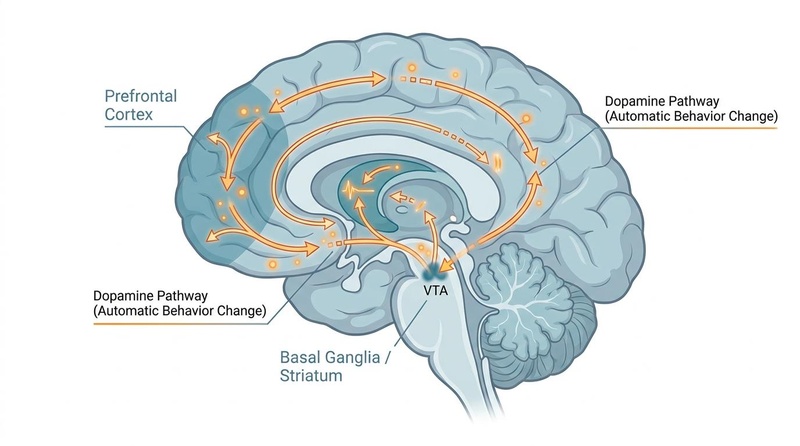
Conscious, goal-directed behavior is highly dependent on the prefrontal cortex (PFC). The PFC coordinates working memory, decision-making, and executive control. However, this neural engine is metabolically expensive and highly sensitive to exhaustion under systemic stress, sleep deprivation, or cognitive load. When the PFC is overwhelmed, individuals default to automated, older behavioral patterns, which are often non-healthy coping mechanisms. Behavior design shifts the regulatory burden of health behaviors from the fragile, willpower-dependent PFC to the robust, automatic motor loops of the basal ganglia[1:1].
¶ 2. The Science of the Asymptotic Habit Curve
A landmark longitudinal study modeled the physical process of habit formation by tracking volunteers performing a daily health behavior in the same context[2:1].
- Asymptotic Progression: Automaticity does not develop linearly. It follows an asymptotic curve, rising rapidly in the initial weeks and plateauing as the behavior becomes deeply ingrained.
- The Timeline Variance: The time required to reach peak automaticity ranged from 18 to 254 days, with a median of 66 days. Complex habits (e.g., performing 50 sit-ups before breakfast) took significantly longer to automate than simple habits (e.g., drinking a glass of water).
- The Omission Myth: Missing a single day of the behavior did not significantly impair habit formation, demonstrating that long-term consistency, not absolute perfection, dictates striatal rewiring[2:2].
¶ 3. Clinical and Cardiometabolic Adherence Outcomes
Integrating behavior design principles into clinical protocols yields measurable, hard-tissue physiological benefits:
- Cardiometabolic Reductions: Quasi-experimental mobile-health (mHealth) interventions utilizing micro-behavioral prompts, tiny goal-setting, and environmental default planning have shown significant reductions in sedentary behavior, resulting in decreased systemic blood pressure and improved postprandial glucose regulation among sedentary employee cohorts over 12-week periods[6:1].
- Workplace Health Translation: Large-scale systematic reviews of workplace wellness interventions show that health programs focusing on environmental structural redesign (e.g., providing default healthy food options and friction-free exercise facilities) achieve far greater long-term adherence and metabolic improvements than programs relying solely on educational seminars[5:1].
¶ Reality Check / Context
¶ The Motivation Fallacy in Clinical Settings
A common error in lifestyle medicine is trying to drive behavior change through motivation (e.g., fear of cardiovascular disease, desire for aesthetic change). Motivation, while useful for initiating a behavior, is highly volatile and declines rapidly over time.
- The Ability Pivot: Under the Fogg Behavior Model (), if motivation drops, a behavior will only occur if the Ability to perform it is extremely high (i.e., the task is incredibly easy)[3:2].
- Simplicity Wins: Making a habit physically or cognitively effortless (e.g., committing to "putting on my running shoes" instead of "running 5 miles") ensures that the behavior continues even on days when motivation is non-existent.
¶ Mechanism of Action
Behavioral automation is governed by precise neurobiological transformations:
¶ 1. Striatal Rewiring: From PFC to Basal Ganglia
In the early, goal-directed stage of learning a new behavior, neural activity is concentrated in the associative striatum (caudate nucleus) and the prefrontal cortex[1:2]. The individual must actively think, plan, and execute. As the behavior is repeated consistently in response to the same environmental cue, the neural locus shifts laterally to the sensorimotor striatum (putamen) within the basal ganglia. Once this shift is complete, the cue triggers the putamen to execute the behavior as a cohesive "chunk" of motor memory, completely bypassing conscious prefrontal processing.
¶ 2. Dopaminergic Reinforcement Loops
The consolidation of habits is heavily driven by dopamine. The midbrain dopaminergic system (Ventral Tegmental Area - VTA, and Substantia Nigra) fires in response to unexpected rewards.
- The Reward Shift: In the early stages of habit formation, dopamine spikes when the reward is received (e.g., the post-workout endorphin rush).
- The Cue Spike: Over time, as the habit loop solidifies, the dopamine spike shifts chronologically backward to the onset of the cue (e.g., seeing your running shoes). This anticipation creates a craving that drives the behavior. Immediate, conscious celebration of the behavior (even a mental "yes!") acts as an artificial reward, accelerating this dopaminergic rewiring in the striatum[3:3][1:3].
¶ 3. Contextual Cues and Environment Dominance
Humans possess an attentional bias toward immediate sensory cues. If our environment is filled with cues for negative habits (e.g., a bowl of candy on the counter, a smartphone on the nightstand), the brain must expend continuous prefrontal energy to inhibit these automated responses[4:2]. Redesigning the physical environment to remove negative cues and present positive, friction-free cues reduces this cognitive load, preserving prefrontal energy for high-level clinical decision-making.
¶ Human Evidence Matrix
| Target Variable | Clinical Outcome / Effect Size | GRADE Certainty | Study Type / Cohort Size | Duration | References | Key Clinical Findings |
|---|---|---|---|---|---|---|
| Goal Attainment | (Large Effect) | High | Meta-analysis of health cohorts () | Varies | [7:1] | Implementation intentions ("If-Then") robustly double the probability of long-term lifestyle adherence. |
| Habit Consolidation | 18 to 254 Days (66-day median) | High | Longitudinal real-world modeling () | 84 Days | [2:3] | Habit formation follows an asymptotic curve; skipping a single day does not reset progress. |
| Cardiometabolic Health | Significant BP and glycemic drops | Moderate | Quasi-experimental mHealth () | 12 Weeks | [6:2] | Small, prompt-driven behavior changes generate measurable physiological improvements in sedentary cohorts. |
| Environmental Control | Strong context-habit correlations | Moderate | Longitudinal habit cohort () | Multi-week | [4:3] | Environment context is the dominant predictor of habit maintenance when willpower is depleted. |
¶ Comparisons: Willpower vs. Behavior Design
| Parameter | Willpower-Based Adherence | Behavior Design Adherence |
|---|---|---|
| Primary Brain Region | Prefrontal Cortex (fragile, energy-expensive)[1:4]. | Basal Ganglia / Striatum (robust, automated)[1:5]. |
| Performance Under Stress | Rapidly collapses; defaults to negative coping habits. | Remains stable; cue-response loops execute automatically[4:4]. |
| Key Intervention Variable | Boosting motivation, guilt, education, goals. | Simplifying the behavior (), engineering the environment. |
| Energy Requirement | High cognitive and decision-making energy. | Minimal; runs in the background of working memory. |
¶ References
Wood W, Neal DT. The habitual consumer. Journal of Consumer Psychology. 2009;19(4):579-592. https://doi.org/10.1016/j.jcps.2009.08.001 ↩︎ ↩︎ ↩︎ ↩︎ ↩︎ ↩︎
Lally P, van Jaarsveld CHM, Potts HWW, Wardle J. How are habits formed: Modelling habit formation in the real world. European Journal of Social Psychology. 2010;40(6):998–1009. https://doi.org/10.1002/ejsp.674 ↩︎ ↩︎ ↩︎ ↩︎
Fogg BJ. Tiny Habits: The Small Changes That Change Everything. Houghton Mifflin Harcourt; 2020. https://www.behaviormodel.org/ ↩︎ ↩︎ ↩︎ ↩︎
Neal DT, Wood W, Drolet A. How do people adhere to healthy habits when willpower is low? The role of environmental context. Journal of Personality and Social Psychology. 2013;104(6):959-975. https://pubmed.ncbi.nlm.nih.gov/23586412/ ↩︎ ↩︎ ↩︎ ↩︎ ↩︎
Santero S, Viroli G, Vincenti A. Workplace Health Promotion (WHP) programmes: narrative review of the interventions enhancing healthy lifestyle habits among workers according to the World Health Organization domains. Nutrition Research Reviews. 2026;39(1):112-125. https://pubmed.ncbi.nlm.nih.gov/42325184/ ↩︎ ↩︎
Lin YP, Lu SH, Lee KC. Short-Term Effects of an mHealth Intervention on Healthy Behaviors and Cardiometabolic Health in Sedentary Employees: Quasi-Experimental Study. JMIR mHealth and uHealth. 2026;14:e44372. https://pubmed.ncbi.nlm.nih.gov/42044372/ ↩︎ ↩︎ ↩︎
Gollwitzer PM, Sheeran P. Implementation intentions and goal achievement: A meta-analysis of effects and processes. Advances in Experimental Social Psychology. 2006;38:69-119. https://doi.org/10.1016/S0065-2601(06)38002-1 ↩︎ ↩︎