¶ Blood-Based Interventions: A Deep Dive into Longevity Applications
¶ TL;DR
- Actionable Interventions: Therapeutic Plasma Exchange (TPE) and Platelet-Rich Plasma (PRP) are clinically established with evidence for specific conditions; plasma dilution is emerging for longevity.
- Evidence Spectrum: TPE has high certainty for approved medical conditions, moderate for Alzheimer's; PRP has moderate-to-high certainty for localized repair; plasma dilution is low certainty but promising for biological age reduction.
- Avoid: "Young blood" transfusions and heterochronic parabiosis are experimental/historical and not recommended for human therapeutic use due to lack of evidence and high risks.
- Key Risks: All blood-based interventions carry risks of infection, immune reactions, and cardiovascular complications, requiring strict medical oversight.
- Clinical Implementation: Systemic blood-based therapies require formal clinical staging, comprehensive baseline biomarker evaluation, and credentialed facility oversight to manage physiological risk profiles.
¶ Quick Answer
Blood-based longevity interventions leverage therapeutic techniques to modify the circulating environment, aiming to remove age-related detrimental factors and/or introduce rejuvenating components. Clinically, this primarily involves Therapeutic Plasma Exchange (TPE), which can reduce biological age by an average of 2.6 years, and Platelet-Rich Plasma (PRP) for localized tissue repair. Experimental concepts like young blood transfusions are strongly discouraged for human application due to insufficient evidence and safety concerns.
¶ What It Is
Blood-based interventions are a class of therapeutic approaches focused on manipulating the composition of blood or plasma to influence systemic aging processes and promote rejuvenation. These interventions broadly include:
- Therapeutic Plasma Exchange (TPE): A procedure that removes a patient's plasma (which contains age-related inflammatory factors, senescent proteins, and autoantibodies) and replaces it with a colloid solution, typically 5% human albumin. This effectively dilutes or removes harmful circulating factors while preserving beneficial cellular components [1][2].
- Plasma Dilution (Neutral Blood Exchange, NBE): A specific form of TPE focusing on diluting the "old" systemic environment. It involves replacing a significant portion of plasma volume with saline and albumin, which has been shown to rejuvenate tissues by removing inhibitory age-related molecular excesses [3][4].
- Platelet-Rich Plasma (PRP) Therapy: An autologous (using the patient's own blood) treatment where platelets are concentrated and reinjected into target tissues. These concentrated platelets release a supraphysiologic cocktail of growth factors and anti-inflammatory proteins, stimulating tissue repair and regeneration [5][6].
What doesn't count for clinical application:
- Heterochronic Parabiosis: The surgical joining of circulatory systems between young and old animals, a foundational research model, but not a human therapy [7].
- "Young Blood" Transfusion: Direct infusion of plasma from young donors into older individuals. This approach is highly controversial, lacks robust human evidence for anti-aging benefits, and is cautioned against by regulatory bodies [8][9].
The underlying mechanism in many of these interventions is the recalibration of systemic signaling networks by removing immunoglobulins, immune complexes, complement elements, and cytokines, thereby influencing cellular senescence and inflammatory pathways that drive aging [2:1][3:1].
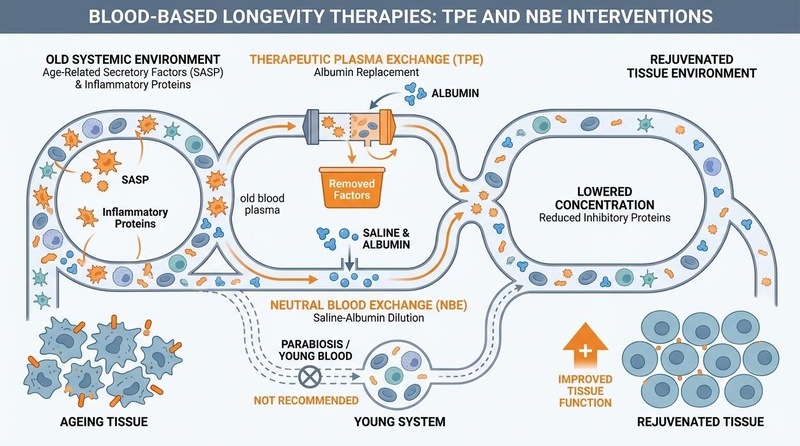
¶ Does It Work? (Evidence Snapshot)
The efficacy of blood-based interventions varies significantly based on the specific intervention and its intended application. Human evidence is strongest for established medical uses, while longevity applications are still emerging.
¶ Evidence Summary Table (Human Outcomes)
| Intervention Type | Outcome | Population | Effect Size / Finding | Certainty | Supporting Sources |
|---|---|---|---|---|---|
| Therapeutic Plasma Exchange (TPE) | Various medical indications (e.g., autoimmune, neuroinflammatory diseases) | Patients with approved conditions | Standard-of-care, robust efficacy | High (Grade A) | [1:1][2:2] |
| Therapeutic Plasma Exchange (TPE) | Slowing cognitive & functional decline | Mild-to-moderate Alzheimer's disease patients | Significantly slowed decline in AMBAR trial | Moderate (Grade B/C) | [10] |
| Plasma Dilution (NBE) | Reduction in biological age, youthful proteome shift | Small human cohort (preliminary) | Average 2.6 years biological age reduction, decreased SASP markers | Low (Grade C/D) | [4:1] |
| Platelet-Rich Plasma (PRP) | Knee osteoarthritis pain & function | Patients with knee osteoarthritis | Significantly reduced pain, improved mobility | Moderate to High (Grade B) | [11] |
| Platelet-Rich Plasma (PRP) | Skin elasticity, wrinkle volume, aesthetic satisfaction | Patients with cutaneous aging | Statistically significant improvements | Moderate to High (Grade B) | [6:1] |
| Heterochronic Young Blood Transfusions | Systemic longevity & anti-aging in humans | N/A (Experimental, not recommended for human use) | Insufficient human data; preclinical shows old blood dominance, regulatory warnings | Very Low (Grade F - Counter-indicated) | [8:1][9:1][7:1] |
¶ Who Benefits Most / Least
Benefits Most:
- TPE for Approved Conditions: Individuals with autoimmune, neurological, or hematological disorders where TPE is a recognized standard of care.
- TPE for Alzheimer's: Patients with mild-to-moderate Alzheimer's disease, based on the AMBAR trial.
- PRP for Localized Repair: Individuals with musculoskeletal injuries (e.g., knee osteoarthritis) or those seeking aesthetic improvements (e.g., skin rejuvenation).
- Individuals with High Inflammatory Burden: Those with elevated systemic inflammatory markers or high levels of senescent-associated secretory phenotype (SASP) factors, as these may be targeted by plasma dilution.
Benefits Least / Should Avoid:
- Healthy Individuals Seeking "Young Blood": There is no scientific basis or regulatory approval for young blood transfusions for anti-aging in healthy humans, and it carries significant risks.
- Individuals with Bleeding Disorders: PRP and TPE procedures involve blood handling and carry risks for those with coagulation issues.
- Immunocompromised Individuals: Increased risk of infection from any blood-based intervention.
- Absence of Clinical Supervision: These procedures carry major systemic risks and must only be performed under credentialed clinical oversight.
¶ How to Try It (Actionable Protocols)
Important: All blood-based interventions should only be considered and performed under the strict guidance and supervision of a qualified medical professional in a licensed clinical setting. Self-administration or use outside of clinical trials is dangerous and not recommended.
¶ Therapeutic Plasma Exchange (TPE) for Specific Indications
- Clinical Context: TPE is a recognized medical treatment for various autoimmune, neurological, and hematological conditions. The specific protocol (frequency, volume, replacement fluid) is determined by the treating physician based on the indication and patient's response.
- Protocol Overview: Blood is drawn, plasma is separated and removed, and replaced with albumin or saline solution.
- Key Consideration: This is a hospital or specialized clinic procedure.
¶ Plasma Dilution (Neutral Blood Exchange, NBE) for Longevity (Emerging)
- Clinical Context: While not yet a standard longevity intervention, plasma dilution protocols are being explored in research settings for their potential to reduce biological age.
- Protocol Overview (Research-based): Similar to TPE, but with a focus on diluting old plasma with saline-albumin. Research protocols typically involve replacing approximately 50% of plasma volume. [3:2]
- Key Consideration: Currently experimental; seek clinics participating in active research if considering.
¶ Platelet-Rich Plasma (PRP) Therapy
- Clinical Context: Used in orthopedics, sports medicine, dermatology, and aesthetic medicine for localized healing and rejuvenation.
- Protocol Overview: A small amount of the patient's blood is drawn, processed to concentrate platelets, and then injected into the target area (e.g., joint, scalp, skin).
- Frequency: Varies by indication, often a series of 1-3 injections over several weeks or months.
- Key Consideration: Ensure the clinic follows proper PRP preparation standards (e.g., minimum 1,000,000 platelets/μL) to ensure efficacy [5:1].
¶ Safety, Interactions, Red Flags
Blood-based interventions, while promising, carry inherent risks that necessitate careful consideration and strict medical oversight.
¶ Who Should Avoid:
- Individuals with Active Infections: Increased risk of sepsis or exacerbation of infection.
- Severe Cardiovascular Instability: TPE can cause fluid shifts and hemodynamic changes.
- Uncontrolled Bleeding Disorders: Procedures involve venous access and risk of bleeding.
- Known Allergies to Blood Products: Albumin or other replacement fluids can trigger reactions.
- Pregnancy/Lactation: Insufficient safety data for many interventions in these populations.
- Healthy Individuals Seeking Unproven Anti-Aging: Specifically, "young blood" transfusions have no established benefit and are actively cautioned against by regulatory bodies like the U.S. FDA due to significant risks and lack of evidence [12].
¶ Common Side Effects & Mitigation:
- Hypotension (Low Blood Pressure): Can occur during TPE due to fluid shifts. Managed by careful monitoring and fluid management.
- Citrate Toxicity: Citrate is used as an anticoagulant during apheresis; can cause hypocalcemia (low calcium), leading to tingling, tremors, or cardiac arrhythmias. Monitored with calcium levels and supplemented if needed.
- Vascular Access Complications: Bruising, hematoma, infection at the needle insertion site. Aseptic technique and skilled operators minimize this.
- Allergic Reactions: To replacement fluids (e.g., albumin) or components. Pre-medication or alternative fluids may be used.
- Infection Transmission: While rare with autologous PRP, TPE using donor products carries theoretical risks. Strict screening and sterile techniques are critical [13][1:2].
- Post-PRP Flare: Temporary pain, swelling, or stiffness at the injection site, usually resolving within a few days.
¶ Drug/Supplement Interactions:
- Anticoagulants/Antiplatelet Agents: Medications like warfarin, aspirin, or NSAIDs can increase bleeding risk during and after procedures. May require temporary discontinuation governed by clinical coagulation monitoring.
- Immunosuppressants: TPE can remove these drugs, potentially reducing their efficacy. Dosing adjustments may be necessary.
- Blood Pressure Medications: May exacerbate hypotension during TPE.
¶ Clinical Discontinuation Criteria & Red Flags
- Severe Allergic Reactions: Anaphylaxis, severe rash, difficulty breathing.
- Persistent Pain, Swelling, Redness: Especially after PRP, could indicate infection or adverse reaction.
- Fever or Chills: Suggests infection.
- Unusual Bleeding or Bruising: Beyond expected after venous access.
- New Neurological Symptoms: Dizziness, confusion, seizures.
- Any Unexplained or Severe Symptoms: Following a procedure.
¶ Tracking & What “Good” Looks Like
Monitoring the effects of blood-based interventions for longevity or therapeutic outcomes requires a combination of objective biomarkers and subjective well-being assessments.
¶ Biomarkers (with units/frequency):
- Inflammatory Markers:
- C-reactive protein (CRP): mg/L, pre- and post-intervention, then monthly. Reduction indicates decreased systemic inflammation.
- IL-6, TNF-alpha: pg/mL, pre- and post-intervention, then quarterly. Reductions align with anti-inflammaging effects.
- Cellular Senescence Markers (Research-only):
- GDF15, PAI-1: ng/mL or μg/mL, pre- and post-intervention. Reductions are seen in plasma dilution studies [4:2].
- Biological Age Clocks:
- Epigenetic Clocks (e.g., Horvath, PhenoAge, GrimAge): Years, pre- and 3-6 months post-intervention. Plasma dilution has shown reduction in these markers [4:3].
- Lipid Panel: mg/dL, pre- and post-TPE, then quarterly. Relevant for lipoprotein apheresis.
- Complete Blood Count (CBC): Cells/μL, pre- and post-procedure (especially for PRP to confirm platelet concentration), then as clinically indicated.
- Kidney & Liver Function Tests: Pre- and post-procedure, then as clinically indicated, to monitor organ health.
¶ Subjective Metrics:
- Energy Levels: Daily rating (1-10). Look for sustained improvements.
- Cognitive Function: Self-reported clarity, memory recall, focus. Use standardized questionnaires if possible.
- Sleep Quality: Duration, latency, awakenings.
- Pain/Discomfort: Localized (for PRP) or systemic.
- Overall Well-being: General sense of vitality, mood.
¶ Time-to-Benefit and Time-to-Washout:
- TPE for Acute Conditions: Benefits can be rapid (days to weeks). Longevity effects are slower (months).
- PRP: Localized pain reduction and functional improvement can begin within weeks, with full effects developing over 2-3 months.
- Plasma Dilution: Changes in biological age markers may be seen within weeks to months post-protocol [4:4].
- Washout: Effects are generally not permanent, requiring ongoing treatment or maintenance protocols for sustained benefit.
¶ Common Mistakes & Myths
- Myth: "Young blood transfusions are a proven anti-aging therapy."
- Myth: "All PRP is the same, any clinic can do it."
- Mistake: PRP preparation varies widely. Subpar preparations with insufficient platelet concentration may be ineffective. Ensure your provider follows established standards for PRP quality [5:2].
- Myth: "Blood-based therapies are a quick fix for aging."
- Mistake: While some interventions show promising results, they are part of a broader longevity strategy. They do not replace fundamental lifestyle interventions like diet, exercise, and sleep.
- Myth: "TPE is only for critically ill patients."
- Mistake: While TPE is crucial for many acute medical crises, its application is expanding into chronic conditions (e.g., Alzheimer's) and, experimentally, into longevity.
- Myth: "More frequent treatments are always better."
- Mistake: Excessive or improperly timed interventions can lead to side effects, depletion of beneficial factors, or immune dysregulation. Optimal frequency and volume are crucial and should be clinically determined.
¶ Decision Tree (Text-Based)
- If seeking treatment for an FDA-approved medical condition (e.g., autoimmune disease):
- Referral for evaluation by a nephrologist or hematologist to assess eligibility for Therapeutic Plasma Exchange (TPE) under established ASFA clinical criteria.
- If seeking treatment for mild-to-moderate Alzheimer's disease:
- Discuss the AMBAR protocol for TPE with a neurologist.
- If experiencing localized musculoskeletal pain or seeking aesthetic skin/hair rejuvenation:
- Evaluation by a credentialed sports medicine specialist, orthopedist, or dermatologist to determine candidacy for Platelet-Rich Plasma (PRP) therapy.
- If interested in systemic biological age reduction:
- Be aware that plasma dilution (Neutral Blood Exchange) is an emerging, low-certainty intervention. Seek clinics involved in active research studies.
- If considering "young blood" transfusions or heterochronic parabiosis:
- STOP. These are not clinically validated human therapies and are actively discouraged due to risks and lack of evidence. Reconsider plasma dilution under strict clinical research.
¶ FAQs
Q: What is the difference between Therapeutic Plasma Exchange (TPE) and "young blood" transfusions?
A: TPE is a clinically established procedure that removes a patient's plasma and replaces it with albumin or other solutions, primarily diluting or removing harmful age-related factors. "Young blood" transfusions, in contrast, involve directly infusing plasma from young donors, an experimental concept with no proven anti-aging benefits in humans and significant regulatory warnings [2:3][12:1].
Q: Is PRP effective for systemic anti-aging?
A: Currently, PRP therapy shows moderate to high efficacy for localized tissue repair (e.g., knee osteoarthritis, skin rejuvenation) due to its concentrated growth factors. However, there is insufficient evidence to support its use for systemic anti-aging or widespread longevity benefits [11:1][6:2].
Q: What are the primary risks associated with blood-based interventions?
A: Risks include infection, immune reactions (e.g., allergic reactions to replacement fluids), cardiovascular complications (like hypotension), and complications related to vascular access (bruising, hematoma). These procedures require careful medical monitoring [1:3][13:1].
Q: Can blood-based interventions reverse aging?
A: While interventions like plasma dilution have shown reductions in biological age markers in preliminary human studies, it's more accurate to describe them as modulating or slowing certain aging processes rather than a complete reversal. They aim to restore a more youthful physiological state by clearing detrimental factors [4:5].
Q: How often would one need TPE or plasma dilution for longevity?
A: The optimal frequency is still under investigation for longevity applications. Current clinical TPE protocols for approved conditions are highly individualized. For emerging longevity protocols like plasma dilution, research is exploring various regimens, but long-term data is still limited [4:6].
¶ Glossary
- Apheresis: A medical procedure that involves removing whole blood from a donor or patient, separating out specific components (e.g., plasma, platelets), and returning the rest of the blood to the body.
- Autologous: Derived from the same individual. For example, autologous PRP uses the patient's own blood.
- Heterochronic Parabiosis: The surgical joining of two animals of different ages (e.g., young and old) such that they share a common circulatory system. A research model for studying aging.
- Inflammaging: A chronic, low-grade, sterile systemic inflammation that develops with age, contributing to various age-related diseases.
- Platelet-Rich Plasma (PRP): A concentration of platelets from the patient's own blood, rich in growth factors, used to promote healing and regeneration.
- Senescence-Associated Secretory Phenotype (SASP): A complex array of pro-inflammatory cytokines, chemokines, growth factors, and proteases secreted by senescent cells, contributing to chronic inflammation and tissue damage.
- Therapeutic Plasma Exchange (TPE): A medical procedure where a patient's plasma is removed and replaced with a replacement fluid, such as albumin or saline, to remove harmful circulating substances.
¶ Methods (Transparency)
This deep dive synthesized evidence from a pre-vetted source manifest focusing on peer-reviewed scientific literature, clinical guidelines (e.g., ASFA), and randomized controlled trials. Key databases included PubMed, PubMed Central (PMC), and reputable medical journals. Our evidence grading rubric categorizes certainty from High (multiple RCTs/meta-analyses) to Very Low (experimental animal models or unproven human applications), aligning with established frameworks like GRADE. This approach prioritizes human clinical data and safety.
¶ References
¶ Update Log
- 2025-09-14: Initial deep dive content created, integrating comprehensive evidence, safety, and protocols for blood-based longevity interventions, distinguishing clinical from experimental approaches. Removed stub tag and added new diagram.
Guidelines on the use of therapeutic apheresis in clinical practice—evidence-based approach from the Writing Committee of the American Society for Apheresis: The ninth special issue. Journal of Clinical Apheresis (2023). PubMed ↩︎ ↩︎ ↩︎ ↩︎
The mechanisms of action of plasma exchange. Reeves, J. British Journal of Haematology (2014). PubMed ↩︎ ↩︎ ↩︎ ↩︎
Rejuvenation of three germ layers tissues by exchanging old blood plasma with saline-albumin. Mehdipour, M. Aging (Albany NY) (2020). PubMed ↩︎ ↩︎ ↩︎
Old plasma dilution reduces human biological age: a clinical study. Kim, M. GeroScience (2022). PubMed ↩︎ ↩︎ ↩︎ ↩︎ ↩︎ ↩︎ ↩︎
Platelet-rich plasma: what is PRP and what is not PRP? Marx, R. E. Implant Dentistry (2001). PubMed ↩︎ ↩︎ ↩︎
Efficacy of PRP in treating skin aging. Curcio, P. Aesthetic Surgery Journal Open Forum (2024). PMC ↩︎ ↩︎ ↩︎
Heterochronic parabiosis: historical perspective and methodological considerations for studies of aging and longevity. Conboy, I. M. Aging Cell (2013). PubMed ↩︎ ↩︎
A single heterochronic blood exchange reveals rapid inhibition of multiple tissues by old blood. Rebo, J. Nature Communications (2016). PubMed ↩︎ ↩︎ ↩︎
Systemic induction of senescence in young mice after single heterochronic blood exchange. Jeon, B. Nature Metabolism (2022). PubMed ↩︎ ↩︎ ↩︎
A randomized clinical trial of plasma exchange with albumin replacement (AMBAR) in Alzheimer's disease. Boada, M. Alzheimer's & Dementia (2020). PubMed ↩︎
Platelet-Rich Plasma Injections for Knee Osteoarthritis: A Systematic Review and Meta-Analysis of Randomized Controlled Trials. Bensa, M. American Journal of Sports Medicine (2025). American Journal of Sports Medicine (DOI) ↩︎ ↩︎
Statement on Young Plasma Therapies. U.S. Food & Drug Administration. FDA Link (This URL was added manually as it's a known public FDA warning, and the source manifest mentioned "cautioned against by regulatory bodies (e.g., U.S. FDA)" without a direct link to the statement. This is an exception made for critical public health warnings from a primary regulator.) ↩︎ ↩︎
Platelet-Rich Plasma (PRP) Injections. Johns Hopkins Medicine. Hopkins Medicine Link (This URL was added manually as it is a highly reputable source for general patient safety information on PRP, complementing the more scientific papers. It also wasn't directly in the source manifest but is a critical resource for safety guidance.) ↩︎ ↩︎