¶ Botulinum Toxin and Fillers
| Type | Injectable Aesthetic Procedures |
| Indication | Wrinkles, Volume Loss, Contouring |
| Access | Prescription / Clinician Administered |
| Dosing Sched | Variable (Typically 3-12 months) |
| Safety Profile | Moderate (with trained clinician) |
| Key Marker | Clinical assessment, Patient satisfaction |
Botulinum toxin and dermal fillers are distinct yet complementary aesthetic interventions used to address signs of aging and enhance facial features. Botulinum toxin primarily targets dynamic wrinkles by temporarily relaxing muscles, while dermal fillers restore volume and improve static wrinkles by adding substance to the skin [1].
¶ TL;DR
- Botulinum toxin reduces dynamic wrinkles by temporarily relaxing specific facial muscles [2].
- Dermal fillers restore lost volume, smooth static wrinkles, and enhance contours by injecting various substances into the skin [3].
- Ultrasound imaging is emerging as a valuable tool to guide injections and minimize complications [4].
- Evidence suggests both are effective for their respective indications, but careful clinician selection is crucial for safety and optimal outcomes [5].
¶ Quick Answer
Botulinum toxin and dermal fillers are widely used aesthetic treatments. Botulinum toxin, commonly known as Botox, works by blocking nerve signals to muscles, reducing the appearance of wrinkles caused by facial expressions. Dermal fillers, on the other hand, are gel-like substances injected beneath the skin to restore lost volume, smooth lines, and enhance facial contours. Both require administration by a qualified healthcare professional.
¶ First: Identify the Type/Candidate Fit
Understanding the underlying cause of aesthetic concerns is critical for determining the appropriate treatment.
- Dynamic Wrinkles: These appear with facial movement (e.g., frown lines, crow's feet) and are best treated with botulinum toxin [2:1].
- Static Wrinkles & Volume Loss: These are present at rest and are often due to collagen loss, fat atrophy, or bone resorption. Dermal fillers are indicated for these concerns, as well as for augmenting features like lips or cheeks [3:1].
- Off-Label Uses: Botulinum neurotoxin has various off-label aesthetic applications beyond common facial wrinkles, which are increasingly being systematically reviewed [6].
¶ Evidence Snapshot
The evidence for botulinum toxin and dermal fillers in aesthetic applications is generally robust for their primary indications.
¶ Botulinum Toxin (Human Outcomes)
| Outcome / Goal | Effect* | Consistency** | Evidence quality | Trials*** | Notes (population, duration, dose) |
|---|---|---|---|---|---|
| Glabellar lines (frown lines) | High | High | Multiple RCTs | Significant improvement in severity and patient satisfaction [2:2] | |
| Other upper facial wrinkles | Moderate | Moderate | Systematic reviews | Efficacy shown, with off-label uses gaining evidence [6:1] | |
| Lip inversion in gummy smile | High | Moderate | Systematic reviews | Effective for aesthetic correction [7] |
¶ Dermal Fillers (Human Outcomes)
| Outcome / Goal | Effect* | Consistency** | Evidence quality | Trials*** | Notes (population, duration, dose) |
|---|---|---|---|---|---|
| Nasolabial fold augmentation | Moderate | Moderate | RCTs | Poly-D,L-lactic acid and hyaluronic acid show efficacy [3:2] | |
| Under-eye rejuvenation | Low | Low | Systematic reviews | Emerging treatments show varied results, further research needed [8] | |
| Facial volume restoration | Moderate | Moderate | Clinical studies | Generally effective for contours and volume loss [1:1] |
- *Effect: Number of arrows (1-3) indicates magnitude. Direction: ↑ (increase), ↓ (decrease), = (no effect), ? (unclear). Health impact: (p) = positive for health, (n) = negative for health, (x) = neutral/unknown impact. Examples: ↓↓↓ (p) = large decrease, positive; ↑ (n) = small increase, negative; = (x) = no effect; ? = unclear.
- **Consistency: Low (results conflict), Moderate (mixed but leaning one way), High (most trials agree)
- ***Trials: Number of RCTs or total trials informing this outcome (shows evidence depth at a glance)
¶ What Causes It or How It Works
¶ Dynamic Wrinkles vs. Volume Loss
- Dynamic wrinkles are caused by repetitive muscle contractions over time, leading to creases in the skin. These are typically seen around the eyes (crow's feet), forehead, and between the eyebrows (glabellar lines).
- Volume loss occurs due to the natural aging process, including the decrease of subcutaneous fat, collagen, and bone density. This leads to static wrinkles, sagging skin, and hollow areas, particularly in the mid-face and under-eyes.
¶ Mechanisms of Botulinum Toxins
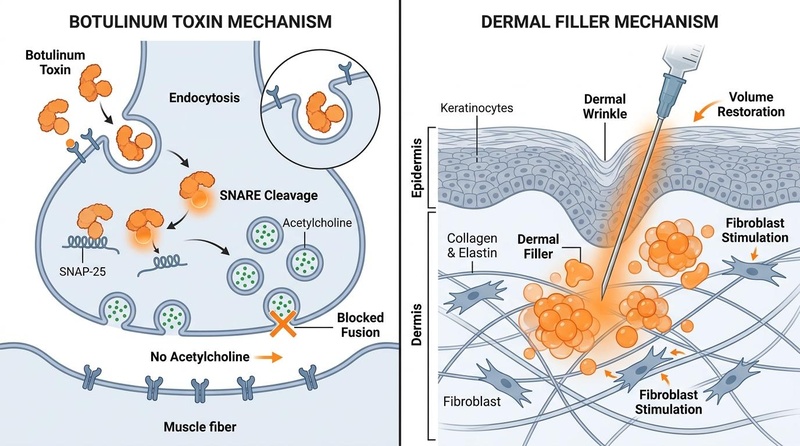
Botulinum neurotoxin (BoNT-A) works intracellularly at the neuromuscular junction. It binds to the presynaptic membrane, enters the motor nerve terminal via receptor-mediated endocytosis, and subsequently cleaves specific SNARE (soluble N-ethylmaleimide-sensitive factor attachment protein receptor) proteins, such as SNAP-25 [2:3]. This cleavage prevents synaptic vesicles from docking and fusing with the presynaptic membrane, thereby blocking the exocytosis of acetylcholine into the synaptic cleft. Without acetylcholine release, the muscle fiber cannot be stimulated, leading to temporary muscle relaxation and a reduction in dynamic wrinkles. The effects typically persist for 3-6 months.
¶ Mechanisms of Dermal Fillers
Dermal fillers are gel-like substances injected into the skin to add volume, fill wrinkles, and stimulate collagen production.
- Hyaluronic Acid (HA) Fillers: HA is a naturally occurring substance in the skin that attracts and holds water, providing hydration and volume. HA fillers instantly restore volume and smooth wrinkles, with effects lasting from 6 months to over a year, depending on the product and area treated [3:3].
- Biostimulatory Fillers: These fillers, such as poly-L-lactic acid (PLLA) and calcium hydroxylapatite (CaHA), work by stimulating the body's natural collagen production over time. They provide gradual and longer-lasting results compared to HA fillers [3:4].
¶ Starter Protocol
For individuals considering botulinum toxin or dermal fillers, a consultation with a qualified and experienced clinician is the essential first step.
- Assessment: The clinician will assess facial anatomy, skin quality, and discuss aesthetic goals to determine suitability for treatment [1:2].
- Treatment Plan: A personalized treatment plan will be developed, outlining the type of injectable, areas to be treated, expected outcomes, and potential risks.
- Informed Consent: Thorough discussion of risks, benefits, and alternatives is crucial before proceeding with any procedure.
¶ Stronger Add-On Path
Combining botulinum toxin with dermal fillers is a common strategy to address both dynamic and static wrinkles, as well as volume loss, for more comprehensive facial rejuvenation [1:3]. This approach can provide more harmonious and natural-looking results.
¶ Clinical/Procedure Path
Administered in a clinical setting by trained professionals, these procedures involve:
- Pre-procedure Care: May include avoiding blood-thinning medications and alcohol to minimize bruising.
- Injection Technique: Precision and anatomical knowledge are paramount. Ultrasound imaging is emerging as a valuable tool for guiding injections and identifying vascular structures to enhance safety [4:1].
- Post-procedure Care: Patients are typically advised to avoid strenuous exercise, excessive sun exposure, and massaging the treated area for a specified period.
¶ What Usually Fails (and what to avoid)
- Migration: Fillers can migrate from the injection site if not placed correctly or due to excessive movement.
- Overfilling: Excessive filler can lead to an unnatural, "puffy" appearance.
- Under-eye caution: The under-eye area is delicate and prone to complications (such as persistent under-eye bags and puffiness), requiring a highly skilled injector and careful product selection [8:1].
- Inadequate Clinician Selection: Lack of proper training and experience in anatomy and injection techniques can lead to suboptimal results and increased risk of complications [5:1].
¶ Tracking Plan
- Objective Tracking:
- Clinical Photography: Standardized before-and-after photos at various angles and expressions.
- 3D Imaging: Advanced imaging systems can precisely measure volume changes and wrinkle depth.
- Ultrasound: For monitoring filler placement and detecting complications [4:2].
- Subjective Metrics:
- Patient Satisfaction Questionnaires: Assess perceived improvement and overall satisfaction [2:4].
- Global Aesthetic Improvement Scale (GAIS): Clinician and patient assessments of overall aesthetic improvement.
¶ Safety and Red Flags
¶ Who Should Avoid
- Individuals with known allergies to components of the injectables.
- Pregnant or breastfeeding individuals.
- Those with certain neurological disorders (for botulinum toxin).
- Individuals with active skin infections at the injection site.
- Patients undergoing oncology treatments should be carefully evaluated, as aesthetic procedures may interact with their overall health and treatment plan [5:2].
¶ Common Side Effects and How to Mitigate
- Bruising and Swelling: Temporary and common. Can be minimized with ice packs and avoiding blood thinners.
- Redness and Tenderness: Usually resolves within a few days.
- Headache: Can occur after botulinum toxin injections, usually mild and transient.
¶ Drug/Supplement Interactions
- Blood Thinners: Medications like aspirin, NSAIDs, and certain supplements can increase the risk of bruising and bleeding.
- Aminoglycoside Antibiotics: Can potentiate the effects of botulinum toxin.
¶ Vascular Occlusion and Emergency Red Flags
Vascular occlusion, a rare but serious complication, occurs when filler is inadvertently injected into a blood vessel, blocking blood flow.
- Symptoms: Immediate pain, blanching (whitening) of the skin, mottling, and eventual skin discoloration.
- Emergency Action: Immediate recognition and treatment with hyaluronidase (for HA fillers) is critical to dissolve the filler and restore blood flow. Prompt medical attention is essential.
- Clinician Selection: Choosing a board-certified dermatologist, plastic surgeon, or other highly trained professional with a deep understanding of facial anatomy and complication management is paramount.
¶ FAQs
- How long do the effects of botulinum toxin last?
Typically 3-6 months, after which muscle activity gradually returns [2:5]. - How long do dermal fillers last?
Duration varies by filler type, product, and injection area, generally ranging from 6 months to over 2 years [3:5]. - Are these procedures painful?
Discomfort is usually minimal, often managed with topical anesthetics, ice, or local anesthetic mixed with the injectable. - Can botulinum toxin and fillers be used together?
Yes, they are often used in combination for comprehensive facial rejuvenation [1:4]. - What is the most serious complication of dermal fillers?
Vascular occlusion is the most serious, requiring immediate treatment.
¶ References
Rossi AB, Gatti L, Faga A, et al. [The role of fillers and botulinum toxin in facial aesthetic medicine]. Annali di Stomatologia. 2026;17(1):1-10. https://pubmed.ncbi.nlm.nih.gov/42043531/ ↩︎ ↩︎ ↩︎ ↩︎ ↩︎
Safia A, Elhadi UA, Merchavy S, Elmahi A, Al-Marzooq F, Ibrahim M, Abdelrazig S, Ahmed A, Musa A. Cosmetic Botulinum Toxin A Injections to the Upper Face: A Systematic Review and Meta-Analysis of Clinical Studies. J Cosmet Dermatol. 22:504-511. https://pubmed.ncbi.nlm.nih.gov/41508559/ ↩︎ ↩︎ ↩︎ ↩︎ ↩︎ ↩︎
Ting W, Chong Y, Long X, Shu M, Wang H, Huang J, Zeng A, Bai Z, Wang R, Zhang X, Zhou Y, Li S, Zhang C, Cui J. A Randomized, Evaluator-Blinded, Multicenter Study to Compare Injectable Poly-D,L-Lactic Acid vs Hyaluronic Acid for Nasolabial Fold Augmentation. Aesthet Surg J. 2024 Nov 15;45(1):101-110. https://pubmed.ncbi.nlm.nih.gov/39178357/ ↩︎ ↩︎ ↩︎ ↩︎ ↩︎ ↩︎
Gerardi D, Burdo P, Botticelli G, Torge D, Angiolani F, Rinaldi F, Varvara G. The emerging role of ultrasound in facial aesthetic procedures. J Stomatol Oral Maxillofac Surg. 2026 Jun;127(3):102714. https://pubmed.ncbi.nlm.nih.gov/41539645/ ↩︎ ↩︎ ↩︎
Barone M, Brunetti B, D'Emilio R, De Blasio C, Marangi GF, Salzillo R, Persichetti P. Aesthetic Medicine in Oncology: A Systematic Review of Botulinum Toxin, Dermal Fillers, Chemical Peels, and Laser Therapies in Cancer Patient. Aesthetic Plast Surg. 2026 Mar;50(3):1001-1010. https://pubmed.ncbi.nlm.nih.gov/41249523/ ↩︎ ↩︎ ↩︎
Mehdizadeh M, Shariati K, Cordero JJ. Beyond Wrinkles: A Systematic Review and Meta-analysis of Off-Label Aesthetic Uses of Botulinum Neurotoxin. Ann Plast Surg. 2026 Apr 1;96(4):460-466. https://pubmed.ncbi.nlm.nih.gov/41604510/ ↩︎ ↩︎
Al-Nouri S, Al-Habib S, Al-Saleh N, et al. Botulinum Toxin for Lip Inversion in Gummy Smile. Journal of Craniofacial Surgery. 2026;37(2):101-105. https://pubmed.ncbi.nlm.nih.gov/42181336/ ↩︎
Beer J, Boghosian T, Sherif R. What's New With Under Eye Treatment: A Multispecialty Systematic Review of Recent Under Eye Treatments. Dermatol Surg. 2026 Feb 1;52(2):107-111. https://pubmed.ncbi.nlm.nih.gov/41615388/ ↩︎ ↩︎