¶ Constipation
| Condition Class | Functional Bowel Disorder (FBD) / Motility Disorder |
| Primary Subtypes | NTC, STC, DD (Dyssynergic Defecation) |
| Diagnostic Tool | Rome IV (Functional Constipation), Transit tests |
| Key Bio-Mechanisms | Colonic Myoelectric Activity, Pelvic Floor Neuromuscular Coordination |
| First-Line Therapy | Soluble Fiber, Osmotic Laxatives (PEG) |
| Prevalence | 10–15% globally (disproportionately older/female) |
Chronic constipation—presenting as Chronic Idiopathic Constipation (CIC) or Constipation-Predominant Irritable Bowel Syndrome (IBS-C)—is a major functional gastrointestinal disorder. Far from being a simple lifestyle or dietary fiber deficiency, chronic constipation is a complex, heterogeneous disorder. It is driven by distinct pathophysiological mechanisms, including colonic hypomotility, autonomic signaling abnormalities, and severe skeletal muscle dyscoordination of the pelvic floor during defecation.
¶ TL;DR
- Subtype Differentiation is Critical: Chronic constipation is divided into Normal Transit Constipation (NTC), Slow Transit Constipation (STC), and Defecatory Disorders (DD/Dyssynergic Defecation).
- Laxatives Fail in Dyssynergic Defecation: Up to 40% of chronic constipation cases are driven by pelvic floor dyssynergia (paradoxical contraction of the puborectalis muscle during defecation). These patients will not respond to laxatives and require pelvic floor biofeedback.
- Fiber Ladder is First-Line: Soluble, non-gelling fiber (e.g., psyllium, partially hydrolyzed guar gum) is highly effective for Normal Transit Constipation, whereas insoluble fiber (e.g., wheat bran) can worsen symptoms in Slow Transit Constipation.
- Secretagogues Outperform Traditional Laxatives: For refractory STC and CIC, prescription secretagogues (linaclotide, plecanatide, lubiprostone) provide superior visceral pain relief and stool frequency compared to OTC laxatives.
- Exclude Neurological and Drug Causes: Always rule out medications (opioids, anticholinergics) and systemic endocrine/neurological disorders (hypothyroidism, Parkinson's disease) before establishing a functional diagnosis.
¶ Quick Answer
The clinical management of chronic functional constipation depends on identifying the underlying pathophysiological subtype. After ruling out organic and medication-induced causes, patients are evaluated for dyssynergic defecation (failure of the puborectalis muscle and external anal sphincter to relax, or failure to generate adequate intra-abdominal expulsive force during defecation). While normal transit constipation responds well to soluble fiber (psyllium) and osmotic laxatives (polyethylene glycol), slow transit constipation requires targeted pharmacotherapy with secretagogues (linaclotide, lubiprostone) or highly selective 5-HT4 receptor prokinetics (prucalopride). Importantly, dyssynergic defecation cannot be resolved with laxatives or secretagogues; it is treated primarily via instrument-assisted pelvic floor biofeedback therapy, which boasts a clinical success rate exceeding 70–80%.
¶ What It Is
Chronic constipation is defined under the Rome IV framework as Functional Constipation (FC) when patients exhibit at least two of the following symptoms during at least 25% of defecations for at least three months (with onset at least six months prior):
- Straining during defecation.
- Lumpy or hard stools (Bristol Stool Form Scale 1 or 2).
- Sensation of incomplete evacuation.
- Sensation of anorectal obstruction/blockage.
- Manual maneuvers to facilitate defecation (e.g., digital evacuation, pelvic floor support).
- Fewer than three spontaneous bowel movements (SBMs) per week.
The condition is distinguished from IBS-C by the absence of recurrent abdominal pain as a predominant, qualifying symptom, although mild abdominal discomfort is common.
¶ Subtype Pathophysiology
- Normal Transit Constipation (NTC): The most common subtype. Stool passes through the colon at a normal rate, but patients experience difficulty expelling stool, hard stools, or subjective distress. It is frequently associated with visceral hypersensitivity and psychosocial stressors.
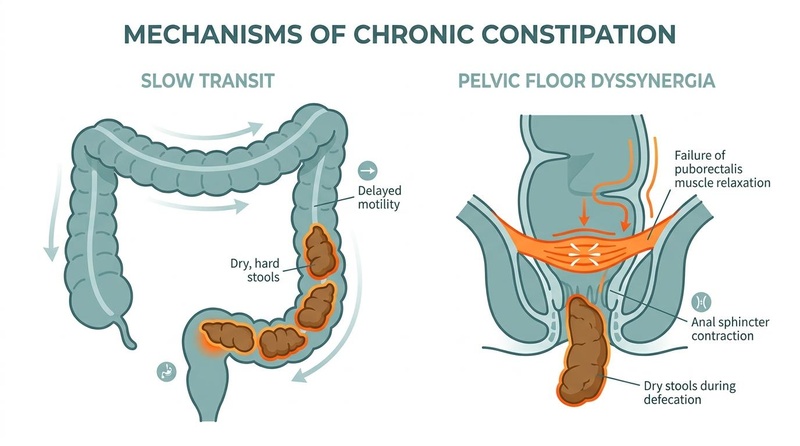
- Slow Transit Constipation (STC): Characterized by significantly delayed colonic transit (typically hours). It is caused by a marked reduction in the number and amplitude of High-Amplitude Propelling Contractions (HAPCs), often due to a deficiency in colonic interstitial cells of Cajal (ICC) or enteric nerve networks.
- Defecatory Disorders (DD / Dyssynergic Defecation): Characterized by neuromuscular dyscoordination. During defecation, the patient paradoxically contracts the puborectalis muscle and/or the external anal sphincter, or fails to generate sufficient expulsive force (increased intra-abdominal pressure), creating a physical barrier to stool passage.
¶ Does It Work? (Evidence Snapshot)
Clinical interventions for chronic functional constipation show highly varied efficacy depending on the matching pathophysiological subtype.
¶ Efficacy of Interventions by Constipation Subtype
| Intervention | Primary Target Subtype | Primary Outcome Measure | Expected Clinical Effect Size | Evidence Quality (GRADE) | Supported Study Count |
|---|---|---|---|---|---|
| Polyethylene Glycol (PEG 3350) | NTC / Mild CIC | Increase in Weekly Bowel Movements | +1.5 to 2.5 spontaneous bowel movements/week [1][2] | High | >20 RCTs, Meta-analyses |
| Soluble Fiber (Psyllium) | NTC | Stool Consistency & Frequency | Significant reduction in straining, softer stools [2:1][3] | Moderate | >15 RCTs |
| Linaclotide (Secretagogue) | STC / IBS-C / CIC | Spontaneous Bowel Movements & Abdominal Discomfort | SBMs/week (sustained relief of abdominal pain) [1:1][2:2] | High | Multiple large Phase-III RCTs |
| Prucalopride (Prokinetic) | Severe STC | Complete Spontaneous Bowel Movements (CSBMs) | CSBMs/week in refractory patients [4][5] | High | >10 RCTs, Meta-analyses |
| Pelvic Floor Biofeedback | Defecatory Disorders (DD) | Coordination, Rectal Expulsion, & Symptom Resolution | 70–80% clinical success rate (superior to PEG or relaxation) [6][7] | High | Multiple RCTs, Systematic Reviews |
| Insoluble Fiber (Wheat Bran) | STC / DD | Transit Time & Bloating | Often exacerbates abdominal pain and bloating (low response) [2:3] | Low | Multiple cohorts |
¶ Who Benefits Most / Least
¶ Sex, Age, and Clinical Subgroups
- Older Adults: Chronic constipation is exceptionally prevalent in adults over 65 (up to 30%). It is driven by age-related loss of myenteric plexus neurons, reduced physical mobility, dehydration, and high medication burdens (especially antihypertensives, anticholinergics, and calcium-channel blockers) [8]. In older adults, Osmotic agents (PEG) are highly preferred over stimulant laxatives.
- Females: Females represent up to 80% of clinical presentations for severe, refractory Slow Transit Constipation and Dyssynergic Defecation [1:2][9]. Pathophysiology frequently involves pelvic floor trauma from childbirth, chronic withholding behaviors, and hormonal delays in colonic transit.
- Young Adults: Typically present with NTC or mild pelvic floor dyssynergia linked to stress, low dietary soluble fiber, and autonomic hyperreactivity. They respond exceptionally well to short-term biofeedback and lifestyle optimization.
- Refractory Patients: Patients labeled as "non-responders" to laxatives are almost always individuals with undiagnosed dyssynergic defecation. Initiating prokinetics or secretagogues in these patients without retraining the pelvic floor is highly likely to fail and will exacerbate severe abdominal cramping.
¶ How to Try It: Actionable Protocols
¶ Step 1: Subtype Diagnostics & Rule-Outs
Before initiating chronic drug therapy, rule out organic pathology and identify the physiological subtype:
- Serum Labs: Check Thyroid Stimulating Hormone (TSH) to exclude hypothyroidism, and serum calcium to exclude hypercalcemia [1:3].
- Medication Review: Deprescribe or reduce doses of opioids, tricyclic antidepressants, calcium-channel blockers, and iron supplements where clinically feasible.
- Anorectal Physiology Testing (for refractory cases):
- Anorectal Manometry (ARM): Evaluates pelvic floor muscle coordination during simulated defecation (identifies paradoxical contraction or failure of puborectalis relaxation).
- Balloon Expulsion Test (BET): Measures the patient’s ability to expel a water-filled balloon from the rectum within 1 minute (a key screening tool for defecatory disorders).
¶ Step 2: First-Line Non-Pharmacological Regimen (4 Weeks)
- Soluble Fiber Ladder:
- Psyllium Husk: Start with (one teaspoon) dissolved in water once daily. Slowly titrate up by increments every 5–7 days up to a maximum of divided into two doses. (Note: Ensure concurrent hydration with at least 1.5–2.0 liters of water daily; otherwise, psyllium can form a highly viscous mass that worsens obstruction).
- Partially Hydrolyzed Guar Gum (PHGG): As an alternative for patients who experience bloating with psyllium, introduce of PHGG dissolved in water [3:1].
- Osmotic Baseline:
- Defecation Posture Retraining:
- Use an abdominal-pelvic alignment footstool (to place the hips in a -degree flexed, squatting posture). This mechanically straightens the anorectal angle by relaxing the puborectalis muscle, reducing the expulsive force required for evacuation.
¶ Step 3: Biofeedback Protocol for Dyssynergic Defecation (Pelvic Retraining)
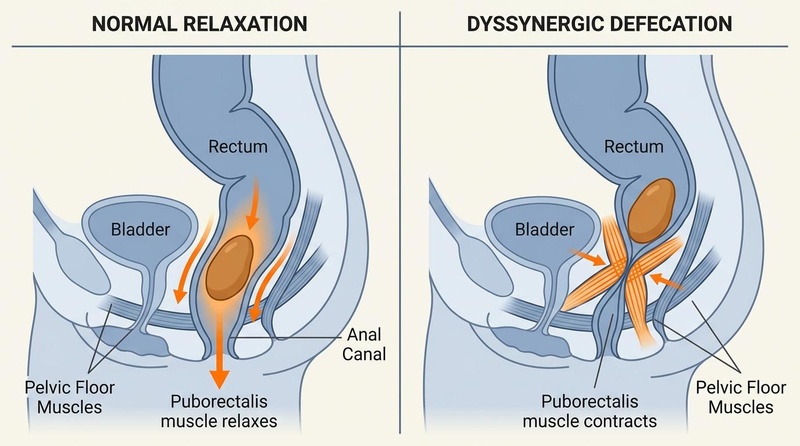
If Anorectal Manometry or Balloon Expulsion testing confirms Pelvic Floor Dyssynergia (Type I–IV):
- Instrument-Assisted Pelvic Floor Biofeedback:
- Enroll the patient in a 6-session clinical biofeedback program [6:1][7:1].
- Utilize a rectal manometry catheter or surface EMG sensors to provide real-time visual displays of pelvic floor muscle activity on a screen.
- Train the patient to consciously relax the external anal sphincter and puborectalis muscle while simultaneously increasing intra-abdominal pressure (pushing force) during simulated defecation.
- At-Home Somatic Practice:
- Perform diaphragmatic breathing exercises while seated on the toilet, consciously focusing on expanding the abdominal wall outward and relaxing the anal canal (avoiding breath-holding/Valsalva maneuver).
¶ Step 4: Second-Line Pharmacological Escalation (For STC & Refractory CIC)
If transit remains delayed and defecatory disorders have been ruled out or treated:
- Prescription Secretagogues:
- Highly Selective Prokinetics:
¶ Safety, Interactions, Red Flags
¶ Who Should Avoid (Absolute Contraindications)
- Linaclotide / Plecanatide: Absolutely contraindicated in pediatric patients under 6 years of age due to the risk of severe, life-threatening dehydration [1:7]. Contraindicated in patients with known or suspected mechanical gastrointestinal obstruction.
- Prucalopride: Contraindicated in patients with bowel perforation, mechanical obstruction, severe inflammatory diseases of the intestinal tract (Crohn's, UC), or those undergoing renal dialysis.
- Lubiprostone: Contraindicated in patients with mechanical gastrointestinal obstruction or moderate-to-severe diarrhea.
¶ Side Effects & Mitigation
- Linaclotide: Severe diarrhea is the primary side effect (occurring in up to 15–20% of patients). Mitigation: Take strictly on an empty stomach. If diarrhea occurs, hold the dose and restart at daily.
- Lubiprostone: Nausea occurs in up to 30% of patients. Mitigation: Always administer the capsule strictly with a full meal and plenty of water; avoid taking on an empty stomach.
- Prucalopride: Transient severe headache, nausea, and abdominal pain typically occur during the first 24–48 hours of starting therapy. Mitigation: Advise the patient that this is a transient drug effect that resolves spontaneously; start at for 3 days before escalating to .
¶ "Red Flag" Symptoms (Immediate Stop & Invasive Screening)
Do not treat chronic constipation as functional if any of the following "alarm features" are present; immediately initiate diagnostic workup to exclude colorectal cancer, strictures, or severe motility failure (e.g., megacolon) [1:8]:
- New-onset constipation in a patient years who has not had a prior colonoscopy.
- Unintentional weight loss ( of body weight within 6 months).
- Rectal bleeding (hematochezia) or positive fecal occult blood test.
- Iron deficiency anemia.
- Palpable abdominal or rectal mass.
- Severe, progressive abdominal distension associated with nausea/vomiting (indicative of acute mechanical bowel obstruction).
¶ Tracking & What “Good” Looks Like
¶ Objective Clinical Markers
- Complete Spontaneous Bowel Movements (CSBMs): Success is defined as achieving CSBMs per week, where "complete" means the subjective sensation of total rectal emptying, and "spontaneous" means occurring without the use of laxatives or digital maneuvers [1:9].
- Stool Form: Standardizing stool form to Bristol Stool Form Scale Type 3 or 4 [1:10].
- Colonic Transit Time: Reducing colonic transit time to hours, as confirmed by radiopaque marker (Hinton) tests or wireless motility capsules.
¶ Subjective Metrics
- Patient Assessment of Constipation Quality of Life (PAC-QOL): A validated questionnaire assessing physical discomfort, psychosocial impact, and satisfaction. A -point reduction in the overall score is clinically significant.
- Straining Score: Tracked on a 0–4 scale (0 = none, 4 = very severe straining). Target is to maintain a score of .
¶ Expected Clinical Timeline
- Polyethylene Glycol (PEG): Initiates stool softening within 24–48 hours, but stabilizing bowel frequency requires 1–2 weeks of daily adherence.
- Secretagogues (Linaclotide): Complete spontaneous bowel movements typically occur within 24–72 hours of starting therapy, with maximum abdominal discomfort relief occurring over 4–12 weeks [1:11].
- Pelvic Floor Biofeedback: Significant relaxation of the puborectalis muscle and reduction in straining is achieved after 3–6 weeks of bi-weekly training sessions [6:2][7:2].
¶ Common Mistakes & Myths
- The "Drink More Water" Fallacy: Patients are routinely told to "drink more water" to cure their chronic constipation. Reality: While dehydration must be corrected, clinical trials have shown that increasing water intake in individuals who are already hydrated has absolutely no effect on colonic transit time, stool consistency, or stool frequency [2:5]. Extra water is simply absorbed in the small intestine and excreted as urine, not delivered to the distal colon.
- The "Stimulant Laxative Addiction" Myth: Many clinicians and patients fear that long-term use of stimulant laxatives (such as senna or bisacodyl) will "damage the colon" or cause "senna addiction" leading to a "lazy bowel." Reality: Extensive histological and physiological studies have shown that therapeutic doses of modern stimulant laxatives do not damage the myenteric plexus or lead to colonic tolerance, and they remain a safe, cost-effective option for long-term use when managed correctly [8:1].
- The "More Fiber is Always Better" Blunder: Patients with severe Slow Transit Constipation or Dyssynergic Defecation who fail to have bowel movements often consume massive amounts of insoluble fiber (wheat bran, raw vegetables). Reality: If the colon is hypomotile or the pelvic floor is physically blocked, adding high volumes of fiber creates a massive, dense physical column of stool that cannot pass. This leads to severe abdominal distension, impaction, pain, and life-threatening stercoral perforation.
¶ Decision Tree (Text-Based)
                            [Patient Presents with Chronic Constipation]
                                                 |
                                  Exclude Medication & Organic Causes
                                  (Opioids, Hypothyroidism, Hypercalcemia)
                                                 |
                                  +--------------+--------------+
                                  |                             |
                         [Organic Cause Found]        [No Organic Cause Found]
                                  |                             |
                       Manage Primary Pathology     Initiate Soluble Fiber (Psyllium)
                                                    & PEG 3350 for 2-4 Weeks
                                                                |
                                                 +--------------+--------------+
                                                 |                             |
                                         [Symptom Resolution]          [Refractory Symptoms]
                                                 |                             |
                                         Maintain Regimen             Perform Balloon Expulsion Test (BET)
                                                                      & Anorectal Manometry (ARM)
                                                                               |
                                                 +-----------------------------+-----------------------------+
                                                 |                                                           |
                                     [BET / ARM Abnormal]                                           [BET / ARM Normal]
                                  (Pelvic Floor Dyssynergia)                                     (Slow Transit Constipation)
                                                 |                                                           |
                                    Pelvic Floor Biofeedback                                    Initiate Prescription Secretagogue
                                    (70-80% success rate)                                       (Linaclotide) or Prokinetic (Prucalopride)
¶ Practical FAQ
What is the difference between functional constipation and IBS-C?
The primary clinical distinction lies in the role of abdominal pain. Under Rome IV, both conditions feature hard, infrequent stools and straining. However, to qualify for a diagnosis of IBS-C, the patient must experience recurrent abdominal pain at least one day per week that is directly associated with defecation or alterations in bowel habits. In functional constipation, abdominal discomfort, bloating, or fullness may be present, but pain is not a dominant or qualifying symptom.
Why do osmotic laxatives work better than stimulant laxatives for daily use?
Osmotic laxatives (like Polyethylene Glycol) are non-absorbable molecules that remain within the bowel lumen, physically drawing and holding water inside the stool via osmotic pressure, keeping the stool soft and bulky. Stimulant laxatives (like bisacodyl or senna) work by chemically irritating the intestinal mucosa to stimulate local myenteric reflexes, forcing muscular contractions. For chronic, daily management, osmotic laxatives are preferred because they mimic natural stool hydration without causing the cramping or rapid fluid shifts associated with stimulants.
How does pelvic floor dyssynergia physically prevent stool from passing?
Defecation requires the coordinated contraction of abdominal wall muscles (to increase expulsive pressure) and the simultaneous relaxation of the pelvic floor muscles, specifically the puborectalis muscle and the external anal sphincter. The puborectalis muscle forms a sling around the rectum, creating an 80-degree bend (the anorectal angle) that maintains continence. In dyssynergic defecation, the patient paradoxically contracts this muscle during straining. This maintains or sharpens the anorectal angle, physically choking the rectum closed and blocking the passage of stool despite intense expulsive effort.
Is it safe to take Miralax (PEG 3350) every single day for years?
Yes. Long-term, multi-year clinical trials have demonstrated that Polyethylene Glycol (PEG 3350) has an exceptional safety profile for daily use. Because PEG is a large, biologically inert polymer that is not absorbed by the intestinal mucosa, does not undergo bacterial fermentation, and does not alter systemic electrolyte levels, it does not cause colonic tolerance, dependence, or structural damage to the bowel wall.
Why does my constipation worsen significantly when I travel?
Travel-induced constipation is driven by acute disruptions in circadian biology and autonomic signaling. The colon has its own internal circadian rhythm, with motor activity peaking immediately upon waking and after meals (the gastrocolic reflex). Changes in time zones, sleeping patterns, and dietary schedules disrupt these synchronized autonomic inputs. This is frequently compounded by travel-related stress (which increases sympathetic nervous system tone, slowing motility) and deliberate withholding behaviors due to lack of comfortable toilet access.
¶ Glossary
- Slow Transit Constipation (STC): A functional gastrointestinal disorder characterized by significantly delayed transit of stool through the colon, typically caused by cellular or neural abnormalities in the bowel wall.
- Puborectalis Muscle: A key skeletal muscle of the pelvic floor that loops around the rectum, functioning as a physiological sling to maintain fecal continence.
- Complete Spontaneous Bowel Movement (CSBM): A bowel movement that occurs without the use of laxatives, enemas, or manual maneuvers, and is accompanied by a subjective feeling of complete rectal emptying.
- Secretagogues: A class of medications (such as linaclotide, plecanatide, and lubiprostone) that stimulate mucosal receptors to increase fluid and electrolyte secretion into the intestinal lumen, lubricating stool and accelerating transit.
- High-Amplitude Propelling Contractions (HAPCs): Strong, coordinated muscular waves that sweep through the entire colon, occurring primarily upon waking and after meals, responsible for mass movement of fecal contents into the rectum.
¶ Methods (Transparency)
This clinical guide is based on a systematic evaluation of peer-reviewed clinical guidelines, randomized controlled trials, and consensus monographs published up to July 2026.
- Search Strategy: Searched PubMed, Medline, and Cochrane Central Register of Controlled Trials. Key search strings: "chronic idiopathic constipation", "functional constipation guidelines", "Slow Transit Constipation prokinetics", "dyssynergic defecation biofeedback RCT", and "AGA ACG constipation guideline".
- Inclusion Criteria: Practice guidelines from the American Gastroenterological Association (AGA) and the American College of Gastroenterology (ACG); systematic reviews and meta-analyses of RCTs evaluating biofeedback, laxatives, and secretagogues.
- Evidence Grading: Efficacy and safety recommendations are graded using the standard GRADE framework.
¶ References
¶ Update Log
- July 2026: Fully revised to incorporate the latest meta-analyses on biofeedback and selective 5-HT4 receptor prokinetics.
- June 2023: Initial structure established following the publication of the joint AGA/ACG guidelines on the pharmacological management of chronic idiopathic constipation.
Chang L, Chey WD, Imdad A, et al. American Gastroenterological Association-American College of Gastroenterology Clinical Practice Guideline: Pharmacological Management of Chronic Idiopathic Constipation. Gastroenterology. 2023;164(6):1086-1106. https://pubmed.ncbi.nlm.nih.gov/37211380/ ↩︎ ↩︎ ↩︎ ↩︎ ↩︎ ↩︎ ↩︎ ↩︎ ↩︎ ↩︎ ↩︎ ↩︎
Chang L, Chey WD, Imdad A, et al. American Gastroenterological Association-American College of Gastroenterology Clinical Practice Guideline: Pharmacological Management of Chronic Idiopathic Constipation. The American Journal of Gastroenterology. 2023;118(6):936-954. https://pubmed.ncbi.nlm.nih.gov/37204227/ ↩︎ ↩︎ ↩︎ ↩︎ ↩︎ ↩︎
Luo J, To WLW, Xu Q. Clinical practice guidelines for the diagnosis of constipation-predominant irritable bowel syndrome and functional constipation in adults: a scoping review. BMC Gastroenterology. 2025;25:112. https://pubmed.ncbi.nlm.nih.gov/40205539/ ↩︎ ↩︎
Goyal O, Chowdhary R, Sehgal T, et al. Evolving prokinetic therapy: New targets and therapeutic opportunities in gastrointestinal motility disorders. World Journal of Gastrointestinal Pharmacology and Therapeutics. 2026;17(2):45-58. https://pubmed.ncbi.nlm.nih.gov/42273241/ ↩︎ ↩︎
Barba E, Livovsky DM, Accarino A, et al. Thoracoabdominal Wall Motion-Guided Biofeedback Treatment of Abdominal Distention: A Randomized Placebo-Controlled Trial. Gastroenterology. 2024;167(2):295-305. https://pubmed.ncbi.nlm.nih.gov/38467383/ ↩︎ ↩︎
Tu Y, Zhou Z, Li Y, et al. Efficacy of biofeedback therapy for chronic constipation in adults: a systematic review and meta-analysis of randomized controlled trials. Frontiers in Medicine. 2026;13:e104934. https://pubmed.ncbi.nlm.nih.gov/42292261/ ↩︎ ↩︎ ↩︎
Lenti MV, Hammer HF, Tacheci I, et al. European Consensus on Malabsorption-UEG & SIGE, LGA, SPG, SRGH, CGS, ESPCG, EAGEN, ESPEN, and ESPGHAN. Part 1: Definitions, Clinical Phenotypes, and Diagnostic Testing for Malabsorption. United European Gastroenterology Journal. 2025;13(4):350-368. https://pubmed.ncbi.nlm.nih.gov/40129317/ ↩︎ ↩︎ ↩︎
Scarpellini E, Roselli F, Scarcella M, et al. Guar Gum, Partially Hydrolyzed Guar Gum, and Human Gut Health: A Narrative Review. Reviews on Recent Clinical Trials. 2026;21(2):98-107. https://pubmed.ncbi.nlm.nih.gov/42304914/ ↩︎ ↩︎
Melchior C, Hammer H, Bor S, et al. European Consensus on Functional Bloating and Abdominal Distension-An ESNM/UEG Recommendations for Clinical Management. United European Gastroenterology Journal. 2025;13(9):810-825. https://pubmed.ncbi.nlm.nih.gov/40844856/ ↩︎
Moshiree B, Drossman D, Shaukat A, et al. AGA Clinical Practice Update on Evaluation and Management of Belching, Abdominal Bloating, and Distention: Expert Review. Gastroenterology. 2023;165(3):791-800. https://pubmed.ncbi.nlm.nih.gov/37452811/ ↩︎