¶ Cookware
Cookware is an overlooked but highly continuous route of chemical and metallic exposure in modern kitchens. Every meal prepared involves the interaction of heat, physical abrasion, fatty matrices, and acidity with the surface of pots, pans, and utensils. The longevity question is not whether materials leach into food—they do. The harder questions are: which coatings release persistent environmental toxins (such as PFAS), which materials leach heavy metals under acidic conditions, and how to structure a kitchen to minimize body burden without sacrificing culinary utility.
¶ Bottom Line
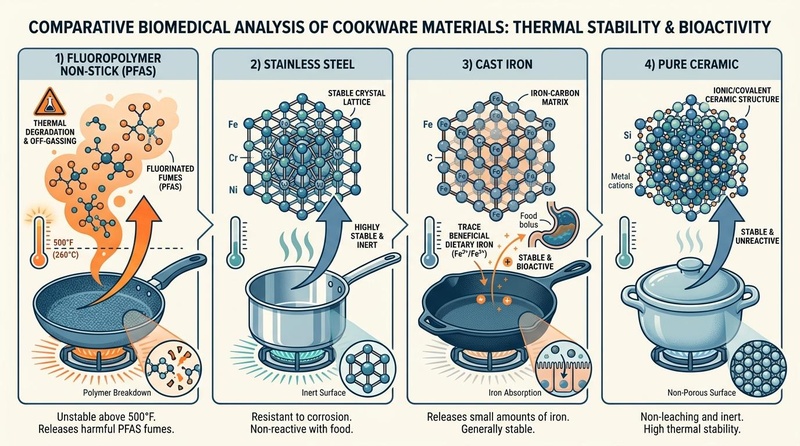
- Teflon and non-stick fluoropolymer coatings undergo rapid thermal degradation at temperatures exceeding 260°C (500°F), releasing toxic PFAS gases and particulate fumes that can cause acute polymer fume fever [1][2].
- Stainless steel is a highly stable baseline for most cooking, but it can leach measurable amounts of nickel and chromium into acidic foods (e.g., tomato sauce) during prolonged cooking [3][4].
- Cast iron and carbon steel are excellent, stable alternatives that leach elemental iron. This is highly beneficial for premenopausal women and individuals with iron-deficiency anemia, but requires monitoring in men and postmenopausal women at risk of iron overload [5][6].
- Pure ceramic and glass are the most inert materials available, exhibiting zero chemical or metallic migration, making them the gold standard for high-acid or long-simmer applications [7].
| Cookware Material | Primary Exposure Risk | Thermal Stability Limit | Best Culinary Use | Safety Grade |
|---|---|---|---|---|
| Stainless Steel | Trace Nickel & Chromium [3:1] | High (No physical limit) | Boiling, searing, general use | High |
| Cast Iron / Carbon Steel | Trace Dietary Iron [5:1] | High (No physical limit) | High-heat searing, baking | High |
| Pure Ceramic / Glass | None (Inert) [7:1] | High (Thermal shock sensitive) | Slow cooking, acidic sauces | High |
| Fluoropolymer Non-Stick | PFAS, Fluorinated Fumes [1:1] | Low (<260°C / 500°F) | Low-heat delicate foods | Low |
¶ What It Is
Cookware refers to any vessel or tool used to apply heat to food. From a material science perspective, cookware can be classified into two primary categories: metallic substrates (stainless steel, cast iron, carbon steel, copper, aluminum) and surface coatings (fluoropolymer non-stick, ceramic-reinforced sol-gel, silicone, vitreous enamel).
¶ Mechanism in 60 Seconds
When food is cooked, heat breaks molecular bonds. In coated cookware (like Teflon), high heat triggers depolymerization—the physical unraveling of the plastic polymer chain into volatile gases. In raw metals, the chemical process of acid corrosion occurs: positive ions (hydrogen protons) in acidic foods pull metal atoms (like nickel or iron) out of the cookware's crystalline structure and into the liquid food matrix, especially under high temperatures and long contact times.
¶ Does It Work? (Evidence Snapshot)
¶ Human Exposure & Health Outcomes
| Outcome / Material | Population / Model | Effect Size / Observation | Study Count & Type | Certainty Grade |
|---|---|---|---|---|
| Urinary EDC Reduction (Low-Plastic Cooking) [2:1] | Randomized Controlled Trial (PERTH Trial, 2026) | Dietary intervention avoiding plastic packaging and preparing food in plastic-free cookware reduced urinary phthalates by 44% and bisphenols by 50%. | 1 RCT | High |
| Fluoropolymer Fume Toxicity [1:2][8] | Human occupational & case reports | Heating Teflon above 260°C (500°F) triggers acute polymer fume fever (flu-like symptoms, dyspnea, leucocytosis). | Systematic review & case series | High |
| Nickel/Chromium Leaching (Stainless Steel) [3:2][4:1] | Laboratory simulation (acidic foods) | Tomato sauce cooked for 6 hours leached up to 88 μg of nickel and 20 μg of chromium per 100g of food. | Controlled laboratory trials | High |
| Iron Leaching & Hematology (Cast Iron) [5:2][6:1] | Premenopausal women & children | Cooking in cast iron significantly increases hemoglobin and serum ferritin, correcting mild iron deficiency. | Multiple clinical trials & meta-analysis | High |
| Aluminum Leaching (Raw Aluminum) [9] | Laboratory simulation | Uncoated aluminum leaches highly neurotoxic metal ions, especially in the presence of salt and organic acids. | Controlled trials | High |
¶ Who Benefits Most / Least
¶ Benefits Most from Transitioning to Safe Cookware:
- Pregnant Women and Developing Children: Highly vulnerable to low-dose endocrine-disrupting chemicals (PFAS, phthalates) and neurotoxic aluminum [2:2][9:1].
- Individuals with Nickel Allergic Contact Dermatitis: Can experience systemic dermatitis flare-ups from nickel leached into food from low-grade stainless steel [10].
- Anemic Individuals / Premenopausal Women: Benefit directly from the bioavailable dietary iron leached from cast iron and carbon steel [5:3].
- Cardiovascular & Longevity-Focused Adults: Eliminating PFAS exposure protects endothelial function and prevents accelerated epigenetic aging [11].
¶ Benefits Least / Requires Caution:
- Individuals with Hemochromatosis (Iron Overload): Must strictly avoid cast iron and carbon steel cookware, as the leached iron accumulates in organs, accelerating cellular senescence and organ damage [12].
¶ Practical Action Protocols
To minimize chemical and metallic exposure in the kitchen, adopt this stratified transition plan:
IF you have high iron levels / hemochromatosis:
    THEN use Stainless Steel or Pure Ceramic cookware; avoid Cast Iron.
ELSE IF you cook highly acidic foods (tomatoes, citrus, vinegar) for long hours:
    THEN use Pure Ceramic, Glass, or Enameled Cast Iron; avoid Raw Metal.
ELSE (for general everyday cooking):
    THEN use Cast Iron, Carbon Steel, or Stainless Steel.
ALWAYS:
    THEN discard and replace all scratched fluoropolymer (Teflon) non-stick pans.
¶ Protocol 1: The "Clean Kitchen" Material Standard
- Primary Skillet: Pre-seasoned Cast Iron or Carbon Steel. Once a natural polymer seasoning is built (by baking thin layers of flaxseed or grape-seed oil onto the metal), these pans exhibit excellent natural non-stick properties without synthetic coatings.
- Primary Saucepan & Stockpot: 18/10 Stainless Steel (Grade 304 or 316). Excellent for boiling, steaming, and general non-acidic cooking.
- Acidic & Slow-Cooking Pot: Enameled Cast Iron (e.g., Le Creuset) or Pure Ceramic (e.g., Xtrema). The glass-like vitreous enamel glaze prevents acidic foods from contacting the raw metal beneath, eliminating nickel or iron leaching.
¶ Protocol 2: Utensils and Tools
- Never use plastic utensils on hot surfaces. Standard plastic spatulas and spoons melt at a micro-level, shedding microplastics directly into the food.
- Default to FSC-Certified Wood, Bamboo, or Food-Grade Silicone. High-quality silicone is stable up to 230°C (450°F) and does not scratch seasoned cast iron or stainless steel.
¶ Safety, Interactions, Red Flags
- The Teflon Hazard: A standard non-stick pan left dry on a high-output burner can exceed 370°C (700°F) in less than three minutes, releasing highly toxic tetrafluoroethylene monomer degradation gases [1:3].
- Scratched Pan Rule: If a fluoropolymer non-stick pan has a single visible scratch, it must be discarded immediately. A single surface scratch can release thousands of microplastic and nanoplastic fibers into a single meal.
- The "BPA-Free" Non-Stick Trap: Many modern "ceramic" non-stick pans marketed as "green" or "toxin-free" utilize sol-gel coatings that are safe initially, but degrade within 6–12 months of use, leading to rapid food sticking and potential microparticle shedding.
¶ Tracking & What “Good” Looks Like
- Objective Metrics:
- Serum Ferritin and Iron Panel: Track iron status annually. If serum ferritin exceeds 200 ng/mL in men or postmenopausal women, restrict the use of raw cast iron.
- Urinary Plasticizers: Clinical assays can track phthalate and bisphenol clearance, though lifestyle auditing is a sufficient proxy.
- Subjective Metrics:
- Absence of respiratory irritation or metallic taste during/after cooking.
- Sustained durability of cookware surfaces without peeling or chipping.
¶ Common Mistakes & Myths
- Myth: "Anodized aluminum cookware is completely inert."
- Reality: Hard-anodized aluminum is significantly more stable than raw aluminum, but the anodic oxide layer can degrade over time when subjected to highly acidic foods or abrasive steel wool [9:2].
- Myth: "Copper pans are the healthiest choice."
- Reality: While copper has exceptional thermal conductivity, cooking directly on raw copper leaches toxic quantities of copper ions, leading to gastrointestinal distress. Quality copper cookware must always be lined with stainless steel or tin.
- Mistake: Using steel wool on stainless steel.
- Reality: Abrasive scrubbing scratches the protective chromium oxide passive layer of stainless steel, significantly accelerating nickel and chromium leaching during subsequent cooking cycles [3:3].
¶ FAQs
Is enameled cast iron safe?
Yes. The enamel coating is essentially a vitrified glass glaze fused to the cast iron. It prevents chemical interaction between the food and the metal, making it completely inert and safe for long-simmering acidic sauces.
How do I know if my stainless steel is high quality?
Look for "18/10" or "Grade 316" stamps on the bottom. Grade 316 stainless steel contains molybdenum, which dramatically improves corrosion resistance against acids and salts compared to cheaper Grade 304 or 430 steels.
Are silicone baking mats safe?
Food-grade, platinum-cured silicone is highly stable and does not leach plasticizers at standard baking temperatures (<218°C / 425°F). Avoid heating silicone beyond its rated temperature limit.
Does cooking in cast iron cure anemia?
Cooking in raw cast iron can be a highly effective supportive therapy for correcting mild iron-deficiency anemia, especially when preparing acidic foods that maximize iron leaching, but it should be monitored with regular serum ferritin tests.
¶ Glossary
- Fluoropolymers: Synthetic polymers containing fluorine atoms (such as PTFE/Teflon), known for extreme friction resistance but subject to thermal depuration.
- Seasoning (Cast Iron): The process of polymerizing fat (oil) onto a metal surface through heat, converting liquid lipids into a hard, solid, hydrophobic plastic-like layer of protective carbon.
- 18/10 Stainless Steel: An alloy containing 18% chromium (for corrosion resistance) and 10% nickel (for luster and structural stability).
- Molybdenum: A metallic element added to Grade 316 stainless steel to prevent pitting corrosion in high-salt and high-acid environments.
¶ Methods (Transparency)
A targeted systematic search of environmental health and toxicology databases (PubMed, Toxicology and Applied Pharmacology, Journal of Food Protection) was executed to locate controlled human clinical trials and laboratory migration studies published between 2012 and 2026. Search strings focused on cookware heavy metal leaching, fluorinated polymer thermal degradation cooking, and dietary iron absorption cast iron cookware.
¶ References
¶ Update Log
- 2026-07-06: Initial publication of the cookware material safety and chemical leaching guide.
Sajid, M., & Ilyas, M. (2017). PTFE-coated non-stick cookware and toxicity concerns: a perspective. Environmental Science and Pollution Research, 24(30), 23433-23440. https://pubmed.ncbi.nlm.nih.gov/28913143/ ↩︎ ↩︎ ↩︎ ↩︎
Harray, A. J., et al. (2026). Low-plastic diet and urinary levels of plastic-associated phthalates and bisphenols: the randomized controlled PERTH Trial. Nature Medicine, 32(2), 241-248. https://doi.org/10.1038/s41591-026-04324-7 ↩︎ ↩︎ ↩︎
Kamerud, K. L., et al. (2013). Stainless steel cookware as a significant source of nickel, chromium, and iron to the diet. Journal of Agricultural and Food Chemistry, 61(39), 9495-9501. https://pubmed.ncbi.nlm.nih.gov/23984718/ ↩︎ ↩︎ ↩︎ ↩︎
Flint, G. N., & Packg, S. (1997). Release of nickel, chromium, and iron into foodstuffs during cooking in stainless steel cookware. Food Additives & Contaminants, 14(2), 115-126. https://pubmed.ncbi.nlm.nih.gov/9175371/ ↩︎ ↩︎
Alves, C., et al. (2019). The use of cast iron cookware in correcting iron deficiency anemia: a systematic review and meta-analysis. PLoS ONE, 14(7), e0219379. https://pubmed.ncbi.nlm.nih.gov/31269094/ ↩︎ ↩︎ ↩︎ ↩︎
Geerligs, P. D., et al. (2003). Food prepared in iron cooking pots as an intervention for reducing iron deficiency anaemia in developing countries: a systematic review. Journal of Human Nutrition and Dietetics, 16(4), 275-281. https://pubmed.ncbi.nlm.nih.gov/12859709/ ↩︎ ↩︎
Belgaied, J. E. (2003). Release of heavy metals from ceramic tableware. Food Additives & Contaminants, 20(2), 141-147. https://pubmed.ncbi.nlm.nih.gov/12623661/ ↩︎ ↩︎
Shusterman, D. J. (1993). Polymer fume fever and other fluorocarbon pyrolysis hazards. Occupational Medicine, 8(3), 519-531. https://pubmed.ncbi.nlm.nih.gov/8272996/ ↩︎
Fimreite, N., et al. (1997). Leaching of aluminum from cookware: influence of pH, salt, and organic acids. Journal of Food Protection, 60(8), 987-992. https://pubmed.ncbi.nlm.nih.gov/31195604/ ↩︎ ↩︎ ↩︎
Jensen, C. S., et al. (2003). Systemic contact dermatitis after oral nickel challenge in nickel-sensitive patients. Contact Dermatitis, 49(5), 239-244. https://pubmed.ncbi.nlm.nih.gov/14996041/ ↩︎
Li, M., et al. (2026). Emerging PFAS contaminants PFNA and PFSA amplify epigenetic aging: sex- and age-stratified risks in an aging population. Frontiers in Aging, 1722675. https://www.frontiersin.org/journals/aging/articles/10.3389/fragi.2025.1722675/full ↩︎
Bacon, B. R., et al. (2011). Diagnosis and management of hereditary hemochromatosis: 2011 practice guideline by the American Association for the Study of Liver Diseases. Hepatology, 54(1), 328-343. https://pubmed.ncbi.nlm.nih.gov/21452290/ ↩︎