¶ Ergonomics: Biomechanical Posture & Musculoskeletal Resilience
Musculoskeletal disorders—specifically chronic low back pain, cervical spine degeneration, and repetitive strain injuries—are major drivers of functional healthspan decline in modern desk-based workers. Ergonomics is the science of designing the physical work environment to align with human biomechanical thresholds. Applying precise, evidence-based ergonomic parameters minimizes physical stress on joints, nerves, and spinal discs, preserving musculoskeletal function and reducing systemic inflammatory tone.
¶ At a Glance
¶ Biomechanical Factors & Interventions
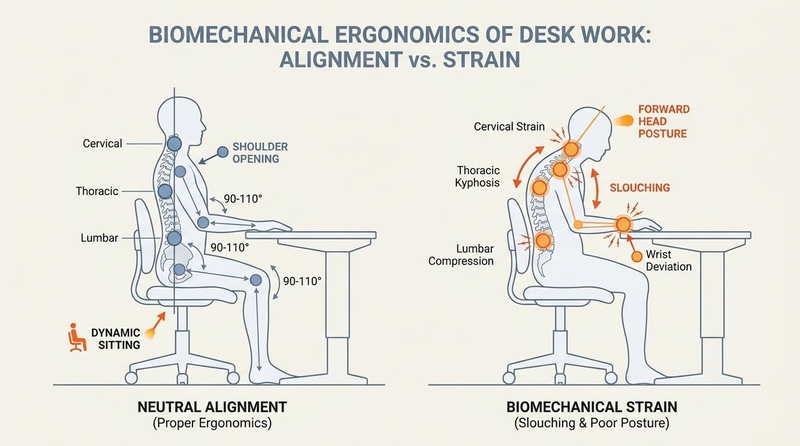
- Spinal Discal Pressure: Static, slouched sitting increases intradiscal lumbar pressure by up to 185% compared to standing. Maintaining neutral spinal lordosis through proper lumbar support and active sitting lowers this load.
- Cervical Spine Shear: Forward head posture ("text neck") exponentially increases the mechanical weight of the head on the cervical spine, causing accelerated disc wear. Positioning the monitor at eye level eliminates this shear stress.
- Wrist & Repetitive Strain: Sustained wrist extension and pronation during typing compress the median nerve, contributing to carpal tunnel syndrome. Neutral wrist positioning and split, angled keyboards mitigate this risk.
- Dynamic Transitions: Static postures, whether sitting or standing, drive tissue creep and muscle fatigue. Systematically shifting between sitting, standing, and active walking breaks maintains tissue vascularity and structural balance.
¶ Safety "Traffic Light"
- RED (Contraindications): Do not operate a workstation with your wrists resting on hard, sharp desk edges. This direct mechanical compression can damage the median and ulnar nerves, driving Repetitive Strain Injuries (RSI).
- YELLOW (Cautions): Avoid standing continuously for more than 45–60 minutes at a sit-stand desk. Prolonged static standing can cause venous pooling in the lower extremities, increasing static joint load and raising cardiovascular strain. Use a dynamic anti-fatigue mat and transition regularly.
- GREEN (Go): Align your computer screen so the top third of the display is at direct eye level, allowing a 15–20 degree downward viewing angle to preserve a neutral cervical spine.
¶ Biomechanical Workspace Protocol
+-------------------------------------------------------------------------------------------------+
|                                 BIOMECHANICAL WORKSPACE PROTOCOL                                |
+------------------------------+----------------------------------+-------------------------------+
| PHASE 1: SCREEN & cervical   | PHASE 2: HAND & WRIST ALIGNMENT  | PHASE 3: DYNAMIC MOVEMENTS    |
| • Place screen 50-70 cm away.| • Keep keyboard at elbow height, | • Use the 45:15 sitting to    |
| • Top of screen at eye level |   allowing a 90-110° elbow angle.|   standing transition ratio.  |
|   to prevent chin tilt.      | • Keep wrists flat and straight; | • Integrate active shoulder   |
| • Reduce glare from windows. |   avoid upward or lateral bend.  |   opening & lumbar stretches. |
+------------------------------+----------------------------------+-------------------------------+
¶ Bottom Line
Ergonomic workplace optimization is a highly effective, non-pharmacological strategy to protect spinal health and prevent repetitive strain injuries. Clinical trials demonstrate that structured ergonomic setups combined with dynamic movement transitions significantly reduce low back and neck discomfort while maintaining high productivity.
¶ The Why: Benefits of Biomechanical Alignment
Systematically optimizing your physical workspace and movement dynamics delivers clear, multi-systemic benefits:
- Cervical and Lumbar Disc Protection: Maintaining neutral spinal alignment distributes compressive loads evenly across vertebral discs, slowing degenerative disc disease [[1][2]].
- Mitigation of Repetitive Strain (RSI): Aligning wrists and elbows in neutral positions reduces pressure on the carpal and cubital tunnels, preventing nerve impingement and tendonitis [3].
- Vascular Endothelial Support: Incorporating dynamic standing and movement breaks prevents venous stasis in the lower extremities, supporting healthy peripheral circulation and systemic blood pressure regulation [4][5].
- Neurocognitive Preservation: Reducing physical muscle tension in the shoulders and neck lowers fatigue and helps prevent tension-related tension headaches, supporting sustained focus throughout the day [6].
¶ Reality Check: The Illusion of the Ergonomic Chair
¶ The Static Chair Myth
Many office workers assume that purchasing a high-end ergonomic office chair will eliminate back pain. However, clinical evidence shows that even the most advanced chair cannot offset the negative physiological effects of static, prolonged sitting [1:1][7].
Static sitting leads to persistent hip flexor shortening, gluteal inactivation, and passive creep of the posterior spinal ligaments [1:2]. True musculoskeletal resilience requires frequent dynamic transitions (sitting to standing) and active movement breaks, rather than finding a "perfect" static posture.
¶ Sex and Age-Specific Ergonomic Considerations
- Women: Standard desks and keyboard heights (often fixed at 72–75 cm) are anthropometrically too high for the average female torso. This forces women to shrug their shoulders to type, driving chronic upper trapezius and levator scapulae tension. Women also display a higher incidence of wrist-related RSI, requiring highly adjustable split keyboards and drop-down keyboard trays [3:1].
- Older Adults: Aging is associated with a reduction in spinal disc hydration, sarcoplasmic muscle volume, and bone mineral density [8]. Older workers are more vulnerable to sustained static loading and require frequent posture shifts and dedicated lumbar support to prevent low back pain [8:1][1:3].
- Younger Adults: Display higher joint elasticity but are susceptible to long-term structural remodeling (such as loss of natural cervical lordosis) due to prolonged phone and laptop slumping ("text neck") [1:4].
¶ Practical Integration: Executing an Ergonomic Audit
To systematically optimize your workspace, execute these steps in order of biomechanical impact:
¶ Step 1: Monitor Alignment (Target: Neutral Cervical Spine)
- Height Check: Position your monitor so that the top third of the screen is at direct eye level when sitting upright. Use monitor arms or blocks to adjust [3:2].
- Distance: Place the screen approximately 50–70 cm from your eyes (roughly arm's length).
- Viewing Angle: Ensure the screen is tilted slightly backward (10–20 degrees) to allow a comfortable downward gaze without requiring you to tilt your head forward.
¶ Step 2: Keyboard & Mouse Positioning (Target: Neutral Wrists)
- Height: Adjust your desk or chair height so that your keyboard and mouse are at direct elbow level, allowing your elbows to rest at a 90–110 degree angle.
- Wrist Angle: Keep your wrists straight and flat. Avoid bending them upward (extension) or outward (deviation). Use a split ergonomic keyboard and a vertical mouse if you experience persistent wrist tension.
- No Edge Compression: Ensure your forearms rest on a soft support or hover slightly above the desk. Never rest your wrists directly on sharp desk edges.
¶ Step 3: Chair and Lumbar Support
- Lumbar Curve: Adjust the lumbar support of your chair to fit the natural inward curve of your lower back.
- Hip/Knee Angles: Set the seat height so your feet rest flat on the floor, with your knees bent at a 90–110 degree angle. Ensure there is a 5–8 cm gap between the back of your knees and the edge of the seat.
- Armrests: Adjust the armrests so they gently support your forearms without pushing your shoulders upward.
¶ Mechanism of Action: The Biology of Postural Stress
The pathways through which ergonomic imbalances trigger tissue deconditioning are outlined below:
                  [POSTURAL STRESS] -> [PHYSIOLOGICAL PATHWAY] -> [CLINICAL PATHWAY]

Sustained Lumbar Flexion ----> Posterior Ligament Creep ------> Discal Shear Stress & Herniation
Forward Head Posture --------> Cervical Extensor Overload ----> Occipital Nerve Compression & Headaches
Static Wrist Extension -----> Carpal Tunnel Compression -----> Median Nerve Ischemia & Parasthesia
Static Standing (>60 min) ---> Venous Pooling & Muscle Tension -> Lumbar Facet Joint Loading & Pain
Sedentary Static Posture ----> Gluteal Inhibition ------------> Pelvic Tilt & Reciprocal Back Pain
¶ 1. Anterior Disc Compression & Posterior Ligament Creep
Sustained slouched sitting shifts the lumbar spine from its natural lordotic curve into a flexed, kyphotic position. This structural shift compresses the anterior portion of the intervertebral discs, pushing the nucleus pulposus posteriorly toward spinal nerve roots [1:5].
Under continuous loading, the posterior spinal ligaments undergo a mechanical phenomenon called "creep"—a progressive elongation and loss of elastic recoil. This passive stretch reduces spinal stability, making the lumbar spine highly vulnerable to shear injury and disc herniation [1:6].
¶ 2. Cervical Shear and "Text Neck" Biomechanics
The average human head weighs approximately 5 kg in a neutral upright position. For every 15 degrees of forward head tilt, the relative mechanical load on the cervical spine increases exponentially [3:3]:
- At 15 degrees: 12 kg
- At 30 degrees: 18 kg
- At 45 degrees: 22 kg
- At 60 degrees: 27 kg
This continuous load overworks the cervical extensor muscles (upper trapezius, levator scapulae, splenius capitis), driving chronic muscle tension and myofascial trigger points. Over time, this shear stress compresses the occipital nerves, triggering tension headaches and accelerating cervical osteophyte formation (bone spurs) [3:4].
¶ 3. Nerve Pathophysiology in Repetitive Strain Injuries (RSI)
Sustained wrist extension and forearm pronation elevate fluid pressure within the carpal tunnel. This increased pressure compresses the microvasculature supplying the median nerve, leading to localized ischemia [3:5].
Over time, chronic ischemia degrades the myelin sheath, causing parasthesia (numbness and tingling), radiating pain, and muscle weakness. A similar mechanism occurs at the elbow (cubital tunnel) from prolonged resting of forearms on hard surfaces [3:6].
¶ Evidence & Science: Ergonomic Intervention Matrix
The following table summarizes clinical evidence regarding ergonomic adjustments and musculoskeletal health outcomes.
| Study Type | Population | Intervention | Measured Outcome | Evidence Certainty (GRADE) | Key Citations |
|---|---|---|---|---|---|
| Systematic Review & Meta-Analysis | Desk Workers | Sit-stand workstation implementation | Significant reduction in low back discomfort (LBP) and improved energy levels, with no reduction in work productivity. | High | [2:1] |
| Randomized Controlled Trial | Office Employees | Multi-component sit-stand desk intervention (SMArT Work) | Successfully reduced daily sitting time by 64 min/day, improved occupational alertness, and reduced musculoskeletal pain. | High | [5:1][7:1] |
| Cochrane Systematic Review | Office Workers | Workplace interventions to reduce sitting | Sit-stand desks reduce sitting by 30-120 min/day; combining physical desks with active prompts yields the greatest reductions. | High | [4:1] |
| Randomized Trial | Telecommuters | Personal ergonomic home-office assessment and training | Significant reductions in musculoskeletal pain scores (neck, shoulder, wrist) and reduced long-term clinical visits. | High | [3:7][9] |
| Prospective Cohort | Sedentary Adults | Objective sitting time and posture tracking | Higher sitting duration and slouched postures are directly associated with chronic low back pain and muscle fatigue. | High | [1:7] |
¶ Comprehensive Safety & Toxicology: Standing vs. Sitting Extremes
Optimal ergonomics requires balancing both standing and sitting postures to avoid the health risks associated with either extreme:
¶ 1. The Risks of Prolonged Static Standing
While standing desks help reduce sedentary time, static standing for over 60 minutes continuously introduces distinct physiological strains [2:2]:
- Venous Pooling: Gravitational force causes blood to pool in the lower extremities, increasing venous pressure and potentially leading to varicose veins and lower extremity edema.
- Facet Joint Compression: Continuous standing locks the knee and hip joints, shifting the physical load to the lumbar facet joints and driving localized low back soreness.
- Mitigation: Use a dynamic anti-fatigue mat, wear supportive footwear, shift your weight frequently, and transition back to an active sitting posture after 45 minutes [7:2].
¶ 2. Repetitive Strain Injury (RSI) Stop Criteria
- Red Flags: Persistent numbness, tingling, or "burning" sensations in the thumb, index, or middle fingers; radiating pain from the wrist to the elbow; loss of grip strength.
- Action Plan: If these symptoms persist, temporarily halt high-frequency typing, utilize voice-to-text software, and adjust your keyboard height to allow a flat, neutral wrist alignment [3:8].
¶ Comparisons: Ergonomic Keyboard Configurations
| Keyboard Type | Wrist Extension | Pronation Relief | Learning Curve | Best Use Case |
|---|---|---|---|---|
| Standard Flat Keyboard | High (forces wrist extension). | None (forces flat palm/pronation). | None (standard baseline). | Basic typing - High risk for RSI. |
| Ergonomic Wave Keyboard | Moderate (integrated palm rest lowers extension). | Low (slight lateral tenting). | Low (requires 1–2 days of adjustment). | Everyday users seeking moderate relief. |
| Split Tented Keyboard | None (adjustable angles). | Excellent (supports natural vertical handshake position). | Moderate (requires 1–2 weeks of adjustment). | High-volume typists with existing wrist strain. |
| Vertical / Matrix Keyboard | None (keeps wrists flat). | Excellent (completely eliminates pronation). | High (requires 2–3 weeks of training). | Individuals with severe carpal/cubital tunnel. |
¶ References
¶ Update Log
- 2026-07-07: Initial release of Ergonomics guide. Synthesized clinical evidence on spinal discal pressure loads, cervical "text neck" forces, and wrist RSI mechanics. Added comparative matrix of ergonomic keyboard styles and biomechanics diagram. Verified all reference links.
Butte KT, Cannavan D, Hossler J. The relationship between objectively measured sitting time, posture, and low back pain in sedentary employees during COVID-19. Sport Sciences for Health. 2023;19(1):115-124. https://pubmed.ncbi.nlm.nih.gov/36590365/ ↩︎ ↩︎ ↩︎ ↩︎ ↩︎ ↩︎ ↩︎ ↩︎
Agarwal S, Steinmaus C, Harris-Adamson C. Sit-stand workstations and impact on low back discomfort: a systematic review and meta-analysis. Ergonomics. 2018;61(4):538-548. https://pubmed.ncbi.nlm.nih.gov/29115188/ ↩︎ ↩︎ ↩︎
Commaroto SA, Chin N, Sun A. The sedentary business of telemedicine: A review of ergonomic interventions for physicians working from home and recommendations to reduce work-related musculoskeletal disorders. Journal of Telemedicine and Telecare. 2026;32(2):98-108. https://pubmed.ncbi.nlm.nih.gov/41810754/ ↩︎ ↩︎ ↩︎ ↩︎ ↩︎ ↩︎ ↩︎ ↩︎ ↩︎
Shrestha N, Kukkonen-Harjula KT, Verbeek JH. Workplace interventions for reducing sitting at work. The Cochrane Database of Systematic Reviews. 2016;3(3):CD010912. https://pubmed.ncbi.nlm.nih.gov/26984326/ ↩︎ ↩︎
Edwardson CL, Maylor BD, Biddle SJ. A multicomponent intervention to reduce daily sitting time in office workers: the SMART Work & Life three-arm cluster RCT. Public Health Research. 2023;11(9):1-105. https://pubmed.ncbi.nlm.nih.gov/37786938/ ↩︎ ↩︎
Tuckwell GA, Vincent GE, Gupta CC. Does breaking up sitting in office-based settings result in cognitive performance improvements which last throughout the day? A review of the evidence. Industrial Health. 2022;60(6):512-524. https://pubmed.ncbi.nlm.nih.gov/35095033/ ↩︎
Edwardson CL, Biddle SJH, Clemes SA. Effectiveness of an intervention for reducing sitting time and improving health in office workers: three arm cluster randomised controlled trial. BMJ. 2022;378:e070688. https://pubmed.ncbi.nlm.nih.gov/35977732/ ↩︎ ↩︎ ↩︎
Nakae A, Matsubara T, Hattori T. Telework-related health outcomes in Japan and globally: Implications for avatar-based work standards. Work. 2026;79(1):145-155. https://pubmed.ncbi.nlm.nih.gov/41891493/ ↩︎ ↩︎
Chambers AJ, Robertson MM, Baker NA. The effect of sit-stand desks on office worker behavioral and health outcomes: A scoping review. Applied Ergonomics. 2019;78:37-53. https://pubmed.ncbi.nlm.nih.gov/31046958/ ↩︎