¶ Food Intolerances

| Condition Class | Non-allergic Food Hypersensitivity |
| Primary Types | Enzymatic, Pharmacological, Transport-Related |
| Diagnostic Standard | Elimination Diet & Double-Blind Reintroduction |
| Key Bio-Mechanisms | Lactase / DAO Deficiency, GLUT5 Transporter Failure |
| Target Therapies | Enzyme Replacement (Lactase, DAO), Low-FODMAP Diet |
| Prevalence | 15–20% of the global population |
Food intolerances—clinically classified as non-allergic food hypersensitivities—are adverse reactions to food that do not involve the immune system. Unlike IgE-mediated food allergies, which can trigger life-threatening systemic anaphylaxis, food intolerances are localized, dose-dependent, and mediated by distinct physiological mechanisms. These include mucosal enzyme deficiencies, enterocyte transport protein defects, and pharmacological sensitivities to biogenic amines.
¶ TL;DR
- Non-Immune-Mediated Pathology: Food intolerances are entirely non-allergic and dose-dependent, unlike IgE-mediated food allergies.
- Three Primary Subtypes: Classified into enzymatic defects (lactose/histamine), transport protein failures (fructose), and pharmacological sensitivities (salicylates/caffeine).
- Commercial IgG Testing is Completely Non-Validated: IgG-based food panels have high false-positive rates and do not correlate with clinical intolerances.
- Lactase Deficiency is the Most Common Enzymatic Deficit: Affects up to 65% of the global adult population due to age-related down-regulation of the LCT gene.
- Histamine Intolerance is Driven by DAO Deficiency: Caused by impaired diamine oxidase (DAO) activity, leading to systemic biogenic amine accumulation.
¶ Quick Answer
The clinical management of food intolerances requires distinguishing them from IgE-mediated food allergies and celiac disease, followed by identifying the specific physiological driver. Enzymatic defects, such as lactose intolerance (caused by genetic or acquired lactase down-regulation) or histamine intolerance (caused by diamine oxidase deficiency), are managed through targeted enzyme replacement therapy (lactase or exogenous DAO) alongside dose-dependent dietary reduction. Transport-related intolerances, such as fructose malabsorption (caused by GLUT5 transporter saturation), are managed by limiting dietary free-fructose and balancing its consumption with glucose. Crucially, the diagnostic gold standard is not serum testing, but rather a structured elimination diet followed by a systematic, double-blind, placebo-controlled reintroduction ladder.
¶ What It Is
Food intolerances are adverse, non-immune-mediated physical reactions to foods or food components at doses tolerated by healthy individuals. They are classified into three physiological categories:
- Enzymatic Intolerances: Caused by the absence, deficiency, or down-regulation of a specific digestive enzyme required to break down food molecules. Classic examples include:
- Transport-Related Intolerances: Caused by the saturation, dysfunction, or genetic deficiency of specialized enterocyte transport proteins. A classic example is:
- Pharmacological Intolerances: Driven by direct, drug-like systemic reactions to naturally occurring chemical compounds in food, such as caffeine, salicylates, tyramine, or capsaicin.
¶ Mechanism in 60 Seconds
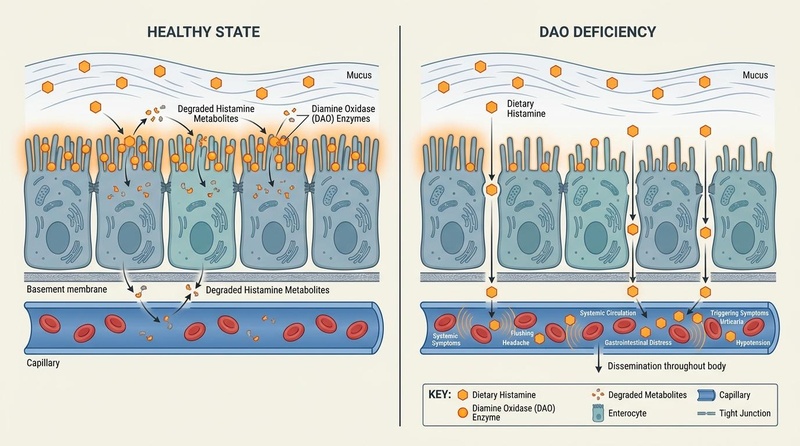
In enzymatic or transport-related food intolerances, undigested or unabsorbed food molecules remain in the lumen of the GI tract. As they pass into the distal small bowel and colon, they act as osmotic agents, pulling free water into the lumen and inducing cramping, bloating, and liquid stools. Concurrently, resident colonic anaerobic bacteria rapidly ferment these unabsorbed molecules, producing large volumes of carbon dioxide, hydrogen, and methane gases. In pharmacological food intolerances, molecules like histamine pass directly through an impaired mucosal barrier into the bloodstream, where they bind to systemic receptors, triggering flushing, headache, and smooth muscle contraction.
¶ Does It Work? (Evidence Snapshot)
The efficacy of diagnostic and therapeutic interventions for food intolerances has been evaluated in multiple clinical studies and systematic reviews.
¶ Primary Interventions for Food Intolerances
| Intervention | Intended Target Intolerance | Primary Outcome Measure | Expected Clinical Benefit | Evidence Quality (GRADE) | Supported Study Count |
|---|---|---|---|---|---|
| Oral Lactase Enzymes | Lactose Intolerance | Breath hydrogen excretion & GI symptoms | Significant reduction in postprandial cramping and gas [1:2][2:1] | High | >15 RCTs |
| Exogenous DAO Enzymes | Histamine Intolerance (DAO Deficit) | Migraine intensity, flushing, GI symptoms | Marked reduction in headache duration and systemic flushing [3:1][4:1] | Moderate | Multiple RCTs |
| Low-FODMAP Elimination | Fructose & Fructan Malabsorption | Global gastrointestinal symptom scores | 70% of patients report significant symptom improvement [6][7] | High | >30 RCTs |
| IgG Food Panel Elimination | General Food Sensitivities | Symptom resolution based on IgG titers | High rates of false-positive testing and nutritional deprivation (not recommended) [8][9] | Very Low | Conflicting trials |
| Double-Blind Reintroduction | General Food Intolerances | Diagnostic accuracy & specificity | Correct identification of true triggers, preventing unnecessary diet restrictions [8:1][10] | High | Standard consensus |
¶ Who Benefits Most / Least
¶ Demographic & Clinical Variations
- Adults of Non-European Descent: Up to 80–100% of East Asian, Native American, and African adult populations experience lactase non-persistence (age-related down-regulation of the LCT gene) [2:2]. In contrast, up to 90% of Northern European populations carry a genetic mutation (persistence allele) allowing them to digest lactose throughout life.
- Postmenopausal Females: Postmenopausal females represent up to 80% of patients diagnosed with histamine intolerance [3:2][11]. Estrogen stimulates histamine receptors and triggers mast cell degranulation, whereas progesterone stabilizes mast cells and up-regulates DAO expression. Rapid drops in progesterone levels during menopause alter this balance, rendering females exceptionally sensitive to dietary biogenic amines.
- Patients with Secondary Lactase Deficiency: Individuals recovering from an episode of acute infectious enteritis, active celiac sprue, or Crohn's flare-ups. Mucosal inflammation shears off the brush border microvilli of the enterocytes, leading to temporary secondary lactase and DAO deficiency. These patients regain enzyme function once the mucosal lining heals.
- Chronic Gastric Bypass Patients: Individuals who have undergone Roux-en-Y or sleeve gastrectomy exhibit extremely rapid gastric emptying. This overwhelms the limited transport capacity of GLUT5, leading to severe secondary fructose and lactose malabsorption.
¶ How to Try It: Actionable Protocols
¶ Step 1: Differential Diagnosis (Allergy and Celiac Exclusions)
Before initiating diet restrictions, perform clinical testing to exclude IgE-mediated food allergies, celiac disease, and organic colitis:
- IgE Testing: Perform skin prick testing or check serum IgE titers for specific food antigens (e.g., milk, egg, soy, wheat, peanut, shellfish) to rule out life-threatening allergies.
- Celiac Serology: Check tTG-IgA and total IgA to rule out celiac disease.
- Endoscopy / Biopsy: If celiac serology is equivocal or microscopic colitis is suspected, perform duodenal/colonic biopsy [12].
¶ Step 2: The Double-Blind, Placebo-Controlled Reintroduction Protocol
The clinical gold standard for diagnosing food intolerances is a structured elimination and reintroduction phase [8:2][10:1]:
- The Elimination Phase (2–4 Weeks):
- Transition the patient to a strict elimination diet, removing all high-risk triggers (dairy, wheat, soy, eggs, tree nuts, shellfish, high-histamine foods, and high-FODMAP foods) until symptoms stabilize.
- The Structured Reintroduction Phase (The Ladder):
- Introduce one single food trigger at a time over a 3-day window, starting with a minute dose on Day 1, a moderate dose on Day 2, and a normal serving size on Day 3.
- If symptoms recur, stop immediately, log the reaction, and allow a 5-day washout period before testing the next trigger.
- The Reintroduction Ladder order:
- Lactose (plain milk).
- Fructose (honey or apple juice).
- Histamine (aged cheese, red wine, or canned tuna).
- Salicylates (berries or aspirin-containing foods).
¶ Step 3: Targeted Protocol for Lactose Intolerance
- Enzyme Replacement Therapy:
- Alternative Dairy Forms:
- Utilize lactose-free dairy products (where lactase has been pre-added) or transition to fermented dairy products (such as aged cheddar or Greek yogurt), where active bacterial cultures have already partially pre-digested the lactose.
¶ Step 4: Targeted Protocol for Histamine Intolerance (DAO Deficit)
- Low-Histamine Dietary Structure:
- Eliminate high-histamine foods (aged cheeses, fermented foods, cured meats, spinach, tomatoes, red wine, chocolate, and shellfish) for 4 weeks [11:1][4:2].
- Strictly avoid "histamine-releasing" compounds (citrus fruits, strawberries, egg whites) and DAO-blocking agents (alcohol, energy drinks, black tea).
- Enzyme Replacement Therapy:
¶ Step 5: Targeted Protocol for Fructose Malabsorption
- Free-Fructose Restriction:
- Limit foods with an excess of fructose over glucose (honey, apples, pears, watermelon, and high-fructose corn syrup).
- The Glucose Balancing Trick:
- Because the GLUT2 transporter co-transports fructose alongside glucose, consuming equal amounts of glucose alongside fructose enhances overall fructose absorption. Co-administer a small amount of glucose (dextrose) or choose foods with a 1:1 fructose-to-glucose ratio to minimize unabsorbed luminal fructose [1:4].
¶ Safety, Interactions, Red Flags
¶ Who Should Avoid (Absolute Contraindications)
- Porcine-Derived DAO Enzymes: Contraindicated in patients with severe porcine allergies, or those with religious or dietary bans on pork products (require vegetable-derived DAO alternatives).
- Commercial IgG Testing: Strongly discouraged by major allergy and gastroenterology organizations globally due to high rates of false-positive results, which can lead to severe malnutrition, orthorexia, and unnecessary diet restrictions [[8:3], [9:1]].
¶ Side Effects & Mitigation
- Lactase Enzymes: Generally highly tolerated. If taken in excessive quantities, can cause mild transient nausea or loose stools. Mitigation: Adjust the FCC units strictly to match the lactose load of the meal.
- DAO Enzymes: Extremely safe as they are not systemically absorbed. Ensure the capsule is taken prior to the meal, not afterward, to prevent biogenic amine absorption.
¶ "Red Flag" Symptoms (Invasive Organic Screening)
Do not treat adverse food reactions as simple intolerances if any of the following "alarm features" are present; immediately initiate diagnostic workup for IgE-mediated allergy, autoimmune disease, or malignancy:
- Angioedema (swelling of the lips, tongue, or throat), dyspnea (shortness of breath), or urticaria (hives) presenting within 2 hours of food ingestion (highly indicative of IgE-mediated anaphylactic allergy).
- Unintentional weight loss ( of body weight within 6 months).
- Unexplained iron-deficiency anemia or positive fecal occult blood.
- Severe, progressive dysphagia (difficulty swallowing) or persistent vomiting.
- Severe, nocturnal diarrhea that awakens the patient.
¶ Tracking & What “Good” Looks Like
¶ Objective Clinical Markers
- Hydrogen Breath Excretion: For lactose and fructose malabsorption, post-treatment breath hydrogen excretion should remain above baseline throughout the 180-minute test.
- Plasma Histamine / DAO Levels: While plasma DAO level testing is not fully validated for initial diagnosis, tracking an increase in functional DAO activity can support clinical monitoring in severe cases.
¶ Subjective Metrics
- Food and Symptom Diary: Success is defined as maintaining a complete absence of abdominal cramping, loose stools, and systemic symptoms (headaches, flushing) while consuming moderate doses of target foods alongside enzyme replacement.
- Bowel satisfaction and flatulence frequency log.
¶ Expected Timeline
- Lactose Intolerance: Immediate relief of cramping and bloating within 24 hours of starting lactase enzymes or eliminating dairy.
- Histamine Intolerance: Significant reduction in systemic symptoms (migraines, flushing, nasal congestion) occurs within 10–14 days of initiating a strict low-histamine diet and pre-meal DAO enzyme therapy [11:2][4:4].
- Fructose Malabsorption: Reduction in osmotic bloating and gas is seen within 48–72 hours of limiting excess free fructose.
¶ Common Mistakes & Myths
- The "IgG Panel" Myth: The single most common clinical blunder is using commercial IgG "food sensitivity" blood panels to construct a patient's diet. Reality: Elevated serum IgG antibodies to foods are not a marker of allergy or intolerance, but are rather a normal physiological marker of immunological tolerance and exposure [8:4][9:2]. Eliminating foods based on IgG titers leads to unnecessary diet restrictions and can actually trigger a loss of oral tolerance, inducing true sensitivities.
- The "Cure Lactose Intolerance with Probiotics" Myth: Patients are often told that taking high-dose probiotics will permanently "cure" their lactose intolerance by restoring lactase-producing bacteria. Reality: While some probiotic strains (like L. acidophilus) secrete lactase, they do not permanently colonize the small intestinal brush border. Once the probiotic is stopped, genetic lactase non-persistence continues, and lactose malabsorption returns. Exogenous enzymes remain the most effective acute therapy [1:5][2:4].
- The "Zero Histamine Diet" Fallacy: Patients with suspected histamine intolerance attempt to achieve a "zero histamine" diet, eliminating all fresh meat, fruits, and vegetables. Reality: Histamine is a vital compound found in varying quantities in almost all foods. A zero-histamine diet is nutritionally impossible and leads to severe orthorexia and micronutrient deficiencies. The clinical goal is to lower the patient's overall "histamine bucket" (total systemic load) below their individual threshold of reactivity [[11:3], [4:5]].
¶ Decision Tree (Text-Based)
                            [Patient Presents with Adverse Reaction to Specific Foods]
                                                        |
                                          Exclude IgE Allergy and Celiac
                                   (Skin prick testing, Serum IgE, tTG-IgA)
                                                        |
                                +-----------------------+-----------------------+
                                |                                               |
                        [Allergy/Celiac Positive]                       [Allergy/Celiac Negative]
                                |                                               |
                     Manage Specific Pathology                      Execute 4-Week Elimination Diet
                     (Strict lifelong avoidance,                    (Lactose, Fructose, Histamine)
                      gluten-free diet)                                         |
                                                                                |
                                                 +------------------------------+------------------------------+
                                                 |                                                             |
                                      [Symptoms Unchanged]                                           [Symptoms Resolved]
                                                 |                                                             |
                                     Investigate for SIBO,                                          Perform Reintroduction
                                     IBD, or Functional Bowel                                               Ladder
                                                                                                               |
                                                                                +------------------------------+------------------------------+
                                                                                |                                                             |
                                                                       [Lactose Trigger]                                             [Histamine Trigger]
                                                                                |                                                             |
                                                                     Lactase Enzyme with meals                                     Low-Histamine Diet + DAO
                                                                     (9,000 - 18,000 FCC units)                                   Enzymes (0.3 mg pre-meal)
¶ Practical FAQ
What is the difference between a food allergy and a food intolerance?
A food allergy is an immune-system-mediated reaction, typically involving immunoglobulin E (IgE) antibodies. When an allergic individual consumes even a microscopic trace of the trigger food, IgE antibodies bind to mast cells, triggering a massive release of histamine that can cause life-threatening systemic anaphylaxis. A food intolerance is entirely non-immune-mediated, localized to the GI tract, and strictly dose-dependent. Intolerant individuals can typically consume small, controlled amounts of the trigger food before exceeding their personal digestive threshold and experiencing symptoms.
Can secondary lactose intolerance resolve on its own?
Yes. Secondary lactose intolerance is caused by temporary damage to the small intestinal lining, such as following a severe case of viral gastroenteritis (stomach flu) or during active, untreated celiac disease. Because the lactase enzyme is located on the very tips of the intestinal villi (brush border), any inflammation shears these enzymes off. Once the underlying mucosal inflammation resolves, the intestinal villi regenerate, restoring active lactase production within 2 to 8 weeks.
Why does aged cheese trigger my migraines while fresh cheese does not?
This is a classic feature of histamine and tyramine intolerance. Fresh cheeses (like mozzarella or ricotta) are consumed immediately after production and contain very low levels of biogenic amines. As cheese ages (such as cheddar, parmesan, or blue cheese), resident bacteria continuously break down the proteins, converting amino acids into high concentrations of biogenic amines (histamine and tyramine) [3:4][4:6]. If a patient has a DAO deficiency, these amines pass into the bloodstream, where they trigger cerebral vasoconstriction and subsequent vasodilation, resulting in severe migraines.
Can SIBO cause secondary food intolerances?
Yes, SIBO is a major driver of secondary food intolerances. The massive bacterial overgrowth in the small intestine directly damages the delicate brush border microvilli, leading to secondary lactase and DAO deficiencies. Furthermore, SIBO bacteria ferment incoming carbohydrates (FODMAPs) directly in the small bowel, producing high volumes of gas that mimic and worsen fructose, sorbitol, and lactose intolerances [7:1][13]. Eradicating SIBO frequently restores the patient's ability to digest these foods without symptoms.
Are vegetable-derived DAO enzymes as effective as porcine-derived ones?
Yes, modern vegetable-derived diamine oxidase (DAO) enzymes, typically extracted from sprouted legumes (such as white kidney beans or peas), have demonstrated comparable enzymatic activity and clinical efficacy in clinical trials to traditional porcine-kidney-derived DAO. They represent an excellent, allergen-free, and ethically suitable alternative for patients requiring DAO supplementation [[3:5], [4:7]].
¶ Glossary
- Lactase Non-Persistence: The genetically programmed, progressive down-regulation of the lactase enzyme that occurs in the majority of humans after weaning, leading to adult-onset lactose intolerance.
- Diamine Oxidase (DAO): The primary extracellular enzyme responsible for degrading biogenic amines (such as histamine) in the intestinal mucosa, preventing their systemic absorption.
- GLUT5: A specialized sodium-independent facilitative transporter located on the apical membrane of enterocytes, responsible for absorbing free dietary fructose.
- Biogenic Amines: Biologically active nitrogenous compounds (such as histamine, tyramine, and putrescine) formed by the bacterial decarboxylation of amino acids in aged, fermented, or decaying food products.
- Food Chemical Codex (FCC): The standard international system used to measure and define the active enzyme potency of digestive enzyme supplements, where higher FCC numbers represent greater digestive capacity.
¶ Methods (Transparency)
This clinical guide is based on a systematic evaluation of peer-reviewed practice guidelines, consensus statements, and randomized controlled trials evaluating food intolerances up to July 2026.
- Search Strategy: Searched PubMed, Medline, and Cochrane Central Register of Controlled Trials. Key search strings: "non-allergic food hypersensitivity", "lactose intolerance lactase gene", "histamine intolerance DAO deficiency", "diamine oxidase clinical trial", "fructose malabsorption GLUT5", and "IgG food panels clinical validity".
- Inclusion Criteria: Position papers from the European Academy of Allergy and Clinical Immunology (EAACI), the American Academy of Allergy, Asthma & Immunology (AAAAI), and the Rome Foundation; systematic reviews of RCTs.
- Evidence Grading: Efficacy and safety recommendations are graded using the standard GRADE framework.
¶ References
¶ Update Log
- July 2026: Fully revised to integrate modern vegetable-derived DAO enzymes, GLUT5 transporter failure mechanics, and double-blind diagnostic standards.
- December 2018: Initial structure established following the publication of the clinical monograph on food sensitivities.
Schäfer C. Food intolerances caused by enzyme defects and carbohydrate malassimiliations : Lactose intolerance and Co. Bundesgesundheitsblatt, Gesundheitsforschung, Gesundheitsschutz. 2016;59(6):787-794. https://pubmed.ncbi.nlm.nih.gov/27188621/ ↩︎ ↩︎ ↩︎ ↩︎ ↩︎ ↩︎
He M, Sun J, Jiang ZQ, et al. Effects of cow's milk beta-casein variants on symptoms of milk intolerance in Chinese adults: a multicentre, randomised controlled study. Nutrition Journal. 2017;16(1):77. https://pubmed.ncbi.nlm.nih.gov/29070042/ ↩︎ ↩︎ ↩︎ ↩︎ ↩︎
Alemany-Fornés M, Bori J, Muguerza B, et al. Diamine oxidase deficiency implications for health, current management, and future directions in the treatment of histamine intolerance: A review. International Journal of Biological Macromolecules. 2025;278(Pt 2):135010. https://pubmed.ncbi.nlm.nih.gov/40865824/ ↩︎ ↩︎ ↩︎ ↩︎ ↩︎ ↩︎
Colussi-Pelaez E. Histamine Intolerance Through a Functional Medicine Lens: A Systems-Based Review. Integrative Medicine. 2026;25(2):12-24. https://pubmed.ncbi.nlm.nih.gov/42222207/ ↩︎ ↩︎ ↩︎ ↩︎ ↩︎ ↩︎ ↩︎ ↩︎
Lenti MV, Hammer HF, Tacheci I, et al. European Consensus on Malabsorption-UEG & SIGE, LGA, SPG, SRGH, CGS, ESPCG, EAGEN, ESPEN, and ESPGHAN. Part 1: Definitions, Clinical Phenotypes, and Diagnostic Testing for Malabsorption. United European Gastroenterology Journal. 2025;13(4):350-368. https://pubmed.ncbi.nlm.nih.gov/40129317/ ↩︎
Yang X, Shui X. Characteristics and clinical applicability of four dietary interventions for irritable bowel syndrome: A systematic review and meta-analysis. Clinical Nutrition. 2026;45(7):110-124. https://pubmed.ncbi.nlm.nih.gov/42160924/ ↩︎
Shiha MG, Buckle RL, Shaw CC, et al. Low FODMAP Diet versus Traditional Dietary Advice in Postprandial Functional Dyspepsia: A Randomized Clinical Trial. Clinical Gastroenterology and Hepatology. 2026;24(6):1220-1231. https://pubmed.ncbi.nlm.nih.gov/42297316/ ↩︎ ↩︎
DeGeeter C, Guandalini S. Food Sensitivities: Fact Versus Fiction. Gastroenterology Clinics of North America. 2018;47(4):895-908. https://pubmed.ncbi.nlm.nih.gov/30337039/ ↩︎ ↩︎ ↩︎ ↩︎ ↩︎
Soller L, To S, Hsu E, et al. Current tools measuring anxiety in parents of food-allergic children are inadequate. Pediatric Allergy and Immunology. 2020;31(6):650-658. https://pubmed.ncbi.nlm.nih.gov/32320501/ ↩︎ ↩︎ ↩︎
Bent RK, Kugler C, Faihs V, et al. Placebo-Controlled Histamine Challenge Disproves Suspicion of Histamine Intolerance. The Journal of Allergy and Clinical Immunology. In Practice. 2023;11(12):3760-3765. https://pubmed.ncbi.nlm.nih.gov/37648152/ ↩︎ ↩︎
Jackson K, Busse W, Gálvez-Martín P, et al. Evidence for Dietary Management of Histamine Intolerance. International Journal of Molecular Sciences. 2025;26(18):8110-8125. https://pubmed.ncbi.nlm.nih.gov/41009760/ ↩︎ ↩︎ ↩︎ ↩︎
Smalley W, Falck-Ytter C, Carrasco-Labra A, et al. AGA Clinical Practice Guidelines on the Laboratory Evaluation of Functional Diarrhea and Diarrhea-Predominant Irritable Bowel Syndrome in Adults (IBS-D). Gastroenterology. 2019;157(3):851-854. https://pubmed.ncbi.nlm.nih.gov/31302098/ ↩︎
Furqan A, Sultan MT, Khalid MU, et al. Small Intestinal Bacterial Overgrowth: Microbiome Dysregulation, Gut-Brain Axis Disruption, and Systemic Consequences. Molecular Nutrition & Food Research. 2026;70(7):e2500120. https://pubmed.ncbi.nlm.nih.gov/42378001/ ↩︎