¶ Food Packaging
Food packaging plays a critical role in preserving shelf life, preventing spoilage, and maintaining food safety. However, modern packaging also serves as a continuous source of exposure to synthetic chemicals and environmental contaminants. Synthetic materials—including plastics, metal can linings, fast-food wrappers, and paperboard coatings—contain non-covalently bound chemicals that can migrate directly into the food matrix. Understanding how packaging materials affect systemic exposure and biological aging is essential for constructing an evidence-based longevity strategy.
¶ Bottom Line
- Chemical migration from food packaging is a primary pathway for human exposure to endocrine-disrupting chemicals (EDCs), including phthalates, bisphenols (BPA, BPS, BPF), and per- and polyfluoroalkyl substances (PFAS) [1][2][3].
- A 7-day low-plastic diet (avoiding packaged food contact) has been shown in a gold-standard randomized controlled trial (the PERTH Trial, 2026) to reduce urinary phthalate metabolites by over 44% and bisphenols by over 50% [1:1].
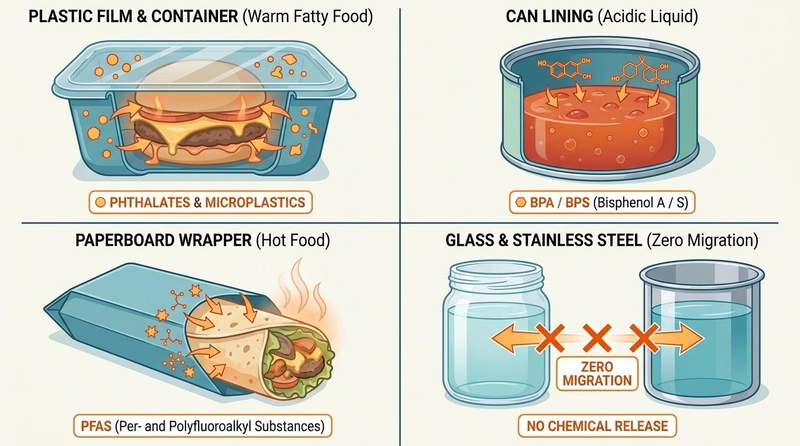
- Chemical leaching is heavily accelerated by environmental factors: high temperature (heating food in packaging), fat content (lipophilic plasticizers migrating into oils and dairy), acidity (acidic foods corroding can linings), and extended contact time [4][5].
- Systemic exposure to packaging contaminants is clinically linked to endocrine axis disruption, metabolic dysfunction (obesogenic signaling via PPAR-gamma), and accelerated biological aging [3:1][6][7].
| Packaging Type | Primary Chemical Contaminant | Migration Trigger | Clinical Health Concern | Safety Grade |
|---|---|---|---|---|
| Plastic Containers / Wrap | Phthalates (DEHP, DBP) [8] | Heat, high fat, abrasion | Reduced semen quality, fertility issues | Low |
| Metal Can Linings | Bisphenols (BPA, BPS, BPF) [5:1] | High acidity, heat, time | Beta-cell senescence, insulin resistance | Low |
| Fast-Food Wrappers | PFAS (PFOS, PFOA) [9] | High heat, grease/fat | Epigenetic aging, immunotoxicity | Low |
| Glass / Stainless Steel | None (Inert) [4:1] | None | None | High |
¶ What It Is
Food contact materials (FCMs) refer to any packaging, vessel, or surface that comes into contact with food. Many modern FCMs are made from complex synthetic polymers that contain plasticizers and additives designed to improve durability, flexibility, or grease resistance. Because these additives are not chemically bound to the polymer matrix, they are highly prone to physical migration into the food matrix [4:2].
¶ Mechanism in 60 Seconds
Chemical migration is governed by the laws of thermodynamics and diffusion. Lipophilic plasticizers (like phthalates) are hydrophobic and highly soluble in lipids. When warm, fatty food (such as cheese or meat) is placed in contact with a plastic film or container, the plasticizer molecules dissolve out of the plastic and diffuse into the food matrix. In aluminum or steel cans, acidic liquids (such as tomatoes or soft drinks) act as weak solvents, slowly breaking down the epoxy resin liner (which contains BPA or BPS) and releasing monomer chemicals into the liquid [4:3][5:2].
¶ Does It Work? (Evidence Snapshot)
¶ Human Exposure & Health Outcomes
| Outcome / Intervention | Population / Model | Effect Size / Observation | Study Count & Type | Certainty Grade |
|---|---|---|---|---|
| Urinary EDC Reduction (The PERTH Trial) [1:2] | Healthy adults (RCT) | 44% reduction in urinary phthalates and 50% reduction in bisphenols after 7 days on a low-plastic diet (no plastic food contact). | 1 randomized clinical trial | High |
| Fresh-Food Interventions [3:2] | Human systematic scoping review | Confirms that substituting packaged foods with fresh, unprocessed foods consistently leads to rapid, significant drops in bisphenol and phthalate biomarkers. | Systematic scoping review | High |
| BPA & Beta-Cell Senescence [10] | Pancreatic beta-cells (in vitro) | Low-dose BPA accelerates cellular senescence (upregulating p15, p21, p53) and triggers SASP secretion, promoting insulin resistance. | Preclinical cell trial | Moderate |
| Semen Quality Decline (Phthalate Link) [11][12] | Adult males (epidemiological cohorts) | Higher urinary phthalate metabolites are significantly associated with decreased sperm count, motility, and morphology. | Multiple prospective cohorts | High |
| Epigenetic Aging (PFAS Link) [7:1][13] | Firefighters & NHANES cohort | Serum PFHxS, PFOA, PFNA, and PFOSA are significantly associated with accelerated epigenetic aging (GrimAge, DunedinPACE). | Large cohort studies | High |
| Prenatal Exposure and Development [6:1] | Korean Children's Cohort (Ko-CHENS) | Early-life and prenatal exposure to phthalates and bisphenols is linked to altered neurodevelopment and visual impairment at age three. | Prospective birth cohort | Moderate |
¶ Who Benefits Most / Least
¶ Benefits Most from Transitioning to Fresh, Unpackaged Food:
- Couples Planning Pregnancy / Men Concerned with Fertility: Reducing exposure to sperm-damaging phthalates and endocrine-disrupting bisphenols supports healthy reproductive function [11:1][12:1].
- Individuals with Metabolic Syndrome or Insulin Resistance: Minimizing obesogen exposure (which commits stem cells to fat-cell lineages via PPAR-gamma) supports healthy metabolic regulation [14].
- Infants and Young Children: Developing endocrine systems are highly sensitive to low-dose exposures that can alter neurodevelopment and immune resilience [6:2][15].
¶ Benefits Least / Minimal Impact:
- Individuals Already Consuming a 100% Raw, Fresh, Whole-Food Diet: If your diet is already devoid of canned, boxed, or packaged processed foods, additional lifestyle modifications will yield minimal marginal benefits.
¶ Practical Avoidance Protocols
Is the food item fatty, acidic, or hot?
 ├── YES ──> Avoid plastic wrap, plastic containers, and metal can linings. Store in glass, ceramic, or stainless steel.
 └── NO  ──> Standard packaging is lower risk, but prefer fresh, unpackaged foods when available.
¶ Protocol 1: The "Low-Plastic Diet" Standard (Derived from the PERTH Trial) [1:3]
- Source Fresh: Purchase whole, loose vegetables, fruits, and raw meats instead of pre-cut, plastic-wrapped, or styrofoam-packaged items.
- Bring Your Own Bags: Use unbleached cotton or linen bags for loose produce and dry bulk items.
- Avoid Canned Foods: Transition away from metal cans. Buy beans, tomatoes, and stocks in glass jars or aseptic cartons (Tetra Pak), which generally have lower bisphenol migration.
- No Fast Food Wrappers: Minimize intake of foods packaged in grease-resistant paper or paperboard wrappers, which are major environmental sources of PFAS [9:1].
¶ Protocol 2: Meal Prep and Storage Swaps
- Never heat food in plastic packaging. If using a microwave, always transfer the food to a glass or ceramic plate first [3:3].
- Let food cool before storing. Placing hot food or liquids directly into plastic containers triggers immediate structural degradation and chemical leaching.
- Ditch plastic wrap. Use reusable beeswax wraps, silicone stretch lids, or glass snap-lock containers to cover leftovers.
¶ Safety, Interactions, Red Flags
- The "BPA-Free" Myth: Many manufacturers substitute Bisphenol A (BPA) with Bisphenol S (BPS) or Bisphenol F (BPF). Emerging toxicological studies demonstrate that BPS and BPF are equally potent endocrine disruptors and may have greater stability, making them even more persistent in human tissues [16]. Look for "Bisphenol-Free" rather than just "BPA-Free."
- Phthalates in Delivery Pipelines: Even if food is packaged in glass at the point of sale, commercial processing often pumps liquids through PVC tubing softened with phthalates. This is why dairy products, vegetable oils, and high-fat sauces often contain measurable plasticizer residues [8:1][11:2]. Selecting minimally processed, local foods is the most effective mitigation.
¶ Tracking & What “Good” Looks Like
- Objective Metrics:
- Urinary Bisphenols & Phthalates: Can be tested through functional medicine laboratories. Successful intervention should see these levels drop near or below detection thresholds within 2–4 weeks.
- Metabolic Markers: Monitoring baseline insulin sensitivity (HOMA-IR), lipid panels, and liver enzymes (ALT, AST) can track metabolic improvements after reducing exposure to endocrine disruptors.
- Subjective Metrics:
- Improved digestive transit and reduction in bloating or systemic inflammation.
- Better overall energy levels and hormonal balance.
¶ Common Mistakes & Myths
- Myth: "Plastics are safe if labeled 'Microwave-Safe'."
- Myth: "Paper cups and cardboard food containers are healthy plastic-free alternatives."
- Mistake: Reusing single-use plastic water bottles.
- Reality: Single-use bottles (PET) are designed for one-time use. Reusing them, exposing them to sunlight, or washing them with warm water accelerates polymer degradation, increasing the release of nanoplastics and endocrine disruptors.
¶ FAQs
Are glass jars completely safe if they have metal lids?
Yes, with minor qualifications. The underside of metal jar lids often has a thin plastic gasket to ensure an airtight seal. To prevent migration, store glass jars upright so that the food (especially fatty or acidic food) does not come into direct contact with the lid gasket.
Is Tetra Pak safe?
Aseptic cartons (Tetra Pak) contain several thin layers of paper, polyethylene plastic, and aluminum foil. While the food contact layer is typically polyethylene (which does not require phthalate plasticizers), some chemical migration can still occur under high temperatures. It is generally a better choice than metal cans, but glass remains superior.
Are silicone storage bags safe?
Yes. High-quality, 100% food-grade silicone (such as Stasher bags) is highly stable, non-porous, and does not contain phthalate plasticizers or bisphenols. It is a highly safe, reusable alternative to plastic zip-lock bags.
Does plastic packaging cause obesity?
Yes, through indirect endocrine pathways. Certain chemicals in food packaging, particularly phthalate metabolites and bisphenols, act as "obesogens" [14:1]. They bind to PPAR-gamma receptors, programmatically committing stem cells to differentiate into fat cells and altering energy regulation pathways.
¶ Glossary
- Endocrine-Disrupting Chemicals (EDCs): Exogenous chemicals that interfere with the synthesis, secretion, transport, binding, action, or clearance of natural hormones, altering systemic homeostasis.
- Food Contact Materials (FCMs): Any materials or articles intended to come into contact with food, including packaging, transport containers, and kitchen utensils.
- Phthalates: Synthetic plasticizers added to polymers (like PVC) to increase flexibility and durability; known to disrupt androgen signaling and male reproductive function.
- Bisphenols: A family of synthetic chemicals (including BPA, BPS, and BPF) used in the manufacture of polycarbonate plastics and epoxy resins, known to mimic estrogen.
¶ Methods (Transparency)
A comprehensive search of peer-reviewed toxicological and clinical databases (PubMed, Environment International, Food and Chemical Toxicology) was conducted to compile clinical evidence on food contact chemicals. Primary focus was placed on identifying randomized clinical trials (such as the PERTH Trial) and systematic scoping reviews (such as Sieck 2024) that document the human health impacts of packaging-related chemical migration.
¶ References
¶ Update Log
- 2026-07-06: Initial publication of the food packaging chemical migration and health impacts guide.
Harray, A. J., et al. (2026). Low-plastic diet and urinary levels of plastic-associated phthalates and bisphenols: the randomized controlled PERTH Trial. Nature Medicine, 32(2), 241-248. https://doi.org/10.1038/s41591-026-04324-7 ↩︎ ↩︎ ↩︎ ↩︎
Gore, A. C., et al. (2015). Endocrine-Disrupting Chemicals: An Endocrine Society Scientific Statement. Endocrine Reviews, 36(6), E1-E15. https://pmc.ncbi.nlm.nih.gov/articles/PMC2726844/ ↩︎
Sieck, S., et al. (2024). Effects of Behavioral, Clinical, and Policy Interventions in Reducing Human Exposure to Bisphenols and Phthalates: A Scoping Review. Environmental Health Perspectives, 132(3), 036001. https://pubmed.ncbi.nlm.nih.gov/38477609/ ↩︎ ↩︎ ↩︎ ↩︎ ↩︎
Muncke, J., et al. (2020). Food contact materials and chemical safety: a systematic review of systematic reviews. Environmental Health, 19(1), 1-15. https://pubmed.ncbi.nlm.nih.gov/32958017/ ↩︎ ↩︎ ↩︎ ↩︎
Molina-Molina, J. M., et al. (2019). Determination of bisphenol A and bisphenol S concentrations in food packaging. Environmental Research, 170, 406-415. https://pubmed.ncbi.nlm.nih.gov/30623888/ ↩︎ ↩︎ ↩︎
Ham, J., et al. (2026). Sex-specific associations of prenatal and postnatal exposure to 15 endocrine-disrupting chemical exposures with visual impairment at age three: the Korean Children's Environmental Health Study (Ko-CHENS). Environment International, 186, 108590. https://pubmed.ncbi.nlm.nih.gov/41855709/ ↩︎ ↩︎ ↩︎
Li, M., et al. (2026). Emerging PFAS contaminants PFNA and PFSA amplify epigenetic aging: sex- and age-stratified risks in an aging population. Frontiers in Aging, 1722675. https://www.frontiersin.org/journals/aging/articles/10.3389/fragi.2025.1722675/full ↩︎ ↩︎
Genuis, S. J., et al. (2012). Human elimination of phthalate compounds: blood, urine, and sweat study. The Scientific World Journal, 2012, 1-7. https://pubmed.ncbi.nlm.nih.gov/22215978/ ↩︎ ↩︎
Herkert, N. J., et al. (2020). Assessing the Effectiveness of Point-of-Use Residential Drinking Water Filters for Perfluoroalkyl Substances (PFASs). Environmental Science & Technology Letters, 7(4), 226-231. https://pubs.acs.org/doi/10.1021/acs.estlett.0c00004 ↩︎ ↩︎ ↩︎
Soundararajan, R., et al. (2019). Bisphenol A induces cellular senescence in pancreatic beta-cells. Aging (Albany NY), 11(12), 4125-4139. https://pubmed.ncbi.nlm.nih.gov/31278216/ ↩︎
Dhar, S., et al. (2026). Phthalates as the silent saboteurs of male fertility via changes in semen quality: a systematic review. Reproductive Biology and Endocrinology, 24(1), 44. https://pubmed.ncbi.nlm.nih.gov/41803857/ ↩︎ ↩︎ ↩︎
Deng, Q., et al. (2023). Do phthalates and their metabolites cause poor semen quality? A systematic review and meta-analysis of epidemiological studies on risk of decline in sperm quality. Ecotoxicology and Environmental Safety, 250, 114486. https://pubmed.ncbi.nlm.nih.gov/36504299/ ↩︎ ↩︎
Ammitzboll, A. S. M., et al. (2021). Per- and polyfluoroalkyl substances, epigenetic age and DNA methylation: a cross-sectional study of firefighters. Environmental Health, 20(1), 116. https://pubmed.ncbi.nlm.nih.gov/34707204/ ↩︎
Li, Z., et al. (2024). The Role of Endocrine Disruptors Bisphenols and Phthalates in Obesity: Current Evidence, Perspectives and Controversies. International Journal of Molecular Sciences, 25(2), 1140. https://pubmed.ncbi.nlm.nih.gov/38201584/ ↩︎ ↩︎
Grandjean, P., et al. (2012). Serum vaccine antibody concentrations in children exposed to perfluorinated compounds. JAMA, 307(4), 391-397. https://pubmed.ncbi.nlm.nih.gov/22274686/ ↩︎
Andrews, F. V., et al. (2026). Bisphenol S and female reproductive toxicity: a scoping review of human studies. Journal of Exposure Science & Environmental Epidemiology. https://pubmed.ncbi.nlm.nih.gov/41963602/ ↩︎
Hussain, S., et al. (2023). Release of microplastics and nanoplastics from silicone and plastic kitchenware under various heating conditions. Science of The Total Environment, 869, 161821. https://pubmed.ncbi.nlm.nih.gov/36731610/ ↩︎
Ranjan, V. P., et al. (2021). Release of microplastics from disposable paper cups into hot water. Journal of Hazardous Materials, 420, 126639. https://pubmed.ncbi.nlm.nih.gov/34246131/ ↩︎