¶ FOXO4-DRI
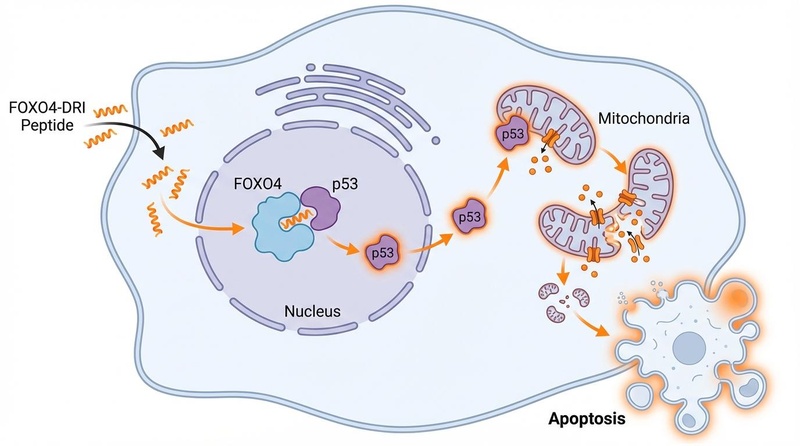
FOXO4-DRI (Forkhead box O4 D-Retro-Inverso) is a synthetic peptide designed to selectively eliminate senescent cells ("zombie cells") by interfering with the interaction between the transcription factor FOXO4 and the tumor suppressor protein p53.
First described in a pivotal 2017 study by Baar et al. in Cell, FOXO4-DRI represents a targeted approach to "senolysis"—the clearance of senescent cells to improve healthspan. Unlike some other senolytic agents (such as navitoclax), FOXO4-DRI has shown a favorable safety profile in preclinical models, notably avoiding severe hematological toxicity like thrombocytopenia[1][2].
¶ Mechanism of Action
The therapeutic strategy of FOXO4-DRI is based on the specific molecular dysregulation observed in senescent cells.
¶ The p53-FOXO4 Axis
In healthy cells, p53 acts as a "guardian of the genome," triggering DNA repair or apoptosis (programmed cell death) when cellular damage is detected. However, in senescent cells, p53 is upregulated but fails to induce apoptosis. Research indicates that FOXO4 is preferentially elevated in senescent cells and interacts directly with p53 within the nucleus, sequestering it and preventing it from initiating cell death[1:1][3].
This interaction effectively neutralizes the toxicity of the chronic DNA damage signaling present in senescent cells, keeping them alive despite their dysfunction.
¶ Disruption and Apoptosis
FOXO4-DRI acts as a "decoy" peptide that competes with endogenous FOXO4 for binding to p53.
- Nuclear Exclusion: The peptide enters the cell and disrupts the FOXO4-p53 complex in the nucleus.
- Mitochondrial Translocation: Freed from FOXO4, p53 is able to exit the nucleus and translocate to the mitochondria.
- Apoptosis Induction: At the mitochondria, p53 interacts with BAK/BAX pathways to trigger cytochrome C release and caspase-3 cleavage, leading to intrinsic apoptosis[1:2][4].
Because FOXO4 expression is low in non-senescent tissues, FOXO4-DRI exhibits high selectivity, inducing death in senescent cells while sparing healthy proliferating or quiescent cells[1:3].
¶ Efficacy in Preclinical Studies
The efficacy of FOXO4-DRI has been demonstrated in several mouse models of aging and disease.
¶ Reversal of Aging Phenotypes (Baar et al., 2017)
The foundational study utilized fast-aging () and naturally aged mice to test the peptide's effects[1:4]:
- Fur Density: Treatment restored coat density in fast-aging mice that typically lose hair rapidly.
- Renal Function: The peptide lowered plasma urea and creatinine levels in aged mice, indicating improved kidney filtration and a reversal of glomerulosclerosis.
- Physical Fitness: Treated geriatric mice showed increased responsiveness and traveled double the distance on running wheels compared to controls.
¶ Testicular Aging (Zhang et al., 2020)
Independent research has explored FOXO4-DRI's effect on male reproductive aging. FOXO4 was found to be highly expressed in senescent Leydig cells (testosterone-producing cells). Treatment with FOXO4-DRI induced apoptosis in these cells, reduced senescence-associated secretory phenotype (SASP) factors, and significantly increased serum testosterone levels in aged mice[5].
¶ Chondrocytes and Cartilage (Huang et al., 2021)
In human chondrocytes expanded in vitro, FOXO4-DRI selectively removed senescent cells while sparing healthy ones. However, the study noted that while it cleared the inflammatory senescent cells, it did not inherently enhance the regenerative capacity of the remaining cartilage cells without further intervention[6].
¶ Safety and Side Effects
A major potential advantage of FOXO4-DRI over other senolytics is its specificity for the p53-FOXO4 interaction, which appears to be unique to senescent cells.
¶ Lack of Thrombocytopenia
BCL-2 inhibitors like navitoclax are known to cause thrombocytopenia (a dangerous drop in platelet count) because BCL-Xl is essential for platelet survival. Baar et al. demonstrated that FOXO4-DRI did not reduce platelet levels in mice, even at therapeutic doses, suggesting it does not interfere with the mechanisms required for platelet maintenance[1:5].
¶ Off-Target Effects
In preclinical observation periods (up to >30 days), no increase in tumor formation or toxicity to healthy tissues (liver, heart, kidney) was reported[1:6][2:1]. The peptide appears to trigger apoptosis only in cells where p53 is already sequestered by FOXO4.
¶ Immunogenicity
As a peptide containing D-amino acids, there is a theoretical risk of immunogenicity (immune reaction) upon repeated administration in humans, although this was not a limiting factor in mouse studies[7].
¶ Clinical Development Status
Despite promising animal data, the specific FOXO4-DRI peptide described in 2017 has not entered human clinical trials.
¶ Drug Development
The original developers (including Peter de Keizer) formed Cleara Biotech to translate this research. They determined that the original FOXO4-DRI (referred to as "Generation 3") had limitations regarding potency, synthesis costs, and pharmacokinetic stability that made it suboptimal for human drug candidates. The company is currently developing optimized "Generation 4" variants (e.g., CL04183) for potential future clinical trials, likely targeting specific cancer indications or severe chronic diseases initially[7:1][8].
¶ Research Chemical Availability
FOXO4-DRI is widely available from online peptide vendors as a "Research Chemical." It is not approved by the FDA or EMA for human use. The purity and sequence accuracy of these gray-market peptides can vary significantly, and no human safety data exists in the peer-reviewed literature.
¶ Administration and Dosage (Animal Protocols)
Note: The following information is derived from animal studies and is for educational purposes only.
In the key study by Baar et al., the following protocol was used for mice[1:7]:
- Dosage: 5 mg/kg body weight.
- Route: Intravenous (i.v.) or Intraperitoneal (i.p.) injection.
- Frequency: 3 times per week, or every other day, typically for a duration of 30 days.
¶ Evidence Assessment
¶ Traffic Light Analysis: Experimental (Red)
- Evidence: Strong mechanistic data and positive results in mice (Baar et al., 2017). No human clinical trial data.
- Safety: Good safety profile in mice (no thrombocytopenia), but unknown long-term risks in humans.
- Action: "Pioneers only. High risk."
¶ GRADE Evaluation
- Certainty: Low (Animal data only).
- Outcome: Improvement in healthspan markers (renal function, fur density) in mice.
¶ References
Baar, M. P., Brandt, R. M., Putavet, D. A., Klein, J. D., Derks, K. W., Bourgeois, B. R., ... & de Keizer, P. L. (2017). Targeted apoptosis of senescent cells restores tissue homeostasis in response to chemotoxicity and aging. Cell, 169(1), 132-147. https://doi.org/10.1016/j.cell.2017.02.031 ↩︎ ↩︎ ↩︎ ↩︎ ↩︎ ↩︎ ↩︎ ↩︎
de Keizer, P. L. (2017). The Fountain of Youth by Targeting Senescent Cells? Trends in Molecular Medicine, 23(1), 6-17. https://doi.org/10.1016/j.molmed.2016.11.006 ↩︎ ↩︎
Bourgeois, B., & Madl, T. (2018). Regulation of cellular senescence via the FOXO4-p53 axis. FEBS Letters, 592(12), 2083-2097. https://doi.org/10.1002/1873-3468.13098 ↩︎
Mendelson, A. (2022). Cleara Biotech raises $2.5 million in seed financing to advance FOXO4 therapeutics pipeline. BioSpace. ↩︎
Zhang, C., Xie, Y., Chen, H., Lv, L., Yao, J., Zhang, M., ... & Liu, G. (2020). FOXO4-DRI alleviates age-related testosterone secretion insufficiency by targeting senescent Leydig cells in aged mice. Aging (Albany NY), 12(2), 1272. https://doi.org/10.18632/aging.102682 ↩︎
Huang, Y., He, Y., Makarcyzk, M. J., & Lin, H. (2021). Senolytic Peptide FOXO4-DRI Selectively Removes Senescent Cells From in vitro Expanded Human Chondrocytes. Frontiers in Bioengineering and Biotechnology, 9, 677576. https://doi.org/10.3389/fbioe.2021.677576 ↩︎
Cleara Biotech. (2025). Pipeline and Technology: FOXO4-based D-amino acid pipeline. Retrieved from https://www.clearabiotech.com/ ↩︎ ↩︎
Kirkland, J. L., & Tchkonia, T. (2020). Senolytic drugs: from discovery to translation. Journal of Internal Medicine, 288(5), 518-536. https://doi.org/10.1111/joim.13141 ↩︎