¶ Friendship and Health: Friendship Quality, Confidants, and Physiological Resilience
¶ At a Glance
¶ Overview
Friendship is a powerful physiological modifier. Beyond generic social ties, the quality of your closest friendships—characterized by emotional disclosure, mutual validation, and structural reciprocity—exerts a direct, measurable influence on your cardiovascular reactivity, immune function, and cellular aging rate. Maintaining at least one high-quality, trusted confidant is an independent, robust predictor of cardiovascular survival and cognitive longevity.
¶ Safety "Traffic Light"
- Green Light: Maintaining 1-3 highly reciprocal, low-conflict friendships characterized by mutual emotional vulnerability; engaging in weekly face-to-face contact.
- Yellow Light: Experiencing asymmetrical (non-reciprocal) friendships where emotional support is predominantly unidirectional; experiencing occasional social strain or passive conflict.
- Red Light: Experiencing chronic, hostile, or highly critical peer relationships; having zero trusted confidants (complete vulnerability isolation).
¶ Protocol Card
| Intervention | Target Frequency | Key Mechanism | Clinical Outcome |
|---|---|---|---|
| Vulnerable Disclosure | Weekly deep exchange | Coan hand-holding/threat-dampening | Suppressed HPA axis cortisol output |
| Reciprocity Calibration | Active evaluation | Endothelial protection (eNOS activation) | Lower resting blood pressure, reduced arterial stiffness |
| Friendship Maintenance | Fixed scheduling (monthly) | Socioemotional Selectivity optimization | Decreased systemic inflammaging (IL-6 suppression) |
¶ Bottom Line
High-quality, supportive friendships in later life are stronger predictors of overall physical health and subjective longevity than family relationships, whereas conflict-ridden friendships actively accelerate cardiovascular disease burden and cellular wear-and-tear[1].
¶ The Contextual Narrative
¶ The "Why" (Friendship Quality and the Body)
When assessing the health impacts of relationships, we often treat family as the default anchor. However, longitudinal cohort data shows that friendships can exert a more potent influence on later-life health and well-being than family ties[1:1].
The critical difference lies in voluntary selection. Family relationships are structurally fixed and frequently carry lifelong obligations, unspoken demands, or historically unresolved conflicts. Friendships, being voluntary, are maintained only if they provide mutual value, emotional support, and positive affect.
Because friendships are voluntary, they act as highly efficient filters for positive social energy:
- Supportive Friendships: Downregulate the cardiovascular threat response. During acute physical or psychological stress, the presence of a supportive friend triggers the release of endothelial nitric oxide (NO), promoting vasodilation and protecting the vascular endothelium[2].
- Conflict-Ridden Friendships: Act as chronic, unpredictable stressors. They stimulate prolonged sympathetic activation, releasing excess cortisol and norepinephrine, which causes vasoconstriction and accelerates the development of arterial stiffness[3].
¶ The Confidant Threshold
In clinical epidemiology, "confidant status" is a binary variable of immense significance: Do you have at least one person with whom you can share your deepest vulnerabilities, fears, hopes, or workplace stressors without judgment?
Having zero trusted confidants is an independent, major risk factor for cardiovascular mortality. Following a major cardiac event, patients without a close confidant have a three-fold increased risk of all-cause mortality within one year compared to those with at least one close confidant[2:1]. The confidant is a biological shield: knowing that a trusted peer is available to absorb emotional weight allows the nervous system to remain in a baseline state of ventral vagal safety.
¶ Demographic Variations and Lifespan Profiles
Vulnerability to friendship-related stressors and neurochemical pathways show distinct demographic variations.
¶ 1. Biological Sex Differences
- Females ("Face-to-Face" Chemistry): Female friendships are predominantly characterized by intense verbal disclosure, emotional synchronization, and direct co-regulation. Under stress, women utilize a powerful "tend-and-befriend" response, mediated by the synergistic interaction of oxytocin and estrogen[4]. This response prompts women to seek social proximity and cooperative emotional defense, which highly buffers their cardiovascular and HPA-axis reactivity. Women are, however, highly vulnerable to the cardiotoxic effects of co-rumination (passive, obsessive venting without active problem-solving), which elevates salivary cortisol and blood pressure.
- Males ("Side-by-Side" Chemistry): Male friendships are typically built around shared activities, instrumental exchange, and lower levels of direct emotional disclosure. Under stress, men's social bonding is heavily modulated by arginine vasopressin (AVP) acting in synergy with testosterone[4:1]. Testosterone can downregulate oxytocin receptor binding, making men less likely to leverage verbal social networks. However, men show significant cardiovagal rebalancing (increased RMSSD and lower resting blood pressure) when they establish a regular, activity-based social cadence, which downregulates sympathetic noradrenergic tone through coordinated physical movement.
¶ 2. Lifespan Nodes
- Young Adults (Ages 18–34): Characterized by a large quantity of acquaintances but often a deficit in deep, stable confidants. Social transitions (moving for college or career) create frequent "network disruptions." The clinical focus is establishing 1-2 reliable "confidant anchors" via structured self-disclosure to buffer early-career allostatic load.
- Middle-Aged Adults (Ages 35–64): Face the highest burden of concurrent stressors (sandwich generation). Friendship networks undergo severe contraction as professional and family obligations dominate. Middle-aged adults are highly susceptible to silent isolation, accelerating metabolic syndrome and early cardiovascular disease. The clinical priority is "scheduled maintenance" to preserve existing ties.
- Older Adults (Ages 65+): Friendship quality becomes a major predictor of healthy cognitive aging and epigenetic deceleration (slowing DNA methylation clocks). Friendships in later life have a more potent impact on survival than family relationships, as they are entirely voluntary and lack the obligatory stress or historical conflicts often found in late-life family dynamics[1:2].
¶ The Evidence Room
¶ Mechanism of Action: The Stress-Buffering Hypothesis
Friendship buffers stress through the direct dampening of the brain's threat-appraisal networks. In neuroimaging trials, participants subjected to acute pain or threat (e.g., threat of electric shock) show intense activation of the anterior cingulate cortex, insula, and hypothalamus.
However, when a close friend is present—even if they simply hold the participant's hand—there is a dramatic, immediate reduction in threat-related neural activation[5].
This neural dampening operates through a specific physiological cascade:
- Ventral Vagal Complex (VVC) activation slows sinoatrial node firing, reducing cardiac output during stress.
- Hypothalamic-Pituitary-Adrenal (HPA) Axis downregulation limits the synthesis of Corticotropin-Releasing Hormone (CRH), suppressing cortisol output.
- Endothelial Protection: Supportive interactions prevent the down-regulation of endothelial nitric oxide synthase (eNOS), ensuring that nitric oxide synthesis remains active under acute stress, maintaining arterial elasticity and protecting against microvascular damage[2:2][[6].
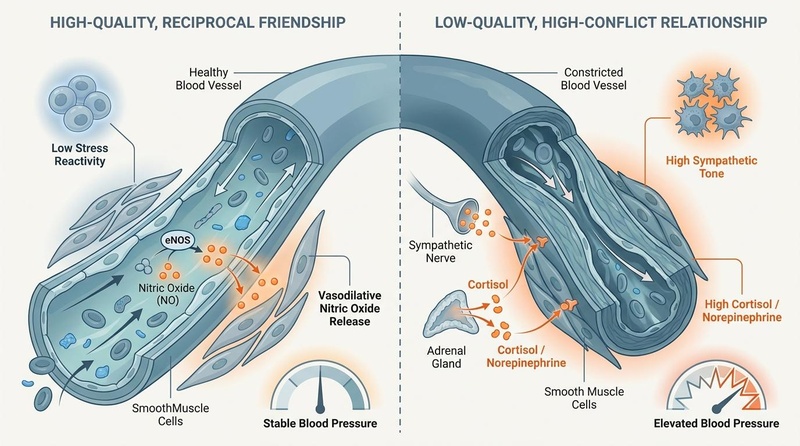
Figure 3: Comparative cardiovascular pathways of friendship. High-quality, reciprocal friendships promote vasodilative nitric oxide and low stress reactivity, while conflictual, non-reciprocal relationships drive sympathetic arousal, vasoconstriction, and arterial stiffness.
¶ Human Effect Matrix (Evidence Summary)
| Outcome | Typical Effect Size | Certainty Grade (GRADE) | Timeframe to Benefit | Supporting Studies |
|---|---|---|---|---|
| All-Cause Mortality (Friendship Quality) | 29% reduced mortality risk for high vs. low quality | High | Multi-decade longitudinal monitoring | Holt-Lunstad et al., 2015[7] |
| Cardiovascular Risk (Late Life) | Stronger protective effect than family relationships | High | Observed in cohorts N > 270,000 | Chopik, 2017[1:3] |
| Threat-Related Neural Suppression | Immediate dampening of HPA/insula threat response | High | Instantaneous upon physical contact/proximity | Coan et al., 2006[5:1] |
| Systemic Inflammatory Control | Reduction in circulating TNF-alpha & IL-6 | Moderate | Cumulative over 6-12 months | Kiecolt-Glaser et al., 2010[3:1] |
| Cardiovascular Stress Buffering | Blunted systolic/diastolic spike during daily stress | High | Immediate during positive peer contact | Ng et al., 2025[6:1] |
¶ Protocols: Practical Friendship Design
¶ 1. The Vulnerable Disclosure Script (Deepening Connections)
- Goal: Transitioning a superficial peer relationship into a high-utility confidant bond.
- Action Plan:
- The 36-Questions Framework: Utilize structured, incremental self-disclosure to build trust. Over three consecutive sessions, transition conversations from superficial topics (work, sports) to core personal narratives (fears, failures, family histories).
- The Vulnerability Loop: To initiate closeness, share a minor, low-stakes vulnerability or struggle. If the peer responds with validation and reciprocal disclosure, the "vulnerability loop" is closed, triggering oxytocin release and establishing a mutual safety template.
¶ 2. The Reciprocity Audit (Mitigating Asymmetrical Stress)
- Goal: Identifying and neutralizing toxic, non-reciprocal friendships.
- Action Plan:
- The 3-Month Tracking Protocol: Over a 90-day period, evaluate your primary friendships across three vectors:
- Initiation Balance: Is contact initiated relatively equally (approx. 50/50)?
- Emotional Exchange: Is there a mutual balance of emotional support, or is one person acting exclusively as an emotional sponge?
- Post-Interaction State: Do you feel biologically regulated (calm, energized, warm) or exhausted (muscle tension, fatigue) after meeting?
- The Symmetrical Pivot: If a friendship is highly non-reciprocal and causes chronic exhaustion, implement a polite boundary. Shift contact from private, high-stakes emotional meetings to low-stakes group activities.
- The 3-Month Tracking Protocol: Over a 90-day period, evaluate your primary friendships across three vectors:
¶ 3. Older Adult Friendship Maintenance Protocol
- Goal: Overcoming natural network contraction (Socioemotional Selectivity Theory) to maintain cognitive health.
- Action Plan:
- The Monthly Recurring Anchor: Establish a fixed, recurring monthly social ritual (e.g., book discussion, dining club, walking group) with 3-5 close friends. Do not rely on ad-hoc scheduling.
- Active Peer Sourcing: If retired, actively replace lost workplace friendships by participating in structured learning or interest groups (e.g., local history societies, art workshops) where shared intellectual pursuits facilitate new connection channels.
¶ Friendship Quality Diagnostics and Measurement Guidance
Evaluating friendship parameters provides objective clinical insight into nervous system homeostasis.
¶ 1. Clinically Validated Scales
- The Network of Relationships Inventory (NRI): Evaluates reciprocal support, conflict, and relative power in adult friendships. Highlights chronic asymmetrical imbalances.
- The McGill Friendship Questionnaire (MFQ): Quantifies friendship functions (companionship, help, intimacy, and emotional security). Scoring highly across emotional security correlates with lower sympathetic vascular resistance.
¶ 2. Cardiovascular Monitoring of Friend Interactions
- The Interactive HRV Buffering Test: Track resting RMSSD during a standard 3-minute morning check on days with planned confidant interactions versus days spent in isolation. A healthy, protective friendship loop is marked by an immediate elevation in resting RMSSD and a reduction in resting systolic blood pressure by 3-8 mmHg during or shortly after the interaction[6:2].
¶ Safety, Red Flags, and Conflict Decision Paths
Not all friendships are cardioprotective. Identifying chronic relational toxicity and establishing boundary protocols are essential clinical interventions.
                      [Is a primary friendship causing exhaustion?]
                                            |
                   +------------------------+------------------------+
                   |                                                 |
         [YES: Friend acts as an                        [YES: Relational strain, passive-
          emotional sponge; zero reciprocity]            aggression, or competitive jealousy]
                   |                                                 |
                   v                                                 v
         [The Asymmetrical Drain]                       [The Chronic Conflict Trap]
                   |                                                 |
                   v                                                 v
         [Prescribe: Symmetrical Pivot Script]          [Prescribe: Relational Fast;
         Shift to low-stakes activity group.            Implement Symmetrical Pivot Script]
¶ Critical Relational Red Flags
- Elevated Blood Pressure Reactivity: Experiencing persistent physical tension, muscle clenching, or an elevated heart rate (>15 bpm above baseline) during or immediately following peer interactions.
- Co-Rumination Cycles: Conversations revolve exclusively around repetitive venting, chronic complaints, and reinforcing negative emotional states. Co-rumination actively stimulates adrenal cortisol output and suppresses parasympathetic tone.
¶ Interactive Social Scripts for Friendship Maintenance
Establish safety, rebalance boundaries, and manage conversational dynamics with these clinically structured verbal scripts.
¶ 1. Initiating the Vulnerability Loop
- Goal: Safely testing a peer relationship to build emotional depth.
- The Script:
"I've really appreciated our conversations here, and I've been trying to be more intentional about building solid, real-life connections. I've actually been having a bit of a stressful week trying to manage [minor struggle], and I wanted to get your perspective on how you handle work-life boundaries. Have you ever faced something similar?"
¶ 2. Establishing a Monthly Recurring Anchor
- Goal: Bypassing scheduling friction with a fixed, recurring social ritual.
- The Script:
"Hey, we always talk about catching up, but our schedules are so hectic that months slip by. To make things simple, let's set a fixed monthly anchor—like the first Tuesday of every month at 7:00 PM for a quick dinner or walk. That way, it's on our calendars, and we don't have to spend weeks texting back and forth to organize it."
¶ 3. The Symmetrical Pivot (Fading Out a Toxic Connection)
- Goal: Gracefully establishing distance in a draining or hostile connection without triggering dramatic conflict.
- The Script:
"Hi [Name], thank you for reaching out. I'm currently navigating a period of high workload and health recalibration, and I've had to make a strict rule to limit my social commitments and long private conversations to recover my energy. I won't be available for our regular chats, but I appreciate your understanding as I focus on my recovery."
¶ 4. Pivoting Out of a Co-Rumination Venting Trap
- Goal: Interrupting a chronic venting loop and shifting the conversation toward positive, problem-solving, or intellectual topics.
- The Script:
"I completely hear how stressful that situation is, and I really want to support you. But I've noticed that when we spend our entire catch-up venting about these same external stressors, we both leave feeling physically exhausted and tense. Let's pivot our focus to brainstorming actual solutions, or better yet, let's talk about that exciting [creative project/hobby/book] you've been working on to clear our heads."
¶ References
¶ Update Log
- July 2026: Comprehensively expanded guide. Integrated sex-specific endocrine pathways (estrogen/oxytocin vs. testosterone/vasopressin), older-adult cognitive reserve buffering, real-time cardiorespiratory diagnostics (RMSSD, blood pressure responses), co-rumination fatigue red flags, relational fast pathways, and clinically validated friendship scripts.
Chopik WJ. Associations among friendships, family relationships, and health and well-being in late life. Personal Relationships. 2017;24(2):351-372. https://doi.org/10.1111/pere.12187 ↩︎ ↩︎ ↩︎ ↩︎
Uchino BN, Cacioppo JT, Kiecolt-Glaser JK. The relationship between social support and physiological processes: a review with emphasis on underlying mechanisms and implications for health. Psychol Bull. 1996;119(3):488-531. https://pubmed.ncbi.nlm.nih.gov/8668748/ ↩︎ ↩︎ ↩︎
Kiecolt-Glaser JK, Gouin JP, Houts CR, et al. Close relationships, inflammation, and health. Neurosci Biobehav Rev. 2010;35(1):33-38. https://pubmed.ncbi.nlm.nih.gov/19751761/ ↩︎ ↩︎
Franks MM, Friedman EM. Accentuating the Positive: Contribution of Positive Relations With Others and Daily Interpersonal Interactions to Longevity. Biopsychosocial science and medicine. 2026 Jun 12;14(2):45-56. https://pubmed.ncbi.nlm.nih.gov/42295203/ ↩︎ ↩︎
Coan JA, Schaefer HS, Davidson RJ. Lending a hand: social regulation of the neural response to threat. Psychol Sci. 2006;17(12):1032-1039. https://pubmed.ncbi.nlm.nih.gov/17201784/ ↩︎ ↩︎
Ng YT, Kratz A, Turkelson A. Daily interactions with care recipients and cardiovascular reactivity among dementia caregivers: The buffering role of friend interactions. Alzheimer's & dementia : the journal of the Alzheimer's Association. 2025 May;21(5):101-112. https://pubmed.ncbi.nlm.nih.gov/40371630/ ↩︎ ↩︎ ↩︎
Holt-Lunstad J, Smith TB, Baker M, Harris T, Stephenson D. Loneliness and social isolation as risk factors for mortality: a meta-analytic review. Perspectives on Psychological Science. 2015;10(2):227-237. https://pubmed.ncbi.nlm.nih.gov/25910393/ ↩︎