¶ Senolytics and Senomorphics: Deep Dive
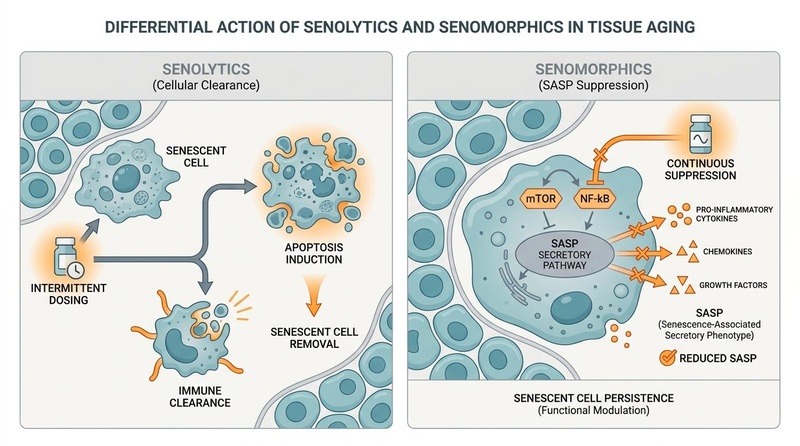
| Mechanism | Selective elimination of senescent cells (senolytics) or modulation of their pro-inflammatory phenotype (senomorphics). |
| Key Senolytics | Dasatinib, Quercetin, Fisetin, Navitoclax, FOXO4-DRI. |
| Key Senomorphics | Rapamycin, Metformin, Apigenin, Resveratrol. |
| Clinical Status | Early-to-mid phase human trials for senolytics; preclinical/early human for senomorphics. |
| Administration | Intermittent (senolytics) or continuous (senomorphics). |
¶ TL;DR
- Senolytics selectively remove senescent cells, while senomorphics suppress their harmful secretions (SASP).
- Early human trials show senolytics (e.g., D+Q) improve physical function and reduce inflammatory markers in age-related diseases like Idiopathic Pulmonary Fibrosis (IPF) and Diabetic Kidney Disease (DKD) [1][2].
- Intermittent dosing for senolytics is crucial to maximize efficacy and minimize side effects, allowing beneficial transient senescent cell functions [3][4].
- Senomorphics like Rapamycin and Metformin are in earlier stages of human evidence for anti-aging applications, primarily leveraging their known metabolic pathways to mitigate SASP [5][6][7].
- Biomarkers like p16/p21 levels and circulating SASP factors are key for tracking intervention efficacy [2:1][8].
¶ Quick Answer
Senolytics and senomorphics are distinct but complementary therapeutic strategies targeting cellular senescence, a key hallmark of aging. Senolytics, such as the combination of Dasatinib and Quercetin, work by selectively inducing apoptosis in senescent cells, thereby clearing them from tissues. Senomorphics, including compounds like Rapamycin and Metformin, do not necessarily kill senescent cells but rather modulate their Senescence-Associated Secretory Phenotype (SASP), reducing the release of pro-inflammatory and tissue-damaging factors. Clinical evidence, though still emerging, suggests that senolytics can improve physical function and reduce markers of inflammation in specific age-related conditions, while senomorphics are being explored for their ability to mitigate chronic inflammation and improve metabolic health.
¶ What It Is
Cellular senescence is a state of irreversible cell cycle arrest that cells enter in response to various stressors, including telomere shortening, DNA damage, and oncogenic activation. While critical for embryonic development, wound healing, and tumor suppression, the persistent accumulation of senescent cells in tissues contributes to aging and age-related diseases. These cells adopt a complex Senescence-Associated Secretory Phenotype (SASP), secreting a cocktail of pro-inflammatory cytokines (e.g., IL-6, IL-8), chemokines, growth factors, and proteases that can damage surrounding healthy cells and drive chronic inflammation, known as "inflammaging" [2:2][5:1].
Senolytics are a class of compounds designed to selectively induce apoptosis (programmed cell death) in senescent cells. By eliminating these harmful cells, senolytics aim to reduce the overall senescent cell burden in tissues, thereby alleviating chronic inflammation and restoring tissue homeostasis.
Senomorphics, on the other hand, act by modulating the SASP. Instead of killing senescent cells, they suppress the secretion of their inflammatory and detrimental factors. This approach aims to neutralize the harmful effects of senescent cells, even if the cells themselves remain present in the tissue.
¶ Mechanism in 60 seconds
Senescent cells develop unique pro-survival pathways (Senescent Cell Anti-Apoptotic Pathways, SCAPs) that protect them from apoptosis. Senolytics exploit these SCAPs, selectively targeting and eliminating senescent cells. For example, Dasatinib and Quercetin disrupt key survival pathways, leading to senescent cell death [9]. Senomorphics, like Rapamycin, inhibit the mTOR (mammalian target of rapamycin) pathway, a critical regulator of cell growth and metabolism, thereby dampening SASP production. Metformin, through AMPK activation, also reduces SASP by inhibiting NF-kB signaling [6:1].
¶ Does It Work? (Evidence Summary Table: Human Outcomes)
| Intervention | Target Population | Clinical Outcomes & Findings | Certainty | Study Type & Key Citations |
|---|---|---|---|---|
| Dasatinib + Quercetin (D+Q) | Idiopathic Pulmonary Fibrosis (IPF) | Improved physical function: 6-minute walk distance (+21.5m), gait speed (+0.1m/s), chair-stand time (-1.5s), and Short Physical Performance Battery (SPPB). No significant pulmonary function changes. | Moderate | Phase 1 Open-Label Pilot Trial (n=14) [1:1] |
| Dasatinib + Quercetin (D+Q) | Diabetic Kidney Disease (DKD) | Reduced senescent cell burden in adipose tissue (p16+ and p21+ cells, SA-β-gal activity) and decreased circulating SASP factors (IL-1α, IL-6, IL-8, MCP-1, MMP-9, MMP-12). | Moderate | Phase 1 Open-Label Trial (n=9) [2:3] |
| Dasatinib + Quercetin (D+Q) | Postmenopausal Women | Demonstrated high safety and feasibility of intermittent dosing; established bone metabolic biomarker target engagement, though bone mineral density changes were not statistically significant. | Moderate | Phase 2 Randomized Controlled Trial (n=120) [10] |
| Dasatinib + Quercetin (D+Q) | Mild Alzheimer's Disease (AD) | Feasible and well-tolerated intermittent regimen; exploratory fluid biomarkers in CSF showed potential reduction in chemokine/SASP profiles. | Low | Phase 1 Feasibility Trial (SToMP-AD, n=5) [11] |
| Fisetin | Obese Men | Supplementation combined with exercise significantly decreased pro-inflammatory adipokines (asprosin, IL-6, TNF-α) and upregulated the pro-resolving lipid mediator Maresin-1. | Moderate | Phase 2 Randomized Controlled Trial [12] |
| Fisetin | Healthy Adults | Bioavailability study confirming that standard unformulated Fisetin is rapidly metabolized; a hybrid-hydrogel formulation achieved a 47-fold increase in plasma concentrations. | Moderate | Double-Blind Randomized Crossover Study (n=24) [13] |
| Fisetin (Polyphenols) | Humans (Systematic Review) | Systematic review of human trials confirms moderate but statistically significant decreases in circulating inflammatory SASP profiles and improvements in physiological biomarkers. | Moderate | Systematic Review [8:1] |
| Navitoclax (ABT-263) | Humans | Insufficient human data. Primary clinical trials are restricted to hematological oncological indications; senolytic use in humans is currently limited due to severe thrombocytopenia risks [14][15]. | Low | Preclinical & Oncological Feasibility |
| FOXO4-DRI Peptide | Humans | Insufficient human data. Regimen remains entirely preclinical; clinical efficacy and safety profiles in humans have not yet been evaluated [16][3:1][17]. | Low | Preclinical |
| Rapamycin (mTOR inhibitor) | Humans | Insufficient human data. Clinical use for cellular senescence is speculative; human data is primarily restricted to organ transplant immunosuppression and early longevity-focused trials (e.g., PEARL). Ex vivo human studies show reduced senescence in elderly cells [7:1]. | Low | Preclinical & In Vitro [5:2] |
| Metformin (AMPK activator) | Humans | Insufficient human data. Primarily used in type 2 diabetes; longevity and senomorphic benefits in non-diabetic humans are currently being investigated (e.g., TAME trial). Metformin suppresses SASP via AMPK activation and NF-kB inhibition [6:2]. | Low | Preclinical & In Vitro |
| Apigenin (Flavone) | Humans (Epidemiological) | Robust inverse association between dietary intake of apigenin (and luteolin) and Phenotypic Age Acceleration; higher intake correlated with lower biological age acceleration [18]. | Moderate | Cross-Sectional Study (NHANES) [18:1] |
| Apigenin (Polyphenols) | Humans (Systematic Review) | Systematic review of human trials confirms moderate but statistically significant decreases in circulating inflammatory SASP profiles and improvements in physiological biomarkers. | Moderate | Systematic Review [8:2] |
| Resveratrol (Polyphenols) | Humans (Systematic Review) | Systematic review of human trials confirms moderate but statistically significant decreases in circulating inflammatory SASP profiles and improvements in physiological biomarkers. | Moderate | Systematic Review [8:3] |
| Resveratrol | Humans | Insufficient direct human data on senomorphic effects, but preclinical studies show sirtuin activation and downregulation of senescence markers [19]. | Low | Preclinical & In Vivo Models |
Certainty Grade Rubric:
- High: Multiple randomized controlled trials (RCTs) or robust meta-analyses with consistent, statistically significant findings.
- Moderate: One or two well-designed RCTs, strong cohort studies, or large observational studies with minor limitations.
- Low: Small pilot studies, animal studies, in vitro studies, or mechanistic evidence only. This level indicates promising avenues requiring further human investigation.
¶ Who Benefits Most / Least
Potential Beneficiaries:
- Individuals with age-related chronic diseases characterized by senescent cell accumulation (e.g., idiopathic pulmonary fibrosis, diabetic kidney disease, osteoarthritis, neurodegenerative conditions) [1:2][2:4][11:1].
- Older adults seeking to improve physical function, reduce chronic inflammation, and enhance overall healthspan [1:3][10:1].
- Individuals with impaired tissue regeneration or slow wound healing, where senescent cells may contribute to pathology.
- Individuals with heightened cardiovascular risk, as senescent vascular cells contribute to atherosclerosis, which may be mitigated by senotherapeutics [20].
Who Should Exercise Caution or Avoid:
- Individuals undergoing active tissue repair or regeneration (e.g., wound healing, post-surgery), as transient senescent cells play a physiological role in these processes. Intermittent dosing protocols for senolytics are designed to mitigate this risk [3:2][4:1].
- Patients with neutropenia or bone marrow suppression, as some senolytics (e.g., Dasatinib, Navitoclax) can affect hematopoietic cells [14:1].
- Pregnant or lactating women, due to insufficient safety data.
- Individuals on multiple medications, due to potential drug interactions, especially with compounds like Dasatinib (a kinase inhibitor) which is metabolized by CYP3A4 enzymes. Quercetin can also inhibit CYP enzymes.
¶ How to Try It (Actionable Protocols)
The primary interventions discussed here involve senolytics (Dasatinib + Quercetin, Fisetin, Navitoclax, FOXO4-DRI) and senomorphics (Rapamycin, Metformin, Apigenin, Resveratrol).
¶ Senolytics: Intermittent Dosing Paradigm
Senolytics are typically administered intermittently (a "hit-and-run" approach) to maximize senescent cell clearance while minimizing off-target effects and allowing for normal physiological functions where transient senescence is beneficial [3:3][4:2].
¶ Dasatinib + Quercetin (D+Q)
- Mechanism: Dasatinib inhibits tyrosine kinases, disrupting pro-survival pathways in senescent cells. Quercetin, a flavonoid, inhibits the anti-apoptotic protein BCL-xL and other senescent cell anti-apoptotic pathways (SCAPs) [9:1]. This combination has synergistic effects.
- Protocol (Example):
- Dose: Dasatinib (100 mg/day) + Quercetin (1000-1250 mg/day).
- Timing: Administer for 2-3 consecutive days.
- Cycle: Repeat every 2-4 weeks.
- Rationale: This intermittent regimen, observed in clinical trials for IPF, DKD, and AD, aims to clear senescent cells, which then repopulate slowly over several weeks [1:4][2:5][10:2][11:2][3:4][4:3].
¶ Fisetin
- Mechanism: Fisetin is a flavonoid that has shown senolytic activity, particularly by targeting certain SCAPs and influencing the p53 pathway.
- Protocol (Example):
- Dose: 100-150 mg/day of a high-bioavailability formulation (e.g., Fenumat™).
- Timing: Administer for 2-3 consecutive days.
- Cycle: Repeat every 2-4 weeks.
- Considerations: Fisetin has low oral bioavailability, necessitating higher doses or specialized formulations to achieve therapeutic plasma levels [13:1]. The combination with exercise has shown synergistic anti-inflammatory effects [12:1].
¶ FOXO4-DRI
- Mechanism: FOXO4-DRI (D-Retro-Inverso peptide) specifically disrupts the interaction between FOXO4 and p53, allowing p53 to induce apoptosis in senescent cells that rely on this interaction for survival [16:1][3:5][17:1].
- Protocol: Currently preclinical; no established human dosing protocols.
- Considerations: Administered via injection in animal studies. Promising for its high selectivity.
¶ Navitoclax (ABT-263)
- Mechanism: A BCL-2 family inhibitor that targets senescent cells by disrupting their anti-apoptotic pathways [14:2].
- Protocol: Clinical trials are ongoing, primarily in oncology. Not yet established for anti-aging interventions due to significant side effects.
- Considerations: Known side effects include neutropenia and thrombocytopenia due to its broad anti-apoptotic effects on normal hematopoietic stem cells [14:3].
¶ Senomorphics: Continuous Dosing Paradigm
Senomorphics aim to modulate the detrimental effects of senescent cells, often administered continuously to maintain suppression of the SASP.
¶ Rapamycin / mTOR Inhibitors
- Mechanism: Rapamycin inhibits the mammalian target of rapamycin (mTOR) pathway, a key regulator of cell growth, metabolism, and autophagy. This can reduce SASP production and extend lifespan in various organisms [5:3]. Ex vivo human studies have shown it reduces senescence-associated features in elderly mesenchymal stromal cells [7:2].
- Protocol: Low-dose, intermittent (e.g., once weekly) or continuous regimens are being explored in longevity contexts.
- Considerations: Potential side effects include immunosuppression, insulin resistance, and dyslipidemia at higher doses.
¶ Metformin
- Mechanism: Metformin activates AMP-activated protein kinase (AMPK), impacting cellular metabolism and directly suppressing NF-kB, thereby reducing SASP production and senescence markers [6:3].
- Protocol: Commonly prescribed for type 2 diabetes. Longevity-focused dosing typically involves 500-1500 mg/day.
- Considerations: Well-established safety profile, but can cause gastrointestinal upset and, rarely, lactic acidosis.
¶ Apigenin / Resveratrol
- Mechanism: These polyphenols possess anti-inflammatory and antioxidant properties, which can help mitigate the SASP and support cellular health. Resveratrol is also known to activate sirtuins [19:1]. Apigenin can also preserve NAD+ levels by inhibiting CD38 [21].
- Protocol: Dosing varies widely depending on the compound and formulation. Often used as supplements.
- Considerations: Bioavailability can be a challenge for some polyphenols [13:2]. Epidemiological data supports a correlation between apigenin intake and reduced phenotypic age acceleration [18:2].
¶ Safety, Interactions, Red Flags
While promising, interventions targeting cellular senescence carry potential risks and considerations. A critical aspect of senolytic therapy design is the use of intermittent dosing (the "hit-and-run" approach), which is intended to mitigate risks by allowing transient, beneficial senescent cell functions (e.g., in wound healing) to proceed normally between treatment cycles [3:6][4:4].
- Impaired Wound Healing and Tissue Regeneration: Senescent cells play transient roles in wound healing and tissue repair. Broad, continuous elimination could theoretically impair these processes. Intermittent dosing for senolytics aims to circumvent this risk [3:7][4:5].
- Hematological Effects: Senolytics like Dasatinib and Navitoclax can affect bone marrow, leading to neutropenia or thrombocytopenia, particularly Navitoclax due to its broader anti-apoptotic activity against healthy hematopoietic stem cells [14:4].
- Off-Target Effects: Some compounds may have effects on non-senescent cells, leading to unwanted side effects.
- Drug Interactions: Specific senolytics (e.g., Dasatinib) are metabolized by cytochrome P450 enzymes (CYP3A4), leading to potential interactions with many common medications. Quercetin can also inhibit CYP enzymes.
- Unknown Long-Term Consequences: As a relatively new field, the long-term effects of chronic or repeated senolytic/senomorphic interventions in humans are still being investigated.
Red Flags / When to Talk to a Clinician:
- Unexpected or severe side effects.
- Persistent infections or signs of immune suppression.
- Unexplained bruising or bleeding.
- Changes in kidney or liver function.
- Contraindications: Pregnancy, lactation, and active developmental or tissue-repair phases are physiological contraindications.
¶ Tracking & What “Good” Looks Like
Tracking the efficacy of cellular senescence interventions in a clinical or research setting often involves a combination of direct senescent cell burden assessment, measurement of SASP factors, and functional endpoints.
Biomarkers:
- Direct Senescent Cell Burden:
- p16INK4a{.tag-biomarker} and p21CIP1{.tag-biomarker} mRNA/protein levels: In accessible tissues (e.g., skin, adipose tissue biopsies) or circulating cells.
- SA-β-galactosidase{.tag-biomarker} activity: Histochemical staining in tissue biopsies (though less specific).
- Circulating cell-free DNA (cfDNA){.tag-biomarker}: May reflect senescent cell death.
- SASP Factors:
- Pro-inflammatory cytokines: IL-1β{.tag-biomarker}, IL-6{.tag-biomarker}, IL-8{.tag-biomarker}, TNF-α{.tag-biomarker}.
- Chemokines: MCP-1 (CCL2){.tag-biomarker}.
- Matrix Metalloproteinases (MMPs): MMP-2{.tag-biomarker}, MMP-3{.tag-biomarker}, MMP-9{.tag-biomarker}, MMP-12{.tag-biomarker}.
- Growth factors: PAI-1{.tag-biomarker}, TGF-β{.tag-biomarker}.
- These can be measured in plasma or serum [2:6].
- Functional Markers:
- Physical Function: 6-minute walk distance (6MWD){.tag-biomarker}, gait speed (4-meter walk test), chair-stand test, Short Physical Performance Battery (SPPB){.tag-biomarker} score [1:5].
- Cognitive Function: Specific neuropsychological tests [11:3].
- Organ-Specific Function: e.g., Glomerular filtration rate (GFR){.tag-biomarker} for kidney function, forced vital capacity (FVC){.tag-biomarker} for lung function.
Subjective Metrics:
- Self-reported energy levels, fatigue, pain, and overall well-being.
- Improvements in symptoms related to the targeted age-related condition.
Time-to-Benefit and Time-to-Washout:
- Reduction in SASP factors and senescent cell markers can be observed relatively quickly (days to weeks) after senolytic administration [2:7][8:4].
- Functional benefits may take longer to manifest (weeks to months).
- Senescent cells slowly re-accumulate over several weeks after clearance, supporting the intermittent dosing approach [3:8][4:6].
¶ Common Mistakes & Myths
- Myth: Senolytics are a "one-and-done" cure for aging. Senolytics effectively clear senescent cells, but cells continue to become senescent over time. Intermittent dosing is required to maintain the benefit [3:9][4:7].
- Mistake: Continuous daily dosing of senolytics. This can lead to increased side effects and may interfere with physiological processes where transient senescence is beneficial (e.g., wound healing) [3:10][4:8].
- Myth: All senescent cells are bad. While chronic accumulation is detrimental, transient senescent cells play roles in embryonic development, wound healing, and even tumor suppression [3:11][4:9].
- Mistake: Ignoring bioavailability for Fisetin. Fisetin has poor oral bioavailability. Using standard unformulated Fisetin may result in minimal active compound reaching target tissues [13:3].
- Myth: Senolytics work instantly. While some biochemical markers may shift quickly, observable functional improvements take time.
¶ Decision Tree (Text-Based)
- IF aiming to reduce senescent cell burden directly (e.g., for age-related tissue dysfunction or disease): CONSIDER senolytics (D+Q, Fisetin).
- IF targeting specific diseases with human trial data (e.g., IPF, DKD): EXPLORE D+Q with clinician guidance.
- IF seeking a flavonoid-based senolytic with anti-inflammatory properties: EXPLORE Fisetin, prioritizing high-bioavailability formulations.
- IF aiming to modulate inflammation and SASP without necessarily killing senescent cells: CONSIDER senomorphics (Rapamycin, Metformin, Apigenin, Resveratrol).
- IF targeting metabolic pathways and autophagy: EXPLORE Rapamycin (low-dose) or Metformin.
- IF seeking broad anti-inflammatory/antioxidant support: EXPLORE Apigenin or Resveratrol.
- Clinical Framework: Interventions should be evaluated within a controlled clinical context or trial framework given the investigational status of these therapies.
¶ FAQs (People Also Ask targets)
-
What is the difference between senolytics and senomorphics?
Senolytics are compounds that selectively induce apoptosis (death) in senescent cells, clearing them from tissues. Senomorphics, on the other hand, modulate the harmful Senescence-Associated Secretory Phenotype (SASP) without necessarily killing the senescent cells, thereby reducing their inflammatory impact [5:4][6:4]. -
Are senolytics safe for humans?
Early-phase human clinical trials for senolytics like Dasatinib + Quercetin have demonstrated feasibility and a tolerable safety profile with intermittent dosing regimens [1:6][2:8][10:3][11:4]. However, long-term safety and efficacy across diverse populations and conditions are still under investigation [3:12]. -
How often should senolytics be taken?
Senolytics are typically taken intermittently (e.g., for 2-3 consecutive days every 2-4 weeks) rather than continuously. This "hit-and-run" approach allows for efficient clearance of senescent cells while minimizing potential side effects and allowing for normal physiological functions where transient senescence is beneficial [3:13][4:10]. -
Can senolytics reverse aging?
While preclinical studies show senolytics can improve age-related health outcomes and extend lifespan in animals [9:2], in humans, they are currently investigated for ameliorating age-related diseases and improving healthspan, not for "reversing" the aging process itself. -
What are the main side effects of senolytics?
Potential side effects of senolytics can include fatigue, nausea, and gastrointestinal upset. Some compounds, like Dasatinib, can cause myelosuppression (reduced blood cell production) at higher doses. There are also theoretical concerns about impaired wound healing if senescent cells are removed too broadly or continuously [3:14][4:11].
¶ Glossary
- Cellular Senescence: A state of stable cell cycle arrest in response to stress, characterized by resistance to apoptosis and acquisition of a Senescence-Associated Secretory Phenotype (SASP).
- Senescence-Associated Secretory Phenotype (SASP): A complex secretome released by senescent cells, comprising pro-inflammatory cytokines, chemokines, growth factors, and proteases that can drive chronic inflammation and tissue damage.
- Senolytics: Compounds that selectively induce apoptosis (death) in senescent cells.
- Senomorphics: Compounds that modulate or suppress the harmful effects of the SASP without necessarily killing senescent cells.
- p16/INK4a & p21/CIP1: Cyclin-dependent kinase inhibitors that are key mediators of cell cycle arrest in senescent cells, often used as biomarkers for senescent cells.
- FOXO4-DRI: A D-Retro-Inverso peptide designed to selectively trigger apoptosis in senescent cells by disrupting the FOXO4-p53 interaction.
- SCAPs (Senescent Cell Anti-Apoptotic Pathways): Pro-survival pathways that protect senescent cells from apoptosis, making them targets for senolytic drugs.
- Inflammaging: Chronic, low-grade systemic inflammation that increases with age, driven in part by the SASP from senescent cells.
¶ Methods (Transparency)
The content of this deep dive was compiled through a comprehensive review of peer-reviewed scientific literature, clinical trial data, and authoritative biomedical sources, as detailed in the research/frontier-interventions/senolytics-senomorphics_source_manifest.md file. The search strategy focused on identifying high-quality evidence, including:
- Databases: PubMed, ClinicalTrials.gov, Nature Medicine, EBioMedicine.
- Keywords: "senolytics clinical trials," "dasatinib quercetin," "fisetin clinical trial," "FOXO4-DRI," "navitoclax senescence," "senomorphics rapamycin metformin," "cellular senescence SASP p16 p21 pathway."
- Inclusion Criteria: Prioritized human clinical trials (Phase 1, 2), systematic reviews, meta-analyses, and high-impact preclinical studies elucidating mechanisms.
Evidence Grading Rubric:
- High: Multiple randomized controlled trials (RCTs) or robust meta-analyses with consistent, statistically significant findings.
- Moderate: One or two well-designed RCTs, strong cohort studies, or large observational studies with minor limitations.
- Low: Small pilot studies, uncontrolled trials, animal studies, in vitro studies, or mechanistic evidence only. This level indicates promising avenues requiring further human investigation.
¶ References
¶ Update Log
- 2024-07-29: Initial deep-dive creation.
Justice JN, Nambiar AM, Tchkonia T, et al. Senolytics in idiopathic pulmonary fibrosis: Results from a first-in-human, open-label, pilot study. EBioMedicine. 2019;40:554-563. https://pubmed.ncbi.nlm.nih.gov/30616998/ ↩︎ ↩︎ ↩︎ ↩︎ ↩︎ ↩︎ ↩︎
Hickson LJ, Langhi Prata LGP, Bobart SA, et al. Senolytics decrease senescent cells in humans: Preliminary report from a clinical trial of Dasatinib plus Quercetin in individuals with diabetic kidney disease. EBioMedicine. 2019;47:446-456. https://pubmed.ncbi.nlm.nih.gov/31542391/ ↩︎ ↩︎ ↩︎ ↩︎ ↩︎ ↩︎ ↩︎ ↩︎ ↩︎
Alameen AAM, Al-Kuraishy HM, Fawzy MN. Targeting the FOXO4-p53 axis by retro-inverso peptide senolytic agents: a pharmacological strategy to mitigate brain aging and cognitive decline. Naunyn-Schmiedeberg's Archives of Pharmacology. 2026;399(4):1222-1134. https://pubmed.ncbi.nlm.nih.gov/42024235/ ↩︎ ↩︎ ↩︎ ↩︎ ↩︎ ↩︎ ↩︎ ↩︎ ↩︎ ↩︎ ↩︎ ↩︎ ↩︎ ↩︎ ↩︎
Wissler Gerdes EO, Misra A, Netto JME, et al. Strategies for late phase preclinical and early clinical trials of senolytics. Mechanisms of Ageing and Development. 2021;199:111568. https://pubmed.ncbi.nlm.nih.gov/34699859/ ↩︎ ↩︎ ↩︎ ↩︎ ↩︎ ↩︎ ↩︎ ↩︎ ↩︎ ↩︎ ↩︎ ↩︎
R B, Sandur V R. Pharmacological Modulation of Immunosenescence and Inflammaging: Senolytics, Senomorphics, and Emerging Therapies. Immunological Investigations. 2026;55(5):42376766. https://pubmed.ncbi.nlm.nih.gov/42376766/ ↩︎ ↩︎ ↩︎ ↩︎ ↩︎
Aedh AI, Al-Kuraishy HM, Shokr MM. Concept and connotation of the geroprotective and anti-aging effects of metformin: From AMPK activation to SASP suppression. Molecular and Cellular Endocrinology. 2026;521:41942023. https://pubmed.ncbi.nlm.nih.gov/41942023/ ↩︎ ↩︎ ↩︎ ↩︎ ↩︎
Khorraminejad-Shirazi M, Sani M, Falamarzi K, et al. Rapamycin and nicotinamide treatment attenuates senescence-associated features in mesenchymal stromal cells isolated from elderly donors by modulating autophagy. Scientific Reports. 2026;16(1):42380169. https://pubmed.ncbi.nlm.nih.gov/42380169/ ↩︎ ↩︎ ↩︎
Lin Y, Altulea A, Demaria M. Effects of nutritional interventions on biomarkers of cellular senescence in humans: a systematic review. Ageing Research Reviews. 2026;28(2):42401265. https://pubmed.ncbi.nlm.nih.gov/42401265/ ↩︎ ↩︎ ↩︎ ↩︎ ↩︎
Xu M, Pirtskhalava T, Farr JN, et al. Senolytics improve physical function and increase lifespan in old age. Nature Medicine. 2018;24(8):1246-1256. https://pubmed.ncbi.nlm.nih.gov/29988130/ ↩︎ ↩︎ ↩︎
Farr JN, Atkinson EJ, Achenbach SJ, et al. Effects of intermittent senolytic therapy on bone metabolism in postmenopausal women: a phase 2 randomized controlled trial. Nature Medicine. 2024;30(9):2483-2494. https://pubmed.ncbi.nlm.nih.gov/38956196/ ↩︎ ↩︎ ↩︎ ↩︎
Gonzales MM, Garbarino VR, Kautz TF, et al. Senolytic therapy in mild Alzheimer's disease: a phase 1 feasibility trial. Nature Medicine. 2023;29(10):2483-2494. https://pubmed.ncbi.nlm.nih.gov/37679434/ ↩︎ ↩︎ ↩︎ ↩︎ ↩︎
Alipour M, Saeidi A, Hejazi K, et al. The Effects of Interval Resistance-Aerobic Training and Fisetin Supplementation on Asprosin and Selected Adipokines in Obese Men: A Double-Blind Randomized Control Trial. Nutrients. 2026;18(1):155. https://pubmed.ncbi.nlm.nih.gov/41683255/ ↩︎ ↩︎
Krishnakumar IM, Jaja-Chimedza A, Joseph A, et al. Enhanced bioavailability and pharmacokinetics of a novel hybrid-hydrogel formulation of fisetin orally administered in healthy individuals: a randomised double-blinded comparative crossover study. Journal of Nutritional Science. 2022;11:e93. https://pubmed.ncbi.nlm.nih.gov/36304817/ ↩︎ ↩︎ ↩︎ ↩︎
Nishinaka T, Wake H, Watanabe M, et al. IL-4/IL-13 signaling suppresses ABT-263-induced apoptosis in senescent human fibroblasts. International Immunopharmacology. 2026;135:42224998. https://pubmed.ncbi.nlm.nih.gov/42224998/ ↩︎ ↩︎ ↩︎ ↩︎ ↩︎
Kohl S, Schaper M, Lajarín JA, et al. CXCR2 affects sensitization of radioresistant HPV-negative head and neck squamous cell carcinoma cells by ABT-263. Radiation Oncology. 2026;21:41680869. https://pubmed.ncbi.nlm.nih.gov/41680869/ ↩︎
Bourgeois B, Spreitzer E, Platero-Rochart D, et al. The disordered p53 transactivation domain is the target of FOXO4 and the senolytic compound FOXO4-DRI. Nature Communications. 2025;16:40593617. https://pubmed.ncbi.nlm.nih.gov/40593617/ ↩︎ ↩︎
Baar MP, Brandt RMC, Putavet DA, et al. Targeted Apoptosis of Senescent Cells Restores Tissue Homeostasis in Response to Chemotoxicity and Aging. Cell. 2017;169(1):132-147.e16. https://pubmed.ncbi.nlm.nih.gov/28340347/ ↩︎ ↩︎
Wang X, Liu C, Li G, et al. Associations of dietary flavones, particularly apigenin and luteolin, with phenotypic age acceleration: A cross-sectional study using NHANES data. Medicine. 2025;104(50):41398778. https://pubmed.ncbi.nlm.nih.gov/41398778/ ↩︎ ↩︎ ↩︎
Hernández-Silva D, Cabello C, Cayuela ML, et al. Synergizing Virtual Screening and Zebrafish Models to Identify Resveratrol-Derived Antiaging Polyphenols. Pharmaceuticals. 2025;18(11):41304876. https://pubmed.ncbi.nlm.nih.gov/41304876/ ↩︎ ↩︎
Manni E, Al-Kuraishy HM, Fawzy MN. Pharmacological targeting of the senescence-associated secretory phenotype in atherosclerosis: therapeutic potential of senolytics and senomorphics. Naunyn-Schmiedeberg's Archives of Pharmacology. 2026;399(5):42133066. https://pubmed.ncbi.nlm.nih.gov/42133066/ ↩︎
Yu J, Hou M, Deng Y, et al. Double-Pronged NAD Preservation: Delaying Cellular Senescence and Initiating Musculoskeletal Regeneration. Aging Cell. 2026;25(4):41944220. https://pubmed.ncbi.nlm.nih.gov/41944220/ ↩︎