¶ Hair Quality, Thickness, Shine, Breakage, and Graying
¶ TL;DR
- Multifaceted Approach: Effective hair health involves addressing biological causes from cuticle degradation to oxidative stress in follicles.
- Protection is Foundational: Daily care routines focus on protecting keratin structure and maintaining a healthy scalp.
- Targeted Interventions: Advanced options include peptides, minoxidil/finasteride, PDLLA fillers, PRP, microneedling, and LLLT for specific concerns.
- Debunking Myths: Collagen supplements, anti-graying shampoos, and biotin without deficiency are generally ineffective.
- Long-Term Tracking: Monitor progress over 3-6 months using objective metrics like elasticity, breakage counts, and density.
¶ Quick Answer
Maintaining optimal hair quality, thickness, shine, and preventing breakage or premature graying requires a comprehensive strategy that spans daily care, targeted interventions (such as Poly-D,L-Lactic Acid, or PDLLA fillers), and in some cases, clinical procedures. Hair health is influenced by factors such as cuticle integrity, lipid content (especially 18-MEA), follicle miniaturization, and oxidative stress impacting melanocyte stem cells. Effective strategies prioritize protecting existing hair, stimulating growth, and mitigating damage, while being mindful of potential risks from over-supplementation or inappropriate treatments.
¶ Type-Identification Table
| Hair Concern | Key Characteristics | Underlying Biology | Common Treatments |
|---|---|---|---|
| Thinning/Loss | Reduced density, smaller individual hair shafts, increased shedding. | Follicle miniaturization, hormonal influences (androgenetic alopecia), nutritional deficiencies, telogen effluvium. | Minoxidil, finasteride, PRP, microneedling, LLLT, specific nutrient repletion. |
| Breakage | Hair strands fracture easily, split ends, dull appearance. | Cuticle degradation, loss of 18-MEA lipid layer, chemical damage, heat styling, mechanical stress. | Gentle washing, conditioning, protective styling, bond-repairing treatments, nourishing oils. |
| Dullness/Lack of Shine | Hair appears lackluster, rough texture, tangles easily. | Compromised cuticle (rough surface), insufficient lipid coverage (18-MEA), low moisture content. | Acidic rinses, smoothing conditioners, silicone-based serums, gentle brushing, lipid-replenishing treatments. |
| Graying (Canities) | Loss of natural pigment, white or silvery hairs. | Melanocyte stem cell exhaustion, hydrogen peroxide accumulation, reduced catalase activity, oxidative stress. | Antioxidant scalp treatments, topical peptides (experimental), exosome therapy (experimental). |
¶ Evidence Snapshot Table (Human Outcomes)
| Outcome | Effect | Quality | Consistency | Trials | Notes |
|---|---|---|---|---|---|
| Hair Density (Minoxidil) | High | High | Many RCTs | Significant increase in hair count for androgenetic alopecia [1] | |
| Hair Count (Topical Finasteride) | High | High | Phase III RCTs | Reduces hair loss with minimized systemic effects [2] | |
| Hair Density (PRP) | Moderate | Moderate | Meta-analysis | Moderate gains in density and hair count [3] | |
| Hair Thickness (Microneedling) | Low | Mixed | Review, small studies | Activates wound healing pathways, modest thickness increases [4][5] | |
| Hair Density (LLLT) | Moderate | Moderate | Reviews, clinical trials | Improves hair density in androgenetic alopecia [6] | |
| Hair Count (Rosemary Oil) | Moderate | High | RCT | As effective as 2% minoxidil at 6 months [7] | |
| Hair Thickness & Shine (PDLLA Filler) | Moderate | High | Clinical trial | Restores thickness and shine by ameliorating age-associated follicular decline [8] | |
| Gray Hair Repigmentation (Exosomes) | Very Low | Limited | Observational | Preliminary evidence of repigmentation [9] | |
| Gray Hair Repigmentation (Topical Peptides) | Very Low | Limited | Open-label study | Mild repigmentation reported [10] | |
| Hair Shaft Diameter (Collagen) | Low | Limited | RCT | Moderate improvements, no density/count restoration [11][12][13] | |
| Hair Shedding (Topical Melatonin) | Low | Moderate | Small RCT | Improved density and reduced shedding [14] | |
| Scalp Inflammation (Ketoconazole) | Moderate | High | Clinical trials | Supports hair density by reducing fungal-driven inflammation [15] |
¶ Causes Tied to Biology & Anatomy
Hair quality and its decline are intricately linked to cellular processes and structural integrity.
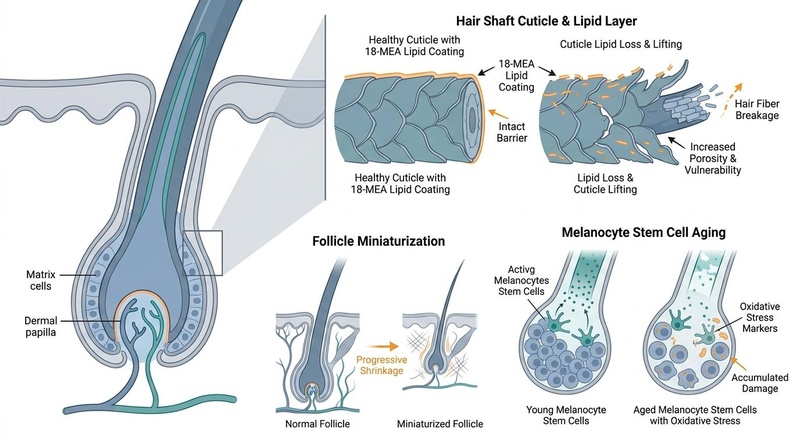
¶ Cuticle Degradation and Lipid Loss (specifically 18-MEA)
The hair cuticle, the outermost protective layer, is crucial for shine and strength. It's covered by a hydrophobic layer rich in 18-methyl eicosanoic acid (18-MEA). This lipid layer is easily damaged by chemical treatments, heat, and even vigorous washing, leading to cuticle lifting, increased friction, breakage, and dullness [16][17][18]. The loss of 18-MEA is a significant marker of hair aging and damage, impacting the hair's natural barrier function [19][20].
¶ Follicle Miniaturization
In conditions like androgenetic alopecia and senescent hair thinning, hair follicles progressively shrink, producing shorter, finer, and less pigmented hair. This process is driven by hormonal factors (such as dihydrotestosterone, DHT), genetic predisposition, and age-associated follicular decline, leading to a reduction in hair density, overall thickness, and natural shine [1:1][8:1].
¶ Oxidative Stress in Melanocyte Stem Cells Causing Canities
Hair graying (canities) is primarily caused by the exhaustion and dysfunction of melanocyte stem cells (McSCs) in the hair follicle. These stem cells are responsible for producing the pigment (melanin) that gives hair its color. Oxidative stress plays a critical role, leading to damage and premature senescence of McSCs. Environmental factors and genetic predispositions can accelerate this process [21][22][23].
¶ Hydrogen Peroxide Accumulation and Loss of Catalase
A key mechanism in hair graying is the accumulation of hydrogen peroxide (H2O2) within the hair follicle. This toxic compound inhibits the enzyme tyrosinase, which is essential for melanin production. Under normal conditions, the enzyme catalase breaks down H2O2. However, with aging and increased oxidative stress, catalase activity declines, allowing H2O2 to build up and bleach the hair from within [24][25][26].
¶ Starter Protocol (Practical Daily/Weekly Care Routine Protecting Keratin Structure and Scalp Health)
A foundational routine focuses on minimizing damage and fostering a healthy environment for hair growth.
- Gentle Cleansing (2-3 times/week): Use a sulfate-free, pH-balanced shampoo to clean the scalp without stripping natural oils. Consider a ketoconazole shampoo if scalp inflammation (dandruff, seborrheic dermatitis) is present, which can support hair density [15:1].
- Hydrating Conditioner (Every wash): Apply a rich conditioner to the mid-lengths and ends to smooth the cuticle, reduce tangles, and replenish moisture.
- Leave-in Treatment (Daily/After wash): A leave-in conditioner or lightweight oil (e.g., argan, jojoba) can provide continuous hydration and protection against environmental stressors.
- Scalp Massage (Daily, 5-10 minutes): Gentle scalp massage can increase blood circulation to the follicles and has been shown to modestly increase hair thickness [5:1].
- Heat Protection (Always before heat styling): Use a heat protectant spray to minimize thermal damage to the keratin structure and 18-MEA layer.
- Protective Styling: Minimize tight hairstyles that pull on the hair roots. Use silk pillowcases or scrunchies to reduce friction and breakage.
- Topical Melatonin (Optional, nightly): Small clinical trials suggest topical melatonin can improve hair density and reduce shedding [14:1].
¶ Stronger Add-On Path (Targeted Peptides, Minoxidil/Finasteride, Clinical Strength Topicals)
For those seeking more aggressive intervention for thinning or specific concerns:
- Topical Minoxidil (2% or 5% solution/foam): A vasodilator that extends the anagen (growth) phase of hair follicles. Highly effective for androgenetic alopecia [1:2].
- Topical Finasteride (Prescription): Applied as a spray or solution, this 5-alpha reductase inhibitor reduces local DHT levels with fewer systemic side effects than oral finasteride [2:1].
- Copper Peptides (GHK-Cu): In vitro studies show GHK-Cu can stimulate hair follicle elongation and dermal papilla proliferation. Available in various topical formulations [27].
- Rosemary Oil: Clinical research indicates rosemary oil can be as effective as 2% minoxidil for increasing hair count over 6 months [7:1].
- Antioxidant Scalp Serums: Formulations containing antioxidants and catalase mimetics may help mitigate oxidative stress in melanocyte stem cells, potentially slowing graying [24:1][25:1].
¶ Clinical/Procedure Path (PRP, Microneedling, LLLT under Professional Supervision)
For advanced hair loss or graying, professional interventions offer powerful options. These should always be performed under the supervision of a qualified dermatologist or clinician.
- Platelet-Rich Plasma (PRP) Injections: Concentrated platelets, rich in growth factors, are injected into the scalp to stimulate follicular regeneration and growth. Meta-analyses show significant improvements in hair density and count [3:1].
- Microneedling: Creates micro-injuries in the scalp, activating wound-healing cascades and stimulating growth factors and Wnt/beta-catenin signaling, which are crucial for hair follicle development and regeneration [4:1]. Often combined with topical treatments for enhanced penetration.
- Low-Level Laser Therapy (LLLT): Devices emit red and near-infrared light to stimulate cellular activity in hair follicles, increasing circulation and extending the anagen phase. Effective for improving hair density in androgenetic alopecia [6:1].
- Exosome Therapy: Emerging treatment involving micro-injections of exosomes (extracellular vesicles) derived from stem cells, which carry growth factors and signaling molecules to promote hair growth and potentially repigment gray hair. Preliminary evidence is promising [9:1].
- Poly-D,L-Lactic Acid (PDLLA) Filler: Intradermal administration of PDLLA filler is a novel, advanced clinical intervention. PDLLA serves as a biostimulator that promotes tissue remodeling, increases vascularization, and activates regenerative pathways. A clinical trial demonstrated that PDLLA filler effectively restores hair thickness and shine by directly ameliorating age-associated follicular decline [8:2].
¶ What Fails (Debunking Collagen Supplements, Anti-Graying Shampoos, and Biotin without Deficiency)
Many popular solutions lack robust scientific backing or are only effective in specific, limited scenarios.
- Collagen Supplements: While collagen is a structural protein, oral collagen supplements have limited direct evidence for improving hair thickness, shine, or density. Research shows moderate improvements in hair shaft diameter but no direct restoration of hair count or density [11:1][12:1][13:1]. The body breaks down ingested collagen into amino acids, which are then used generally, not specifically directed to hair.
- Anti-Graying Shampoos: Shampoos claiming to reverse gray hair are largely ineffective. The contact time for shampoos is too brief for active ingredients to penetrate the follicle deeply enough to impact melanocyte stem cells or oxidative stress mechanisms. Regulatory bodies like the FTC have challenged these baseless claims [21:1][28].
- Biotin without Deficiency: Biotin (Vitamin B7) is crucial for keratin infrastructure, and deficiency can lead to hair loss. However, supplementing with biotin when not deficient does not typically improve hair quality, thickness, or growth [29]. Routine over-supplementation is often unnecessary and can interfere with lab tests.
¶ Tracking Plan (3-6 Month Timeline with Elasticity/Stretch Test, Hair Breakage Counts, and Density Tracking)
Consistent tracking helps evaluate treatment efficacy and identify areas for adjustment.
- Baseline Photos (Monthly): Take standardized photos of the scalp and overall hair to track density and growth patterns.
- Hair Elasticity/Stretch Test (Monthly): Gently stretch a single wet hair strand. Healthy hair can stretch up to 30% without breaking. Track changes in elasticity.
- Hair Breakage Count (Weekly): Collect shed hairs after washing and brushing. Count visible broken strands versus full strands. A reduction in broken strands indicates improved quality.
- Hair Density Tracking (Every 3 months): Professional assessment using trichoscopy or a hair count device to objectively measure changes in follicular density.
- Scalp Health Assessment (Monthly): Note any changes in scalp redness, flaking, or itching.
- Gray Hair Tracking (Every 3 months): For graying concerns, monitor the proportion of pigmented vs. non-pigmented hairs in a standardized area.
¶ Safety & Red Flags (Including Telogen Effluvium, Progressive Scarring Alopecia, and Toxicity from Selenium, Zinc, or Vitamin A Over-supplementation)
While many hair treatments are safe, awareness of potential adverse effects and serious conditions is crucial.
- Telogen Effluvium: A common form of temporary hair loss often triggered by stress, illness, rapid weight loss, or certain medications. It presents as diffuse shedding, usually 2-4 months after the trigger. While often self-resolving, prolonged cases warrant medical evaluation.
- Progressive Scarring Alopecia (Cicatricial Alopecia): A group of inflammatory hair loss disorders that destroy hair follicles, replacing them with scar tissue, leading to permanent hair loss. Symptoms include severe itching, burning, pain, and redness. Urgent medical intervention is required to prevent irreversible damage [30].
- Toxicity from Selenium, Zinc, or Vitamin A Over-supplementation: Excessive intake of certain micronutrients can be detrimental to hair health.
- Selenium: Doses above 400 mcg/day can cause selenium toxicity (selenosis), leading to hair loss, brittle nails, and neurological symptoms [29:1][31][32].
- Zinc: High doses of zinc can interfere with copper absorption and induce hair shedding, follicular toxicity, and gastrointestinal issues [29:2][32:1].
- Vitamin A: Chronic over-supplementation of Vitamin A (retinol) can induce acute telogen effluvium and hair loss due to follicular toxicity [29:3][31:1].
- Biotin: While less toxic, excessive biotin can interfere with laboratory test results for thyroid hormones and cardiac biomarkers, leading to misdiagnosis [29:4].
¶ FAQs
What causes hair to become thin and brittle?
Hair thinning and brittleness can stem from a variety of factors, including genetic predisposition (androgenetic alopecia), hormonal imbalances, nutritional deficiencies (e.g., iron, zinc, vitamin D), excessive heat styling, chemical treatments, mechanical stress, and underlying medical conditions. Loss of the protective 18-MEA lipid layer and cuticle degradation also contribute significantly to brittleness and breakage [16:1][17:1].
Can stress cause hair graying?
While chronic stress can contribute to a range of hair issues, including telogen effluvium (temporary hair shedding), its direct role in accelerating hair graying is complex. Research suggests stress can contribute to oxidative stress, which impacts melanocyte stem cells. However, direct causation and the extent of its influence on permanent graying are still being studied, with genetic factors playing a more dominant role [21:2][22:1].
Are "hair vitamins" effective for growth and thickness?
"Hair vitamins" are typically only effective if you have a documented deficiency in specific micronutrients (e.g., iron, zinc, vitamin D, biotin) that are crucial for hair growth. If you are not deficient, taking additional supplements usually does not provide further benefits and can sometimes lead to toxicity if over-dosed (e.g., selenium, vitamin A) [29:5][31:2]. Focus on a balanced diet and targeted supplementation only when a deficiency is confirmed.
How can I make my hair shinier?
Hair shine largely depends on a smooth, intact cuticle that reflects light. Strategies for enhancing shine include using pH-balanced shampoos and conditioners, applying acidic rinses (like diluted apple cider vinegar), incorporating lipid-rich treatments (e.g., argan oil, silicone-based serums to mimic 18-MEA), minimizing heat damage, and gentle brushing. These methods help flatten the cuticle and replenish the protective lipid layer [16:2][17:2].
¶ References
Suchonwanit, P., et al. (2019). Minoxidil and its use in hair disorders: a review. Drug Design, Development and Therapy. https://pmc.ncbi.nlm.nih.gov/articles/PMC6691938/ ↩︎ ↩︎ ↩︎
Piraccini, B. M., et al. (2022). Topical finasteride spray solution for male androgenetic alopecia: a phase III randomized controlled trial. Journal of the European Academy of Dermatology and Venereology. https://pubmed.ncbi.nlm.nih.gov/34634163/ ↩︎ ↩︎
Gupta, A. K., & Versteeg, S. G. (2022). Efficacy of platelet-rich plasma in androgenetic alopecia: systematic review and meta-analysis. Journal of Dermatological Treatment. https://pubmed.ncbi.nlm.nih.gov/34854395/ ↩︎ ↩︎
Fertig, R., & Gammon, R. (2018). Microneedling for the treatment of hair loss?. Journal of the European Academy of Dermatology and Venereology. https://pubmed.ncbi.nlm.nih.gov/29194786/ ↩︎ ↩︎
Koyama, T., et al. (2016). Standardized scalp massage results in increased hair thickness by inducing stretching forces to dermal papilla cells. Eplasty. https://pmc.ncbi.nlm.nih.gov/articles/PMC4740347/ ↩︎ ↩︎
Afifi, L., et al. (2017). Low-level laser therapy as a treatment for androgenetic alopecia. Lasers in Surgery and Medicine. https://pubmed.ncbi.nlm.nih.gov/28335213/ ↩︎ ↩︎
Panahi, Y., et al. (2015). Rosemary oil vs minoxidil 2% for the treatment of androgenetic alopecia: a randomized comparative trial. Skinmed. https://pubmed.ncbi.nlm.nih.gov/25842469/ ↩︎ ↩︎
Oh, S., Choi, H., Kim, J., Yoo, H. J., Son, K. H., & Byun, K. (2026). Poly-D,L-Lactic Acid Filler Restores Hair Thickness and Shine by Ameliorating Age-Associated Follicular Decline. International Journal of Molecular Sciences. https://pubmed.ncbi.nlm.nih.gov/41828329/ ↩︎ ↩︎ ↩︎
ExosomeGray, F. (2024). Hair Repigmentation Outcomes in Patients With Graying Hair Treated With Exosome Therapy: A Cross-Sectional Observational Study. PMC. https://pmc.ncbi.nlm.nih.gov/articles/PMC12593320/ ↩︎ ↩︎
Seiberg, M., et al. (2023). Reversal of Premature Hair Graying Treated with a Topical Formulation Containing α-Melanocyte-Stimulating Hormone Agonist (Greyverse Solution 2%). Journal of Cosmetic Dermatology. https://pmc.ncbi.nlm.nih.gov/articles/PMC10075347/ ↩︎
Milani, M., & Basavaraj, H. (2023). Efficacy and tolerability of an oral supplement containing amino acids, iron, selenium, and marine hydrolyzed collagen in subjects with hair loss. Skin Research and Technology. https://onlinelibrary.wiley.com/doi/10.1111/srt.13381 ↩︎ ↩︎
Harvard Health. (2023). Considering collagen drinks and supplements?. Harvard Health. https://www.health.harvard.edu/blog/considering-collagen-drinks-and-supplements-202304122911 ↩︎ ↩︎
Cleveland Clinic. (2024). Collagen for Hair Growth. Cleveland Clinic. https://health.clevelandclinic.org/collagen-for-hair-growth ↩︎ ↩︎
Fischer, T. W., et al. (2012). Topical melatonin for treatment of androgenetic alopecia. International Journal of Trichology. https://pmc.ncbi.nlm.nih.gov/articles/PMC3681103/ ↩︎ ↩︎
Piérard, G. E., et al. (1998). Ketoconazole shampoo: effect of long-term use in androgenic alopecia. Dermatology. https://pubmed.ncbi.nlm.nih.gov/9669136/ ↩︎ ↩︎
Takahashi, T., & Takehara, K. (2022). The Role of Lipids in the Process of Hair Ageing. Cosmetics. https://www.mdpi.com/2079-9284/9/6/124 ↩︎ ↩︎ ↩︎
Shin, H. D., et al. (2019). Prevention of lipid loss from hair by surface and internal modification. Scientific Reports. https://www.nature.com/articles/s41598-019-46370-x ↩︎ ↩︎ ↩︎
Lima, V., et al. (2026). Thermal Induced Changes in Cuticle and Cortex to Chemically Treated Hair. Biopolymers. https://onlinelibrary.wiley.com/doi/10.1002/bip.70071 ↩︎
Bioconjugation, K. (2024). Biomimetics through bioconjugation of 16-methylheptadecanoic acid to damaged hair for hair barrier recovery. Scientific Reports. https://www.nature.com/articles/s41598-024-78770-x ↩︎
LipidLoss, J. (2025). Utilizing Lipid Bond Technology With Molecular Lipid Complex to Provide Lipid Treatment for Damaged Hair. PMC. https://pmc.ncbi.nlm.nih.gov/articles/PMC12352994/ ↩︎
Poonia, K., et al. (2024). Premature Graying of Hair: A Comprehensive Review and Recent Insights. Indian Dermatology Online Journal. https://pmc.ncbi.nlm.nih.gov/articles/PMC11444426/ ↩︎ ↩︎ ↩︎
Tobin, D. J., & Paus, R. (2001). Graying: gerontobiology of the hair follicle melanocyte. International Journal of Dermatology. https://pubmed.ncbi.nlm.nih.gov/11260341/ ↩︎ ↩︎
Ito, M., et al. (2023). Dedifferentiation maintains melanocyte stem cells in a dynamic niche. Nature. https://www.nature.com/articles/s41586-023-05960-6 ↩︎
Wood, J. M., et al. (2009). Senile hair graying: H2O2-mediated oxidative stress affects human hair color by inhibiting tyrosinase activity. The FASEB Journal. https://pubmed.ncbi.nlm.nih.gov/19237503/ ↩︎ ↩︎
Schallreuter, K. U., et al. (2013). Basic science and clinical observations on the reversal of vitiligo and gray hair. The FASEB Journal. https://pubmed.ncbi.nlm.nih.gov/23637165/ ↩︎ ↩︎
Poonia, K., et al. (2020). Evaluation of Systemic Oxidative Stress in Patients with Premature Canities and Correlation of Severity of Hair Graying with the Degree of Redox Imbalance. PMC. https://pmc.ncbi.nlm.nih.gov/articles/PMC7276162/ ↩︎
Pyo, H. K., & Yoo, H. G. (2007). The effect of tripeptide-copper complex on human hair growth in vitro. Archives of Pharmacal Research. https://pubmed.ncbi.nlm.nih.gov/17687679/ ↩︎
Federal Trade Commission. (2015). FTC Challenges Marketers' Baseless Claims That Their Supplements Prevent or Reverse Gray Hair. Federal Trade Commission. https://www.ftc.gov/news-events/news/press-releases/2015/05/ftc-challenges-marketers-baseless-claims-their-supplements-prevent-or-reverse-gray-hair ↩︎
Almohanna, H. M., et al. (2019). The role of vitamins and minerals in hair loss: a review. Dermatology and Therapy. https://pmc.ncbi.nlm.nih.gov/articles/PMC6380979/ ↩︎ ↩︎ ↩︎ ↩︎ ↩︎ ↩︎
Mirmirani, P., et al. (2011). Primary cicatricial alopecia: diagnosis and treatment. Canadian Family Physician. https://pmc.ncbi.nlm.nih.gov/articles/PMC3247865/ ↩︎
Guo, E. L., & Katta, R. (2017). Diet and hair loss: effects of nutrient deficiency and supplement use. Dermatology Practical & Conceptual. https://pmc.ncbi.nlm.nih.gov/articles/PMC5315033/ ↩︎ ↩︎ ↩︎
Cosmoderma. (2023). Controversies of micronutrients supplementation in hair loss. Cosmoderma. https://cosmoderma.org/controversies-of-micronutrients-supplementation-in-hair-loss/ ↩︎ ↩︎