¶ Home Office Health: Cognitive Performance & Ergonomic Resilience
The home office has become a primary occupational setting for modern knowledge workers. While remote work offers flexibility, it frequently introduces silent environmental stressors: elevated carbon dioxide () levels from poor ventilation, insufficient circadian lighting, prolonged sedentary sitting, and ergonomic strain. These factors directly contribute to cognitive fatigue, musculoskeletal disorders, and long-term metabolic decline. Systematically optimizing the home office is a potent clinical strategy for enhancing executive performance, physical resilience, and metabolic health.
¶ At a Glance
¶ Environmental Office Factors & Interventions
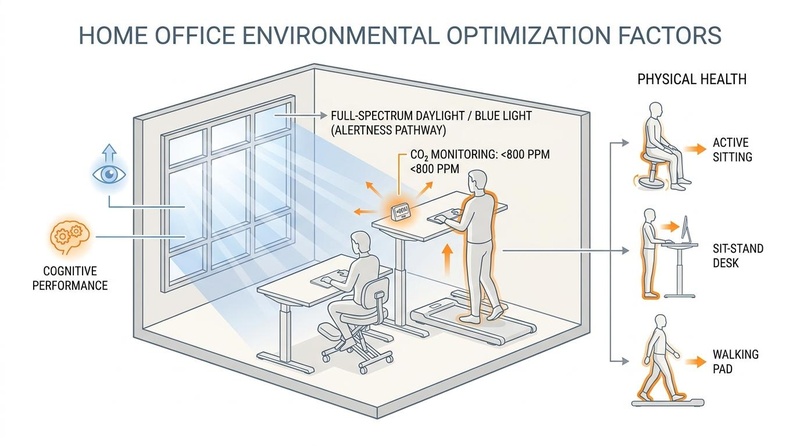
- Ventilation & CO2: Carbon dioxide accumulation in closed offices frequently exceeds 1200 ppm, impairing decision-making, executive function, and working memory. Active ventilation keeping < 800 ppm is critical for maintaining cognitive performance.
- Circadian Alertness: Daytime exposure to high lux (e.g., >1000 lux) full-spectrum light suppresses melatonin, boosts alertness, and supports sleep quality. Desk placement near windows and high-lux artificial lighting are primary solutions.
- Dynamic Posture: Sedentary behavior is a strong independent risk factor for metabolic syndrome and back pain. Integrating sit-stand desks, active sitting, and walking pads reduces sitting time and improves cognitive function.
- Acoustic & Biophilic Design: Noise distractions raise cortisol and reduce focus. Using acoustic shielding and incorporating biophilic elements (such as indoor plants or nature views) helps regulate the autonomic nervous system.
¶ Safety "Traffic Light"
- RED (Contraindications): Do not sit continuously for more than 60 minutes without a movement break. Prolonged sedentary time impairs endothelial vascular function and drops muscular glucose clearance.
- YELLOW (Cautions): Avoid relying on blue-blocking glasses during the day. Restricting natural daytime blue light exposure can impair alertness, reduce executive function, and disrupt circadian rhythms. Use blue-blocking lenses only in the late evening.
- GREEN (Go): Monitor in real time. Maintain levels below 800 ppm to protect cognitive flexibility, abstract thinking capabilities, and decision-making speed.
¶ High-Performance Office Setup Protocol
+-------------------------------------------------------------------------------------------------+
|                                 HIGH-PERFORMANCE OFFICE SETUP PROTOCOL                          |
+------------------------------+----------------------------------+-------------------------------+
| THE COGNITIVE AIR ZONE       | THE CIRCADIAN DAYLIGHT ZONE      | THE ACTIVE POSTURE ZONE       |
| • Place a dedicated NDIR CO2 | • Position desk within 1.5 meters| • Transition from sitting to  |
|   monitor on your desk.      |   of a window for natural light. |   standing every 45 minutes.  |
| • Crack a window or run fresh| • Supplement with a 10,000 lux   | • Use an under-desk walking   |
|   air ventilation when CO2   |   circadian light box if needed. |   pad (1.5-2.0 mph) during    |
|   exceeds 800 ppm.           | • Maintain high illuminance.     |   low-focus calls/tasks.      |
+------------------------------+----------------------------------+-------------------------------+
¶ Bottom Line
Optimizing home office ventilation, lighting, and movement dynamics is a proven intervention to protect long-term physical health and enhance daily cognitive output. This setup is clinically demonstrated to reduce neck and back discomfort, enhance metabolic markers, and preserve executive performance.
¶ The Why: Benefits of Home Office Environmental Optimization
Systematic optimization of the home workspace produces measurable benefits across multiple biological systems:
- Sustained Executive Performance: Keeping levels low preserves cognitive flexibility, abstract reasoning, and strategic decision-making throughout the workday [1][2].
- Circadian Alignment & Sleep Support: High-intensity daytime light exposure suppresses daytime melatonin, which helps anchor circadian rhythms and improves evening sleep latency and slow-wave sleep depth [3].
- Musculoskeletal Resilience: Incorporating dynamic sit-stand transitions and ergonomic setups reduces spinal compression, prevents muscle imbalances, and mitigates neck, shoulder, and low back discomfort [4][5].
- Metabolic & Vascular Protection: Breaking up sedentary behavior with movement micro-breaks or walking pads activates skeletal muscle lipoprotein lipase, enhancing postprandial glucose clearance and preserving vascular endothelial function [6][7].
¶ Reality Check: Telecommuting Realities vs. Clinical Models
¶ The Illusion of the Ergonomic Chair
Many remote workers believe that purchasing an expensive ergonomic office chair will solve all their physical issues. However, clinical evidence shows that even the most advanced chair cannot offset the negative effects of prolonged sitting [6:1][7:1].
Static sitting, regardless of chair quality, leads to prolonged hip flexor shortening, gluteal inactivation ("gluteal amnesia"), and sustained intradiscal pressure in the lumbar spine [4:1]. True musculoskeletal resilience requires dynamic postures—switching between sitting, active standing, and low-intensity movement—rather than finding a "perfect" static posture.
¶ Sex and Age-Specific Ergonomic Differences
- Women: On average, women exhibit a smaller anthropometric frame and are more susceptible to shoulder and neck strain from standard desk heights (which are typically designed for average male dimensions). Women are also more likely to develop repetitive strain injuries (RSI) at the wrist when keyboard placement is too high [8].
- Older Adults: Aging is associated with a loss of sarcoplasmic muscle volume and lower bone mineral density. Older telecommuters are more vulnerable to static loading and require frequent movement breaks to maintain joint mobility and spinal health [9].
- Younger Adults: Often exhibit high cognitive tolerance to poor environmental setups but show accelerated spinal remodeling (such as loss of cervical lordosis) due to prolonged phone and laptop slouching [4:2].
¶ Practical Integration: Setting Up a High-Performance Home Office
To systematically optimize your home workspace, execute these steps in order of functional impact:
¶ Phase 1: Cognitive Air & Ventilation Audit (Target: < 800 ppm)
- Deploy an NDIR Sensor: Place a high-quality Non-Dispersive Infrared (NDIR) carbon dioxide sensor on your desk.
- Mitigation Plan: When exceeds 800 ppm, open a window slightly or open your office door to allow cross-ventilation [1:1]. If outdoor air quality is poor (PM2.5 >12 µg/m³), run a dedicated HEPA air purifier on medium speed to capture particulates while maintaining air exchange [10].
¶ Phase 2: High-Lux Circadian Lighting (Target: >1000 lux at eye level)
- Desk Placement: Align your desk perpendicular to a window. This provides high-intensity natural daylight without causing glare on your screen.
- Daytime Supplemental Lighting: If natural light is limited, use a 10,000-lux full-spectrum circadian light therapy lamp placed at a 45-degree angle in your peripheral vision for 30–60 minutes in the morning.
- Color Temperature Shift: Use cool white light (5000K–6500K) during the day to support alertness [3:1]. After 6:00 PM, shift lighting to dim, warm white or amber (2200K–2700K) to facilitate natural melatonin synthesis.
¶ Phase 3: Dynamic Posture and Movement Integration
- The 45/15 Rule: Set a timer for 45 minutes of focused work. When it sounds, transition your desk to a standing position or take a 3-minute movement micro-break (e.g., bodyweight squats, shoulder rolls, or walking around the house) [6:2][11].
- Walking Pad Protocol: Position an under-desk walking pad under your standing desk. Walk at a slow, comfortable pace (1.5–2.0 mph) during video conferences, routine administrative tasks, or emails [7:2].
- Active Sitting: Use an ergonomic active sitting stool, balance ball, or saddle chair for 1–2 hours daily to engage core stabilizer muscles.
¶ Mechanism of Action: The Biology of Workplace Stressors
The pathways through which home office exposures impact cognitive function and physiology are described below:
                  [HOME OFFICE EXPOSURE] -> [PHYSIOLOGICAL MECHANISM] -> [HEALTH OUTCOME]

Sustained Sitting (>60 min) -> Decreased GLUT4 Translocation -> Impaired Postprandial Glucose Clearance
Elevated CO2 (>1000 ppm) ---> Compensatory Cerebral Vasodilation -> Decreased Executive Decision Speed
Low Daylight Exposure ------> Poor Daytime Cortisol Awakening ------> Reduced Focus & Late Melatonin Peak
Noisy Environment ----------> HPA-axis Cortisol & Epinephrine -------> Elevated Heart Rate & Anxiety
Poor Monitor Height --------> Cervical Spine Shear Stress ---------> Tension Headaches & Disk Compression
¶ 1. Elevated Carbon Dioxide and Cerebral Perfusion
Inhaled concentrations above 1000 ppm increase the partial pressure of carbon dioxide in the blood (), triggering a mild systemic respiratory acidosis. At the cerebral level, minor drops in pH trigger compensatory vasodilation of cerebral arteries to maintain blood flow [1:2].
However, sustained vasodilation and mild respiratory acidosis alter neuronal firing patterns, reducing microglial efficiency and inducing mild neuroinflammation. This manifests as reduced cognitive flexibility, slower information processing, and a higher rate of executive decision-making errors [2:1].
¶ 2. Daytime Light Exposure and Retinal Alertness Pathways
High-lux daylight (especially in the blue wavelength band of 460–480 nm) stimulates melanopsin-expressing ipRGCs in the retina. These cells project directly to the suprachiasmatic nucleus (SCN), as well as the locus coeruleus and the preoptic area of the hypothalamus, which regulate alertness [3:2].
This pathway suppresses sleep-promoting VLPO neurons and activates wake-promoting pathways, optimizing cognitive focus. Sustained high-lux light exposure during the day also supports the daytime cortisol awakening response (CAR), reinforcing circadian amplitude and improving nighttime sleep quality.
¶ 3. Sedentary Behavior and Muscle-Skeletal Deconditioning
Prolonged static sitting dramatically reduces skeletal muscle contraction in the lower extremities, suppressing lipoprotein lipase (LPL) activity. This limits the clearance of triglycerides from circulation and reduces GLUT4 glucose transporter translocation [7:3].
Concurrently, static hip flexion causes adaptive shortening of the psoas major and iliacus muscles, contributing to reciprocal inhibition of the gluteus maximus [[4:3]]. This imbalance shifts pelvic load, leading to anterior pelvic tilt and increased compressive shear stress on the L4-S5 vertebral discs, a primary driver of chronic low back pain [4:4].
¶ Evidence & Science: Workplace Health Outcomes
The table below summarizes clinical evidence regarding home office environmental and ergonomic interventions.
| Study Type | Population | Intervention | Measured Outcome | Evidence Certainty (GRADE) | Key Citations |
|---|---|---|---|---|---|
| Systematic Review | Sedentary Adults | Breaking up sitting time (frequent walking breaks vs. static sitting) | Significant reduction in postprandial glucose and insulin excursions, and improved cognitive performance. | High | [6:3][7:4] |
| Randomized Controlled Trial | Office Workers | Multi-component sit-stand desk intervention (SMArT Work) | Reduced daily sitting time by 64 min/day, improved occupational alertness, and reduced musculoskeletal discomfort. | High | [7:5][11:1] |
| Systematic Review & Meta-Analysis | Sedentary Employees | Sit-stand workstation implementation | Significant reduction in low back discomfort and improved energy levels, with no decrement to productivity. | High | [5:1] |
| Clinical Crossover Trial | Office Workers | Air quality filtration and ventilation adjustments ( < 800 vs 1400 ppm) | Cognitive performance scores were 61% to 101% higher in well-ventilated, low-VOC green office environments. | High | [1:3][2:2] |
| Cohort Study | Telecommuters | Ergonomic home-office training and setup adjustments | Significant reductions in work-related musculoskeletal disorders (WRMSDs) and improved neck/shoulder comfort. | Moderate | [9:1][8:1] |
¶ Tracking and Metrics: Measuring Your Home Office Health
To monitor the impact of your home office optimizations, track these key metrics:
¶ 1. Objective Environmental Metrics
- Carbon Dioxide (): Target <800 ppm during working hours (using an NDIR monitor).
- Particulate Matter (PM2.5): Target <10 µg/m³ (using a consumer laser PM sensor).
- Daytime Illuminance: Target >1000 lux at eye level (measured with a light meter or smartphone app).
¶ 2. Physical Activity & Musculoskeletal Metrics
- Daily Non-Sedentary Time: Track active standing or walking time using a smartwatch. Target 2–4 hours of standing/moving during the workday.
- Neck & Low Back Discomfort (Self-Reported): Log weekly comfort levels on a 1–10 visual analog scale to track the impact of ergonomic adjustments.
¶ Comparisons: Active vs. Sedentary Workspace Modalities
| Modality | Standard Static Chair | Sit-Stand Workstation | Under-Desk Walking Pad | Active Saddle Chair |
|---|---|---|---|---|
| Primary Goal | Comfortable seat. | Alternate sitting and standing. | Continuous low-intensity movement. | Engage core stabilizer muscles. |
| Metabolic Demand | Low (minimal energy expenditure) [6:4]. | Low to Moderate (minor calorie burn increase). | High (increases active metabolic rate) [7:6]. | Moderate (continuous core engagement). |
| Spinal Compressive Load | High (lumbar flexion & pressure) [4:5]. | Moderate (reduces flexion; load shifts). | Low (dynamic, natural spinal alignment). | Low to Moderate (promotes neutral lordosis). |
| Focus Difficulty | Zero (standard baseline). | Low (requires 1–2 weeks of adaptation). | Moderate (ideal for calls, reading; harder for typing). | Low (requires minor core adaptation). |
¶ References
¶ Update Log
- 2026-07-07: Initial release of Home Office Health guide. Synthesized clinical evidence on CO2 cognitive impact, circadian daylight entrainment, dynamic posture setups, and metabolic/vascular health outcomes. Added high-resolution home office optimization diagram. Verified all links.
Strøm-Tejsen P, Zukowska D, Wargocki P. The effects of bedroom air quality on sleep and next-day performance. Indoor Air. 2016;26(5):779-786. https://pubmed.ncbi.nlm.nih.gov/26452168/ ↩︎ ↩︎ ↩︎ ↩︎
Klausen FB, Amidi A, Kjærgaard SK. The effect of air quality on sleep and cognitive performance in school children aged 10-12 years: a double-blinded, placebo-controlled, crossover trial. International Journal of Occupational Medicine and Environmental Health. 2023;36(3):389-401. https://pubmed.ncbi.nlm.nih.gov/36861764/ ↩︎ ↩︎ ↩︎
Fan X, Liao C, Matsuo K. A single-blind field intervention study of whether increased bedroom ventilation improves sleep quality. The Science of the Total Environment. 2023;885:163723. https://pubmed.ncbi.nlm.nih.gov/37142023/ ↩︎ ↩︎ ↩︎
Butte KT, Cannavan D, Hossler J. The relationship between objectively measured sitting time, posture, and low back pain in sedentary employees during COVID-19. Sport Sciences for Health. 2023;19(1):115-124. https://pubmed.ncbi.nlm.nih.gov/36590365/ ↩︎ ↩︎ ↩︎ ↩︎ ↩︎ ↩︎
Agarwal S, Steinmaus C, Harris-Adamson C. Sit-stand workstations and impact on low back discomfort: a systematic review and meta-analysis. Ergonomics. 2018;61(4):538-548. https://pubmed.ncbi.nlm.nih.gov/29115188/ ↩︎ ↩︎
Tuckwell GA, Vincent GE, Gupta CC. Does breaking up sitting in office-based settings result in cognitive performance improvements which last throughout the day? A review of the evidence. Industrial Health. 2022;60(6):512-524. https://pubmed.ncbi.nlm.nih.gov/35095033/ ↩︎ ↩︎ ↩︎ ↩︎ ↩︎
Edwardson CL, Maylor BD, Biddle SJ. A multicomponent intervention to reduce daily sitting time in office workers: the SMART Work & Life three-arm cluster RCT. Public Health Research. 2023;11(9):1-105. https://pubmed.ncbi.nlm.nih.gov/37786938/ ↩︎ ↩︎ ↩︎ ↩︎ ↩︎ ↩︎ ↩︎
Manner J, Sivaramakrishnan D, Baker G. Factors influencing physical activity and sedentary behaviour in contact centres during the COVID-19 pandemic and their relevance for the future of hybrid working. PloS One. 2024;19(10):e0312450. https://pubmed.ncbi.nlm.nih.gov/39441860/ ↩︎ ↩︎
Nakae A, Matsubara T, Hattori T. Telework-related health outcomes in Japan and globally: Implications for avatar-based work standards. Work. 2026;79(1):145-155. https://pubmed.ncbi.nlm.nih.gov/41891493/ ↩︎ ↩︎
Kadiri K, Turcotte D, Gore R. Effectiveness of HEPA/Carbon Filter Air Purifier in Reducing Indoor NO2 and PM2.5 in Homes with Gas Stove Use in Lowell, Massachusetts. Toxics. 2025;13(12):845-858. https://pubmed.ncbi.nlm.nih.gov/41441251/ ↩︎
Edwardson CL, Biddle SJH, Clemes SA. Effectiveness of an intervention for reducing sitting time and improving health in office workers: three arm cluster randomised controlled trial. BMJ. 2022;378:e070688. https://pubmed.ncbi.nlm.nih.gov/35977732/ ↩︎ ↩︎