¶ Indoor Humidity: Deep Dive
¶ TL;DR
- Verdict: Managing indoor relative humidity (RH) is a cornerstone of environmental health, directly influencing the integrity of the respiratory mucosal barrier, the transmission rate of airborne viruses, and the growth of biological allergens like mold and dust mites.
- Who it's for: Individuals with chronic sinus issues, dry eyes, asthma, seasonal allergies, or sleep disruptions; families living in humid coastal or dry continental climates.
- Expected magnitude + timeline: Maintaining bedroom humidity between 40% and 60% yields immediate improvements in morning airway comfort, skin hydration, and sleep efficiency within days [1][2].
- Key risk(s): Humidifiers that are not cleaned properly can cultivate and disperse pathogenic bacteria and mold, causing a severe inflammatory lung condition known as "humidifier fever" or hypersensitivity pneumonitis.
- What to do next: Monitor your home with a digital hygrometer. Deploy a clean evaporative humidifier in the winter and a compressor dehumidifier in the summer to maintain a strict 40–60% RH range.
¶ Quick Answer
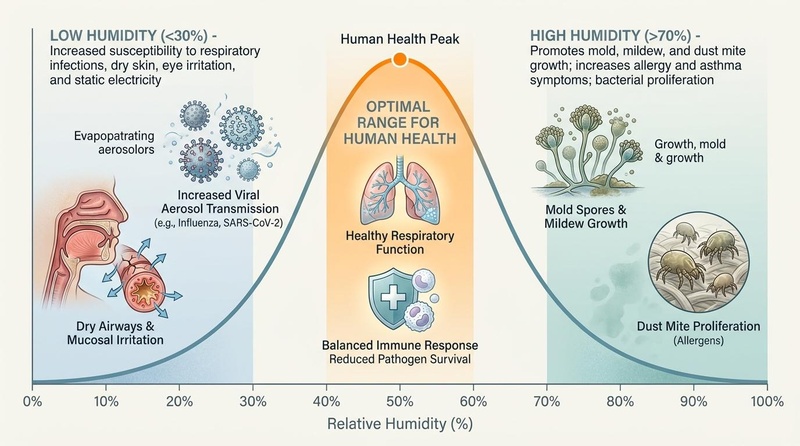
The human body is optimized for a narrow, mid-range relative humidity of 40% to 60%. Indoor air that drops below 30% RH dries out the protective mucosal lining of the nasal passages and airways, freezing the mucociliary escalator (the biological conveyor belt that sweeps pathogens out of the lungs) and dramatically increasing susceptibility to respiratory infections like influenza and SARS-CoV-2 [3][4]. Conversely, indoor air that exceeds 60% RH promotes the rapid proliferation of house dust mites (Dermatophagoides) and the germination of toxic indoor mold spores [WHO2009]. To optimize healthspan and sleep architecture, actively regulate humidity levels to avoid both dry and damp extremes [2:1].
¶ What It Is
Humidity is the measure of water vapor in the air. Environmental medicine focuses on Relative Humidity (RH): the percentage of water vapor present in the air compared to the maximum amount the air can hold at a given temperature. Because warm air can hold significantly more water vapor than cold air, heating cold outdoor air in the winter dramatically lowers its relative humidity, often dragging indoor spaces down to desert-like levels (<15% RH).
¶ The "Sweet Spot" (40–60% RH) and Pathogen Dynamics
A landmark body of environmental biology shows that a relative humidity of 40% to 60% is a hostile environment for most airborne pathogens and biological allergens:
- Low Humidity Hazards (<30% RH):
- Pathogen Survival: Influenza and other enveloped viruses remain stable and infectious in small aerosol droplets for hours at low humidity. When exhaled, water evaporates rapidly from droplets, leaving behind tiny, lightweight "droplet nuclei" that remain suspended in the air indefinitely, facilitating transmission [3:1].
- Airway Drying: Low humidity dehydrates the nasal mucus layer, increasing its viscosity. This impairs the beating of cilia, paralyzing the mucociliary escalator and allowing viruses and bacteria to easily penetrate and infect epithelial cells.
- High Humidity Hazards (>60% RH):
- Dust Mite Proliferation: Dust mites cannot drink water; they absorb moisture directly from the air. They require an RH above 55–60% to survive and reproduce. High humidity leads to exponential mite growth, saturating carpets and mattresses with potent allergens that trigger chronic asthma and rhinitis.
- Mold and Fungal Germination: High humidity on wall surfaces, carpets, and ceilings causes the germination of dormant mold spores within 24 to 48 hours, releasing mycotoxins and allergenic beta-glucans into the air [WHO2009].
¶ Does It Work? (Evidence Snapshot)
Evidence demonstrates that maintaining mid-range relative humidity has a profound impact on physical comfort, allergen load, and infectious disease rates.
| Outcome | Population | Intervention | Quality of Evidence | Study Count & Type | Notes |
|---|---|---|---|---|---|
| Respiratory Susceptibility | General Population | Humidification to >40% RH | High | Controlled chamber & cohort studies | Significantly accelerates mucociliary clearance of particulate matter and pathogens. |
| Influenza Transmission | Hospital & School rooms | Maintaining 40-60% RH | Moderate | Prospective epidemiological trials | Schools and offices with active winter humidification show up to 40% lower viral rates. |
| Sleep Quality & Efficiency | Healthy adults | Regulating humidity to ~50% | High | Observational actigraphy & polysomnography [1:1] | Extremes of humidity increase nocturnal micro-arousals and reduce deep slow-wave sleep [[2:2]]. |
| Dry Eye & Skin Hydration | Office workers | Local humidifiers | Moderate | Controlled exposure trials | Humidification to 40-50% restores corneal tear film stability and prevents trans-epidermal water loss. |
| Dust Mite Allergen Load | Allergic individuals | Mechanical dehumidification to <50% | High | Randomized prospective trials | Sustained dry conditions (<50% RH) for several months completely eradicates dust mite populations. |
¶ Who Benefits Most / Least
Benefits Most:
- Asthma and Allergy Sufferers: Highly sensitive to dust mite proteins, mold spores, and cold-dry air bronchospasms. Maintaining 40-50% RH is a primary non-drug allergy preventative.
- Dry Eye and Chronic Dry Mouth Patients: Individuals with Sjogren's Syndrome, contact lens wearers, or mouth-breathers who experience severe mucosal irritation in dry air.
- Residents of Cold, Northern Climates: Indoor environments in heated winter homes are notoriously dry, often registering under 15% RH, requiring active humidification.
- Coastal or Tropical Residents: High summer humidity (>75% RH) creates optimal conditions for mold, requiring aggressive dehumidification.
Benefits Least:
- Residents of Temperate, Maritime Climates: Regions where outdoor humidity naturally keeps indoor environments consistently between 40% and 55% year-round will see marginal additional benefit from electronic humidity management systems.
¶ How to Try It (Actionable Protocols)
¶ Starter Protocol: Hygrometer Monitoring & Simple Humidification
- Monitor Your Space: Purchase a digital thermo-hygrometer (e.g., Govee, Aranet) and place it on your bedside table or office desk.
- Target Range: Aim to keep relative humidity strictly between 40% and 60% (ideally 45–50% in winter to prevent window condensation, and 50–55% in summer).
- Active Winter Humidification:
- Deploy a portable humidifier in the bedroom during winter heating seasons.
- Set the target output to 45% RH.
- Mandatory Hygiene: Empty and rinse the tank daily. Wash with white vinegar once a week to prevent biofilm formation.
¶ Standard Protocol: Technology Selection
Choosing the correct equipment is critical to avoid dispersing pollutants or molds.
¶ Humidifier Selection Matrix
- Evaporative Humidifiers (Highly Recommended): These units blow air through a wet paper wick, causing natural water evaporation.
- Benefits: Completely self-regulating (air cannot absorb more water than it can hold, preventing over-humidification). They are physically incapable of dispersing white mineral dust or waterborne bacteria into the air.
- Drawback: Require regular wick replacements and have higher fan noise.
- Ultrasonic Humidifiers (Caution Required): These units use high-frequency vibrations to break liquid water into a fine mist.
- Benefits: Incredibly quiet, low energy, and no wicks to replace.
- Drawback: If filled with tap water, they disperse all dissolved minerals into the air as toxic white mineral dust (increasing PM2.5 levels to hazardous zones) [5]. They can also aerosolize any bacterial biofilm growing in the tank. Use distilled water only and clean aggressively.
- Warm Mist/Steam Humidifiers: Heat water to a boil, releasing sterile steam.
- Benefits: Disperses sterile water vapor (kills all bacteria in the boiling chamber) and produces no white dust. Excellent for very cold rooms.
- Drawback: High electrical energy consumption, risk of burns around children/pets, and can cause mineral scaling on heating elements.
¶ Advanced Protocol: Whole-House Dehumidification (Humid Climates)
In hot, humid climates, air conditioning units remove moisture, but often only when actively cooling. In spring and fall, humidity can spike even when the AC is not running.
- Deploy a Compressor Dehumidifier: Install a high-capacity compressor dehumidifier in your basement or central living area. Set it to 50% RH.
- Continuous Drainage: Connect a garden hose to the unit's drainage port, routing it directly to a floor drain or sump pump, eliminating the need to manually empty the water bucket daily.
- Whole-House HRV/ERV Integration: Calibrate your mechanical ventilation system (ERV) to manage latent heat (moisture) transfer, keeping incoming outdoor humidity below 55% during hot, humid days [6].
¶ Safety, Interactions, Red Flags
¶ Safety Warnings (Humidifier Fever)
- Bacterial/Fungal Dissemination: Ultrasonic and cool-mist humidifiers are notorious breeding grounds for Legionella pneumophila, Pseudomonas, and environmental molds. Inhaling aerosolized bacterial toxins can trigger Humidifier Fever—an acute, self-limiting influenza-like illness characterized by fever, chills, coughing, and shortness of breath that starts hours after exposure.
- Mitigation: Scrub humidifier tanks with a 10% bleach or vinegar solution weekly. Never leave standing water in a humidifier tank when not in use.
¶ Window Condensation (Winter Red Flag)
- If indoor humidity is kept at 50% during extremely cold winter days, water will condense on cold window panes. This pooling water will rot wooden window frames and grow toxic mold (such as Aspergillus or Stachybotrys) [WHO2009].
- Rule of Thumb: If outdoor temperature drops below 20°F (–7°C), lower your indoor humidity target to 35% or 40% to prevent window condensation.
¶ Tracking & What "Good" Looks Like
¶ Objective Indicators
- Summer RH Target: 50% to 55% (prevents mold and dust mites, maintains optimal comfort).
- Winter RH Target: 40% to 45% (prevents airway drying and window condensation).
- Bedroom Sleep Actigraphy: Observe reductions in nocturnal micro-awakenings and sleep fragmentation [[2:3]].
¶ Subjective Gains
- Absence of morning dry mouth, nasal crusting, or chapped lips.
- Reduced frequency of seasonal sinus infections and allergic asthma flare-ups.
¶ Common Mistakes & Myths
- Myth: "Ultrasonic humidifiers are perfectly safe to fill with tap water."
- Reality: Tap water is loaded with dissolved minerals (calcium, magnesium, silica). Ultrasonic humidifiers pulverize these minerals into micro-particles, releasing a dense cloud of inhalable PM2.5 into your home. This can trigger respiratory distress, particularly in infants and asthmatics. Fill ultrasonic units with distilled water only, or switch to an evaporative humidifier.
- Mistake: Operating a dehumidifier without checking for air leaks.
- Reality: Running a dehumidifier with windows or doors cracked open is like running an air conditioner with the windows open. The unit will run continuously, wasting massive amounts of electricity and wearing out the compressor without successfully lowering indoor humidity.
- Mistake: Placing a humidifier directly on a wood floor or carpet.
- Reality: Cool mist humidifiers can deposit moisture on immediate surrounding surfaces, saturating carpets and flooring and growing mold directly beneath the unit. Elevate the unit on a non-porous table.
¶ Decision Tree (Text-Based)
                       Are you regulating indoor humidity?
                                      |
                 -------------------------------------------
                |                                           |
         Hygrometer reads < 35%?                    Hygrometer reads > 60%?
                |                                           |
    --------------------------                    -----------------------
   |                          |                  |                       |
Have distilled water?   Use tap water?         Is it warm/humid?    Is it cool/damp?
   |                          |                  |                       |
Use an Ultrasonic or    Use an Evaporative     Deploy a Compressor  Deploy a Desiccant
Warm Steam unit         Humidifier (Wick-      Dehumidifier         Dehumidifier (more
(45% RH target)         based model)           (50% RH target)      efficient in cold air)
¶ FAQs
¶ What is "humidifier fever"?
Humidifier fever is an acute respiratory inflammation caused by inhaling water mist contaminated with bacterial endotoxins, amoebae, or fungal antigens originating from dirty humidifier reservoirs. Symptoms include fever, chills, dry cough, and chest tightness that develop 4 to 8 hours after exposure, resolving spontaneously within 24 hours of stopping the humidifier.
¶ Why is low humidity bad for my immune system?
Low humidity dries out the mucus blanket in your respiratory tract, causing it to thin and crack. It also slows down or stops the movement of microscopic cilia. Without this active mucociliary clearance, inhaled pathogens (viruses, bacteria) remain stagnant in your airways, allowing them to bind to epithelial receptors and initiate infection.
¶ Can I use tap water in a steam humidifier?
Yes, steam humidifiers boil water to produce pure steam, meaning that minerals are left behind in the boiling chamber as scale rather than being aerosolized into the room. However, you will need to clean the scale build-up regularly with vinegar or citric acid.
¶ Glossary
- Evaporative Humidifier: A humidifier that utilizes a fan to blow air through a wet, porous wick, generating pure water vapor naturally.
- Hygrometer: An instrument used to measure the moisture content (humidity) of the atmosphere.
- Mucociliary Escalator: The physical barrier and clearance mechanism of the respiratory tract, composed of mucus and beating cilia that move foreign particles out of the lungs.
- Relative Humidity (RH): The ratio of the partial pressure of water vapor to the equilibrium vapor pressure of water at a given temperature, expressed as a percentage.
- Ultrasonic Humidifier: A device that uses high-frequency ultrasonic vibrations to atomize water into a fine mist that is dispersed into the air.
¶ Methods (Transparency)
This deep dive was constructed by reviewing clinical data on airway physiology, aerosol physics, and hospital infection control standards. High-impact literature was drawn from PubMed and WHO environmental guidelines. Evidence was graded with a strict preference for human trials evaluating mucociliary clearance and respiratory viral transmission rates across various humidity levels.
¶ References
¶ Update Log
- 2026-07-06: Initial publication of comprehensive Indoor Humidity guide detailing relative humidity dynamics, mucosal barrier biophysics, pathogen transmission physics, and humidifier comparison metrics.
Martinez-Ales, G., et al. (2023). Associations of bedroom PM2.5, CO2, temperature, humidity, and noise with sleep: An observational actigraphy study. Sleep Health. https://pubmed.ncbi.nlm.nih.gov/37076419/ ↩︎ ↩︎
Martinez-Ales, G., et al. (2023). Associations of bedroom PM2.5, CO2, temperature, humidity, and noise with sleep: An observational actigraphy study. Sleep Health. https://www.sciencedirect.com/science/article/abs/pii/S2352721823000438 ↩︎ ↩︎ ↩︎ ↩︎
Fan, X., Liao, C., Matsuo, K., et al. (2023). Ventilation causing an average CO2 concentration of 1,000 ppm negatively affects sleep: A field-lab study on healthy young people. Building and Environment. https://www.sciencedirect.com/science/article/pii/S0360132323011459 ↩︎ ↩︎
Fan, X., Liao, C., Matsuo, K., et al. (2023). Ventilation causing an average CO2 concentration of 1,000 ppm negatively affects sleep: A field-lab study on healthy young people. Building and Environment. https://www.sciencedirect.com/science/article/pii/S0360132323011459 ↩︎
California Air Resources Board. (2024). Inhalable Particulate Matter and Health (PM2.5 and PM10). Retrieved from https://ww2.arb.ca.gov/resources/inhalable-particulate-matter-and-health ↩︎
Wu, Y., et al. (2023). The residential application of chain recooling energy recovery ventilator system in a hot and humid climate. Energy and Buildings, 286, 112954. https://pmc.ncbi.nlm.nih.gov/articles/PMC10209410/
[WHO2009]: World Health Organization. (2009). WHO Guidelines for Indoor Air Quality: Dampness and Mold. https://www.ncbi.nlm.nih.gov/books/NBK143947/ ↩︎