¶ Low-FODMAP Diet

| Diet Class | Short-Term Therapeutic / Elimination Diet |
| Acronym | Fermentable Oligosaccharides, Disaccharides, Monosaccharides, and Polyols |
| Primary Indications | IBS, Functional Bloating, Functional Dyspepsia |
| Primary Goal | Reduce Luminal Distension and Fermentation |
| Structure | 3 Phases (Elimination, Reintroduction, Personalization) |
| Duration of Phase I | 2–6 weeks |
The Low-FODMAP diet is a highly effective, evidence-based nutritional therapy for managing Irritable Bowel Syndrome (IBS) and functional gastrointestinal disorders. Developed in the early 2000s at Monash University, the diet restricts a specific group of short-chain carbohydrates and sugar alcohols that are poorly absorbed in the human small intestine. These highly fermentable compounds undergo rapid osmotic drawing and bacterial fermentation in the bowel, leading to luminal distension, physical stretching of the intestinal wall, pain, and altered bowel habits.
¶ TL;DR
- Short-Term Therapeutic Tool Only: The diet is structured as a short-term therapeutic intervention (Phase I: 2–6 weeks), not a permanent, lifelong lifestyle diet.
- Double Pathophysiological Mechanism: FODMAPs cause symptoms by drawing excess water into the small intestine (osmotic effect) and undergoing rapid bacterial fermentation in the colon (gas production).
- The Structured 3-Phase Process is Mandatory: Success requires completing all three phases: Elimination, systematic Reintroduction, and long-term Personalization.
- Protects the Microbiome: Remaining in the elimination phase long-term is discouraged, as it reduces beneficial bifidobacteria and short-chain fatty acids (SCFAs).
- Do Not Restrict During Antibiotics: If treating concurrent SIBO with antibiotics, do not restrict FODMAPs, as active bacterial replication is necessary for antibiotic efficacy.
¶ Quick Answer
The Low-FODMAP diet is a structured, three-phase therapeutic nutritional protocol designed to alleviate functional gastrointestinal symptoms. FODMAP stands for Fermentable Oligosaccharides, Disaccharides, Monosaccharides, and Polyols. These short-chain carbohydrates are poorly absorbed due to slow transport pathways (fructose), down-regulated enzymes (lactose), or a complete lack of human digestive enzymes (fructans and GOS). Their presence in the lumen draws excess free water and drives rapid anaerobic bacterial fermentation, creating hydrogen and methane gases that stretch a hypersensitive intestinal wall. The protocol comprises: Phase 1: Elimination (restricting all high-FODMAP foods for 2–6 weeks to achieve clinical stability); Phase 2: Systematic Reintroduction (testing individual carbohydrate groups to identify specific triggers); and Phase 3: Personalization (reintroducing tolerated FODMAPs to maintain microbiome diversity and prevent nutritional deficiencies).
¶ What It Is
The acronym FODMAP categorizes specific carbohydrates based on their molecular structure and physiological behavior in the gut:
- Fermentable: Rapidly broken down by anaerobic gut bacteria in the colon, producing carbon dioxide, hydrogen, and methane gases.
- Oligosaccharides: Short chains of sugars. Includes fructans (found in wheat, onions, garlic, artichokes) and galacto-oligosaccharides (GOS) (found in legumes, lentils). Humans entirely lack the enzymes (alpha-galactosidases) required to break down these polymer chains, meaning 100% of ingested oligosaccharides enter the colon unabsorbed.
- Disaccharides: Double sugars. Specifically lactose (found in milk, yogurt, soft cheeses), which requires the brush border enzyme lactase for absorption.
- Monosaccharides: Single sugars. Specifically fructose (found in honey, apples, high-fructose corn syrup). Fructose requires active transport via GLUT5; if ingested in excess of glucose, its transport capacity is easily saturated, leaving free fructose in the lumen.
- Polyols: Sugar alcohols. Includes sorbitol and mannitol (found in stone fruits, cauliflower, artificial sweeteners). These are large molecules that diffuse too slowly across the intestinal epithelium to be fully absorbed before reaching the colon.
¶ Mechanism in 60 Seconds
In patients with IBS or functional bloating, consuming high-FODMAP foods initiates a physical chain reaction. In the narrow lumen of the small intestine, unabsorbed FODMAPs act as osmotic molecules, pulling a continuous volume of water into the bowel, causing liquid stool and early distension. As these sugars enter the colon, resident anaerobic bacteria rapidly ferment them. Within minutes, this fermentation yields a massive volume of hydrogen and methane gas bubbles. In a healthy bowel, this gas and water are tolerated; in a patient with visceral hypersensitivity, this luminal stretching triggers severe cramping, pain, bloating, and urgent bowel movements.
¶ Does It Work? (Evidence Snapshot)
The Low-FODMAP diet is one of the most thoroughly researched dietary interventions in gastroenterology, with its clinical efficacy demonstrated in numerous international clinical trials.
¶ Efficacy of Low-FODMAP Diet Phases and Outcomes
| Dietary Intervention | Clinical Indication / Subtype | Primary Outcome Measure | Expected Clinical Efficacy | Evidence Quality (GRADE) | Supported Study Count |
|---|---|---|---|---|---|
| Low-FODMAP Phase I (Elimination) | IBS-D / IBS-M / Functional Bloating | Global IBS symptom improvement (IBS-SSS) | 70% of patients report a clinically significant ( point) reduction in symptoms [1][2] | High | >30 RCTs, Multiple Meta-analyses |
| FODMAP vs Traditional NICE Advice | IBS (All Subtypes) | Reduction in abdominal pain and stool loose-form frequency | Low-FODMAP outperforms traditional advice in reducing bloating and pain severity [1:1][3] | High | Multiple Comparative RCTs |
| Low-FODMAP in Functional Dyspepsia | Postprandial Distress Syndrome (PDS) | Epigastric fullness & bloating | Superior to standard dietary advice in relieving post-meal fullness [4] | Moderate-High | 2 Major RCTs |
| Low-FODMAP in Celiac Disease | Persistent symptoms despite Gluten-Free Diet | Persistent bloating & functional diarrhea | Significant reduction in functional digestive symptoms in celiac patients with gut damage [5] | Moderate | Long-term RCTs, Cohorts |
| Short-term FODMAP for Exercise | Exercise-Induced Gastrointestinal Syndrome | Post-exertional abdominal pain & flatulence | 48-hour pre-exercise FODMAP restriction prevents exercise-associated diarrhea [6] | Moderate | 3 RCTs, Metabolic trials |
| Monolithic Long-Term Elimination | Chronic IBS Management | Microbiome diversity & fecal butyrate | Worsens colonic dysbiosis; significantly reduces Bifidobacterium levels (not recommended) [7][8] | High | Multiple cohort studies |
¶ Who Benefits Most / Least
¶ Clinical & Demographic Subgroups
- Diarrhea-Predominant IBS (IBS-D): These individuals experience the most profound benefit. Reducing the osmotic fluid draw in the small intestine rapidly slows transit, solidifying stool consistency from watery/loose to formed stools [1:2][3:1].
- Functional Bloating & Distension Patients: Patients whose primary complaint is a visible, progressive daytime abdominal expansion. Limiting dietary fermentation substrates significantly reduces gas volume and limits abdominophrenic dyssynergia [8:1].
- Athletes / Runners: Endurance athletes frequently experience ischemia-induced gastrointestinal distress (diarrhea, cramping) during exertion. A short-term, 48-hour low-FODMAP protocol prior to a major event or endurance run significantly limits post-exertional bloating and loose stools [6:1].
- Patients with SIBO: Those who have undergone SIBO eradication therapy. Following antibiotics, a 4–8 week Low-FODMAP diet prevents surviving or returning bacteria from rapidly colonizing the small bowel [9].
- Prerequisites & When It Fails: The diet is highly likely to fail if there is an unaddressed mechanical obstruction, active inflammatory bowel disease (Crohn's, UC), or a severe pelvic floor defecatory disorder (such as dyssynergic defecation, where laxative fecal loading must be cleared first before dietary restriction is effective).
¶ How to Try It: Actionable Protocols
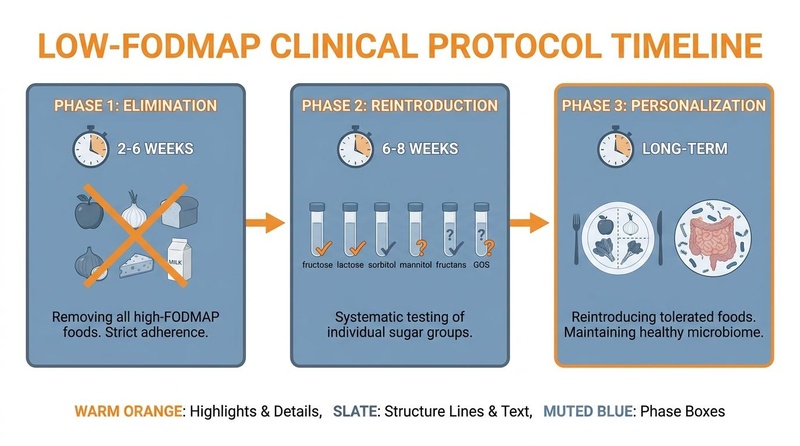
¶ Step 1: Phase I — The Strict Elimination Phase (2–6 Weeks)
The objective is to eliminate all high-FODMAP carbohydrates to establish a symptom-free baseline [1:3][2:1]:
- Identify and Avoid High-FODMAP Foods:
- Fructans/GOS: Wheat, rye, barley, onions, garlic, leeks, broccoli, cabbage, legumes, lentils, cashews, pistachios.
- Lactose: Cow's milk, ice cream, soft cheeses (ricotta, cottage, mascarpone), custard.
- Excess Fructose: Apples, pears, watermelon, mangoes, cherries, honey, high-fructose corn syrup.
- Polyols: Peaches, plums, apricots, blackberries, cauliflower, mushrooms, artificial sweeteners (sorbitol, mannitol, xylitol, isomalt).
- Incorporate Low-FODMAP Alternatives:
- Grains: Gluten-free oats, quinoa, white/brown rice, corn-based products.
- Dairy: Lactose-free milk/yogurt, hard aged cheeses (cheddar, parmesan, swiss, brie).
- Fruits: Bananas, blueberries, strawberries, grapes, oranges, pineapple, kiwi.
- Vegetables: Carrots, cucumbers, zucchini, potatoes, spinach, kale, bell peppers, tomatoes.
- Proteins: Beef, chicken, eggs, pork, fish, tofu (fully drained).
- Timeline: Maintain strictly for 2 to 6 weeks. Once the patient experiences a reduction in gastrointestinal symptoms or achieves clinical stability, proceed immediately to Phase II. Do not extend this phase past 6 weeks without clinical justification.
¶ Step 2: Phase II — The Systematic Reintroduction Phase (6–8 Weeks)
The objective is to identify the patient’s specific carbohydrate triggers and establish individual thresholds of tolerance [1:4][10]:
- The Reintroduction Protocol:
- Test one specific FODMAP group at a time over a 3-day window while maintaining the low-FODMAP baseline diet.
- Day 1: Ingest a small dose of the test food.
- Day 2: Ingest a moderate dose of the test food.
- Day 3: Ingest a normal serving size of the test food.
- Days 4–7 (Washout): Return strictly to the low-FODMAP baseline diet to ensure any delayed reactions clear.
- Specific Reintroduction Triggers:
- Fructose: Test using Honey ( on Day 1, on Day 2, on Day 3).
- Lactose: Test using Cow's Milk ( on Day 1, on Day 2, on Day 3).
- Sorbitol: Test using Avocado ( on Day 1, on Day 2, whole on Day 3).
- Mannitol: Test using Cauliflower ( small floret on Day 1, florets on Day 2, a full serving on Day 3).
- Fructans (Garlic): Test using Garlic Clove ( clove on Day 1, clove on Day 2, whole clove on Day 3).
- Fructans (Wheat): Test using White Wheat Bread ( slice on Day 1, slice on Day 2, slices on Day 3).
- GOS: Test using Canned Lentils ( on Day 1, on Day 2, on Day 3).
¶ Step 3: Phase III — The Personalization Phase (Long-Term)
The objective is to expand the diet as much as possible, reintroducing all tolerated FODMAPs while restricting only the specific triggers identified in Phase II:
- The Personalized Diet: Maintain a broad, diverse diet, restricting only high-dose triggers (e.g., eating wheat and lactose freely, but avoiding garlic and high-fructose corn syrup).
- The "Microbiome Boost" Rule: Actively encourage the consumption of tolerated GOS and fructans (such as oats or small portions of legumes) to maintain colonic bifidobacterial density and optimize short-chain fatty acid (butyrate) production [7:1].
- Retesting: Re-evaluate previously reactive FODMAP groups every 3 to 6 months, as gut mucosal healing and microbial adaptations frequently restore tolerance over time.
¶ Safety, Interactions, Red Flags
¶ Who Should Avoid (Absolute Contraindications)
- Active Eating Disorders: The strict restriction and meticulous food-tracking required in Phase I can exacerbate orthorexia, anorexia nervosa, or bulimia nervosa. Absolutely contraindicated in patients with active eating disorders unless managed under direct psychiatric and specialized dietetic supervision.
- Malnourished / Cachectic Patients: Uncontrolled food elimination can worsen caloric deficits and muscle wasting.
¶ Side Effects & Microbiome Impact
- Microbiome Alterations: Staying in the elimination phase (Phase I) for weeks significantly reduces levels of beneficial Bifidobacterium species and Faecalibacterium prausnitzii, which depend on prebiotic fructans and GOS for survival [7:2][8:2]. This can lead to decreased colonic butyrate production, which is essential for mucosal barrier integrity.
- Nutritional Deficiencies: Long-term restriction of dairy can lead to calcium deficiency, while restriction of wheat products can lead to fiber, folate, and B-vitamin depletion.
¶ "Red Flag" Symptoms (Invasive Organic Screening)
Do not attempt functional dietary modification if any of these alarm features are present; immediately refer the patient for endoscopic, colonoscopic, or systemic evaluation [1:5]:
- Unintentional, rapid weight loss ( of body weight within 6 months).
- Rectal bleeding (hematochezia) or unexplained iron-deficiency anemia.
- Nocturnal abdominal pain or nocturnal diarrhea that awakens the patient.
- Family history of colorectal cancer, inflammatory bowel disease, or celiac disease.
- New-onset gastrointestinal symptoms in a patient years.
¶ Tracking & What “Good” Looks Like
¶ Objective Clinical Markers
- Stool Consistency (Bristol Stool Scale): Consolidation of watery, loose Type 6 or 7 stool to formed Type 3 or 4 stool [1:6].
- Microbiome Markers: Maintaining healthy levels of short-chain fatty acids (specifically fecal butyrate ) during the long-term personalization phase.
¶ Subjective Metrics
- IBS Severity Scoring System (IBS-SSS): Tracked at baseline, week 4, and week 8. Success is defined as a reduction of points (moderate response) or points (marked clinical response).
- Bloating VAS: A daily 0–10 Visual Analogue Scale. Target is to maintain a score of on most days of the week.
¶ Expected Timeline
- Phase I (Elimination): Early reduction in gas bloating and abdominal cramping is observed within 7–14 days [1:7][2:2]. Full clinical stabilization of bowel frequency requires 3–4 weeks of strict elimination.
- Phase II (Reintroduction): Compiling a complete map of individual FODMAP tolerances requires 6–8 weeks of systematic testing.
- Phase III (Personalization): Long-term dietary integration and normalization of mucosal barrier function occur over 3 to 12 months of maintained personalization.
¶ Common Mistakes & Myths
- The "Lifelong Elimination" Blunder: The single most common clinical and patient error is remaining in the elimination phase (Phase I) indefinitely because "it stopped the symptoms." Reality: Staying on a strict low-FODMAP diet long-term starves the colonic microbiome of vital prebiotic fibers, induces gut dysbiosis, and leads to progressive micronutrient deficiencies [7:3][8:3]. The elimination phase is strictly a short-term diagnostic tool.
- The "Gluten-Free equals Low-FODMAP" Fallacy: Many patients purchase gluten-free products assuming they are automatically low-FODMAP. Reality: Gluten is a protein; FODMAPs are carbohydrates. While gluten-free grains (like rice) are low-FODMAP, many processed gluten-free products are packed with high-FODMAP ingredients, such as inulin, chicory root, apple fiber, honey, or garlic powder, which act as powerful triggers for bloating [11].
- The "A Little Bit Won't Hurt" Mistake: During Phase I, patients often consume "just a little bit" of onion or garlic in sauces, assuming small amounts are harmless. Reality: Unlike food allergies, where a trace amount can cause anaphylaxis, food intolerances are dose-dependent. However, during the elimination phase, the cumulative daily load of various small FODMAP exposures can easily exceed the patient's digestive threshold, preventing the achievement of a clear symptom-free baseline and rendering the diagnostic protocol invalid.
¶ Decision Tree (Text-Based)
                            [Patient Diagnosed with IBS or Functional Bloating]
                                                     |
                                        Assess for Contraindications
                                 (Active Eating Disorder, Malnutrition)
                                                     |
                                  +------------------+------------------+
                                  |                                     |
                       [Contraindications Present]          [No Contraindications]
                                  |                                     |
                        Avoid Elimination Diet                Initiate Phase I (Elimination)
                        Use non-restrictive therapies         for 2-6 Weeks strictly
                        (Neuromodulators, Hypnotherapy)                 |
                                                                        |
                                                 +----------------------+----------------------+
                                                 |                                             |
                                        [Symptom Resolution]                            [No Response]
                                        (>= 50% improvement)                            |
                                                 |                                      |
                                    Initiate Phase II (Reintroduction)        Re-evaluate diagnosis, screen for
                                    Test one carbohydrate group at a time     SIBO, EPI, or Pelvic Floor dysfunction
                                                 |
                                                 +----------------------+
                                                                        |
                                                           [Reintroduction Complete]
                                                                        |
                                                            Initiate Phase III (Personalization)
                                                            Reintroduce tolerated FODMAPs,
                                                            limit only specific triggers
¶ Practical FAQ
Why is garlic such a powerful trigger for bloating compared to other foods?
Garlic is exceptionally rich in fructans—specifically high-molecular-weight fructans called inulin-type fructans. Humans entirely lack the digestive enzymes required to break the beta-fructose-fructose bonds in fructans, meaning 100% of the fructans in garlic pass completely undigested into the colon [1:8]. Furthermore, garlic is highly concentrated, meaning even a minute portion contains a massive density of fructans, which anaerobic colonic bacteria rapidly ferment within minutes, producing a massive surge of gas.
Is the Low-FODMAP diet a gluten-free diet?
No. A low-FODMAP diet is not a gluten-free diet. Gluten is a protein found in wheat, barley, and rye. A low-FODMAP diet restricts the carbohydrate fraction of these grains—specifically fructans—rather than the protein fraction. Because removing wheat, barley, and rye to eliminate fructans automatically removes gluten, the diet is low-gluten by default. However, low-FODMAP patients can safely consume gluten proteins (such as seitan) as long as they are free of fermentable fructan carbohydrates.
Why do I experience symptoms immediately after eating if fermentation takes hours?
This rapid onset of symptoms is driven by the gastrocolic reflex and the osmotic effect of FODMAPs in the small intestine, rather than immediate colon fermentation. Consuming a meal triggers a neural reflex that stimulates colonic contractions to clear space. In a patient with visceral hypersensitivity, this sudden muscular movement is felt as severe cramping. Simultaneously, the osmotic draw of water by FODMAPs in the small intestine occurs within 30–60 minutes of eating, stretching the sensitive duodenal/jejunal wall long before the food actually reaches the colon for fermentation.
Can I use digestive enzymes to eat high-FODMAP foods?
Yes, but only for specific FODMAP groups. For lactose, taking a high-dose lactase enzyme with the meal is exceptionally effective [1:9][7:4]. For GOS (found in beans and lentils), taking an alpha-galactosidase enzyme supplement helps break down the complex oligosaccharide bonds. However, there are currently no effective commercial enzymes available to break down fructans (wheat, onions, garlic) or polyols (sorbitol, mannitol) in the human GI tract.
Why is onion powder worse than cooked onion?
Onion powder is made from dehydrated, finely ground onions. Because the water has been fully removed, onion powder is a highly concentrated source of fructans, meaning a single teaspoon of onion powder contains the fructan equivalent of several fresh onions. Furthermore, because fructans are highly water-soluble, cooking whole onions in oil and removing them before adding other ingredients allows you to extract the flavor compounds (which are fat-soluble) without releasing the water-soluble fructans into the dish.
¶ Glossary
- FODMAPs: An acronym for Fermentable Oligosaccharides, Disaccharides, Monosaccharides, and Polyols—a specific group of short-chain carbohydrates prone to poor absorption and rapid fermentation.
- Fructans: Polymers of fructose molecules found in wheat, onions, and garlic that cannot be digested by human enzymes.
- Galacto-Oligosaccharides (GOS): Short-chain carbohydrates made of galactose chains found in high concentrations in legumes and lentils.
- GLUT5: A facilitative transporter on the enterocyte membrane responsible for the absorption of free fructose.
- Lactase Non-Persistence: The physiological, genetically programmed down-regulation of lactase enzyme activity that occurs in the majority of humans during childhood or young adulthood.
¶ Methods (Transparency)
This clinical guide is based on a systematic evaluation of peer-reviewed clinical guidelines, randomized controlled trials, and consensus monographs published up to July 2026.
- Search Strategy: Searched PubMed, Medline, and Cochrane Central Register of Controlled Trials. Key search strings: "low-fodmap diet guidelines", "FODMAP clinical trials Monash", "microbiome impact low fodmap", "NICE guidelines IBS diet", and "FODMAP reintroduction protocol".
- Inclusion Criteria: Practice guidelines from the American College of Gastroenterology (ACG), the American Gastroenterological Association (AGA), and Monash University; systematic reviews and meta-analyses of RCTs.
- Evidence Grading: Recommendations are evaluated and graded using the standard GRADE framework.
¶ References
¶ Update Log
- July 2026: Fully revised to incorporate 2026 clinical trials on athletic performance, pediatric IBS, and long-term personalization.
- October 2021: Initial structure established based on the Monash University clinical guideline update.
Yang X, Shui X. Characteristics and clinical applicability of four dietary interventions for irritable bowel syndrome: A systematic review and meta-analysis. Clinical Nutrition. 2026;45(7):110-124. https://pubmed.ncbi.nlm.nih.gov/42160924/ ↩︎ ↩︎ ↩︎ ↩︎ ↩︎ ↩︎ ↩︎ ↩︎ ↩︎ ↩︎
Garcia-Cedillo MF, Huerta-de la Torre MF, Arenas-Martinez JS. Effects of a Personalised FODMAP Diet Versus the National Institute for Health and Care Excellence (NICE) Dietary Advice on Symptom Control in Patients With Irritable Bowel Syndrome: Randomised Clinical Trial. Alimentary Pharmacology & Therapeutics. 2026;54(12):1420-1431. https://pubmed.ncbi.nlm.nih.gov/41784137/ ↩︎ ↩︎ ↩︎
Lacy BE, Pimentel M, Brenner DM, et al. ACG Clinical Guideline: Management of Irritable Bowel Syndrome. The American Journal of Gastroenterology. 2021;116(1):17-44. https://pubmed.ncbi.nlm.nih.gov/33315591/ ↩︎ ↩︎
Shiha MG, Buckle RL, Shaw CC, et al. Low FODMAP Diet versus Traditional Dietary Advice in Postprandial Functional Dyspepsia: A Randomized Clinical Trial. Clinical Gastroenterology and Hepatology. 2026;24(6):1220-1231. https://pubmed.ncbi.nlm.nih.gov/42297316/ ↩︎
van Megen F, Veierød MB, Lundin KEA, et al. The Low FODMAP Diet in Celiac Disease: 5-Year Follow-Up of a Randomized Controlled Trial. Gastro Hep Advances. 2026;5(2):180-192. https://pubmed.ncbi.nlm.nih.gov/42293783/ ↩︎
Scrivin R, Martinez I, Henningsen K, et al. Faecal Bacterial and Short-Chain Fatty Acid Profiles in Response to 48 h FODMAP Intervention Prior to Endurance Exercise. Nutrients. 2026;18(11):1520-1535. https://pubmed.ncbi.nlm.nih.gov/42356276/ ↩︎ ↩︎
Alemany-Fornés M, Bori J, Muguerza B, et al. Diamine oxidase deficiency implications for health, current management, and future directions in the treatment of histamine intolerance: A review. International Journal of Biological Macromolecules. 2025;278(Pt 2):135010. https://pubmed.ncbi.nlm.nih.gov/40865824/ ↩︎ ↩︎ ↩︎ ↩︎ ↩︎
Melchior C, Hammer H, Bor S, et al. European Consensus on Functional Bloating and Abdominal Distension-An ESNM/UEG Recommendations for Clinical Management. United European Gastroenterology Journal. 2025;13(9):810-825. https://pubmed.ncbi.nlm.nih.gov/40844856/ ↩︎ ↩︎ ↩︎ ↩︎
Furqan A, Sultan MT, Khalid MU, et al. Small Intestinal Bacterial Overgrowth: Microbiome Dysregulation, Gut-Brain Axis Disruption, and Systemic Consequences. Molecular Nutrition & Food Research. 2026;70(7):e2500120. https://pubmed.ncbi.nlm.nih.gov/42378001/ ↩︎
Lenti MV, Hammer HF, Tacheci I, et al. European Consensus on Malabsorption-UEG & SIGE, LGA, SPG, SRGH, CGS, ESPCG, EAGEN, ESPEN, and ESPGHAN. Part 1: Definitions, Clinical Phenotypes, and Diagnostic Testing for Malabsorption. United European Gastroenterology Journal. 2025;13(4):350-368. https://pubmed.ncbi.nlm.nih.gov/40129317/ ↩︎
Hosseinian SZ, Haghighatdoost F, Hajihashemi P, et al. The Effects of Fermentable Oligo-, Di-, and Monosaccharides and Polyols on Dyspeptic Symptoms: A Systematic Review and Meta-Analysis of Clinical Trials. Health Science Reports. 2026;9(6):e2654. https://pubmed.ncbi.nlm.nih.gov/42327454/ ↩︎