¶ Midlife Recalibration
Midlife—typically spanning ages 40 to 60—is a critical biological and psychological pivot point. At this stage, individuals experience a simultaneous convergence of hormonal transitions (menopause and andropause), a systemic decline in basal metabolic rate, and a documented psychological dip in life satisfaction (the "midlife U-curve")[1][2]. Successful midlife recalibration requires clinical, behavioral, and somatic strategies designed to mitigate endocrine decline, maintain lean body mass, and redefine personal meaning[3][4].
¶ At a Glance
- The "Midlife U-Curve": Large-scale global surveys and prospective longitudinal cohorts confirm a robust, U-shaped distribution of psychological well-being across the lifespan, with satisfaction reaching its lowest point and depressive tendencies peaking in the mid-to-late 40s[2:1].
- The Endocrine Cliff: Women face a rapid decline in 17β-estradiol and progesterone during the perimenopause-to-menopause transition, while men experience a gradual but progressive 1% to 2% annual decline in bioavailable testosterone (andropause)[3:1][4:1].
- The Somatopsychic Recalibration: Endocrine declines have direct, systemic effects. They drive visceral fat accumulation, increase insulin resistance, cause bone mass demineralization, and trigger neuroplastic changes in cortical regions that regulate mood and cognitive executive function[3:2][5][6].
- Cardiometabolic Shifts: Decreases in thyroid hormones (T3/T4) and growth hormone (GH) output reduce resting energy expenditure, shifting body composition toward sarcopenic adiposity (loss of muscle, gain of fat) unless balanced by resistance training and protein optimization[6:1][7].
- Highly Actionable: This biological transition represents an opportunity. Proactive clinical, dietary, and behavioral strategies can prevent the metabolic "dip" and turn midlife into a period of high-impact physiological rejuvenation[3:3][5:1].
¶ Midlife Endocrine & Somatic Diagnostics
| Priority | Physiological System | Target Clinical Parameter | Immediate Recalibration Pivot |
|---|---|---|---|
| GREEN | Endocrine Balance | Stable sex hormones (estradiol/progesterone; bioavailable testosterone) within physiological midlife norms. | Support with micronutrients, stress mitigation, and hormone replacement therapy (HRT) if clinically indicated[3:4][7:1]. |
| YELLOW | Somatic & Musculoskeletal | Diminishing handgrip strength; early osteopenic bone density trends (T-score < -1.0). | Immediately introduce heavy progressive resistance training and optimize dietary protein intake ()[6:2]. |
| RED | Metabolic & Depressive Dip | Escalating fasting glucose (> 100 mg/dL), visceral fat accumulation, and clinical depressive symptoms. | Implement severe metabolic restriction (added sugars), daily physical anchors, and targeted cognitive well-being therapy[4:2][1:1]. |
¶ Midlife Recalibration Protocols
Navigating the midlife transition requires coordinating hormone tracking, metabolic management, and behavior change.
¶ 1. The "Anabolic Anchor" Protocol (Sarcopenia & Visceral Fat Mitigation)
- Practice: Perform heavy progressive resistance training 3 days per week (targeting large compound movements: squats, deadlifts, presses), paired with a daily protein intake of 1.6 to 2.2 grams per kilogram of body weight.
- Biological Target: Counteracts the endocrine-driven loss of muscle tissue (sarcopenia) and prevents visceral fat deposition by maximizing insulin sensitivity and skeletal muscle protein synthesis[6:3].
¶ 2. Endocrine & Micronutrient Optimization (Metabolic Stability)
- Practice: Optimize dietary intake of key metabolic cofactors. Ensure adequate plasma vitamin profiles (including vitamins D3, B12, and active folate) and dietary trace minerals (magnesium, zinc)[7:2].
- Biological Target: Essential for optimal mitochondrial enzyme activity, supporting hypothalamic-pituitary-adrenal (HPA) axis balance and thyroid hormone conversion (T4 to T3)[3:5][7:3].
¶ 3. The "Meaning Recalibration" Protocol (Slowing the U-Curve Dip)
- Practice: Engage in structured eudaimonic journaling. Once a week, audit your daily vocational and personal tasks, categorizing them into "Hedonic" (comfort-seeking) vs. "Eudaimonic" (contribution, learning, values-aligned)[[8]]. Transition at least 10% of your weekly schedule away from empty obligations toward high-value mentorship or complex learning.
- Biological Target: Activates the prefrontal cortex to downregulate amygdala hyper-reactivity, suppressing the pro-inflammatory CTRA profile and mitigating the "midlife crisis" depressive spike[4:3][2:2].
¶ Bottom Line
The midlife U-curve is a biological reality, but it is not an inevitable path to physical decline. By combining metabolic and endocrine tracking with heavy progressive resistance exercise, nutritional optimization, and values-aligned behavior change, individuals can successfully navigate this transitional phase and lay a strong foundation for their healthspan.
¶ The "Why" (Physiological Transitions)
¶ 1. The Anatomy of the Endocrine Transition
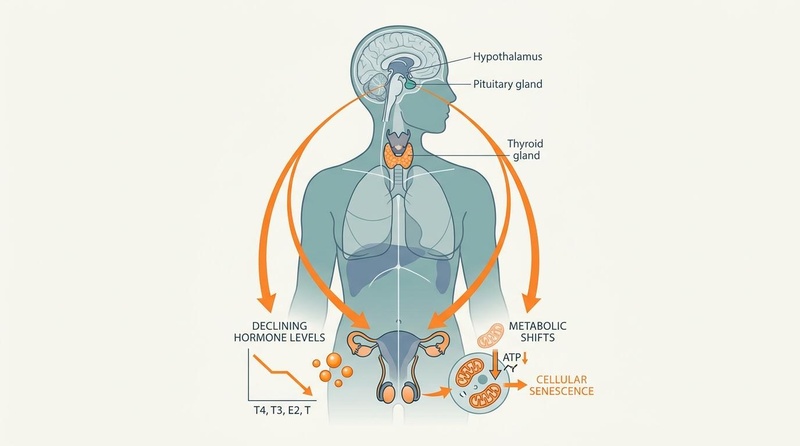
Midlife is characterized by major alterations in hypothalamic-pituitary-adrenal and gonadal signaling. In women, the perimenopause-to-menopause transition is marked by erratic fluctuations and an eventual drop in ovarian follicle output, leading to severe estrogen depletion[3:6][5:2]. In men, Leydig cell attrition in the testes and altered gonadotropin-releasing hormone (GnRH) pulsatility lead to a progressive decline in bioavailable testosterone[3:7].
- Metabolic Consequences: Estradiol and testosterone are primary regulators of lipid storage, vascular elasticity, and insulin sensitivity. Their decline shifts adipose tissue deposition from subcutaneous depots to the visceral cavity, directly increasing the risk of cardiovascular disease, liver steatosis, and systemic metabolic syndrome[3:8][6:4].
¶ 2. The Midlife Well-Being Dip (The U-Curve)
Epidemiological and cross-sectional data across global cohorts demonstrate a highly consistent "U-curve" of happiness, which reaches its absolute lowest point in the mid-40s[2:3].
- Biological Associations: This psychological dip is not merely situational. It correlates with high circulating cortisol levels, elevated markers of systemic inflammation, and a higher prevalence of clinical depressive symptoms[4:4][1:2].
- Somatic Interconnection: Longitudinal data from the CHARLS cohort reveals that perimenopausal and menopausal women experiencing high depressive symptom trajectories also exhibit rapid declines in overall life satisfaction and physical somatic resilience, creating a feedback loop between mental distress and physical decline[4:5][[5:3]].
¶ 3. Sarcopenic Adiposity and Musculoskeletal Fractures
As estrogen and testosterone drop, bone mineral density and muscle mass decrease. Data from the NHANES cohort highlights a critical diagnostic relationship:
- Fragility Fracture Risk: The combination of low bone mass and reduced handgrip strength in adults aged 50-59 is associated with a dramatic, multi-fold increase in fragility fractures[6:5]. Visceral fat accumulation combined with muscle loss (sarcopenic obesity) creates a physical profile prone to metabolic dysfunction and postural instability[5:4][[6:6]].
¶ Reality Check / Context
¶ Cognitive, Balance, and Somatic Preservation
Midlife shifts have direct impacts on functional performance and cognitive execution. Cross-sectional studies evaluating perimenopausal and postmenopausal cohorts demonstrate:
- Cognitive and Balance Dips: Postmenopausal women perform significantly worse on balance testing and show lower executive functioning scores compared to premenopausal peers, independent of chronological age[5:5].
- The Activity Pivot: This functional drop is highly mitigated by the level of habitual physical activity, proving that consistent physical movement and coordination exercises (e.g., balance training, resistance work) are critical somatic interventions during the endocrine transition[5:6].
- The Gender/Identity Differential: Midlife transitions are highly influenced by personal history. For instance, transgender and gender-nonconforming adults show distinct mental health and endocrine trajectories during midlife, which are highly mediated by minority stress and hormone-therapy transitions[9].
¶ Mechanism of Action
The physiological recalibration of midlife operates across three primary pathways:
¶ 1. Hypothalamic-Pituitary-Gonadal (HPG) Remodeling
The aging hypothalamus exhibits altered sensitivity to feedback loops, leading to a down-regulation of GnRH release. This endocrine shift alters downstream pituitary output of Luteinizing Hormone (LH) and Follicle-Stimulating Hormone (FSH), leading to a progressive reduction in peripheral tissue exposure to anabolic sex hormones. This decline reduces cellular transcription of proteins involved in muscle repair, mitochondrial biogenesis, and bone remodeling[3:9][[6:7]].
¶ 2. Neuroplastic and Neurosteroid Alterations
Allopregnanolone and other neurosteroids derived from progesterone and testosterone decrease sharply during midlife. Because these neurosteroids are powerful positive allosteric modulators of receptors in the brain, their depletion leads to heightened amygdalar reactivity, increased anxiety, and sleep fragmentation, directly contributing to the psychological midlife dip[3:10][4:6].
¶ 3. Mitochondrial Deceleration & Visceral Fat Deposition
Declining levels of thyroid hormones (T3/T4) and insulin-like growth factor 1 (IGF-1) reduce mitochondrial oxidative capacity. As cellular ATP output decreases, fatty acid oxidation slows down. Excess lipids are diverted from skeletal muscle to visceral adipose tissue, which then releases pro-inflammatory cytokines (IL-6, TNF-alpha) directly into the portal circulation, accelerating systemic aging ("inflammaging")[3:11][7:4].
¶ Human Evidence Matrix
| Target Trajectory | Clinical Outcome / Effect Size | GRADE Certainty | Cohort / Study Size | Duration | References | Key Clinical Findings |
|---|---|---|---|---|---|---|
| Menopausal Trajectory | Significant depressive linkage () | High | CHARLS Panel Cohort () | Longitudinal | [4:7] | Depressive symptom trajectories during menopause transition directly impair long-term life satisfaction. |
| Musculoskeletal Risk | Hazard Ratio for fractures | High | NHANES Cohort () | Cross-sectional | [6:8] | The joint presence of low bone mass and reduced handgrip strength in midlife predicts high fragility fracture risk. |
| Well-Being Distribution | Robust U-bend distribution () | High | Global Population cohorts () | Cross-sectional | [2:4] | Psychological well-being reaches its lowest point in the mid-40s, correlating with peak antidepressant use. |
| Functional Balance | Reduced postural stability () | Moderate | Perimenopause/Postmenopause () | Cross-sectional | [5:7] | Menopause is linked to diminished balance and executive function, which is mitigated by physical activity levels. |
| Metabolic Wellbeing | Favorable lipid/metabolic clustering | Moderate | Midlife Asian Women () | Cross-sectional | [7:5] | Plasma vitamin and trace mineral profiles are strongly correlated with physical and mental health in midlife. |
| Body Image & Relations | High relationship buffer () | Moderate | Menopausal transition cohort () | Cross-sectional | [10] | Relationship quality and partner support buffer the negative body image shifts during midlife endocrine changes. |
¶ References
de Wit LM, van Straten A, van Herten M. Depression and body mass index, a u-shaped association. BMC Public Health. 2009;9:14. https://pubmed.ncbi.nlm.nih.gov/19144098/ ↩︎ ↩︎ ↩︎
Stone AA, Schwartz JE, Broderick JE, Deaton A. A snapshot of the age distribution of psychological well-being in the United States. Proceedings of the National Academy of Sciences. 2010;107(22):9985-9990. https://pubmed.ncbi.nlm.nih.gov/20479218/ ↩︎ ↩︎ ↩︎ ↩︎ ↩︎
Vallée A, Ayoubi JM. Digital twins in menopause: a roadmap for integrating endocrine dynamics, multisystem physiology, and precision medicine. Maturitas. 2026;185:108234. https://pubmed.ncbi.nlm.nih.gov/42398472/ ↩︎ ↩︎ ↩︎ ↩︎ ↩︎ ↩︎ ↩︎ ↩︎ ↩︎ ↩︎ ↩︎ ↩︎
Zhang Z, Wang Y, Xie Z. Depressive symptoms trajectories among Chinese menopause transition women and their subsequent impact on life satisfaction: A longitudinal study based on the CHARLS database. International Journal of Gynaecology and Obstetrics. 2026;165(1):92-101. https://pubmed.ncbi.nlm.nih.gov/41568418/ ↩︎ ↩︎ ↩︎ ↩︎ ↩︎ ↩︎ ↩︎ ↩︎
Albishi AM, Alagil J, Aljunaini S. Cognitive function, balance, and physical activity among perimenopausal and postmenopausal women: a cross-sectional study. Frontiers in Global Women's Health. 2026;7:42376609. https://pubmed.ncbi.nlm.nih.gov/42376609/ ↩︎ ↩︎ ↩︎ ↩︎ ↩︎ ↩︎ ↩︎ ↩︎
Wang W, Zhen J, Zhu X. Joint association of low bone mass and reduced relative handgrip strength with fragility fracture risk in adults aged 50-59 years: A cross-sectional study from NHANES 2013-2014. Medicine. 2026;105(26):e35359. https://pubmed.ncbi.nlm.nih.gov/42363539/ ↩︎ ↩︎ ↩︎ ↩︎ ↩︎ ↩︎ ↩︎ ↩︎ ↩︎
Tan KML, Tint MT, Cabral RM. Plasma vitamin profiles and their associations with metabolic health and mental wellbeing in midlife Asian women. Scientific Reports. 2026;16:3254. https://pubmed.ncbi.nlm.nih.gov/41673074/ ↩︎ ↩︎ ↩︎ ↩︎ ↩︎ ↩︎
Ryff CD. Eudaimonic well-being, inequality, and health: Recent findings and future directions. International Review of Psychiatry. 2017;29(6):547-557. https://pubmed.ncbi.nlm.nih.gov/29161986/ ↩︎
Cicero EC, Flatt JD, Kaabi O. History of anxiety, depression, and post-traumatic stress disorder diagnoses among midlife and older transfeminine and transmasculine adults in the United States: A cross-sectional analysis within the STRONG cohort. Journal of Affective Disorders. 2026;398:452-461. https://pubmed.ncbi.nlm.nih.gov/42362064/ ↩︎
Bień A, Grzesik-Gąsior J, Górska B. Body image and self-attractiveness in a relationship during the menopausal transition: associations with digital media and perceived media influence. Frontiers in Public Health. 2026;14:108871. https://pubmed.ncbi.nlm.nih.gov/42388771/ ↩︎