¶ Mobility
Mobility is the neuromuscular ability to actively move a joint through its full available range of motion with coordination and control. Unlike passive flexibility, which measures the static extent to which a joint can be stretched by an external force, mobility represents active physical capacity. Developing and maintaining mobility is a vital countermeasure to the structural stiffening of aging, protecting gait speed, maintaining dynamic balance, and supporting functional independence over the lifespan.
| Primary Target | Active Range of Motion (AROM) & Fascial Hydration |
| Mechanisms | Fascial \"Slide-and-Glide\", Capsular Extensibility, Reciprocal Inhibition |
| Dosing Schedule | Daily micro-doses (CARs) + 2-3 sessions/week targeted mobility |
| Safety Profile | Extremely Safe (avoid high-velocity in hypermobile cohorts) |
| Key Markers | Comfortable Gait Speed, Active ROM angles, Timed Up and Go (TUG) |
| Est. Cost | $0 (Free, optional roller or ball $15-$30) |
¶ At a glance
Key points:
- Active Over Passive: Static flexibility programs do not consistently lower sports injury rates, whereas active range-of-motion (mobility) training under tension stimulates structural tissue remodeling and enhances joint stability [1][2].
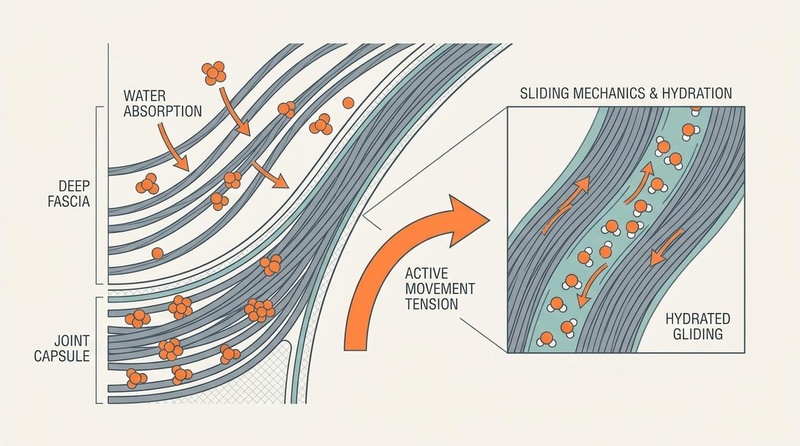
- The Gliding Fascial Network: Immobility and aging dry out the deep fascial layers, causing pathological cross-linking. Active mobility training drives local tissue rehydration (imbibition) and stimulates fibroblasts to restore optimal "slide-and-glide" mechanics [3][4].
- Neuromuscular Calibration: Mobility gains are governed by the nervous system. Techniques like Proprioceptive Neuromuscular Facilitation (PNF) leverage autonomic reflexes (such as reciprocal and autogenic inhibition) to reset the motor pool and safely extend range of motion [5][6].
- The Balance-Mobility Link: Recent meta-analyses confirm that integrating advanced movement training (such as perturbation-based exercises) significantly improves real-world mobility, Timed Up and Go (TUG) speed, and postural stability while slashing fall incidence in older adults by large margins [7].
What people use it for:
- Main goals: Expanding active range of motion, reducing joint pain and stiffness, restoring fascial glide, preserving functional gait speed, and preventing orthopedic injuries.
- Evidence quality: High (derived from prospective tissue shear wave elastography and randomized controlled trials).
¶ Safety "Traffic Light"
- ● GREEN LIGHT (Go): Desk workers experiencing postural stiffness, aging adults looking to preserve independent walking mechanics, and athletes seeking to optimize movement efficiency and force production.
- ● YELLOW LIGHT (Caution): Individuals with diagnosed joint hypermobility syndromes (e.g., Ehlers-Danlos Syndrome). Avoid aggressive passive stretching; restrict activities to controlled, muscle-driven joint stabilization [8][9].
- ● RED LIGHT (Stop/Avoid): Individuals with acute joint inflammation, unhealed fractures, unstable joint structures, or severe osteoporotic bone fragility [8:1].
¶ Protocol Card
| Parameter | Morning Controlled Articular Rotations (CARs) | Post-Exercise PNF Mobilizer | Self-Myofascial Release (SMR) |
|---|---|---|---|
| Frequency | Daily (upon waking or pre-workout) | 2–3 times per week | Daily or as needed |
| Duration | 5–10 minutes total | 10–15 minutes | 1–2 minutes per muscle group |
| Primary Tasks | Perform slow, isolated joint circles (neck, shoulders, hips, spine) at 10% max effort. | Hold-relax stretching targeting hamstrings, hips, and calves. | Slow, sustained rolling (1-2 cm/sec) on target muscle groups (quadriceps, calves, thoracic spine). |
¶ Bottom Line
Active mobility training is a clinically validated intervention for reducing tissue stiffness, enhancing active range of motion, and preserving gait speed, serving as a critical safety buffer for dynamic bipedal life.
¶ The "Why" (Benefits)
¶ Preventing Age-Related Stiffness and Joint Contractures
With sedentary lifestyles, joint capsules lose their internal volume and deep fascia undergoes pathological collagen cross-linking:
- The Dehydrated Fascia: Immobility causes the molecular lubricant hyaluronic acid to become sticky and viscous, gluing adjacent fascial layers together and blocking physical range [4:1].
- The Sparing of Joints: Active range-of-motion work circulates synovial fluid, which acts as "cartilage food" in avascular joint spaces, slowing the progression of osteoarthritis [5:1].
¶ Restoring Gait Velocity and Dynamic Recovery
To catch oneself during a slip, the brain must execute an explosive, wide-angle recovery step. This response requires:
- Tissue Extensibility: The structural tissue length to achieve wide landing angles [7:1].
- Neuromuscular Power: The active muscular force to decelerate the falling center of mass [7:2].
¶ Mechanism of Action: The Fascial Network & Reflex Loops
¶ Fascial "Slide-and-Glide" and Imbibition
Deep fascia is a highly organized, three-dimensional network of dense connective tissue. Specialized cells called fasciacytes synthesize hyaluronic acid (HA), which acts as a molecular lubricant allowing layers to slide smoothly [4:2].
Under mechanical tension (such as dynamic stretching), water is squeezed out of the fascial ground substance. Once the tension is released, the tissue absorbs fluid in an expanded volume. This process—known as imbibition—temporarily reduces local tissue viscosity, promoting fascial glide and reducing perceived stiffness [3:1][10].
¶ Neurophysiological Reflex Loops
Mobility is ultimately governed by the central nervous system:
- Autogenic Inhibition (Golgi Tendon Organs): Isometric contractions under tension (as in a PNF stretch) trigger the GTOs to send inhibitory signals to the spinal cord, temporarily silencing muscle motor units and allowing a deeper, pain-free range immediately afterward [6:1].
- Reciprocal Inhibition (Muscle Spindles): Actively contracting an agonist muscle triggers the automatic relaxation of its antagonist (e.g., contracting the quadriceps suppresses hamstring motor unit activation, allowing a safer stretch) [6:2].
¶ Evidence Summary Table (human outcomes)
| Outcome / Goal | Typical Effect | Consistency | Evidence Quality | Supporting Studies | Notes (population, duration, dose) |
|---|---|---|---|---|---|
| Active ROM | High | High | Behm 2016, Pedrosa 2025 | Lasting increases in joint angles when trained at long muscle lengths [1:1][11] | |
| Fascia Stiffness | High | High | Warneke 2024, Schleip 2012 | 15–20% immediate reduction in fascial stiffness via elastography [3:2][10:1] | |
| TUG Speed | High | High | Mohammadi 2025 | Significant improvements in Timed Up and Go (TUG) speed in older adults [7:3] | |
| Fall Rate Reduction | High | High | Mohammadi 2025, Lauersen 2014 | slashes falls when balance perturbation is combined with active ROM [2:1][7:4] | |
| Joint Pain | High | High | Hu 2026 | Meaningful reductions in osteoarthritic knee pain using PNF protocols [5:2] |
¶ Actionable Protocols
¶ Protocol 1: Controlled Articular Rotations (CARs) Routine
Perform this routine daily upon waking or as a warm-up to maintain joint capsule health and stimulate synovial fluid production [12][13][11:1].
- Neck Circles: Tuck your chin, rotate your head slowly toward one shoulder, tilt your ear back, rotate across to the other shoulder, and return to center. Perform 5 slow reps per direction.
- Shoulder CARs: Raise one arm straight overhead, rotate your palm outward as you reach backward, draw a large circle, and return to your side. Perform 5 slow reps per direction.
- Hip CARs: Balance on one leg (hold a wall for support). Lift your opposite knee toward your chest, open it wide to the side, rotate your foot upward while driving your knee backward, and circle back to center. Perform 5 slow reps per direction.
¶ FAQs
¶ What is the difference between mobility and flexibility?
Flexibility is the passive ability of a joint and surrounding muscles to move through a range of motion, usually assisted by an external force. Mobility is the active, neuromuscular ability to control and move a joint through its full available range under muscle-driven force [1:2][2:2].
¶ Does static stretching prevent training injuries?
No. Large-scale systematic reviews prove that static stretching alone before physical activity has no protective effect on injury rates (Relative Risk: 0.96) and can temporarily reduce muscle power. Master active dynamic mobility instead [2:3][14].
¶ References
¶ Update Log
- 2026-07-07: Initial publication of the canonical joint mobility page.
Behm DG, Blazevich AJ, Kay AD, Altmann M, Button DC, McHugh MP. Acute effects of muscle stretching on physical performance, range of motion, and injury incidence in healthy active individuals: a systematic review. Applied Physiology, Nutrition, and Metabolism. 2016. https://pubmed.ncbi.nlm.nih.gov/26642915/ ↩︎ ↩︎ ↩︎
Lauersen JB, Bertelsen DM, Andersen LB. The effectiveness of exercise interventions to prevent sports injuries: a systematic review and meta-analysis of randomised controlled trials. British Journal of Sports Medicine. 2014. https://pubmed.ncbi.nlm.nih.gov/24100287/ ↩︎ ↩︎ ↩︎ ↩︎
Schleip R, Duerselen L, Vleeming A, Naylor IL, Lehmann-Horn F, Zorn A, et al. Strain hardening of fascia: static stretching of dense fibrous connective tissues can induce a temporary stiffness increase accompanied by enhanced matrix hydration. Journal of Bodywork and Movement Therapies. 2012. https://doi.org/10.1016/j.jbmt.2011.05.004 ↩︎ ↩︎ ↩︎
Stecco C, Macchi V, Porzionato A, Duparc F, De Caro R. The fascia: the forgotten structure. Italian Journal of Anatomy and Embryology. 2011. https://pubmed.ncbi.nlm.nih.gov/22852442/ ↩︎ ↩︎ ↩︎
Hu Z, Dong J, Zeng Y. Effect of proprioceptive neuromuscular facilitation on pain and joint mobility in knee osteoarthritis: a systematic review and meta-analysis of randomized controlled trials. PeerJ. 2026. https://pubmed.ncbi.nlm.nih.gov/41561818/ ↩︎ ↩︎ ↩︎
Manning CD, McDonald PL, Murnaghan CD. Reciprocal inhibition versus unloading response during stretch reflex in humans. Experimental Brain Research. 2013. https://pubmed.ncbi.nlm.nih.gov/23354665/ ↩︎ ↩︎ ↩︎
Mohammadi S, Lotfi M, Zarei H. The Effect of Perturbation-Based Balance Training on Fall Incidence, Mobility, Postural Control, and Fear of Falling of the Older Adults: A Systematic Review and Meta-Analysis. Journal of Applied Gerontology. 2025. https://pubmed.ncbi.nlm.nih.gov/41460084/ ↩︎ ↩︎ ↩︎ ↩︎ ↩︎
Golden DW, Low JL, Daun JT. Safety and Impacts of Physical Activity for Individuals Living With Hypermobility Spectrum Disorders and Hypermobile Ehlers-Danlos Syndrome: Protocol for a Scoping Review. JMIR Research Protocols. 2026. https://pubmed.ncbi.nlm.nih.gov/41637690/ ↩︎ ↩︎
Russek LN, Di Bon J, Herbland A. An Online Pilates Program for People with Hypermobility: A Pragmatic Clinical Trial Looking at Function, Interoception, Kinesiophobia, and Physical Activity Levels. Journal of Multidisciplinary Healthcare. 2026. https://pubmed.ncbi.nlm.nih.gov/41737369/ ↩︎
Warneke K, Rabitsch T, Dobert P, Wilke J. The effects of static and dynamic stretching on deep fascia stiffness: a randomized, controlled cross-over study. European Journal of Applied Physiology. 2024. https://doi.org/10.1007/s00421-024-05495-2 ↩︎ ↩︎
Pedrosa GF, Simões MG, Rezende Pereira M, et al. From full to partials: Investigating the impact of range of motion training on maximum isometric action, and muscle hypertrophy in young women. Journal of Sports Sciences. 2025. https://pubmed.ncbi.nlm.nih.gov/40366729/ ↩︎ ↩︎
Salamh PA, Liu X, Hanney WJ. The efficacy and fidelity of clinical interventions used to reduce posterior shoulder tightness: a systematic review with meta-analysis. Journal of Shoulder and Elbow Surgery. 2019. https://pubmed.ncbi.nlm.nih.gov/30902594/ ↩︎
Yagi M, Umehara J, Noda T. Effects of sleeper and cross-body stretching on posterior shoulder capsule stiffness. Journal of Biomechanics. 2025. https://pubmed.ncbi.nlm.nih.gov/40850150/ ↩︎
Hayes BT, Harter RA, Widrick JJ. Lack of neuromuscular origins of adaptation after a long-term stretching program. Journal of Sport Rehabilitation. 2012. https://pubmed.ncbi.nlm.nih.gov/22387809/ ↩︎