¶ Movement
Movement is the baseline biological signal that sustains human physiological function. While structured exercise (such as a 45-minute gym session) acts as a high-intensity stimulus, the cumulative physical movement performed during the remaining 15–16 waking hours—known as Non-Exercise Activity Thermogenesis (NEAT)—plays an equally, if not more, profound role in regulating systemic metabolic rate, vascular health, and cognitive function [1][2][3].
| Primary Indicator | NEAT, Daily Step Count, Active Sitting Time |
| Mechanisms | LPL Activation, GLUT4 Translocation, Shear Stress Vasodilation |
| Dosing Sched | Continuous integration (breaks every 45–60 mins) |
| Safety Profile | Very Low Risk (highly customizable) |
| Key Marker | Lipid Profile, Postprandial Glycemia, Standing Balance |
| Est. Cost | $0 (Zero-cost behavior) |
The modern sedentary environment has engineered spontaneous physical movement out of daily life, resulting in a systemic state of biological stagnation that structured exercise alone cannot fully correct [4][5].
¶ At a glance
Understanding the physiological difference between a dedicated workout and basic, continuous daily movement is critical for maximizing healthspan.
Key takeaways:
- The "Active Couch Potato" Trap: Exercising for 30–60 minutes in the morning does not neutralize the metabolic and vascular damage caused by sitting uninterrupted for 8–10 hours [4:1][5:1].
- NEAT is a Metabolic Engine: Non-Exercise Activity Thermogenesis (standing, pacing, walking, cooking, fidgeting) accounts for up to 15% to 50% of total daily energy expenditure, representing the largest variable component of metabolic rate [2:1][3:1].
- Vascular Shield: Prolonged sitting pools blood in the lower extremities, impairing endothelial function. Regular standing or walking breaks trigger shear-stress vasodilation, maintaining arterial flexibility [6][5:2].
- Cognitive Refresh: Continuous low-level movement enhances cerebral blood flow and promotes the systemic release of exerkines, supporting focus, mood, and long-term neurogenesis [1:1][7].
What people use it for:
- Main goals: Metabolic health, blood glucose control, vascular flexibility, daily energy levels, postural longevity, and cognitive focus.
- Evidence quality: High (based on device-measured prospective cohorts and randomized crossover trials).
¶ Safety "Traffic Light"
- ● GREEN LIGHT (Go): Individuals looking to optimize metabolic efficiency, reverse occupational stiffness, lower daily postprandial glucose spikes, and protect vascular integrity.
- ● YELLOW LIGHT (Caution): Individuals with moderate orthopedic deconditioning, managed joint arthritis, or postural orthostatic tachycardia syndrome (POTS). Movement breaks should avoid rapid posture shifts (e.g., jumping up from a chair) and instead utilize low-impact, slow-tempo standing stretches, or seated leg extensions.
- ● RED LIGHT (Stop/Avoid): Individuals recovering from acute orthopedic trauma (such as a recent spinal disc herniation or unhealed bone fracture) where joint loading is strictly contraindicated until cleared by a physical therapist.
¶ Protocol Card
| Parameter | The Occupational Pacing Protocol | The Post-Meal Insulin Buffer | The Postural Variety Protocol |
|---|---|---|---|
| Frequency | Every 45–60 minutes of desk work | Within 15–30 minutes after major meals | Continuous throughout the day |
| Duration | 2–3 minutes | 10–15 minutes | Under 30 seconds per change |
| Primary Tasks | Stand up, pace, perform 10 shoulder rolls, and 5 calf raises. | Brisk, flat-surface walking or light housework (washing dishes, tidying). | Alternate between sitting, standing, and active floor sitting (deep squat/seiza). |
| Safety Setup | Clear floor of wires/tripping hazards. | Avoid high-impact running immediately after eating to prevent digestive distress. | Use a stable, adjustable desk; avoid maintaining any single posture to the point of numbness. |
¶ Bottom Line
Daily movement—specifically accumulating 8,000–10,000 steps and breaking up sitting every 45 minutes—is the necessary physical baseline for preventing metabolic decline and all-cause mortality.
¶ The "Why" (Benefits)
¶ Eradicating the Postprandial Glucose Spike
Consuming a meal rich in carbohydrates in a sedentary state forces the pancreas to secrete high levels of insulin to clear glucose from the bloodstream.
- The Power of Post-Meal Walking: Walking for as little as 10–15 minutes immediately after a meal pulls glucose directly into working skeletal muscle fibers without requiring insulin.
- Flattening Glycemic Spikes: Randomized crossover studies prove that breaking up post-meal sitting with light walking lowers peak glycemic excursions by 15% to 20%, reducing systemic endothelial inflammation and improving metabolic flexibility [8][6:1].
¶ Maximizing Metabolic Energy Expenditure (NEAT)
Many individuals struggle with weight management despite consistent exercise because they unconsciously downregulate their spontaneous movement for the rest of the day—a process called compensatory adaptation.
- The Energy Gap: Standing and pacing burns 2–3 times more energy per minute than sitting. Over a 10-hour workday, choosing to stand, pace, and move dynamically can increase daily caloric expenditure by 300 to 800 kcal, effectively combating age-related fat accumulation and supporting body composition [2:2][3:2][9].
¶ Protecting the Vascular Grid
Prolonged, motionless sitting causes blood to pool in the calf veins, reducing the mechanical friction (shear stress) of blood flowing against the vessel walls.
- Preventing Endothelial Decay: Low shear stress triggers local vasoconstriction and endothelial dysfunction within hours. Interruption breaks (standing or light walking for 2 minutes every hour) stimulate nitric oxide release and restore healthy arterial dilation, protecting long-term cardiovascular health [6:2][5:3].
¶ Reality Check & Clinical Context
¶ Mouse Energetics vs. Human Sedentary Reality
While preclinical research in rodents is highly valuable for identifying cellular energy pathways, animal studies cannot replicate the human sedentary lifestyle:
- Spontaneous Activity Profiles: Mice are nocturnal, highly active creatures whose cage environments do not feature the prolonged, chair-based motionless sitting characteristic of modern human office workers.
- Bipedal Gravity Challenges: Upright human standing requires continuous, micro-co-contractions of postural muscles (soleus, gastrocnemius, erector spinae) to maintain balance. This unique mechanical load is absent in quadrupedal animal models, necessitating that human movement guidelines are built upon device-measured, human prospective cohorts and clinical crossover trials [10][11].
¶ The Solitary Session Fallacy
Many people believe that hitting the gym for 45 minutes in the morning "clears" them of their sedentary lifestyle for the rest of the day.
- The "Active Couch Potato": Device tracking reveals that individuals who meet standard exercise guidelines but sit for the remaining 15 hours of their waking day still suffer from high metabolic risk profiles. Spreading movement throughout the day is an independent, non-negotiable requirement for optimal healthspan [4:2][5:4].
¶ Practical Integration
¶ Building a Dynamic Movement Workspace
- Postural Variety: The "perfect posture" does not exist. The best posture is the next posture. Set a timer to alternate between sitting (45 mins) and standing (15 mins).
- The Standing Meeting: Make all internal phone calls or 1-on-1 conversations "mobile" by pacing your office or walking outdoors.
- Kitchen Mechanics: Integrate light balance or calf raises while washing dishes or waiting for coffee to brew (habit stacking).
¶ Mechanism of Action
¶ Cellular Bioenergetics: Lipoprotein Lipase & GLUT4 Activation
During physical movement, low-level muscle contractions in the lower limbs (such as the soleus muscle) initiate powerful cellular signaling pathways:
                  POSTURAL MUSCLE CONTRACTION (SOLEUS)
                                   |
         +-------------------------+-------------------------+
         |                                                   |
  [Shear Stress]                                      [ATP Hydrolysis]
         |                                                   |
Nitric Oxide Release                                   AMPK Activation
         |                                                   |
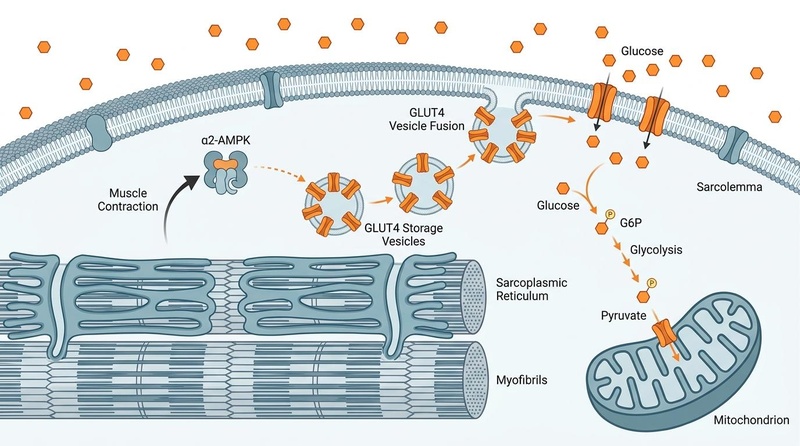
Arterial Dilation & FMD                          GLUT4 Translocation (Sarcolemma)
         |                                                   |
Vascular Shield                                 Insulin-Independent Glucose Uptake
         |                                                   |
  Lower Blood Pressure                              Reduced Glycemic Volatility
- LPL Activation: Spontaneous muscular contractions maintain the activity of Lipoprotein Lipase (LPL), an enzyme anchored to the capillary walls of skeletal muscle. LPL catches circulating fats (triglycerides) in the blood and converts them into fuel. Motionless sitting suppresses LPL activity by up to 90%, leading to stagnant lipids, elevated LDL cholesterol, and increased cardiovascular plaque risk [2:3][11:1].
- GLUT4 Translocation: Muscle contraction utilizes ATP, shifting the cellular AMP-to-ATP ratio. This activates AMPK (adenosine monophosphate-activated protein kinase), which triggers the migration of GLUT4 glucose transporters to the cell membrane (sarcolemma), pulling glucose directly from the blood without requiring insulin [8:1].
- Postural Muscle Fatigue Resistance: Postural muscles, such as the soleus, are composed almost entirely of Type I slow-twitch muscle fibers. They are packed with mitochondria, rely heavily on fat oxidation, and do not fatigue easily. Activating them via standing or pacing requires zero recovery time, making daily movement highly sustainable [2:4][11:2].
¶ Evidence Summary Table (human outcomes)
| Outcome / Goal | Typical Effect | Consistency | Evidence Quality | Primary Evidence | Notes (population, duration, dose) |
|---|---|---|---|---|---|
| All-Cause Mortality | High | High | Ekelund 2020, Shivgulam 2026 | 30–40% risk reduction in cohorts accumulating 8,000–10,000 steps compared to sedentary cohorts [3:3][11:3] | |
| Postprandial Glycemia | High | High | Babir 2026, Fang 2026 | 15% to 20% reduction in post-meal blood sugar spikes with light post-meal walking [8:2][6:3] | |
| Vascular Function (FMD) | High | High | Alexe 2025, Fang 2026 | Prevents sitting-induced decline in endothelial flow-mediated dilation of the lower limbs [6:4][5:5] | |
| Metabolic Rate (Energy) | High | Moderate | Eskildsen 2026, Rizzato 2022 | Increase of 300–800 kcal in daily energy expenditure through optimization of NEAT [2:5][11:4] | |
| Workplace Fatigue | High | Moderate | Leppe-Zamora 2025, Alexe 2025 | Marked reduction in perceived fatigue, musculoskeletal stiffness, and brain fog [12][5:6] |
¶ Safety and Troubleshooting
While daily movement is highly safe, certain orthostatic and structural patterns must be monitored:
¶ Occupational Orthostatic Load
- The Standing Trap: Standing completely motionless for hours at a standing desk is not healthy. It increases hydrostatic pressure in the lower veins, leading to blood pooling, varicose veins, and lower-back muscle fatigue.
- Correction: Incorporate active standing. Shift weight from side to side, perform occasional calf raises, or place one foot on a small step-stool to unload the lumbar spine.
¶ Relative Contraindications
- Severe Plantar Fasciitis: Requires gradual progressive loading and proper arch support; avoid sudden increases in daily steps.
- Postural Orthostatic Tachycardia Syndrome (POTS): Standing motionless can trigger rapid heart rate and lightheadedness. Prioritize seated movement, floor mobility, and walking rather than motionless standing.
¶ Comparisons & Engagement
¶ "Compare With": Daily Movement vs. Structured Cardio
| Metric | Daily Movement (NEAT) | Structured Zone 2 Cardio | High-Intensity Intervals (HIIT) |
|---|---|---|---|
| Primary Goal | Postural health, metabolic base, vascular flexibility | Mitochondrial biogenesis, aerobic capacity | Peak cardiac output, VO2 max |
| Glycemic Control | Continuous, low-level regulation | Massive acute glucose clearance | Rapid post-exercise insulin sensitivity |
| Systemic Recovery | Zero recovery time required | 24 hours between sessions | 48–72 hours between sessions |
| Time Commitment | Integrated into daily lifestyle | 150–300 minutes/week | 20–30 minutes, 1–2 times/week |
| Typical Intensity | Low (RPE 1-3) | Moderate (RPE 4-6) | High (RPE 8-10) |
¶ FAQs
¶ What is the minimum step count for longevity?
Prospective cohort studies show a steep decline in all-cause mortality risk up to 7,500 to 8,000 steps per day. Beyond this, benefits continue to accumulate at a slower rate up to 10,000–12,000 steps, after which they plateau [11:5]. Hitting 8,000 steps represents the optimal healthspan target for most adults.
¶ Can standing desks replace my daily walk?
No. Standing motionless still lacks the dynamic muscle pumping action of walking. Walking actively contracts the calves, squeezing the veins to pump blood back to the heart. Standing desks are excellent for changing posture and increasing daily NEAT, but they must be paired with dynamic walking breaks [6:5][5:7].
¶ How do I break up my sitting if I work in a strict office?
Use subtle micro-movements: do seated calf raises under your desk, stand up every time you drink water, pace during phone calls, or walk to a colleague's desk instead of sending an internal message [12:1][5:8].
¶ References
¶ Update Log
- 2026-07-07: Initial publication of the comprehensive canonical guide on Daily Movement and NEAT.
Sousa RAL, Costa JMM, Pereira RRS, et al. Exercise Snacking in Alzheimer's Disease: A Mechanistic Rationale Based on Repeated Exerkine Signaling. Journal of Neurochemistry. 2026. https://pubmed.ncbi.nlm.nih.gov/42400308/ ↩︎ ↩︎
Eskildsen KD, Dos Santos H, Medina E, et al. The Association Between Non-exercise Activity Thermogenesis and Diabetes Status in U.S. Adults: NHANES 2013-2014. American Journal of Lifestyle Medicine. 2026. https://pubmed.ncbi.nlm.nih.gov/42244893/ ↩︎ ↩︎ ↩︎ ↩︎ ↩︎ ↩︎
Shivgulam ME, Liu H, MacDonald E, et al. Sedentary time and television viewing time are associated with an increased risk for all-cause mortality: A systematic review of systematic reviews. Preventive Medicine. 2026. https://pubmed.ncbi.nlm.nih.gov/42217831/ ↩︎ ↩︎ ↩︎ ↩︎
McCarthy SF, Harness E, Mulkewich N, et al. Exercise Snacks in Adults Living With Obesity: Protocol for a Randomized Feasibility Trial. JMIR Research Protocols. 2026. https://pubmed.ncbi.nlm.nih.gov/42284592/ ↩︎ ↩︎ ↩︎
Alexe DI, Saha S, Choudhary PK, et al. Exercise Snacks as a Strategy to Interrupt Sedentary Behavior: A Systematic Review of Health Outcomes and Feasibility. Healthcare. 2025. https://pubmed.ncbi.nlm.nih.gov/41464286/ ↩︎ ↩︎ ↩︎ ↩︎ ↩︎ ↩︎ ↩︎ ↩︎ ↩︎
Fang Y, Li H, Dong P, et al. Micro-exercise breaks every hour: a feasible strategy to improve metabolic health in sedentary office workers. BMC Public Health. 2026. https://pubmed.ncbi.nlm.nih.gov/41629846/ ↩︎ ↩︎ ↩︎ ↩︎ ↩︎ ↩︎
Stults-Kolehmainen MA, et al. Humans have a basic physical and psychological need to move the body: Physical activity as a primary drive. Frontiers in Psychology. 2023. https://pubmed.ncbi.nlm.nih.gov/37113126/ ↩︎
Babir FJ, Marcotte-Chénard A, Sandilands RE, et al. Exercise snacks performed in real-world settings reduce postprandial hyperglycaemia and glycaemic variability in individuals living with type 2 diabetes: a randomised crossover study. Diabetologia. 2026. https://pubmed.ncbi.nlm.nih.gov/42029706/ ↩︎ ↩︎ ↩︎
Dutheil F, Pélangeon S, Duclos M, et al. Protective Effect on Mortality of Active Commuting to Work: A Systematic Review and Meta-analysis. Sports Medicine. 2020. https://pubmed.ncbi.nlm.nih.gov/33034873/ ↩︎
Correia IR, Hetherington-Rauth M, Magalhães JP, et al. Compensatory mechanisms from different exercise intensities in type 2 diabetes: a secondary analysis of a 1-year randomized controlled trial. Acta Diabetologica. 2023. https://pubmed.ncbi.nlm.nih.gov/36729308/ ↩︎
Ekelund U, Tarp J, Fagerland MW, et al. Joint associations of accelerometer-measured physical activity and sedentary time with all-cause mortality: a harmonised meta-analysis in more than 44,000 middle-aged and older individuals. British Journal of Sports Medicine. 2020. https://pubmed.ncbi.nlm.nih.gov/33239356/ ↩︎ ↩︎ ↩︎ ↩︎ ↩︎ ↩︎
Leppe-Zamora J, Ramos-Fuster S, Muñoz-Monari B, et al. The effect of computer prompt in breaks of sedentary behaviour among office workers: a systematic review and meta-analysis. The International Journal of Behavioral Nutrition and Physical Activity. 2025. https://pubmed.ncbi.nlm.nih.gov/40514667/ ↩︎ ↩︎