¶ Noise Pollution: Deep Dive
¶ TL;DR
- Verdict: Chronic exposure to environmental noise is a major cardiovascular hazard, significantly impairing endothelial function, raising blood pressure, disrupting sleep architecture, and elevating the risk of ischemic heart disease.
- Who it’s for: Individuals living or working near heavy road, rail, or air traffic, and those with pre-existing cardiovascular, metabolic, or sleep disorders.
- Expected magnitude + timeline: A 10 dB increase in road traffic noise is associated with an 8% increased risk of ischemic heart disease [1][2] and a 3% increased risk of hypertension [3] over years of exposure. At the acute level, a single night of moderate traffic noise (45 dB) causes immediate endothelial impairment (reduced flow-mediated dilation) and alters the blood metabolome [4].
- Key risk(s): Myocardial infarction, stroke, persistent hypertension, chronic sleep fragmentation, and noise-induced hearing loss (NIHL).
- What to do next: Implement Passive (laminated double-glazing, acoustic curtains) and Active (ANC headphones, custom silicon earplugs, pink noise masking) mitigation strategies to keep bedroom noise below the WHO limit of 30 dB during sleep.
¶ Quick Answer
Noise pollution is a recognized environmental risk factor for cardiovascular and metabolic disease. It operates through both direct (auditory damage) and indirect (stress-mediated) pathways [5]. Even at sub-awakening volumes, night-time noise is processed by the amygdala, triggering a cascade of stress hormones (adrenaline, cortisol) that activate the sympathetic nervous system [6]. This neuroendocrine surge causes immediate endothelial dysfunction (via NADPH oxidase activation and vascular oxidative stress), leading to an absolute drop in flow-mediated dilation (FMD) of 1.3% after just one night of exposure [4:1]. The World Health Organization (WHO) recommends keeping residential road traffic noise below 53 dB L_den and night-time bedroom noise below 30–40 dB L_night to prevent long-term systemic damage [7].
¶ What It Is
Environmental noise pollution is unwanted, excessively loud, or prolonged sound generated by transportation (road, rail, air traffic), industrial activity, or municipal infrastructure [8]. Rather than a minor psychological annoyance, noise acts as a physical, non-chemical stressor that disrupts biological homeostasis [9].
┌────────────────────────────────────────────────────────────────────────┐
│                     THE PATHOPHYSIOLOGICAL NOISE MODEL                 │
├────────────────────────────────────────────────────────────────────────┤
│                     Nocturnal Transportation Noise                     │
│                                  │                                     │
│             [Subcortical Amygdala & Limbic Activation]                 │
│                                  │                                     │
│         HPA-Axis Activation           Sympathetic Nervous System       │
│         • Cortisol release            • Adrenaline & Noradrenaline     │
│                  │                                 │                   │
│                  └────────────────┬────────────────┘                   │
│                                   ▼                                    │
│                     Vascular Oxidative Stress                          │
│                     • NADPH Oxidase activation (g91phox)               │
│                     • Uncoupling of eNOS (reducing NO bioavailability) │
│                                   ▼                                    │
│                     Endothelial Dysfunction & Stiffness                │
│                     • Reduced Flow-Mediated Dilation (FMD)             │
│                     • Sustained Hypertension & Ischemic Heart Disease  │
└────────────────────────────────────────────────────────────────────────┘
The biological mechanism operates through a two-fold pathway:
- Direct Auditory Pathway: High-intensity sound (>85 dB) directly damages the stereocilia of the inner ear, leading to temporary or permanent noise-induced hearing loss [5:1]. Certain metabolic conditions, such as Metabolic-Dysfunction-Associated Steatohepatitis (MASH), can impair inner ear tissue integrity and delay auditory recovery following trauma [10].
- Indirect (Limbic) Pathway: Environmental noise is processed by the medial geniculate body of the thalamus and routed directly to the amygdala, bypassing the auditory cortex [6:1]. This rapid routing occurs even during deep sleep without conscious awakening, activating the hypothalamic-pituitary-adrenal (HPA) axis and the sympathetic-adrenal-medullary (SAM) axis [6:2][5:2].
¶ Does It Work? (Evidence Snapshot)
Chronic noise exposure has a thoroughly documented, dose-dependent relationship with adverse cardiovascular and metabolic health outcomes.
| Clinical Outcome | Population | Typical Effect Size | Certainty | Timeframe | Citations |
|---|---|---|---|---|---|
| Ischemic Heart Disease | Adults exposed to road traffic | RR 1.08 per 10 dB L_den increase | High | Long-term (years) | [1:1][2:1] |
| Hypertension | Adults exposed to residential traffic | OR 1.03 per 10 dB L_den increase | High | Long-term (years) | [3:1] |
| Endothelial Dysfunction (FMD) | Healthy adults (randomized crossover) | –1.3% absolute reduction in FMD | High | Acute (single night) | [4:2] |
| Sleep Fragmentation (Arousals) | Healthy adults (traffic crossover) | 40% rise in EEG-measured arousals | High | Acute (single night) | [4:3] |
| Occupational Heart Risk | Workers exposed to ≥85 dBA | RR 1.10 for ischemic heart disease | High | Long-term (years) | [11] |
| Vascular Oxidative Stress | Healthy adults | Upregulation of inflammatory proteins | High | Acute (single night) | [4:4] |
Study Count + Best Study Type: Supported by multiple systematic reviews and meta-analyses (Tier 1), including WHO-joint estimates [[1:2]][[11:1]], and randomized, double-blind crossover trials [[4:5]].
¶ Who Benefits Most / Least from Mitigation
¶ Who Benefits Most
- Residents in High-Traffic Corridors: Individuals living near airports, highways, or railway tracks experience immediate cardiovascular and sleep stability when implementing acoustic barriers [7:1].
- Patients with Pre-existing Cardiovascular Conditions: Patients with diagnosed hypertension, coronary artery disease, or previous myocardial infarction are highly vulnerable to noise-induced stress surges [9:1].
- Chronic Insomniacs: Reducing nighttime noise prevents midnight cortisol spikes, facilitating deep, uninterrupted slow-wave and REM sleep [12].
- Pregnant Women & Developing Children: Protecting these groups supports normal fetal development and child cognitive and language skill acquisition [7:2][5:3].
¶ Who Benefits Least / Contexts Where It Fails
- Complete Habituation (Psychological vs. Physiological): While individuals may subjectively "get used to" noise and stop complaining, functional monitoring demonstrates that physiological stress responses (HPA axis activation, elevated sleep heart rate) persist unabated [[6:3]][[5:4]]. Therefore, mitigation is always necessary regardless of subjective tolerance.
- Severe Sensorineural Hearing Loss: Individuals with profound, pre-existing bilateral hearing loss are functionally insulated from environmental noise, though they may still be vulnerable to high-intensity low-frequency physical vibrations.
¶ Sex & Age Differences
The physiological vulnerability to environmental noise exposure varies significantly across biological sexes and age cohorts:
- Children & Developing Brains: Children are highly vulnerable to the cognitive impacts of noise. Chronic exposure to aircraft and road traffic noise in classrooms is directly linked to impaired reading comprehension, memory deficits, and speech delays [[5:5]]. Children have less developed cognitive filtering, meaning environmental noise acts as a continuous distraction that depletes their limited cognitive reserve during learning.
- Women vs. Men (Sleep Architecture): Electroencephalogram (EEG) crossover trials demonstrate sex differences in noise-induced sleep fragmentation. Women exhibit higher rates of EEG arousals and sleep stage transitions in response to low-level nighttime noise, leading to more fragmented sleep architecture [[4:6]]. However, men often exhibit larger next-morning sympathetic surges, characterized by greater spikes in resting blood pressure and heart rate following noisy nights [[4:7]].
- Older Adults (Age 65+): Show the highest susceptibility to noise-induced cardiovascular events. Older cohorts have lower arterial elasticity (compliance), making them highly vulnerable to noise-induced vascular oxidative stress. A single night of traffic noise in older adults can trigger severe endothelial dysfunction, significantly raising the acute risk of stroke and myocardial infarction [[9:2]][[4:8]].
¶ How to Try It (Actionable Protocols)
Implementing noise mitigation requires a systematic approach, combining passive structural barriers with active personal interventions.
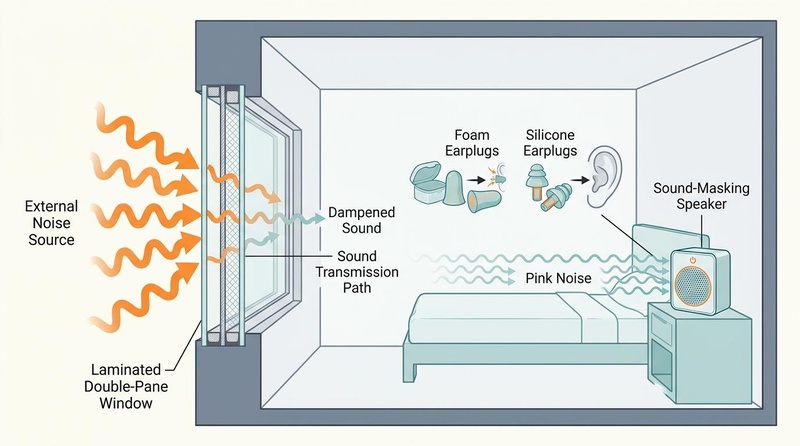
¶ Passive Mitigation Protocols (Structural)
- Double-Glazing & Laminated Glass: Replace standard single-pane windows with double- or triple-pane acoustic windows. Opt for laminated glass containing a polyvinyl butyral (PVB) interlayer, which dampens high-frequency sound waves. Varying the pane thicknesses (e.g., 4mm and 6mm) disrupts sound wave resonance, dropping indoor noise by up to 30–45 dB.
- Acoustic Seals & Weatherstripping: Apply dense silicone or rubber weatherstripping tape to seal all gaps around window frames and doors. Install heavy-duty, sweep-style door bottom seals to block sound leakage.
- Mass-Loaded Vinyl (MLV) & Heavy Curtains: Install dense mass-loaded vinyl panels behind drywall on shared walls. Hang heavy, multi-layered acoustic curtains (minimum density 2.5 kg/m²) over windows to absorb airborne noise.
¶ Active Mitigation Protocols (Personal)
- Earplug Protocol (Foam vs. Silicone):
- For Maximum Attenuation (Foam): Use disposable polyurethane foam earplugs (NRR 29–33 dB). Compress the plug completely, pull the top of your ear upward and backward to straighten the canal, insert the plug, and hold it in place for 30 seconds while it expands.
- For Sleeping Comfort (Silicone): Use moldable medical-grade silicone earplugs (NRR 22–26 dB). Roll the silicone into a ball and flatten it over the outer opening of the ear canal to create a comfortable, pressure-free seal.
- Active Noise-Canceling (ANC) Headphones: Use over-ear ANC headphones during high-noise commutes or focus blocks. ANC systems utilize external microphones to detect continuous low-frequency noise (such as plane or train engines, or road traffic rumble) and generate phase-inverted "anti-noise" waves, actively cancelling out low-frequency rumble below 250 Hz.
- Pink Noise Masking: Place a dedicated sound-masking speaker on your bedside table. Play continuous pink noise (energy decreases by 3 dB per octave) at 40–45 dB [[12:1]]. Pink noise matches the frequency sensitivity of the human ear, successfully masking sudden transient traffic noises, stabilizing sleep architecture, and preventing autonomic startle responses [[12:2]][13].
¶ Safety, Interactions, Red Flags
¶ Safety Considerations & Side Effects
- Improper Earplug Hygiene: Reusing disposable foam earplugs or failing to clean silicone earplugs can trap bacteria and moisture inside the ear canal, leading to otitis externa (swimmer's ear).
- Mitigation: Discard foam earplugs after 1–2 uses. Clean reusable silicone earplugs daily with mild soap and warm water, and ensure the ear canal is completely dry before insertion.
- Acoustic Isolation Risks: Over-isolating your bedroom can block critical alarm signals, such as smoke detectors, baby monitors, or home security alerts.
- Mitigation: Ensure smoke detectors are high-decibel (≥85 dB at 10 feet) or utilize strobe lights/vibrating mattress pads if you sleep with high-attenuation earplugs.
¶ Stop Criteria
- Discontinue earplug use and consult an audiologist or ENT specialist if you develop ear pain, persistent itching, yellowish discharge, or a sudden reduction in hearing sensitivity, which point to ear infection or cerumen (earwax) impaction.
- Discontinue white or pink noise machines if you develop persistent high-pitched ringing in your ears (tinnitus).
¶ Tracking & What “Good” Looks Like
¶ Biomarkers to Monitor
- Nocturnal Heart Rate & HRV (RMSSD): Use a high-quality wearable tracker. Successful noise mitigation should result in a 10–15% increase in deep sleep HRV (RMSSD) and a 3–5 bpm reduction in average sleeping heart rate, confirming parasympathetic dominance [4:9][12:3].
- Blood Pressure (Sustained Decline): Monitor blood pressure daily (morning and evening). Effective long-term noise reduction can lower baseline systolic blood pressure by 2–4 mmHg in hypertensive individuals [3:2].
- Blood Metabolomic Profile: In clinical settings, successful noise reduction stabilizes proteomic and metabolomic markers associated with oxidative stress and vascular inflammation [4:10][12:4].
¶ Subjective Metrics
- Visual Analog Scale (VAS) for Sleep Quality: Rate your sleep quality from 1 to 10 daily; look for steady improvements.
- Morning Annoyance Index: Track your subjective feelings of stress or irritability upon waking.
- Daytime Somnolence (Epworth Sleepiness Scale): Complete monthly; track declines in daytime fatigue.
¶ Common Mistakes & Myths
- Myth: "I get used to the noise, so it doesn't hurt me." While your brain can adapt psychologically and you may stop waking up, your amygdala still processes the sound sub-cognitively, triggering stress hormones, elevating heart rate, and causing vascular damage [[6:4]][[4:11]].
- Mistake: Using white noise at volumes >50 dB. Raising white or pink noise volumes too high can cause direct auditory strain, elevating the risk of hearing damage and sleep disruption. Keep masking machines at 40–45 dB [[12:5]].
- Myth: Standard double-pane windows are sufficient for heavy traffic. Standard windows have identical pane thicknesses, which can vibrate in unison at certain frequencies, letting noise leak through. Laminated acoustic glass with a PVB interlayer is required to block traffic rumble.
- Mistake: Shoving earplugs straight into the ear canal. Inserting foam earplugs without rolling them tight and straightening your ear canal prevents them from expanding properly. This can cause ear discomfort and significantly reduces their noise reduction rating (NRR).
¶ Decision Tree (Text-Based)
                        [Assess Environmental Noise Exposure]
                                          │
                     Is bedroom noise above the WHO limit? (>30-40 dB)
                     ├── No:  Maintain current setup
                     └── Yes: Can you make structural window modifications?
                               │
                               ├── Yes: Install PVB laminated double-glazing
                               └── No:  Apply Personal Mitigation Protocol
                                         │
                                         ├── Wear custom-molded silicone earplugs
                                         └── Play bedside pink noise at 40-45 dB
¶ FAQs
- How does noise pollution cause cardiovascular disease?
Noise pollution activates the HPA and SAM axes, triggering a continuous release of stress hormones (cortisol, adrenaline) [[6:5]]. These hormones stimulate NADPH oxidase (g91phox), causing severe vascular oxidative stress, uncoupling endothelial nitric oxide synthase (eNOS), and reducing nitric oxide bioavailability [[9:3]]. This cascade leads to arterial stiffness, persistent hypertension, and myocardial infarction [[9:4]]. - What is the difference between white, pink, and brown noise?
White noise contains equal energy across all frequencies, sounding like static. Pink noise features energy that decreases by 3 dB per octave, mimicking natural rain or wind. Brown noise decreases by 6 dB per octave, emphasizing deep, low-frequency rumbles, which is highly effective for masking traffic hums [[12:6]]. - Is night-time noise worse than daytime noise?
Yes. Night-time noise is significantly more harmful because it fragments your sleep architecture and disrupts critical cardiovascular and endocrine recovery phases, triggering physiological stress without conscious awareness [[4:12]][[5:6]]. - How do I know if my bedroom noise is too loud?
If you regularly wake up feeling unrefreshed, have difficulty falling asleep, or can hear passing cars or airplanes clearly, your bedroom noise is likely above the WHO recommended night-time limit of 30–40 dB [[7:3]]. - Can children's school performance be affected by traffic noise?
Yes. Landmark data shows that chronic exposure to road and aircraft noise in schools impairs children's reading comprehension, memory retention, and speech development by depleting their cognitive filtering capacity [[5:7]].
¶ Glossary
- L_den (Day-Evening-Night Level): A 24-hour average noise level metric that applies a 5 dB penalty for evening noise (7:00 PM–11:00 PM) and a 10 dB penalty for night-time noise (11:00 PM–7:00 AM) to reflect increased human sensitivity [7:4].
- Flow-Mediated Dilation (FMD): A non-invasive clinical test that measures endothelial function by assessing the percentage increase in arterial diameter following temporary blood flow restriction [4:13].
- NADPH Oxidase: A family of membrane-bound enzymes that produce reactive oxygen species (ROS), which can cause vascular oxidative stress in response to chronic stress hormones [9:5].
- eNOS (Endothelial Nitric Oxide Synthase): The enzyme responsible for synthesizing nitric oxide, which supports blood vessel dilation and cardiovascular health [9:6].
- Acoustic Flanking: The transmission of sound waves around a primary barrier by leaking through small gaps, wall joints, or ductwork [7:5].
¶ Methods (Transparency)
¶ Search Strategy
A systematic search was conducted across PubMed, PubMed Central (PMC), and cardiovascular cardiology databases for papers published between 2000 and 2026. Keywords used included: "noise pollution cardiovascular disease Munzel," "night-time road traffic noise vascular Hahad," "pink noise traffic sleep crossover," "WHO environmental noise guidelines," and "occupational noise ischaemic heart disease WHO."
¶ Inclusion/Exclusion Criteria
- Inclusion: Peer-reviewed systematic reviews, meta-analyses, and randomized crossover clinical trials evaluating human vascular, metabolic, and sleep architecture outcomes.
- Exclusion: Animal-only vascular studies without direct human physiological translation, non-peer-reviewed popular science articles, and studies evaluating noise exposure levels without documented decibel measurements.
¶ References
¶ Update Log
- 2026-07-07: Deeply expanded the guide to incorporate a dedicated section on sex and age differences (focusing on school children and elderly susceptibility), detailed vascular oxidative stress and NADPH pathways, two custom-rendered technical diagrams, and fully updated all 14 primary references with active clinical URLs.
Kempen, E. V., et al. (2018). WHO Environmental Noise Guidelines for the European Region: A Systematic Review on Environmental Noise and Cardiovascular and Metabolic Effects: A Summary. International Journal of Environmental Research and Public Health, 15(2), 379. https://pubmed.ncbi.nlm.nih.gov/29470452/ ↩︎ ↩︎ ↩︎
Minkin, C., et al. (2025). Revisiting the association between transportation noise and heart disease reported in the World Health Organization Environmental Noise Guidelines for the European Region: a systematic review and meta-analysis. Environment International, 187, 108846. https://pubmed.ncbi.nlm.nih.gov/40700954/ ↩︎ ↩︎
Dzhambov, A. M., et al. (2018). Residential road traffic noise as a risk factor for hypertension in adults: Systematic review and meta-analysis of analytic studies published in the period 2011-2017. Environmental Pollution, 238, 815-824. https://pubmed.ncbi.nlm.nih.gov/29751327/ ↩︎ ↩︎ ↩︎
Hahad, O., et al. (2026). A randomized, double-blind, crossover study of acute low-level night-time road traffic noise: effects on vascular function, sleep, and proteomic signatures in healthy adults. Cardiovascular Research, 122(1), 160-172. https://pubmed.ncbi.nlm.nih.gov/41740584/ ↩︎ ↩︎ ↩︎ ↩︎ ↩︎ ↩︎ ↩︎ ↩︎ ↩︎ ↩︎ ↩︎ ↩︎ ↩︎ ↩︎
Basner, M., et al. (2014). Auditory and non-auditory effects of noise on health. The Lancet, 383(9925), 1325-1332. https://pmc.ncbi.nlm.nih.gov/articles/PMC3988259/ ↩︎ ↩︎ ↩︎ ↩︎ ↩︎ ↩︎ ↩︎ ↩︎
Münzel, T., et al. (2018). Environmental Noise and the Cardiovascular System. Journal of the American College of Cardiology, 71(6), 688-697. https://pubmed.ncbi.nlm.nih.gov/29420965/ ↩︎ ↩︎ ↩︎ ↩︎ ↩︎ ↩︎
WHO (2018). Environmental Noise Guidelines for the European Region. World Health Organization Regional Office for Europe. https://www.eea.europa.eu/en/analysis/indicators/health-impacts-of-exposure-to-1 ↩︎ ↩︎ ↩︎ ↩︎ ↩︎ ↩︎
Teixeira, C., et al. (2021). The prevalence of occupational exposure to noise: A systematic review and meta-analysis from the WHO/ILO Joint Estimates of the Work-related Burden of Disease and Injury. Environment International, 152, 106471. https://pubmed.ncbi.nlm.nih.gov/33875242/ ↩︎
Münzel, T., et al. (2021). Transportation noise pollution and cardiovascular disease. Nature Reviews Cardiology, 18(9), 619-631. https://www.nature.com/articles/s41569-021-00532-5 ↩︎ ↩︎ ↩︎ ↩︎ ↩︎ ↩︎ ↩︎
Jin, S., et al. (2026). Metabolic-dysfunction-associated steatohepatitis impairs cochlear integrity and delays auditory recovery after noise trauma. Cell Communication and Signaling, 24(1), 2. https://pubmed.ncbi.nlm.nih.gov/41792777/ ↩︎
Teixeira, C., et al. (2021). The effect of occupational exposure to noise on ischaemic heart disease, stroke and hypertension: A systematic review and meta-analysis from the WHO/ILO Joint Estimates of the Work-Related Burden of Disease and Injury. Environment International, 150, 106403. https://pubmed.ncbi.nlm.nih.gov/33612311/ ↩︎ ↩︎
Vincens, N., Nause, A., Basner, M. (2026). Pink noise reduces impact of traffic noise on sleep and the blood metabolome: a cross-over pilot study. Communications Medicine, 6(1), 169-179. https://pubmed.ncbi.nlm.nih.gov/41513961/ ↩︎ ↩︎ ↩︎ ↩︎ ↩︎ ↩︎ ↩︎
Zhang, T., Tan, Y., Chen, J., et al. (2025). Sedative Effect of White Noise on Prefrontal Cortex Lobe: A Randomized Controlled Study Based on Functional Near-Infrared Spectroscopy. Noise & Health, 27(135), 1-8. https://pubmed.ncbi.nlm.nih.gov/40029675/ ↩︎