¶ Nutrition Starter Kit (1 week)
Minimum Effective Dose
Build meals around protein + plants, and make minimally processed foods the default to establish a robust metabolic baseline.
¶ Layer 1: The Executive Dashboard
¶ At a Glance
A clean, repeatable nutrition baseline is the single most effective lever for optimizing healthspan, preventing chronic disease, and protecting lean skeletal muscle mass. By prioritizing protein adequacy, boosting dietary fiber, choosing minimally processed whole food matrices, and aligning meal timing with circadian rhythms, this guide provides a practical, seven-day protocol designed to transition any individual into a sustainable baseline.
¶ Safety "Traffic Light"
- Red Light (Absolute Contraindications):
- Advanced Chronic Kidney Disease (CKD Stages 3–5): High-protein protocols (>0.8 g/kg/day) are contraindicated due to the risk of accelerating renal function decline. Protein must be restricted to 0.55–0.60 g/kg/day under clinical supervision.[1]
- Active Eating Disorders: Rigid meal windows and precise macronutrient tracking can trigger or exacerbate anorexia nervosa, bulimia, or orthorexia.
- Yellow Light (Precautions & Monitoring):
- Diabetes Mellitus on Hypoglycemic Medications: Shifting eating windows (time-restricted eating) or changing carbohydrate loading requires careful glucose monitoring and potential medication adjustments to avoid severe hypoglycemia.[2][3]
- Acute Gastrointestinal Flares: Rapidly increasing fiber intake during active inflammatory bowel disease (IBD) flares or severe dysbiosis can cause severe mechanical irritation and bloating.[4]
- Green Light (Safe Baselines):
- Healthy Adults: Safe and highly protective for metabolic health, insulin sensitivity, and lean muscle preservation.
| Intervention Pillar | Daily Baseline Target | Clinical Timing & Administration |
|---|---|---|
| Protein Adequacy | 1.2–1.6 g/kg/day[2:1] | Distributed evenly as 30–40 g per meal across 3–4 meals to saturate muscle protein synthesis (MPS) pathways.[5][6][7] |
| Dietary Fiber | 25–35 g/day[8] | Titrated gradually (increase by 5 g/day every 3 days) with concurrent fluid intake of ≥2 L/day to mitigate gastrointestinal distress.[4:1] |
| Minimal Processing | ≥80% of calories from whole foods | Prioritize NOVA Classification Category 1 & 2 foods, minimizing Category 4 ultra-processed foods (UPFs).[9] |
| Meal Structure | 10–12 hour eating window | Early Time-Restricted Eating (eTRE; ending eating by 6:00 PM) with a high-protein breakfast (~30-40 g).[10][3:1][11][12] |
¶ Bottom Line
Consistently integrating adequate protein (~1.2–1.6 g/kg/day), high fiber (~25–35 g/day), and whole food matrices into a structured eating window forms a powerful foundation for preventing chronic disease, optimizing body composition, and supporting long-term metabolic health.[2:2][8:1][13][9:1][10:1]
¶ Layer 2: The Contextual Narrative
¶ The "Why" (Benefits First)
- Lean Mass Preservation & Sarcopenia Prevention: High dietary protein provides essential branched-chain amino acids (particularly leucine) that activate the mechanistic target of rapamycin complex 1 (mTORC1) pathway, driving skeletal muscle protein synthesis and countering age-related muscle loss.[2:3][5:1][14]
- Cardiovascular and All-Cause Mortality Reduction: High dietary fiber intake lowers circulating low-density lipoprotein (LDL) cholesterol by binding bile acids in the gut and reduces systemic chronic inflammation, leading to a 15–30% reduction in cardiovascular events and all-cause mortality.[8:2][4:2][15]
- Satiety and Energy Regulation: Avoiding ultra-processed foods (UPFs) prevents the ad libitum (at-will) overconsumption driven by high energy density, hyper-palatability, and disrupted gut-brain satiety signaling.[13:1][9:2]
- Glycemic Control and Circadian Harmony: Shifting carbohydrate and food consumption earlier in the day and establishing a high-protein breakfast improves postprandial glucose variability, enhances glucagon-like peptide-1 (GLP-1) secretion, and aligns peripheral metabolic clocks.[10:2][3:2][12:1]
¶ Reality Check / Context
- Human Reality vs. Mouse Hopes: Clinical evidence in humans strongly confirms these benefits. For example, Kevin Hall's landmark inpatient randomized controlled trial (RCT) demonstrated that ultra-processed diets lead to an immediate ad libitum intake excess of ~508 kcal/day compared to matched unprocessed diets, resulting in rapid weight gain.[13:2]
- Bioavailability and Food Sources: Bioavailability of amino acids from animal-based proteins is higher (Digestible Indispensable Amino Acid Score [DIAAS] >100) compared to plant-based proteins (DIAAS 50–80). Plant-based proteins require larger portion sizes or specific combinations (e.g., legumes + grains) to match leucine thresholds (~3 g/meal). Dietary fiber must be consumed as whole-food matrices rather than isolated fibers to preserve prebiotic benefits and glycemic dampening.
- Commercial Context & "Health Washing": Many commercially-marketed "high protein" processed bars are high in added sugars, saturated fats, and artificial emulsifiers, which can disrupt the gut microbiome. Whole protein sources (eggs, fish, poultry, tofu, Greek yogurt) are the preferred default.
¶ Practical Integration & Actionable Routines
¶ The Plate Template
To simplify meal preparation, utilize the following visual guide for major meals:
- ½ Plate: Non-starchy vegetables (cruciferous, leafy greens, peppers, zucchini) or whole fruits.
- ¼ Plate: High-quality protein (chicken, turkey, wild fish, tofu, tempeh, eggs).
- ¼ Plate: Complex, fiber-rich carbohydrates (oats, quinoa, brown rice, black beans, lentils, sweet potatoes).
- Fat dressings: Healthy lipids (extra virgin olive oil, avocado, raw nuts, pumpkin seeds) used as accents rather than volume.
¶ Grocery Defaults (The 10 Essential Items)
Keep these staples on hand to guarantee metabolic alignment:
- Eggs: Versatile, highly bioavailable protein source rich in choline.
- Plain Greek Yogurt / Skyr: Excellent high-protein, low-fat source containing probiotics.
- Wild Salmon or Sardines (Canned/Fresh): High protein combined with anti-inflammatory omega-3 fatty acids (EPA/DHA).
- Tofu or Tempeh: Versatile, plant-based proteins with complete amino acid profiles.
- Broccoli or Brussels Sprouts: High-fiber cruciferous vegetables supporting detoxification pathways.
- Berries (Blueberries/Raspberries): Low-glycemic, high-fiber, and polyphenol-rich fruits.
- Rolled Oats: Rich in beta-glucans, a soluble fiber that improves cholesterol profiles.
- Black Beans or Lentils: Dual-action staples offering high protein and high fiber.
- Extra Virgin Olive Oil: Monounsaturated fats supporting cardiovascular markers.
- Mixed Raw Nuts (Almonds/Walnuts): Perfect grab-and-go healthy fat and fiber snack.
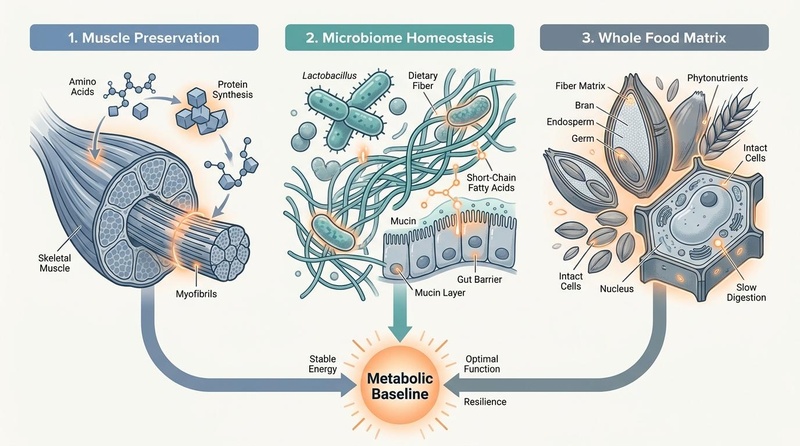
Figure 1: The Triad of Metabolic Nutrition. Muscle preservation (protein adequacy), microbiome homeostasis (dietary fiber), and natural food matrices (minimally processed foods) cooperate to establish a robust metabolic baseline.
¶ Actionable 7-Day Transition Plan
| Day | Protocol Routine | Practical Execution Tip |
|---|---|---|
| Day 1 | Establish Breakfast Default | Buy eggs, Greek yogurt, or protein powder. Set a goal of 30g protein for breakfast. |
| Day 2 | Audit Food Processing (NOVA) | Check pantry labels. Replace one packaged snack with whole foods (e.g., mixed nuts or berries). |
| Day 3 | Integrate Protein-Forward Lunch | Add 150g of chicken breast, wild salmon, or tofu to your lunch. |
| Day 4 | Introduce Fiber-Forward Dinner | Add ½ cup of black beans, lentils, or a large serving of roasted broccoli to your dinner plate. |
| Day 5 | Consolidate the Eating Window | Shift your last meal of the day to end by 6:30 PM, aiming for a 12-hour overnight fast. |
| Day 6 | Fluid Optimization | Ensure you drink at least 2.5 liters of water to support increased fiber excretion. |
| Day 7 | Metabolic Audit & Baseline Check | Evaluate satiety levels, sleep quality, and digestive comfort. Note and adjust outliers. |
¶ Layer 3: The Evidence Room
¶ Mechanism of Action
- Leucine-mTORC1 Pathway: Skeletal muscle protein synthesis is heavily regulated by intracellular amino acid concentrations, particularly leucine. Leucine acts as a direct molecular ligand for Sestrin2. Upon binding, Sestrin2 dissociates from GATOR2, which subsequently activates the Rag GTPases, recruiting and activating the mechanistic target of rapamycin complex 1 (mTORC1) on the lysosomal membrane. This triggers the phosphorylation of p70S6K and 4E-BP1, initiating muscle translation and preventing muscle proteolysis.[5:2][13:3]
- Microbial SCFA Production: Anaerobic fermentation of dietary fibers (pectin, cellulose, inulin) by gut microbiota (e.g., Bifidobacterium, Faecalibacterium prausnitzii) produces short-chain fatty acids (SCFAs), predominantly acetate, propionate, and butyrate. These SCFAs bind to G-protein coupled receptors 41 and 43 (GPR41/43) on enteroendocrine L-cells. This signaling cascade stimulates the release of glucagon-like peptide-1 (GLP-1) and peptide YY (PYY), which cross the blood-brain barrier to act on the arcuate nucleus of the hypothalamus, inducing satiety and improving peripheral insulin sensitivity.[4:3][15:1]
- The Food Matrix and Gastric Emptying: Intact physical structures in whole foods contain a complex matrix of cell walls, fibers, and nutrients. This structural integrity delays mechanical digestion, slow gastric emptying, and limits the accessibility of digestive enzymes to carbohydrates. Consequently, glucose is absorbed slowly and evenly across the length of the small intestine, flattening postprandial glycemic and insulinemic spikes compared to processed counterparts.[13:4][9:3]
- Peripheral Circadian Clock Synchronization: Food consumption acts as a dominant non-photic zeitgeber (time-giver) for peripheral circadian clocks in metabolic organs (liver, pancreas, skeletal muscle). Restricting food intake to an early window and consuming protein-forward meals in the morning activates AMP-activated protein kinase (AMPK) and SIRT1, which phosphorylate and synchronize clock proteins (BMAL1, CLOCK, PER, CRY), improving glucose tolerance and lipid clearance.[10:3][3:3][11:1][12:2]
¶ Evidence & Science: Human Outcomes
¶ Evidence Summary Table (Human Outcomes)
| Outcome | Physiological Effect | Certainty / Quality (GRADE) | Study Count & Design | Notes & Key Findings |
|---|---|---|---|---|
| Lean Mass Preservation | Lean body mass protected during caloric restriction or aging. | High | >50 RCTs, NuAge cohort study[6:1], Bhasin RCT[14:1] | Even protein distribution (30–40 g/meal) optimizes muscle protein synthesis via mTORC1 pathway.[2:4][5:3][7:1] |
| Cardiovascular Mortality Reduction | 15–30% decrease in CVD events and mortality. | High | PREDIMED trial[16], 2019 Lancet meta-analysis[8:3] | Optimal benefits seen at dietary fiber intakes of 25–29 g daily; linear dose-response beyond 30 g.[4:4] |
| Ad Libitum Caloric Regulation | Spontaneous calorie reduction of ~500 kcal/day. | High | Kevin Hall inpatient crossover RCT[13:5], 2025 Lancet review[9:4] | Ultra-processed food matrices bypass satiety centers, inducing hyperphagia despite identical nutrient presentations.[13:6] |
| Glycemic Optimization | Reduced postprandial glucose variability and improved HbA1c. | Moderate | Multiple RCTs (Yu 2025[10:4], Tsameret 2026[3:4], Tricò 2024[12:3]) | Consuming high-protein breakfasts and early restricted carbs improves nocturnal glucose control and increases GLP-1.[3:5] |
¶ Comprehensive Safety & Toxicology
¶ High Protein Clearance and Renal Function
There is no evidence that high protein intake (up to 2.0 g/kg/day) damages renal function in healthy adults with normal baseline kidney performance. However, in patients with pre-existing stage 3-5 Chronic Kidney Disease (CKD), the kidneys exhibit a compromised glomerular filtration rate (GFR). Elevated nitrogenous waste from protein metabolism increases intraglomerular pressure, accelerating nephron hyperfiltration and sclerosis. Thus, protein restriction (0.55–0.60 g/kg/day) is mandatory in this subgroup.[1:1]
¶ Gastrointestinal Adaptation to Fiber Pacing
Introducing large amounts of dietary fiber too rapidly can overwhelm the metabolic capacity of the gut microbiome, leading to excessive gas production (hydrogen, methane), abdominal distension, severe cramping, and constipation. This is mitigated by escalating fiber intake in 5 g increments every 3 days and ensuring water intake is maintained above 2.5 liters daily to facilitate bulk flow and prevent fecal impaction.[4:5][15:2]
¶ Pharmacological and Nutrient Interactions
- Levothyroxine (Thyroid Hormone): Soluble fibers (e.g., psyllium, beta-glucan) can physically adsorb thyroid hormones in the digestive tract, significantly reducing bioavailability. Patients should take levothyroxine on an empty stomach at least 60 minutes before consuming fiber-rich meals.
- Digoxin and Statin Medications: High-viscosity fibers can delay or decrease the absorption of cardiac glycosides and certain HMG-CoA reductase inhibitors (statins). Spacing medication administration 2 hours apart from high-fiber foods is recommended.
¶ Troubleshooting, Quick Wins, & Common Mistakes
¶ Common Mistakes & Myths
- Myth: "All proteins are equal": Plant proteins often lack specific essential amino acids (such as leucine, methionine, or lysine). Vegan protocols must increase portion sizes or utilize supplemental essential amino acids (EAAs) to trigger muscle protein synthesis.
- Myth: "Net carbs make whole foods safe": Added fiber in processed foods does not replicate the metabolic benefits of an intact, natural food matrix.
- Mistake: Skipping breakfast on time-restricted eating: Skipping breakfast and eating late into the evening (late time-restricted eating) is metabolically inferior to early time-restricted eating, as insulin sensitivity naturally declines as the day progresses.[10:5][3:6][11:2]
¶ Decision Tree (Text-Based Flow)
- Is GFR <60 mL/min/1.73m² (CKD Stage 3-5)?
- Yes: Limit protein strictly to 0.55–0.60 g/kg/day. Do NOT follow the high-protein baseline.[1:2]
- No: Proceed to Step 2.
- Do you have a history of eating disorders or clinical orthorexia?
- Yes: Avoid strict meal window tracking and dietary calculations. Focus on intuitive, whole-food choices.
- No: Proceed to Step 3.
- Are you taking insulin or sulfonylureas for Diabetes?
- Yes: Restricting meal timing requires close clinical supervision and medication adjustment.
- No: Implement the standard starter kit protocol (1.2–1.6 g/kg/day protein, 25–35 g/day fiber, 10–12h eTRE window).
¶ Practical FAQ
¶ Can I meet my protein targets entirely from plant sources?
Yes. However, because plant proteins have lower concentrations of essential amino acids and lower digestibility scores, plant-based individuals must consume approximately 10–20% more total protein by volume and pair complementary sources (e.g., pea protein and rice protein) to reach leucine thresholds (~3 g/meal).
¶ What should I do if time-restricted eating causes poor sleep?
If early time-restricted eating causes nocturnal awakenings or elevated evening cortisol, widen the eating window. Consuming a small, low-glycemic, protein-rich snack (such as casein or pumpkin seeds) 90 minutes before bed can stabilize nocturnal blood glucose without disrupting peripheral clocks.
¶ How do I measure my progress during this week?
Track subjective parameters including morning hunger, postprandial fatigue (the "food coma" effect), sleep latency, and digestive comfort. Biomarkers such as fasting glucose, HbA1c, and lipid panels (ApoB, triglycerides) can be measured before and after 8–12 weeks of maintaining this baseline.
¶ References
Ikizler TA, Burrowes JD, Byham-Gray LD, et al. KDOQI Clinical Practice Guideline for Nutrition in CKD: 2020 Update. Am J Kidney Dis. 2020;76(3 Suppl 1):S1-S107. https://pubmed.ncbi.nlm.nih.gov/32829751/ ↩︎ ↩︎ ↩︎
Bauer J, Biolo G, Cederholm T, et al. Evidence-based recommendations for optimal dietary protein intake in older people: a position paper from the PROT-AGE Study Group. J Am Med Dir Assoc. 2013;14(8):542-559. https://pubmed.ncbi.nlm.nih.gov/23867520/ ↩︎ ↩︎ ↩︎ ↩︎ ↩︎
Tsameret S, Froy O, Matz Y, et al. Glycaemic, appetite and circadian benefits of a dairy-enriched diet with high-protein breakfast and early daytime-restricted carbohydrate intake in type 2 diabetes: a randomised crossover trial. Diabetologia. 2026;69(4):715-728. https://pubmed.ncbi.nlm.nih.gov/41578008/ ↩︎ ↩︎ ↩︎ ↩︎ ↩︎ ↩︎ ↩︎
Veronese N, Gianfredi V, Solmi M, et al. The impact of dietary fiber consumption on human health: An umbrella review of evidence from 17,155,277 individuals. Clin Nutr. 2025;44(8):102345. https://pubmed.ncbi.nlm.nih.gov/40651334/ ↩︎ ↩︎ ↩︎ ↩︎ ↩︎ ↩︎
Schoenfeld BJ, Aragon AA. How much protein can the body use in a single meal for muscle-building? Implications for daily protein distribution. J Int Soc Sports Nutr. 2018;15:10. https://pubmed.ncbi.nlm.nih.gov/29497353/ ↩︎ ↩︎ ↩︎ ↩︎
Farsijani S, Morais JA, Payette H, et al. Relation between mealtime distribution of protein intake and lean mass loss in free-living older adults of the NuAge study. Am J Clin Nutr. 2016;104(3):694-703. https://pubmed.ncbi.nlm.nih.gov/27465379/ ↩︎ ↩︎
Hudson JL, Bergia RE 3rd, Campbell WW. Protein Distribution and Muscle-Related Outcomes: Does the Evidence Support the Concept? Nutrients. 2020;12(5):1441. https://pubmed.ncbi.nlm.nih.gov/32429355/ ↩︎ ↩︎
Reynolds A, Mann J, Cummings J, et al. Carbohydrate quality and human health: a series of systematic reviews and meta-analyses. Lancet. 2019;393(10170):434-445. https://pubmed.ncbi.nlm.nih.gov/30638909/ ↩︎ ↩︎ ↩︎ ↩︎
Monteiro CA, Louzada ML, Steele-Martinez E, et al. Ultra-processed foods and human health: the main thesis and the evidence. Lancet. 2025;406(10519):2112-2125. https://pubmed.ncbi.nlm.nih.gov/41270766/ ↩︎ ↩︎ ↩︎ ↩︎ ↩︎
Yu Z, Ueda T. Early Time-Restricted Eating Improves Weight Loss While Preserving Muscle: An 8-Week Trial in Young Women. Nutrients. 2025;17(6):1024. https://pubmed.ncbi.nlm.nih.gov/40290077/ ↩︎ ↩︎ ↩︎ ↩︎ ↩︎ ↩︎
Petridi F, Geurts JMW, Nyakayiru J, et al. Effects of Early and Late Time-Restricted Feeding on Parameters of Metabolic Health: An Explorative Literature Assessment. Nutrients. 2024;16(11):1654. https://pubmed.ncbi.nlm.nih.gov/38892654/ ↩︎ ↩︎ ↩︎
Tricò D, Masoni MC, Baldi S, et al. Early time-restricted carbohydrate consumption vs conventional dieting in type 2 diabetes: a randomised controlled trial. Diabetologia. 2024;67(2):294-304. https://pubmed.ncbi.nlm.nih.gov/37971503/ ↩︎ ↩︎ ↩︎ ↩︎
Hall KD, Ayuketah A, Brychta R, et al. Ultra-Processed Diets Cause Excess Calorie Intake and Weight Gain: An Inpatient Randomized Controlled Trial of Ad Libitum Food Intake. Cell Metab. 2019;30(1):67-77.e3. https://pubmed.ncbi.nlm.nih.gov/31105044/ ↩︎ ↩︎ ↩︎ ↩︎ ↩︎ ↩︎ ↩︎
Bhasin S, Apovian CM, Travison TG, et al. Effect of Protein Intake on Lean Body Mass in Functionally Limited Older Men: A Randomized Clinical Trial. JAMA Intern Med. 2018;178(4):530-541. https://pubmed.ncbi.nlm.nih.gov/29532075/ ↩︎ ↩︎
Reynolds AN, Akerman A, Kumar S, et al. Dietary fibre in hypertension and cardiovascular disease management: systematic review and meta-analyses. BMC Med. 2022;20(1):139. https://pubmed.ncbi.nlm.nih.gov/35449060/ ↩︎ ↩︎ ↩︎
Estruch R, Ros E, Salas-Salvadó J, et al. Primary Prevention of Cardiovascular Disease with a Mediterranean Diet Supplemented with Extra-Virgin Olive Oil or Nuts. N Engl J Med. 2018;378(25):e34. https://pubmed.ncbi.nlm.nih.gov/29897866/ ↩︎