¶ Purpose and Longevity
A robust sense of purpose in life is one of the most powerful and consistent predictors of human longevity. Epidemiological, neurobiological, and clinical cohorts show that having a strong direction in life significantly reduces all-cause mortality, shields the cardiovascular system, and directly protects against cellular and epigenetic aging. Far from being an abstract psychological concept, purpose serves as a central organizing force for human physiology.
¶ At a Glance
- Longevity Verdict: Prospective cohort studies comprising hundreds of thousands of adults demonstrate that individuals with a high sense of purpose have a 20% to 40% reduction in all-cause mortality over 8- to 10-year follow-up periods compared to those with low purpose[1][2][3].
- Physiological Core: Modulates autonomic nervous system (ANS) and endocrine balance, resulting in lower systemic inflammation (reduced IL-6, CRP), decreased cortisol reactivity, and enhanced vagal tone[4][5][6].
- Cellular Protection: High purpose is associated with significantly slower epigenetic age acceleration (measured via GrimAge and PhenoAge clocks) and preserved leukocyte telomere length, signaling slowed biological aging at the molecular level[7][8][9].
- Cognitive Reserve: Strongly preserves executive function and delays the clinical onset of Alzheimer's disease and mild cognitive impairment (MCI). Individuals with high purpose remain cognitively intact even in the presence of extensive post-mortem amyloid and tau neuropathology[10][11].
- Highly Actionable: Purpose is not a static trait; structured, iterative cognitive and behavioral practices can measurably strengthen purpose and its downstream biological benefits across all age groups.
¶ Autonomic, Behavioral & Clinical Alignment
| Priority | Risk Category | Operational Parameter | Action / Avoidance |
|---|---|---|---|
| GREEN | Optimized Vagal Activity | Daily resting Heart Rate Variability (HRV) showing high parasympathetic tone; PHQ-9 score < 5. | Engaging in daily prosocial activities, values-aligned work, and structured volunteering. |
| YELLOW | Systemic Strain & Ambivalence | Elevating inflammatory markers (hs-CRP > 1.0 mg/L); PHQ-9 score 5–9 (mild depressive symptoms). | Mitigate high-conflict relationships; deploy values-clarification exercises and scale down vocational load. |
| RED | Existential Void & Clinical Depression | PHQ-9 score (clinical depression red flag); chronic perceived loneliness or sudden retirement identity loss. | Immediate clinical triage/psychological therapy, behavioral activation, and targeted legacy or community integration plans. |
¶ Purpose Activation Protocols
Strengthening eudaimonic purpose requires behavioral frameworks that bridge psychology with daily physical activity. The following multi-tiered protocols are designed to maximize neuroendocrine and cognitive benefit across different life stages.
¶ 1. Daily Autonomic Integration (Micro-Dosing Prosocial Behavior)
- The "Prosocial Prompt": Every morning, identify one simple task of micro-contribution (e.g., sending an appreciative message, mentoring a peer, or performing a small favor for a family member).
- Behavior Design (Fogg Model): Anchor this behavior to an established daily habit. Format: "After I pour my morning coffee [Prompt], I will send one brief text of appreciation to a colleague or friend [Behavior/Ability]"[12].
- Biological Target: Elevates salivary oxytocin and improves resting cardiac vagal tone, lowering early-morning HPA axis reactivity[13][14].
¶ 2. Weekly Values-Aligned Action (The Ikigai Alignment)
- Structured Activity: Commit to at least 2 to 4 hours per week of structured, non-vocational community engagement or skill-sharing (e.g., formal volunteering, coaching, community gardening).
- Evidence Basis: Prospective cohort data shows that regular volunteerism is associated with a 24% to 40% lower risk of all-cause mortality[15] and a significant reduction in pro-inflammatory leukocyte gene expression[14:1][16].
- Practical Execution: Choose activities where your specific skills (Ability) meet a clear societal need (Motivation) and schedule them as recurring calendar events (Prompt)[12:1].
¶ 3. Monthly Purpose Elicitation (The "Best Possible Self" Exercise)
- Visualization: Devote 20 minutes on the first Sunday of each month to write a detailed vision of your future self (5–10 years ahead), assuming all your efforts have succeeded and you are living your highest-impact, values-aligned life.
- Action Plan: Extract 2 concrete intermediate goals from this vision, map them to immediate lifestyle modifications, and integrate them into your calendar.
¶ Bottom Line
A clear sense of purpose acts as a central physiological organizing force. It coordinates neurovisceral circuits to buffer environmental stressors, preserve cellular longevity (telomeres and epigenetics), delay cognitive decline, and dramatically lower the risk of age-related systemic decay.
¶ The "Why" (Biopsychosocial Benefits)
¶ 1. Lifespan Extension and Mortality Risk Reduction
Large prospective cohort studies have consistently confirmed that the psychological asset of purpose is independently protective against mortality. In a landmark analysis of the U.S. Health and Retirement Study (HRS) involving older adults, individuals in the highest category of purpose in life had a significantly lower hazard ratio for all-cause mortality () compared to those in the lowest category over an 8-year period[1:1]. This protective effect persisted even after rigorously controlling for age, sex, race, education, baseline health status, and health behaviors. A comprehensive meta-analysis of over 136,000 individuals confirmed that higher purpose is associated with a 17% lower risk of all-cause mortality across diverse global demographics[3:1].
¶ 2. Slowed Molecular Aging (Epigenetics & Telomeres)
The biological mechanism of purpose-driven longevity reaches deep into our genomic regulatory systems:
- Epigenetic Deceleration: Individuals with a strong sense of purpose exhibit a younger biological age than their chronological counterparts. Specifically, longitudinal cohort data reveals that high purpose is linked to slower biological aging on second-generation epigenetic clocks, such as GrimAge and PhenoAge, which are highly predictive of mortality and clinical morbidity[7:1].
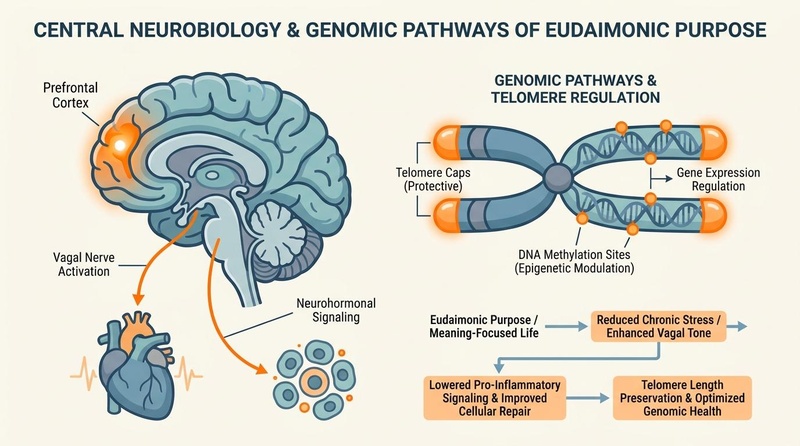
- Telomere Integrity: Telomeres are protective caps at the ends of chromosomes that shorten with cell division and chronic psychological stress. Meta-analyses demonstrate that high psychological well-being—specifically eudaimonic purpose—is robustly associated with longer leukocyte telomeres, indicating a deceleration of cellular senescence pathways[8:1][9:1].
¶ 3. Preservation of Cognitive Reserve & Delay of Dementia
A strong sense of purpose is a major driver of cognitive reserve, shielding the brain from the clinical manifestations of neurodegenerative disease:
- Incidence Reduction: Data from the Rush Memory and Aging Project shows that individuals with a high sense of purpose are 2.4 times more likely to remain free of Alzheimer's disease and mild cognitive impairment (MCI) compared to those with low purpose over a 7-year follow-up[10:1].
- Pathology Buffering: Post-mortem examinations reveal a striking neurobiological phenomenon: among individuals with equivalent, extensive Alzheimer's neuropathology (amyloid plaques and neurofibrillary tangles), those who had reported a high sense of purpose during life demonstrated significantly better cognitive function and executive control close to death[11:1]. Purpose effectively decouples physical neuropathology from clinical cognitive decline.
¶ 4. Cardiovascular and Neurovascular Protection
A high sense of purpose is highly cardioprotective. It is associated with a 20% to 35% reduced risk of cardiovascular events, including myocardial infarction and stroke[17][18]. Epidemiological data from cohorts like the English Longitudinal Study of Ageing (ELSA) and the Japanese Ikigai longitudinal cohorts demonstrate that individuals with high meaning are significantly less likely to develop coronary heart disease or succumb to cardiovascular-related death[19][20].
¶ Reality Check / Context
¶ Socioeconomic Confounders and Accessibility
While the epidemiological associations are clear, translating psychological purpose into clinical outcomes requires navigating several real-world confounders:
- Socioeconomic Confounding: Critics historically argued that a "sense of purpose" is merely a luxury of high socioeconomic status (SES). However, modern multi-cohort prospective analyses (including the Midlife in the United States [MIDUS] and ELSA cohorts) have controlled for income, wealth, and education, confirming that purpose remains a statistically significant, independent predictor of longevity across all socioeconomic strata[1:2][21].
- Eudaimonia vs. Hedonia: It is vital to separate eudaimonic well-being (purpose, self-actualization, contribution) from hedonic well-being (pleasure, comfort). While both correlate with subjective happiness, they possess starkly different biological profiles. Genomic transcriptomics show that eudaimonic well-being is associated with highly favorable gene expression (low inflammation, high antiviral defense), while hedonic well-being in the absence of eudaimonia is linked to a pro-inflammatory gene profile, similar to that seen under chronic stress[14:2].
- The Depressive/Non-Responder Reality: Some individuals struggle to cultivate purpose due to biological barriers (such as major depressive disorder or neurochemical deficits) or systemic socioeconomic constraints. In these cases, cognitive-behavioral therapies, mindfulness, and occupational transitions are necessary precursors to unlock the physiological benefits of purpose.
¶ Gender-Specific Realities in Longevity Pathways
The intersection of purpose, gender, and longevity reveals unique clinical challenges and protective pathways:
- Men and Retirement Shock: Men are demographically more vulnerable to "retirement shock"—a sudden, profound loss of structured purpose post-employment. Because men frequently tie their core identity and social connection to their vocational role, retirement is associated with a sharp spike in post-retirement mortality and rapid cognitive decline if not managed with structured transition plans.
- Women and Social Buffering: Women generally maintain broader, more expressive social networks which provide a resilient buffer for eudaimonic purpose across life transitions. However, women face significantly higher rates of caregiver-associated allostatic load (e.g., caring for parents or spouses), which can lead to chronic HPA axis activation and telomere erosion if not supported by structured community relief networks[16:1][22].
¶ Mechanism of Action
The translation of a psychological construct (purpose) into physical health (longevity) occurs through three primary physiological axes:
[Sense of Purpose]
       │
       ▼
[Prefrontal Cortex & Anterior Cingulate Regulation]
       │
       ├─────────────────────────────────┐
       ▼                                 ▼
[HPA Axis Buffering]             [Vagal Nerve Activation]
       │                                 │
       ▼                                 ▼
[↓ Cortisol Reactivity]          [↑ Heart Rate Variability]
       │                                 │
       └────────────────┬────────────────┘
                        ▼
            [Leukocyte Gene Regulation]
                        │
                        ▼
         [↓ Pro-inflammatory CTRA Profile]
                        │
                        ▼
          [Slowed Cellular Senescence]
¶ 1. Neurovisceral and Autonomic Modulation
The prefrontal cortex (PFC) and the anterior cingulate cortex (ACC) are heavily active in individuals with a high sense of purpose. These brain regions regulate the amygdala and orchestrate autonomic outputs via the vagus nerve (the neurovisceral integration model)[8:2][5:1]. High PFC activation downregulates sympathetic "fight-or-flight" pathways and upregulates parasympathetic "rest-and-digest" activity. This manifests as higher resting Heart Rate Variability (HRV) and enhanced vagal tone, protecting the sinoatrial node and vascular endothelium from chronic stress-induced damage[5:2][6:1].
¶ 2. HPA Axis and Endocrine Stabilization
Chronic stress keeps the Hypothalamic-Pituitary-Adrenal (HPA) axis hyperactive, leading to toxic diurnal cortisol profiles. Purpose acts as a cognitive buffer, altering threat appraisal. Individuals with higher purpose show a healthier Cortisol Awakening Response (CAR) and a more rapid clearance of cortisol after acute stressors, preventing the systemic insulin resistance, muscle wasting, and immune suppression caused by chronic glucocorticoid exposure[20:1][23]. Positive social feedback loops also stimulate the release of oxytocin, which accelerates autonomic vagal recovery and mitigates cortisol-induced tissue damage[13:1][14:3].
¶ 3. Transcriptional Inversion (The CTRA Profile)
The Conserved Transcriptional Response to Adversity (CTRA) is a molecular program in immune cells characterized by the upregulation of pro-inflammatory genes (e.g., IL-6, IL-1b) and the downregulation of genes involved in type I interferon antiviral responses and antibody synthesis[14:4][21:1].
- Pro-inflammatory suppression: Loneliness, stress, and existential distress trigger the CTRA via sympathetic nervous system signaling.
- Eudaimonic activation: High eudaimonic purpose suppresses CTRA gene expression. It drives a systemic reduction in circulating levels of Interleukin-6 (IL-6) and C-reactive protein (CRP) over multi-year periods, directly reducing the background "inflammaging" that drives cardiovascular disease, neurodegeneration, and metabolic decline[4:1][14:5].
¶ 4. Secular Spirituality and Default Mode Network (DMN) Downregulation
Spirituality, stripped of dogma, refers to a sense of awe, connectedness to nature, and feeling part of a larger whole.
- Neurological Basis: Experiences of awe and deep mindfulness downregulate activity in the brain's Default Mode Network (DMN), specifically the posterior cingulate cortex. This suppresses self-referential rumination, worry, and ego-centric anxiety.
- Proinflammatory Suppression: Direct clinical studies show that discrete eudaimonic emotions, particularly awe, are the strongest predictors of low systemic Interleukin-6 (IL-6) levels, providing a biological link between secular spiritual connection and reduced systemic inflammation[24].
¶ Human Evidence Matrix
The following table summarizes the primary prospective human cohort evidence connecting purpose in life to longevity, cognitive health, and biomarker profiles.
| Target Outcome | Hazard Ratio / Effect Size | GRADE Certainty | Cohort / Study Size | Duration | References | Key Clinical Findings |
|---|---|---|---|---|---|---|
| All-Cause Mortality | (CI: 0.67–0.85) | High | U.S. HRS () | 8 Years | [1:3] | Highest vs. lowest category of purpose shows a 24% survival benefit, independent of health behaviors and SES. |
| All-Cause Mortality | (CI: 0.75–0.91) | High | Meta-analysis () | 8.5 Years | [3:2] | Purpose was robustly protective against all-cause mortality across global populations, with an average 17% risk reduction. |
| Alzheimer's Disease | (CI: 0.20–0.86) | High | Rush MAP () | 7 Years | [10:2] | Older adults with high purpose are 2.4 times less likely to develop Alzheimer's disease or mild cognitive impairment. |
| Cognitive Pathology Buffer | Decoupled decline | Moderate | Post-mortem cohort () | Longitudinal | [11:2] | High purpose preserves executive function and memory close to death despite equivalent physical amyloid/tau pathology. |
| Epigenetic Age | years | Moderate | Longitudinal cohort () | 8 Years | [7:2] | High purpose is linked to slower biological aging on GrimAge and PhenoAge clocks, indicating a younger molecular profile. |
| Inflammation (CRP, IL-6) | (p < 0.01) | Moderate | Prospective cohort () | 6 Years | [4:2] | High purpose significantly predicts lower baseline and progressive inflammation, countering age-related inflammaging. |
| Leukocyte Gene Profiles | CTRA suppression | Moderate | Experimental genomic () | Cross-sectional | [14:6] | Eudaimonic well-being (purpose) specifically predicts downregulation of pro-inflammatory CTRA immune genes. |
| Telomere Integrity | (p < 0.01) | Moderate | Meta-analysis ( studies) | Cross-sectional | [8:3] | Robust psychological well-being is positively associated with longer telomeres, representing cellular age protection. |
| Awe and Inflammation | Lower IL-6 (p < 0.05) | Moderate | Clinical laboratory () | Cross-sectional | [24:1] | Experiences of awe and secular connectedness strongly correlate with lower circulating levels of pro-inflammatory cytokine IL-6. |
¶ Clinical Screening, Red Flags, & Decision Tree
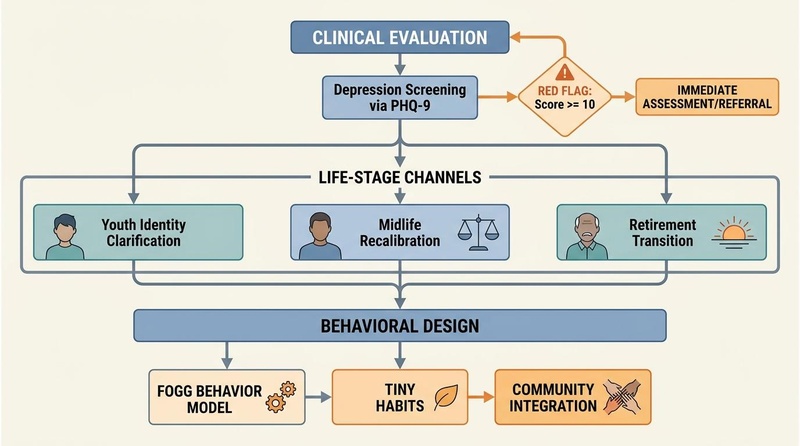
Because chronic psychological distress and clinical depression directly impair the prefrontal networks required to formulate and execute a sense of purpose, structured clinical screening is a mandatory prerequisite before initiating purpose-cultivation protocols.
¶ 1. The Depression Screening Red Flag (PHQ-9)
Clinicians and coaches must utilize the Patient Health Questionnaire-9 (PHQ-9) to assess baseline psychological health:
- PHQ-9 Score < 5: Optimized/Healthy. Proceed directly to values-clarification, volunteering, and behavioral purpose protocols.
- PHQ-9 Score 5–9: Mild depressive symptoms. Deploy mild behavioral activation and micro-dosing prosocial behaviors under monitoring.
- PHQ-9 Score (Clinical Red Flag): Indicates moderate-to-severe clinical depression[25]. Action: Pause self-directed purpose protocols. Prioritize clinical referral for psychotherapy (CBT, ACT) or pharmacological stabilization. Cultivating eudaimonic purpose cannot succeed in an actively depleted neurochemical state.
¶ 2. Caregiver Burnout & Telomere Erosion
- The Caregiver Paradox: Dedicating oneself to a noble, purpose-driven goal (such as full-time caregiving for an ailing spouse or child) is highly meaningful. However, if this purpose is pursued in isolation, with chronic sleep deprivation and zero autonomic recovery, it triggers accelerated telomere shortening equivalent to an additional 10 years of biological cellular aging[22:1].
- Mitigation: Purpose must be harmoniously balanced. Caregivers must be screened for exhaustion and provided with structured community respite to protect their somatic healthspan.
¶ 3. Obsessive vs. Harmonious Passion
- Obsessive Passion: Where self-worth is entirely contingent on a single, rigid goal. If the goal is blocked, the individual experiences severe HPA axis hyperactivity and cortisol spiking.
- Harmonious Passion: Where the individual flexibly pursues meaningful goals as part of a balanced identity, allowing for autonomic recovery and pivoting when faced with obstacles.
¶ Clinical and Behavioral Decision Pathway
The following decision pathway coordinates clinical screening, life-stage specific intervention channels, and behavioral design architecture to safely and effectively cultivate purpose.
¶ Practical Exercises Across the Lifespan
Eudaimonic purpose must be operationalized differently as we transition through distinct life phases. What provides cohesive, biologically protective meaning for a young adult differs radically from what preserves cognition in a post-retirement senior.
¶ 1. Young Adults (Ages 18–25): Identity & Values Clarification
- Primary Challenge: Navigating identity diffusion and avoiding external, prestige-driven (hedonic) traps.
- Clinical Exercise (The Values Audit):
- List the top 5 core values that define your personal integrity (e.g., curiosity, contribution, justice, creativity, connection).
- For each value, identify one weekly, non-academic, non-career action that embodies it.
- Purpose Statement: Formulate a "draft" 1-sentence life aim: "I want to use my skill in [Skill] to help [Target Group/Problem] because I value [Value]."
- Physiological Goal: Strengthens prefrontal cortex development and early emotional regulation networks, buffering against the rising epidemic of young-adult anxiety and depression.
¶ 2. Middle-Aged Adults (Ages 35–55): Overcoming Burnout & The Midlife Shift
- Primary Challenge: The "sandwich generation" squeeze. Career peaks combined with child-rearing and aging parents, leading to high allostatic load and professional burnout.
- Clinical Exercise (Intrinsic Shift & Micro-Mentoring):
- The Extrinsic Audit: Identify professional goals driven purely by external status, income, or fear. Write down how these can be balanced or reframed.
- Micro-Mentoring: Dedicate 1 hour per week to mentor a younger colleague, support an apprentice, or share technical skills with a local non-profit. Sharing accumulated wisdom activates deep eudaimonic cellular networks without adding massive cognitive load.
- Physiological Goal: Lowers chronic salivary cortisol, improves Heart Rate Variability (HRV), and downregulates the pro-inflammatory CTRA profile during peak career stress.
¶ 3. Older Adults (Ages 65+): The Retirement Transition & Legacy Projects
- Primary Challenge: Abrupt loss of professional identity, sudden social network shrinkage, and subsequent cardiovascular and cognitive decline.
- Clinical Exercise (The Legacy Blueprint & Structured Volunteerism):
- The Role Audit: Before or immediately after retiring, list your core professional skills (e.g., project management, teaching, engineering, writing).
- The Volunteering Commitment: Formally enroll in a structured volunteering organization (e.g., local schools, community non-profits, environmental groups) targeting at least 150 to 200 hours per year (approx. 3–4 hours per week)[15:1].
- The Legacy Project: Begin a long-term, self-directed project (e.g., writing a memoir, building a family archive, gardening, restoring historical artifacts) that represents a tangible contribution to future generations.
- Physiological Goal: Directly builds cognitive reserve, delays amyloid-induced cognitive decline, maintains physical mobility, and shields against post-employment mortality spike[26][10:3][11:3][15:2].
¶ Comparisons: Eudaimonia vs. Hedonia
Understanding the biological divergence between different forms of well-being is critical for lifestyle design.
| Parameter | Eudaimonic Well-Being (Purpose & Meaning) | Hedonic Well-Being (Pleasure & Comfort) |
|---|---|---|
| Core Definition | Self-actualization, contribution, and values-aligned living[13:2]. | Subjective happiness, maximizing pleasure, and minimizing pain. |
| Genomic Transcript (CTRA) | Suppressed CTRA: Highly suppressed pro-inflammatory genes, elevated antiviral genes[14:7]. | Elevated CTRA: Pro-inflammatory profile when not paired with eudaimonia[14:8]. |
| Inflammatory Profile | Low CRP, low IL-6, low TNF-alpha[4:3][6:2]. | No independent protective effect on baseline inflammation. |
| All-Cause Mortality Link | Robust, independent 20–40% risk reduction[1:4][3:3]. | Weak or non-significant when controlled for eudaimonia. |
| Biological Role | Actively coordinates homeostasis and autonomic buffering[8:4][5:3]. | Short-term reward seeking; does not buffer chronic HPA axis reactivity. |
¶ References
Shiba K, Kubzansky LD, Williams DR, et al. Purpose in life and 8-year mortality by gender and race/ethnicity among older adults in the U.S. Preventive Medicine. 2022;164:107238. https://pubmed.ncbi.nlm.nih.gov/36283485/ ↩︎ ↩︎ ↩︎ ↩︎ ↩︎
Alimujiang A, Wiensch A, Boss J, et al. Association Between Purpose in Life and All-Cause Mortality Among US Adults. JAMA Network Open. 2019;2(5):e194270. https://pubmed.ncbi.nlm.nih.gov/31125099/ ↩︎
Cohen R, Bavishi C, Rozanski A. Purpose in life and its relationship to all-cause mortality and cardiovascular events: a meta-analysis. Psychosomatic Medicine. 2016;78(2):122-133. https://pubmed.ncbi.nlm.nih.gov/26630230/ ↩︎ ↩︎ ↩︎ ↩︎
Guimond AJ, Shiba K, Kim ES, et al. Sense of purpose in life and inflammation in healthy older adults: A longitudinal study. Psychoneuroendocrinology. 2022;140:105697. https://pubmed.ncbi.nlm.nih.gov/35364478/ ↩︎ ↩︎ ↩︎ ↩︎
Thayer JF, Mather M, Koenig J. Stress and aging: A neurovisceral integration perspective. Psychophysiology. 2021;58(7):e13797. https://pubmed.ncbi.nlm.nih.gov/33723899/ ↩︎ ↩︎ ↩︎ ↩︎
Porges SW. Polyvagal theory: a journey from physiological observation to neural innervation and clinical insight. Frontiers in Behavioral Neuroscience. 2025;19:1373516. https://pubmed.ncbi.nlm.nih.gov/41035859/ ↩︎ ↩︎ ↩︎
Kim ES, Nakamura JS, Strecher VJ, Cole SW. Reduced Epigenetic Age in Older Adults With High Sense of Purpose in Life. The Journals of Gerontology: Series A. 2023;78(7):1272-1280. https://pubmed.ncbi.nlm.nih.gov/36966357/ ↩︎ ↩︎ ↩︎
Montoya M, Uchino BN. Social support and telomere length: a meta-analysis. Journal of Behavioral Medicine. 2023;46(4):606-619. https://pubmed.ncbi.nlm.nih.gov/36617609/ ↩︎ ↩︎ ↩︎ ↩︎ ↩︎
Cole SW. Social regulation of human gene expression. Current Directions in Psychological Science. 2009;18(3):132-137. https://doi.org/10.1111/j.1467-8721.2009.01623.x ↩︎ ↩︎
Boyle PA, Buchman AS, Wilson RS, et al. Effect of purpose in life on risk of incident Alzheimer disease and mild cognitive impairment in community-dwelling older persons. Archives of General Psychiatry. 2010;67(3):304-310. https://pubmed.ncbi.nlm.nih.gov/20194831/ ↩︎ ↩︎ ↩︎ ↩︎
Boyle PA, Buchman AS, Yu L, et al. Association of a purpose in life with senile plaques and neurofibrillary tangles in senior's brains. Archives of General Psychiatry. 2012;69(5):499-505. https://pubmed.ncbi.nlm.nih.gov/22566581/ ↩︎ ↩︎ ↩︎ ↩︎
Fogg BJ. A behavior model for persuasive design. Proceedings of the 4th International Conference on Persuasive Technology. 2009;40:1-7. https://dl.acm.org/doi/10.1145/1541948.1541999 ↩︎ ↩︎
Ryff CD. Purpose in life: An essential component of eudaimonic well-being. Research in Human Development. 2004;1(1-2):13-20. https://doi.org/10.1207/s15427617rhd0101&2_3 ↩︎ ↩︎ ↩︎
Fredrickson BL, Grewen KM, Coffey KA, et al. A functional genomic perspective on human well-being. Proceedings of the National Academy of Sciences. 2013;110(33):13684-13689. https://pubmed.ncbi.nlm.nih.gov/23898182/ ↩︎ ↩︎ ↩︎ ↩︎ ↩︎ ↩︎ ↩︎ ↩︎ ↩︎
Kim ES, et al. Volunteering and subsequent health and well-being in older adults: An outcome-wide longitudinal approach. American Journal of Preventive Medicine. 2020;59(2):176-186. https://pubmed.ncbi.nlm.nih.gov/32540131/ ↩︎ ↩︎ ↩︎
Trachtenberg E. The beneficial effects of social support and prosocial behavior on immunity and health: A psychoneuroimmunology perspective. Brain, Behavior, & Immunity - Health. 2024;40:100868. https://pubmed.ncbi.nlm.nih.gov/38524896/ ↩︎ ↩︎
Kim ES, Delaney SW, Kubzansky LD. Sense of purpose in life and cardiovascular disease: a systematic review and meta-analysis. American Journal of Preventive Medicine. 2018;55(5):681-691. https://pubmed.ncbi.nlm.nih.gov/30243851/ ↩︎
Cohen R, Bavishi C, Rozanski A. Purpose in life and its relationship to all-cause mortality and cardiovascular events: a meta-analysis. Psychosomatic Medicine. 2016;78(2):122-133. https://pubmed.ncbi.nlm.nih.gov/26630230/ ↩︎
Okuzono SS, Shiba K, Kim ES, et al. Ikigai and subsequent health and wellbeing among Japanese older adults: Longitudinal outcome-wide analysis. The Lancet Regional Health - Western Pacific. 2022;21:100407. https://pubmed.ncbi.nlm.nih.gov/35141667/ ↩︎
Gong J, Scholes S, Cole S. Associations between plasma proteins and psychological wellbeing: evidence from over 20 years of the English Longitudinal Study of Ageing. Molecular Psychiatry. 2026;31(2):415-423. https://pubmed.ncbi.nlm.nih.gov/41398370/ ↩︎ ↩︎
Ryff CD. Eudaimonic well-being, inequality, and health: Recent findings and future directions. International Review of Psychiatry. 2017;29(6):547-557. https://pubmed.ncbi.nlm.nih.gov/29161986/ ↩︎ ↩︎
Epel ES, Blackburn EH, Lin J, et al. Accelerated telomere shortening in response to life stress. Proceedings of the National Academy of Sciences. 2004;101(49):17312-17315. https://pubmed.ncbi.nlm.nih.gov/15574496/ ↩︎ ↩︎
Steptoe A, Wardle J. Positive affect and biological function in everyday life. Neurobiology of Aging. 2005;26 Suppl 1:108-112. https://pubmed.ncbi.nlm.nih.gov/16223543/ ↩︎
Stellar JE, John-Henderson N, Anderson CL, et al. Positive affect and markers of inflammation: discrete positive emotions predict lower levels of inflammatory cytokines. Emotion. 2015;15(2):129-133. https://pubmed.ncbi.nlm.nih.gov/25603147/ ↩︎ ↩︎
Kroenke K, Spitzer RL, Williams JB. The PHQ-9: validity of a brief depression severity measure. Journal of General Internal Medicine. 2001;16(9):606-613. https://pubmed.ncbi.nlm.nih.gov/11556941/ ↩︎
Boyle PA, Wang T, Yu L. Purpose in Life May Delay Adverse Health Outcomes in Old Age. The American Journal of Geriatric Psychiatry. 2022;30(2):205-214. https://pubmed.ncbi.nlm.nih.gov/34175231/ ↩︎