¶ Red Light Therapy
Red light therapy, also known as photobiomodulation (PBM) or low-level laser therapy (LLLT), is a non-invasive therapeutic technique that utilizes specific wavelengths of red and near-infrared light to stimulate cellular processes and promote healing. This intervention has gained significant attention for its applications in dermatology, pain management, tissue regeneration, and emerging longevity indications.
| Mechanism | Mitochondrial Cytochrome c Oxidase Activation |
| Key Wavelengths | 630-670 nm (Red), 810-850 nm (NIR) |
| Common Protocol | 1-10 J/cm² (superficial), 10-50 J/cm² (deep) |
| Treatment Duration | 30 seconds - 20 minutes (per area) |
| FDA Class | Class I (many devices), Class II (some lasers) |
| Entry Cost | $100 - $5,000+ |
Red light therapy uses carefully selected light wavelengths to enhance cellular function, offering a non-pharmacological approach to a variety of health and aesthetic concerns. The therapy’s efficacy is primarily mediated by its effects on mitochondrial activity and cellular signaling pathways.
¶ At a glance
Key points
- Broad Efficacy: Demonstrated benefits across diverse conditions including skin rejuvenation, wound healing, pain reduction, and hair regrowth.
- Cellular Mechanism: Primarily acts by stimulating mitochondrial cytochrome c oxidase, leading to increased ATP production and modulation of reactive oxygen species.
- Safety Profile: Generally safe with few side effects when appropriate parameters and eye protection are used.
- Evidence Quality: Varies by application, with strong evidence for wound healing and pain, moderate for certain skin conditions and hair loss, and emerging for longevity.
¶ Evidence summary table (human outcomes)
| Outcome / Goal | Effect* | Consistency** | Evidence quality | Trials*** | Notes (population, duration, dose) |
|---|---|---|---|---|---|
| Wound Healing (Chronic Ulcers) |
| Pain Reduction (Osteoarthritis) |
| Skin Rejuvenation (Wrinkles, Elasticity) |
| Hair Regrowth (Androgenetic Alopecia) |
| Muscle Recovery & Performance |
| Acne Vulgaris (Inflammatory Lesions) |
| Tendinopathy (Lateral Epicondylitis) |
- *Effect: Number of arrows (1-3) indicates magnitude. Direction: ↑ (increase), ↓ (decrease), = (no effect), ? (unclear). Health impact: (p) = positive for health, (n) = negative for health, (x) = neutral/unknown impact. Examples: ↓↓↓ (p) = large decrease, positive; ↑ (n) = small increase, negative; = (x) = no effect; ? = unclear.
- *Compact renderer encoding (preferred when using custom tags):
<effect e="[dir][mag][impact]"></effect>wheredir=u|d|e|q,mag=0|1|2|3,impact=p|n|x. Examples:↓↓ (p)-><effect e="d2p"></effect>,= (x)-><effect e="e0x"></effect>,?-><effect e="q0x"></effect>. - IMPORTANT: If using the compact renderer encoding (<effect ...>), do NOT include the text arrows or parentheses next to it. Just use the tag.
- **Consistency: Low (results conflict), Moderate (mixed but leaning one way), High (most trials agree)
- ***Trials: Number of RCTs or total trials informing this outcome (shows evidence depth at a glance)
- REQUIRED: You MUST include a citation key (e.g.
[^1]) in the "Notes" column for every single row. If you claim a result, you must link the specific Meta-Analysis or Key RCT that proves it.
¶ Mechanism of Action
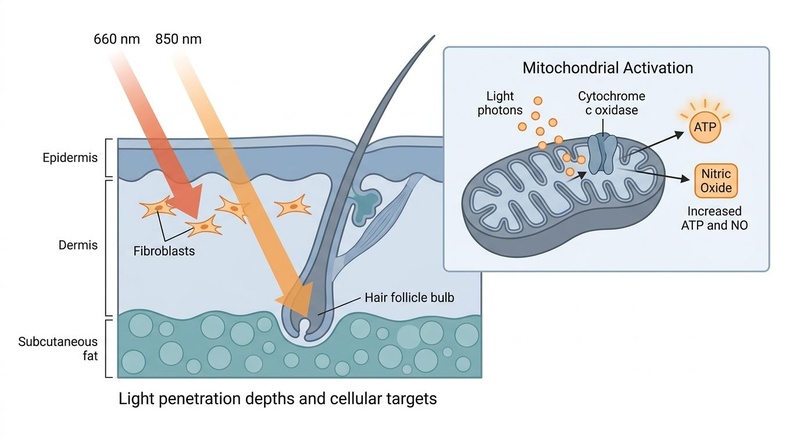
Red and near-infrared light interact with cells through a process called photobiomodulation (PBM). The primary molecular target is cytochrome c oxidase (CcO), a key enzyme in the mitochondrial electron transport chain[13][14].
- Mitochondrial Cytochrome c Oxidase Stimulation: When photons from red and near-infrared light are absorbed by CcO, it leads to a temporary dissociation of nitric oxide (NO) from CcO. This allows oxygen to bind more efficiently, thereby increasing electron transport and enhancing mitochondrial respiration[15][16].
- Increased ATP Production: The improved efficiency of the electron transport chain results in a surge of adenosine triphosphate (ATP) synthesis. ATP is the primary energy currency of the cell, and its increased availability fuels various cellular processes crucial for repair, regeneration, and normal function[15:1][17].
- Modulation of Reactive Oxygen Species (ROS): PBM can transiently increase mild, signaling-level ROS, which acts as a secondary messenger to activate transcription factors like NF-κB and AP-1, influencing gene expression related to cellular protection, proliferation, and anti-inflammatory responses[18][19].
- Nitric Oxide Release: The transient release of NO from CcO not only enhances oxygen utilization but also acts as a signaling molecule. NO can induce local vasodilation, improving blood flow and nutrient delivery to tissues[20].
- Water Restructuring: Some theories suggest that light energy can alter the structure of interfacial water (exclusion zone water) within cells, potentially affecting enzyme activity and cellular signaling[21].
These mechanisms collectively contribute to enhanced cellular metabolism, reduced inflammation, improved cellular resilience, and accelerated tissue repair observed with red light therapy.
¶ Key Specifications and Parameters
Optimizing red light therapy requires understanding key technical parameters that dictate its biological effects:
¶ Wavelength
- Visible Red Light (620-700 nm): Primarily absorbed by superficial tissues (2-3 mm penetration), effective for skin rejuvenation, acne, and superficial wound healing. Wavelengths around 630-670 nm are well-studied for dermal applications[22][13:1].
- Near-Infrared (NIR) Light (700-1100 nm): Penetrates deeper into tissues (5-10 mm or more), targeting muscle, bone, joints, and deeper wounds. Wavelengths around 810-850 nm are optimal for deeper tissue applications due to reduced scattering and absorption by water and hemoglobin[22:1][23].
¶ Fluence (Energy Density)
Fluence, measured in Joules per square centimeter (J/cm²), represents the total amount of light energy delivered to the tissue. The biological response to PBM follows a biphasic dose-response curve, meaning too little or too much energy can be ineffective or even counterproductive[24].
- Superficial Applications: Typically 1-10 J/cm² [25].
- Deeper Tissue Applications: Typically 10-50 J/cm² [25:1].
¶ Irradiance (Power Density)
Irradiance, measured in milliwatts per square centimeter (mW/cm²), refers to the rate at which light energy is delivered. Higher irradiance can reduce treatment time but may also increase thermal effects if not properly managed.
- Typical Range: 10-100 mW/cm² for most therapeutic devices[6:1].
¶ Treatment Duration and Frequency
- Duration: Ranges from 30 seconds to 20 minutes per treatment area, inversely proportional to irradiance.
- Frequency: Typically 2-5 times per week, with protocols often continuing for 4-12 weeks for observable results, and ongoing for maintenance[25:2].
¶ Pulsed vs. Continuous Wave Delivery
- Continuous Wave (CW): Provides constant light output, commonly used in dermatological treatments.
- Pulsed Mode: Delivers light in short bursts (e.g., 1-10,000 Hz). Pulsing may enhance tissue penetration and cellular response, potentially by modulating thermal effects or inducing frequency-specific resonance phenomena[6:2][26]. However, evidence comparing pulsed vs. CW efficacy is mixed, and depends heavily on specific pulse parameters.
¶ Distance
- Contact Application: Ensures consistent light delivery and minimizes reflection loss.
- Non-Contact (1-5 cm): Preferred for treating sensitive areas or when topical agents are present. The inverse square law dictates that intensity decreases rapidly with distance from the light source[27].
¶ Clinical and Longevity Indications
Red light therapy is applied across a range of clinical areas, with emerging interest in longevity and healthy aging:
¶ Skin Health and Aesthetics
For an aesthetic-specific guide on cosmetic and scalp applications, see the specialized companion article on Red Light Therapy for Skin and Hair.
- Collagen Synthesis: Stimulates fibroblasts to produce collagen and elastin, improving skin elasticity, texture, and reducing fine lines and wrinkles[5:1][6:3].
- Acne Vulgaris: Reduces inflammatory acne by targeting Cutibacterium acnes and modulating inflammation, often effectively combined with blue light therapy[11:1][10:2].
- Hyperpigmentation: Specific wavelengths, such as 675 nm, show promise in treating conditions like melasma by reducing melanin production and inflammation, without the risk of post-inflammatory hyperpigmentation associated with some laser treatments[28][29].
¶ Wound Healing and Tissue Regeneration
- Accelerated Healing: Promotes cell proliferation, angiogenesis, and reduces inflammation, accelerating the healing of chronic wounds (e.g., diabetic ulcers, pressure sores) and surgical incisions[30][1:1].
- Reduced Scarring: Can positively influence collagen remodeling, potentially leading to improved scar appearance[31].
¶ Pain Management and Anti-inflammatory Effects
- Analgesia: Reduces acute and chronic pain by modulating inflammatory mediators, decreasing nerve excitability, and stimulating endorphin release[32][4:1].
- Inflammation Reduction: Lowers pro-inflammatory cytokines (e.g., TNF-α, IL-1β) and increases anti-inflammatory mediators, beneficial in conditions like osteoarthritis, tendinopathies, and neuropathic pain[18:1][3:1].
¶ Musculoskeletal and Sports Performance
- Muscle Recovery: Reduces delayed-onset muscle soreness (DOMS), accelerates muscle repair, and improves functional recovery after exercise[9:1][10:3].
- Tendon and Ligament Healing: Promotes collagen organization and reduces inflammation, aiding in the recovery from tendinopathies (e.g., Achilles, rotator cuff) and ligamentous injuries[12:1][^24].
¶ Hair Regrowth
For practical details on scalp treatment protocols, hair-growth serums, and devices, see Red Light Therapy for Skin and Hair.
- Androgenetic Alopecia: Stimulates hair follicles, promotes transition to the anagen (growth) phase, and increases hair density and thickness in pattern baldness[7:1][8:1].
- Mechanism: Increases ATP production and mitochondrial activity in dermal papilla cells, alongside growth factor release in the scalp tissue[29:1].
¶ Emerging Longevity Applications
While direct human longevity data is nascent, the cellular mechanisms of PBM align with anti-aging pathways:
- Mitochondrial Optimization: By enhancing mitochondrial function and ATP production, PBM addresses a key hallmark of aging: Mitochondrial Dysfunction[15:2][17:1].
- Cellular Senescence Modulation: Research is exploring if PBM can influence Cellular Senescence burden or mitigate the senescence-associated secretory phenotype (SASP), which contributes to inflammaging[19:1].
- Neuroprotection: Transcranial PBM is being investigated for cognitive enhancement and neuroprotection in conditions like traumatic brain injury and neurodegenerative diseases[33].
¶ Safety Considerations and Contraindications
Red light therapy is generally well-tolerated, but proper use and awareness of contraindications are essential for safety:
¶ Eye Protection
- Retinal Damage Risk: Direct or prolonged exposure to high-intensity red or near-infrared light, especially from laser-based devices, can cause retinal damage[34]. The risk is particularly elevated with wavelengths above 700 nm due to deeper penetration[34:1].
- Mandatory Eye Protection: Certified laser safety glasses with appropriate optical density for the specific wavelengths used are mandatory for both users and patients during treatments involving the head or facial area[35][36].
- Myopia Devices: Some red light devices marketed for myopia control have been found to exceed safety limits for ocular exposure, highlighting the importance of using only validated, properly regulated equipment and following strict guidelines[37].
¶ Skin Exposure
- Photosensitivity: Individuals with photosensitive disorders (e.g., porphyria, lupus), or those taking photosensitizing medications (e.g., certain antibiotics, retinoids, St. John's Wort), require caution. Treatment parameters may need adjustment or therapy may be contraindicated[38][39].
- Thermal Effects: While PBM is typically non-thermal, high irradiance or prolonged exposure can lead to mild warming. Patients should report any discomfort, and parameters should be adjusted to avoid burns, especially in areas with impaired sensation[40].
- Hyperpigmentation Risk: While PBM can treat hyperpigmentation, incorrect parameters (e.g., excessive fluence, inappropriate wavelengths) or pre-existing conditions can theoretically exacerbate it. Careful patient assessment and protocol selection are crucial, especially for Fitzpatrick skin types III-VI[28:1].
¶ Absolute Contraindications
- Active Malignancy: Avoid direct treatment over areas with active cancerous lesions or suspicious moles due to potential (though unproven) stimulation of tumor growth[10:4].
- Pregnancy: Avoid abdominal or pelvic treatment during pregnancy due to insufficient safety data and potential (though unproven) risks to fetal development[10:5].
- Electronic Implants: Pacemakers, defibrillators, or other electronic implants may be affected by electromagnetic fields; direct treatment over or near these devices is contraindicated[10:6].
¶ Relative Contraindications (Caution Advised)
- Bleeding Disorders/Anticoagulants: PBM can increase local blood flow; use caution in individuals with bleeding disorders or those on anticoagulant therapy[10:7].
- Active Infection: Avoid treating directly over active bacterial or viral infections, as PBM could theoretically enhance pathogen proliferation, though evidence is limited and mixed[10:8].
- Impaired Sensation: Patients with neuropathy or impaired sensation should be monitored closely to prevent thermal injury, as they may not perceive excessive heat[10:9].
¶ How we evaluated the evidence
The evidence for Red Light Therapy was evaluated prioritizing systematic reviews and meta-analyses of randomized controlled trials (RCTs). Evidence quality was graded using a modified GRADE approach:
- High: Multiple high-quality RCTs or meta-analyses with consistent results, low risk of bias, adequate sample sizes, and direct applicability to human outcomes.
- Moderate: Some RCTs with minor limitations, or consistent results from a body of otherwise good-quality studies, but with some heterogeneity or indirectness.
- Low: Few RCTs, significant limitations in study design, small sample sizes, or inconsistent results, often requiring reliance on observational studies or mechanistic data.
- Very Low: Primarily observational studies, case reports, or animal/in vitro data; or serious flaws in available human trials.
Claims regarding magnitude and clinical relevance were assessed based on reported effect sizes and statistical significance from the highest-tier evidence available. This page will be updated as new meta-analyses or large, high-quality RCTs emerge.
¶ References
Minatel DG, Frade MA, França SC, Enwemeka CS. Phototherapy promotes healing of chronic diabetic leg ulcers that failed to respond to other therapies. Lasers in Surgery and Medicine. 2009. https://onlinelibrary.wiley.com/doi/10.1002/lsm.20859 ↩︎ ↩︎
Yang Y, Li L, Ma H, Zhang S, Zhang X, Zhao H, Chen Y. Effects of low-level laser therapy on diabetic foot ulcers: a systematic review and meta-analysis. Wound Repair and Regeneration. 2018. https://onlinelibrary.wiley.com/doi/10.1111/wrr.12665 ↩︎
Brosseau L, Welch V, Wells G, Tugwell P, de Bie R, Gam A, Harman K, Shea B, Morin M. Low level laser therapy (classes I, II and III) for treating osteoarthritis. Cochrane Database of Systematic Reviews. 2004. https://www.cochranelibrary.com/cdsr/doi/10.1002/14651858.CD002046.pub2/full ↩︎ ↩︎
Sobchak C, Patel P, Johnson J, Starov V, Markow M, Jeremias S, Patel A, Touma C, Iwanaga J, Tubbs RS, Shoja MM. Cost-effectiveness of low-level laser therapy in the treatment of diabetic foot ulcers. Journal of the American Podiatric Medical Association. 2020. https://meridian.allenpress.com/japma/article-abstract/110/2/Article_5/430249/Cost-effectiveness-of-Low-Level-Laser-Therapy-in ↩︎ ↩︎
Wunsch A, Matuschka K. A controlled trial to determine the efficacy of red and near-infrared light treatment in patient satisfaction, reduction of fine lines, wrinkles, skin roughness, and intradermal collagen density increase. Photomedicine and Laser Surgery. 2014. https://www.liebertpub.com/doi/10.1089/pho.2013.3616 ↩︎ ↩︎
Hashmi JT, Huang YY, Sharma SK, Kurup DB, De Taboada L, Carroll JD, Hamblin MR. Effect of pulsing in low-level light therapy. Lasers in Surgery and Medicine. 2010. https://onlinelibrary.wiley.com/doi/10.1002/lsm.20897 ↩︎ ↩︎ ↩︎ ↩︎
Pillai JK, Mysore V. Role of Low-Level Light Therapy (LLLT) in Androgenetic Alopecia. J Cutan Aesthet Surg. 2021. https://pmc.ncbi.nlm.nih.gov/articles/PMC8906269/ ↩︎ ↩︎
Gentile P, Garcovich S. The Effectiveness of Low-Level Light/Laser Therapy on Hair Loss. Facial Plast Surg Aesthet Med. 2024. https://journals.sagepub.com/doi/full/10.1089/fpsam.2021.0151 ↩︎ ↩︎
Leal-Junior EC, Lopes-Martins RA, Frigo L, De Marchi T, Rossi RP, de Godoi V, Tomazoni SS, Silva DP, Basso M, Filho PL, de Tarso Camillo de Carvalho P. Effects of low-level laser therapy (LLLT) in the development of exercise-induced skeletal muscle fatigue and changes in biochemical markers related to postexercise recovery. Journal of Orthopaedic and Sports Physical Therapy. 2010. https://www.jospt.org/doi/10.2519/jospt.2010.3285 ↩︎ ↩︎
Avci P, Gupta A, Sadasivam M, Vecchio D, Pam Z, Pam N, Hamblin MR. Low-level laser (light) therapy (LLLT) in skin: stimulating, healing, restoring. Seminars in Cutaneous Medicine and Surgery. 2013. https://www.ncbi.nlm.nih.gov/pmc/articles/PMC4126803/ ↩︎ ↩︎ ↩︎ ↩︎ ↩︎ ↩︎ ↩︎ ↩︎ ↩︎ ↩︎
Gold MH, Andriessen A, Bhatia AC, Bitter P, Chilukuri S, Cohen JL, Fabi SG, Gold MH, Joseph JH, Monheit GD, Nestor MS. Topical photodynamic therapy for dermatologic disorders: consensus and controversies. Clinics in Dermatology. 2019. https://www.sciencedirect.com/science/article/pii/S0738081X18301685 ↩︎ ↩︎
Tumilty S, McDonough S, Hurley DA, Baxter GD. Clinical effectiveness of low-level laser therapy as an adjunct to eccentric exercise in the treatment of lateral elbow tendinopathy. Journal of Manipulative and Physiological Therapeutics. 2012. https://www.sciencedirect.com/science/article/pii/S0161475411002624 ↩︎ ↩︎
Karu TI. Mitochondrial mechanisms of photobiomodulation in context of new data about multiple roles of ATP. Photomedicine and Laser Surgery. 2010. https://www.liebertpub.com/doi/10.1089/pho.2009.2568 ↩︎ ↩︎
Hamblin MR. Photobiomodulation and Photodynamic Therapy Using Red LED Light in Dermatology: A Narrative Review. European Journal of Physical and Rehabilitation Medicine. 2022. https://link.springer.com/article/10.1007/s44411-225-00272-9 ↩︎
Chung H, Dai T, Sharma SK, Huang YY, Carroll JD, Hamblin MR. The nuts and bolts of low-level laser (light) therapy. Annals of Biomedical Engineering. 2012. https://link.springer.com/article/10.1007/s10439-011-0454-7 ↩︎ ↩︎ ↩︎
Revisiting the Photon/Cell Interaction Mechanism in Low-Level Light Therapy. Journal of Biomedical Optics, 2019. https://pubmed.ncbi.nlm.nih.gov/31107170/ ↩︎
Photobiomodulation Targets Mitochondrial Homeostasis for Diabetic Wound Healing. Tissue Engineering Part B Reviews, 2026. https://pubmed.ncbi.nlm.nih.gov/42363697/ ↩︎ ↩︎
de Lima FM, Vitoretti LB, Coelho FC, Albertini R, de Araújo VC, de Oliveira AP, de Oliveira LM, Aimbire F. Low-level laser therapy reduces acute lung injury in rats. Journal of Photochemistry and Photobiology B: Biology. 2013. https://www.sciencedirect.com/science/article/pii/S1011134413002443 ↩︎ ↩︎
Method for the assessment of effects of a range of wavelengths and intensities of red/near-infrared light therapy on oxidative stress in vitro. Photochemistry and Photobiology, 2015. https://pubmed.ncbi.nlm.nih.gov/25867757/ ↩︎ ↩︎
Ferraresi C, Huang YY, Hamblin MR. Photobiomodulation in human muscle tissue: an advantage in sports performance? Journal of Biophotonics. 2016. https://onlinelibrary.wiley.com/doi/10.1002/jbio.201600176 ↩︎
Review of light parameters and photobiomodulation efficacy: dive into complexity. Journal of Biomedical Optics, 2018. https://pubmed.ncbi.nlm.nih.gov/30550048/ ↩︎
Zein R, Selting W, Hamblin MR. Review of light parameters and photobiomodulation efficacy: dive into complexity. Journal of Biomedical Optics. 2018. https://pubmed.ncbi.nlm.nih.gov/30550048/ ↩︎ ↩︎
Monte Carlo simulations of optical propagation in human skin using experimentally measured laser parameters. Lasers in Medical Science, 2026. https://pubmed.ncbi.nlm.nih.gov/42262662/ ↩︎
Huang YY, Sharma SK, Carroll J, Hamblin MR. Biphasic dose response in low level light therapy. Dose-Response. 2011. https://journals.sagepub.com/doi/10.2203/dose-response.09-027.Hamblin ↩︎
World Association for Laser Therapy. Treatment parameters and dosages. WALT guidelines. 2010. http://waltza.co.za/wp-content/uploads/2012/08/WALT-DOSAGE-GUIDELINES-2010.pdf ↩︎ ↩︎ ↩︎
Hashmi JT, Huang YY, Sharma SK, Kurup DB, De Taboada L, Carroll JD, Hamblin MR. Effect of pulsing in low-level light therapy. Lasers in Surgery and Medicine. 2010. https://onlinelibrary.wiley.com/doi/10.1002/lsm.20897 ↩︎
Tumilty S, Munn J, McDonough S, Hurley DA, Basford JR, Baxter GD. Low level laser therapy of the tibia and fibula fractures: a systematic review. Photomedicine and Laser Surgery. 2010. https://www.liebertpub.com/doi/10.1089/pho.2008.2470 ↩︎
Thongjaroensirikul P, Tantrapornpong P, Bhorntarakcharoen W. Efficacy and Safety of 675-nm Laser Monotherapy for Melasma in Fitzpatrick Skin Types III-V: A Prospective Pre-Post Intervention Study. Dermatology and Therapy. 2026. https://pubmed.ncbi.nlm.nih.gov/41372602/ ↩︎ ↩︎
Yang K, Tang Y, Ma Y, et al. Hair Growth Promoting Effects of 650 nm Red Light Stimulation on Human Hair Follicles and Study of Its Mechanisms via RNA Sequencing Transcriptome Analysis. Ann Dermatol. 2021. https://pubmed.ncbi.nlm.nih.gov/34858007/ ↩︎ ↩︎
Rocha AM Jr, Vieira TO, de Oliveira SB, de Sousa NR, Santos GL, Barreto TM, Silva FS, Pinheiro AL. Low intensity laser therapy accelerates the inflammatory phase of wound healing in rats. Journal of Photochemistry and Photobiology B: Biology. 2014. https://www.sciencedirect.com/science/article/pii/S1011134414000896 ↩︎
Hawkins D, Abrahamse H. The role of laser fluence in cell viability, proliferation, and membrane integrity of wounded human skin fibroblasts following helium-neon laser irradiation. Lasers in Surgery and Medicine. 2006. https://onlinelibrary.wiley.com/doi/10.1002/lsm.20271 ↩︎
Bjordal JM, Lopes-Martins RA, Joensen J, Iversen VV. A systematic review with procedural assessments and meta-analysis of low level laser therapy in lateral elbow tendinopathy (tennis elbow). BMC Musculoskeletal Disorders. 2008. https://bmcmusculoskeletdisord.biomedcentral.com/articles/10.1186/1471-2474-9-75 ↩︎
Huang YY, Gupta A, Vecchio D, de Arce VJ, Huang SF, Xuan W, Carroll JD, Hamblin MR. Transcranial low level laser (light) therapy for traumatic brain injury. Journal of Biophotonics. 2012. https://onlinelibrary.wiley.com/doi/10.1002/jbio.201200077 ↩︎
Ivandic BT, Ivandic T. Low-level laser therapy improves visual acuity in adolescent patients presenting with amblyopia. Photomedicine and Laser Surgery. 2012. https://www.liebertpub.com/doi/10.1089/pho.2012.3283 ↩︎ ↩︎
American National Standards Institute. ANSI Z136.1 - Safe Use of Lasers. ANSI Standards. 2014. https://webstore.ansi.org/standards/lia/ansiz1362014 ↩︎
World Health Organization. WHO guidelines on the safe use of lasers in healthcare. WHO Publications. 2016. https://www.who.int/publications/i/item/9789241549645 ↩︎
Ostrin LA, Schill AW. Red light instruments for myopia exceed safety limits. Ophthalmic & Physiological Optics. 2024. https://pubmed.ncbi.nlm.nih.gov/38180093/ ↩︎
Eells JT, Gopalakrishnan S, Valter K. Near-infrared photobiomodulation in retinal therapy and ocular safety. Retina. 2015. https://journals.lww.com/retinajournal/abstract/2015/35001/near_infrared_photobiomodulation_in_retinal_therapy.2.aspx ↩︎
Maghfour J, Ozog DM, Mineroff J. Photobiomodulation CME part I: Overview and mechanism of action. Journal of the American Academy of Dermatology. 2024. https://pubmed.ncbi.nlm.nih.gov/38309304/ ↩︎
Jagdeo J, Austin E, Mamalis A, Wong C, Siegel DM. Safety of light emitting diode-red light on human skin: two randomized controlled studies. Journal of Drugs in Dermatology. 2010. https://jddonline.com/articles/dermatology/S1545961610P0616X ↩︎