¶ Regenerative Medicine: A Deep Dive into Longevity and Tissue Repair
Regenerative medicine is a transformative field focused on repairing, replacing, or regenerating damaged tissues and organs to restore normal function [1]. This field holds significant promise for addressing age-related tissue damage, functional decline, and various chronic diseases by harnessing the body's intrinsic healing processes or introducing advanced therapeutic interventions [2].
¶ TL;DR (5 bullets max)
- Regenerative medicine aims to restore tissue and organ function, offering solutions for age-related degeneration and injury.
- Key approaches include stem cell therapies, advanced tissue engineering (scaffolds, 3D bioprinting), growth factors, and gene therapy.
- Clinical applications range from wound healing to complex organ repair, with ongoing research expanding possibilities.
- Safety, regulatory challenges, high costs, and the need for more robust human evidence are current limitations.
- Focus on therapies with moderate-to-high certainty evidence in human outcomes, and always consult a clinician for personalized guidance.
¶ Quick Answer
Regenerative medicine leverages cellular, biomaterial, and genetic strategies to facilitate the repair and regeneration of damaged tissues and organs. This includes the use of stem cells, advanced scaffolds, and growth factors to promote healing and restore function, with promising applications in areas like musculoskeletal repair and cardiac regeneration.
¶ What It Is
Regenerative medicine encompasses a broad range of medical approaches that stimulate the body's natural healing processes or augment them with advanced biotechnologies. The ultimate goal is to restore the structure and function of diseased or injured tissues and organs that have been compromised by age, disease, or trauma [2:1].
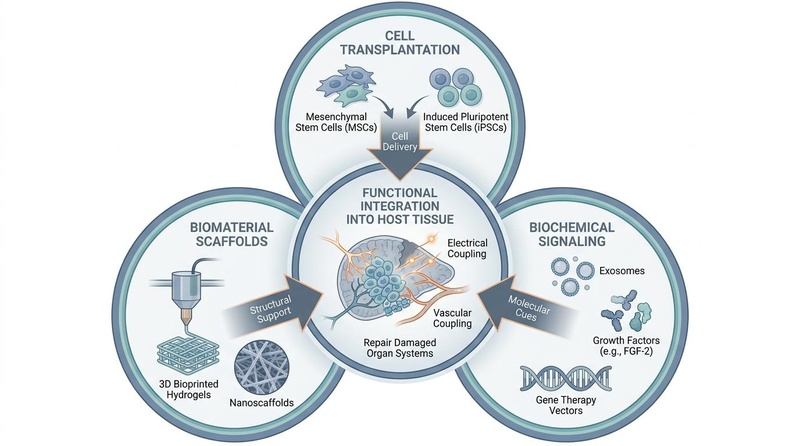
Figure 1: The tripartite framework of regenerative medicine: cell therapies (stem cells), biomaterial scaffolds, and biochemical signaling (growth factors, genetic interventions) converging to restore functional tissue.
Key components of regenerative medicine include:
- Cell Therapies: Utilizing living cells (e.g., stem cells) to replace or repair damaged tissue.
- Tissue Engineering: Combining cells, scaffolds, and bioreactors to create functional tissues.
- Biomaterials: Developing natural or synthetic materials to serve as scaffolds or delivery systems for regenerative factors.
- Growth Factors and Cytokines: Employing biological molecules that stimulate cell growth, proliferation, and differentiation.
- Gene Therapy: Introducing genetic material into cells to achieve a therapeutic effect.
¶ Does It Work? (Evidence Snapshot)
Regenerative medicine is an evolving field with promising but varied evidence across different applications.
¶ Evidence summary table (human outcomes)
| Outcome (Human) | Population | Effect Size | Certainty | Study Type |
|---|---|---|---|---|
| Periodontal Regeneration | Patients with periodontal defects | Improved probing pocket depth (MD: –0.51 mm) and clinical attachment level (MD: –0.75 mm) [3] | Moderate-High | Meta-analysis of RCTs |
| Hair Restoration (AGA) | Androgenetic Alopecia (AGA) patients | PRP, PRF, MSC-derived exosomes show promise in cell-niche restoration [4] | Low-Moderate | Review of preclinical/clinical |
| Myocardial Repair | Post-infarction cardiac damage | HiPSC-derived cardiomyocytes show potential, but require improved electrical integration [1:1] | Low | Translational research |
| Tendon-Bone Healing | Tendon-bone insertion injuries | MSC-derived exosomes facilitate tissue repair and regeneration [5] | Low-Moderate | Review of preclinical/clinical |
| Dentine-Pulp Regeneration | Dental pulp/periapical diseases | SCAP-derived exosomes induce specific dentinogenesis [6] | Low | Preclinical/Translational |
| Endometrial Regeneration | Endometrial disorders | Biotechnological advances show potential for tissue repair [7] | Low | Systematic review |
¶ Certainty grade rubric:
- High: Multiple RCTs or meta-analysis with consistent effects.
- Moderate: 1–2 good RCTs or strong cohorts with minor limits.
- Low: Small, uncontrolled, animal, or mechanistic only.
¶ Who Benefits Most / Least
¶ Who Benefits Most:
- Individuals with acute injuries or chronic degenerative conditions where native healing capacity is insufficient.
- Patients with organ damage leading to functional impairment, seeking alternatives to transplantation.
- Those with specific tissue defects (e.g., cartilage, bone, skin) that can be addressed by targeted cellular or tissue-engineered approaches [8].
¶ Who Benefits Least:
- Individuals seeking "anti-aging" effects without a clear pathological target, due to the experimental nature and cost of many interventions.
- Patients with active infections or systemic inflammatory conditions that could compromise graft integration or treatment efficacy.
- Those unable to adhere to rigorous post-treatment care and monitoring protocols.
¶ How to Try It (Actionable Protocols)
Engaging with regenerative medicine typically involves consultation with specialized clinicians, as these therapies are often complex and personalized.
¶ Starter Protocol: Discussion with a Specialist
- Identify a condition: Pinpoint a specific injury or degenerative condition for which regenerative medicine is a potential option.
- Research evidence: Gather preliminary information on evidence-based regenerative therapies for that condition, prioritizing human clinical trials.
- Consult a specialist: Seek out board-certified physicians in regenerative medicine, orthopedics, cardiology, or other relevant specialties who are experienced in these therapies.
¶ Standard Protocol: Pursuing Established Therapies
- Comprehensive evaluation: Undergo thorough diagnostic testing to assess the extent of tissue damage and overall health.
- Personalized treatment plan: Work with your clinician to develop a plan that may involve stem cell injections, PRP, or other interventions based on your specific condition and medical history.
- Follow-up and monitoring: Adhere strictly to post-treatment instructions, including physical therapy and regular follow-up appointments to monitor progress and manage any side effects.
¶ Safety, Interactions, Red Flags
Regenerative medicine therapies, while promising, carry potential risks and require careful consideration.
¶ Who Should Avoid:
- Individuals with active cancers, as some therapies could potentially promote tumor growth.
- Patients with severe autoimmune disorders, as immune responses to transplanted cells or materials can occur.
- Those with systemic infections or uncontrolled chronic diseases.
- Pregnant or breastfeeding individuals (unless specifically cleared by a specialist).
¶ Common Side Effects and How to Mitigate:
- Injection site reactions: Pain, swelling, or bruising can be managed with rest, ice, and over-the-counter pain relievers.
- Immune response: In some cases, the body may react to transplanted cells or biomaterials. This is usually managed by careful donor matching or immunosuppressive therapies, if required.
- Infection: As with any invasive procedure, there is a risk of infection, which is minimized through sterile techniques and, when appropriate, prophylactic antibiotics.
¶ Drug/Supplement Interactions:
- Immunosuppressants: May interact with immune-modulating regenerative therapies.
- Anticoagulants: May increase the risk of bleeding at injection sites.
- Anti-inflammatory drugs: Can potentially interfere with the regenerative processes, depending on the specific therapy.
¶ Stop Criteria and When to Talk to a Clinician:
- Signs of infection: Fever, increasing pain, redness, or discharge at the treatment site.
- Unexpected severe pain or swelling.
- Allergic reactions: Rash, difficulty breathing, or other signs of an allergic response.
- Lack of expected improvement or worsening symptoms.
¶ Tracking & What “Good” Looks Like
Monitoring the effectiveness of regenerative medicine involves a combination of objective biomarkers and subjective assessments.
¶ Biomarkers (with units/frequency):
- Imaging studies: MRI, CT, or ultrasound to visualize tissue repair and regeneration (e.g., quarterly or as advised).
- Functional assessments: Range of motion, strength tests, or specific functional scales to measure improvement (e.g., monthly).
- Biochemical markers: Relevant blood tests (e.g., inflammatory markers, growth factors) depending on the condition being treated (e.g., pre- and post-treatment, then quarterly).
¶ Subjective Metrics:
- Pain levels: Track daily using a numerical scale (0-10).
- Quality of life: Assess changes in daily activities, sleep, and overall well-being.
- Functional improvement: Document ability to perform tasks that were previously difficult.
¶ Common Mistakes & Myths
- Myth: Regenerative medicine is a "fountain of youth" with instant results. Reality: Therapies are often targeted for specific conditions, require time for healing, and are not a universal anti-aging solution.
- Mistake: Self-administering or seeking unproven therapies. Reality: Always consult qualified medical professionals and adhere to evidence-based protocols to avoid significant health risks.
- Myth: All stem cell therapies are the same. Reality: There are various types of stem cells (e.g., MSCs, iPSCs) with different properties and applications. The source and processing are critical.
- Mistake: Ignoring potential contraindications or side effects. Reality: Thorough medical evaluation and adherence to safety guidelines are paramount.
¶ Decision Tree (Text-Based)
- If you have a specific injury or degenerative disease impacting function AND conventional treatments have been insufficient:
- Then research evidence-based regenerative options and consult a specialist.
- Else If you are seeking general "anti-aging" benefits without a diagnosed condition:
- Then prioritize foundational longevity practices (diet, exercise, sleep) and reconsider experimental regenerative therapies.
- If you have an active cancer, severe autoimmune disorder, or uncontrolled infection:
- Then avoid regenerative medicine until these conditions are managed and cleared by a specialist.
¶ FAQs (People Also Ask targets)
- What is the difference between regenerative medicine and traditional medicine? Regenerative medicine focuses on restoring, repairing, or replacing damaged tissue, whereas traditional medicine often manages symptoms or replaces function with artificial devices.
- Are regenerative medicine treatments covered by insurance? Coverage varies widely and depends on the specific therapy, its established efficacy, and regulatory approvals. Many experimental treatments are not covered.
- How long do regenerative medicine results last? The duration of effects depends on the specific therapy, the condition being treated, and individual patient factors. Some effects are long-lasting, while others may require repeat treatments.
- Is gene therapy considered regenerative medicine? Yes, gene therapy is a component of regenerative medicine, particularly when it aims to introduce genetic material to promote tissue repair or functional restoration [9].
- What role does 3D bioprinting play? 3D bioprinting allows for the creation of complex tissue structures and even organs using cells and biomaterials, offering a pathway for personalized tissue replacement [10].
¶ Glossary
- Biomaterials: Natural or synthetic substances used to make medical devices or to replace or augment a body function.
- Exosomes: Nano-sized extracellular vesicles that facilitate intercellular communication and play a role in tissue repair and regeneration [5:1].
- Growth Factors: Naturally occurring proteins capable of stimulating cell proliferation, differentiation, healing, and cellular differentiation.
- Induced Pluripotent Stem Cells (iPSCs): Adult cells that have been genetically reprogrammed to an embryonic stem cell-like state, enabling differentiation into various cell types.
- Mesenchymal Stem Cells (MSCs): Multipotent stromal cells that can differentiate into various cell types, including osteoblasts (bone cells), chondrocytes (cartilage cells), and adipocytes (fat cells) [5:2].
- Scaffold: A support structure, often made of biomaterials, used in tissue engineering to provide a framework for cell growth and tissue formation.
¶ Methods (Transparency)
This article was developed based on a comprehensive review of scientific literature, primarily utilizing the "free_biomed" and "deep_longevity" source acquisition profiles. Key databases searched included PubMed, and Google Scholar, focusing on systematic reviews, meta-analyses, clinical trials, and high-impact translational research. Inclusion criteria prioritized human studies, with preclinical and mechanistic studies used to support biological plausibility where human data were limited. Evidence grading followed the rubric outlined above.
¶ References (Full URLs)
¶ Update Log
- 2026-07-05: Initial deep dive creation, incorporating source manifest, evidence table, and detailed sections on safety and protocols. Removed stub tag and integrated new image.
Guragain B, Ye L, Rogers JM. Electrical coupling between transplanted cardiomyocytes and host myocardium to prevent arrhythmia. Disease Models & Mechanisms. 2026. https://pubmed.ncbi.nlm.nih.gov/42396870/ ↩︎ ↩︎
Deev R, Kopylov E, Slepov I. Regenerative Medicine: Advanced Therapy for Muscle Tissue Restoration. International Journal of Molecular Sciences. 2026. https://pubmed.ncbi.nlm.nih.gov/42278293/ ↩︎ ↩︎
Ridho FM, Irmawati A, Labib R. Therapeutic efficacy of mesenchymal stem cells in periodontal regeneration: a systematic review and meta-analysis of clinical trials. Journal of Yeungnam Medical Science. 2026. https://pubmed.ncbi.nlm.nih.gov/42338052/ ↩︎
Wang Y, Li D, Hu N. Clinical and preclinical approach in AGA treatment: a review of current and new therapies in the regenerative field. Aesthetic Surgery Journal Open Forum. 2026. https://pubmed.ncbi.nlm.nih.gov/42358656/ ↩︎
Patel JC, Shukla M, Shukla M. From bench to bedside: translating mesenchymal stem cell therapies through preclinical and clinical evidence. Frontiers in Bioengineering and Biotechnology. 2025. https://pubmed.ncbi.nlm.nih.gov/40809065/ ↩︎ ↩︎ ↩︎
Şirinoğlu Çapan B, Birant S, Gümüştaş B. Regenerative Strategies in Pediatric Dentistry: A Comprehensive Overview of Tissue Engineering from Past to Future. Advances in Experimental Medicine and Biology. 2026. https://pubmed.ncbi.nlm.nih.gov/40778978/ ↩︎
Rodríguez-Eguren A, Bueno-Fernandez C, Gómez-Álvarez M. Evolution of biotechnological advances and regenerative therapies for endometrial disorders: a systematic review. Human Reproduction Update. 2024. https://pubmed.ncbi.nlm.nih.gov/38796750/ ↩︎
Mosaid S, Lee P, Jihad Y. Advances in Achilles Tendon Tissue Engineering: Integrating Cells, Scaffolds, and Mechanical Loading for Functional Regeneration. Bioengineering (Basel, Switzerland). 2025. https://pubmed.ncbi.nlm.nih.gov/41463643/ ↩︎
Samatoshenkov I, Zakirova E, Samatoshenkova J. Angiogenic Gene Therapy for Lower Extremity Ischemia: Experimental Advances and Clinical Experience. Cells. 2026. https://pubmed.ncbi.nlm.nih.gov/42346131/ ↩︎
Rajendran RL, Reyaz D, Mahajan AA. Bio-Nanovesicle-Based Approaches for Hair and Skin Regeneration: An Updated Concise Review. Cells. 2026. https://pubmed.ncbi.nlm.nih.gov/41972707/ ↩︎