¶ Retirement Transition
Retirement is not merely a financial or occupational milestone; it is a major biopsychosocial transition that fundamentally alters daily schedules, social networks, and personal identity. Clinical cohort data indicates that the sudden loss of occupational routine can accelerate cognitive decline, increase systemic cardiovascular risk, and lead to rapid physical frailty if not managed with structured behavioral and purposeful protocols[1][2].
¶ At a Glance
- The "Mental Retirement" Threat: Landmark epidemiological studies show that early or unstructured retirement is associated with a significant, accelerated decline in cognitive function—a phenomenon termed "mental retirement," caused by the reduction of complex daily cognitive and executive demands[2:1].
- The Cognitive Shield: Engaging in part-time work, consulting, or structured volunteer roles post-retirement provides robust neuroprotection, reducing the rate of cognitive decline by up to 30% over 3-year follow-ups[1:1].
- Cardiovascular and Frailty Risk: Unstructured retirement often results in a dramatic reduction in daily physical activity, contributing to metabolic dysfunction, increased risk of cardiovascular events, and accelerated sarcopenia (muscle wasting)[3][4].
- Social Shrinkage: Retirement typically removes up to 80% of an individual's casual daily social interactions, putting them at high risk for subjective loneliness—a risk factor for all-cause mortality comparable to smoking[5][6].
- Life-Stage Specificity: Sex-specific trajectories indicate that older men often experience greater identity loss and social isolation post-retirement, while older women may navigate complex intergenerational caregiver demands that accelerate allostatic load[7][4:1].
¶ Biopsychosocial Diagnostics
| Priority | Assessment Domain | Target Clinical Metric | Preventative Behavioral Pivot |
|---|---|---|---|
| GREEN | Cognitive Reserve Maintenance | High scores on cognitive screening (e.g., MoCA > 26); active engagement in complex learning. | Maintain part-time work, structured lecturing, or highly complex hobbies (e.g., learning a language)[1:2][8]. |
| YELLOW | Somatic & Activity Dip | Daily step count drops below 5,000 steps; increased sedentary time. | Immediately establish daily physical exercise anchor (e.g., morning resistance work or walking group)[3:1]. |
| RED | Existential Void & Isolation | Chronic feelings of uselessness or lack of weekly structured social interaction. | Engage in structured volunteerism (minimum 2 hours/week) or seek supportive role transitions[9][10]. |
¶ Retirement Integration Protocols
Transitioning smoothly from a primary career into a longevity-focused lifestyle requires proactive behavioral engineering.
¶ 1. The "Cognitive Bridge" Protocol (Post-Retirement Consulting / Learning)
- Practice: Dedicate a minimum of 10 to 15 hours per week to cognitively demanding activities that require novel problem-solving and social feedback (e.g., executive consulting, learning a musical instrument, mentoring, teaching).
- Biological Target: Promotes synaptic plasticity and preserves myelination in cortical networks, building cognitive reserve against neurodegenerative disease pathways[8:1][11].
¶ 2. The "Physical Anchor" Protocol (Cardio-Metabolic Stability)
- Practice: Establish a non-negotiable daily physical anchor. Commit to 7,500+ steps per day and at least 150 minutes of moderate-to-vigorous physical activity (MVPA) per week (e.g., cycling, walking, lap swimming), and twice-weekly resistance training.
- Biological Target: Counteracts the loss of muscle mass (sarcopenia) and the rise in insulin resistance that typically occurs when daily vocational physical activity drops[3:2].
¶ 3. The "Social Matrix" Reconstruction (Weekly Interaction)
- Practice: Actively schedule at least three distinct social touchpoints per week outside of immediate family. At least one must be a structured community activity (e.g., a service club, sports league, volunteer committee).
- Biological Target: Suppresses pro-inflammatory gene expression (CTRA) and supports cardiorespiratory health by buffering HPA axis stress[5:1][7:1].
¶ Bottom Line
Retirement is a high-risk window for biological aging. To prevent the physiological decline associated with occupational exit, individuals must intentionally design their environments, schedules, and social roles to maintain high cognitive complexity, consistent physical exertion, and deep eudaimonic purpose.
¶ The "Why" (Biopsychosocial Trajectories)
¶ 1. The Biological Toll of the "Mental Retirement" Phenomenon
When individuals exit the workforce, they often transition from environments with high cognitive complexity—demanding continuous decision-making, linguistic processing, and executive management—to passive environments. Landmark studies using international datasets have shown that this shift is linked to a significant decline in cognitive performance, independent of normal biological aging[2:2].
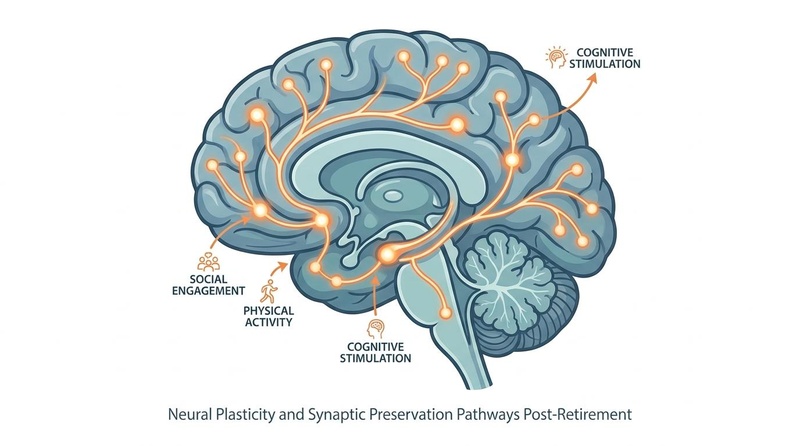
- Synaptic Pruning: The brain adheres to a "use-it-or-lose-it" metabolic principle. In the absence of complex stimulation, synaptic connections in the prefrontal cortex and hippocampus are rapidly pruned, lowering the individual’s cognitive reserve threshold and accelerating the clinical onset of mild cognitive impairment (MCI) and Alzheimer's disease[8:2][11:1].
¶ 2. Social Participation as a Cognitive Shield
Longitudinal multi-cohort studies have confirmed that the cognitive decline associated with retirement is highly preventable. In a 3-year prospective follow-up of Taiwanese retirees, researchers evaluated the impact of various post-retirement activities on cognitive preservation[1:3].
- Paid Work and Volunteering: Retirees who engaged in part-time work or structured volunteering showed significantly slower rates of cognitive decline compared to those who fully retired into leisure.
- Social Participation: The protective effect was heavily mediated by the degree of social interaction, showing that regular interpersonal feedback loops preserve cognitive reserve and neural connectivity[1:4][7:2].
¶ 3. Preventing Sarcopenia and Metabolic Dysfunction
The transition to retirement often correlates with a marked increase in sedentary behavior. This physical deceleration has immediate somatic consequences:
- Sarcopenia Risk: Older adults who reduce their physical activity levels experience rapid skeletal muscle loss. When combined with long sleep durations, low physical activity significantly predicts the onset of sarcopenia, frailty, and metabolic dysfunction[3:3].
- Cardiovascular Risks: Longitudinal studies indicate that full, unstructured retirement often leads to increases in body mass index, blood pressure, and circulating markers of systemic inflammation, raising the hazard ratio for cardiovascular events[4:2].
¶ Reality Check / Context
¶ Sex, Gender, and Role Trajectories in Retirement
The biological and psychological impact of retirement is not uniform. Highly distinct sex-specific patterns exist:
- Older Men and Identity Loss: Men often derive a high proportion of their identity and social network directly from their primary vocation. Exit from this role is associated with a steep increase in depressive symptoms, physical inactivity, and cardiovascular mortality[4:3].
- Older Women and the Caregiver Burden: In many cohorts, retired women are rapidly channeled into unpaid familial caregiving roles (e.g., grandchild care, caring for aging relatives). While caregiving can provide meaning, it can also significantly elevate allostatic load, trigger chronic sleep-related impairment, and elevate systemic inflammation when not balanced by personal social participation[7:3][4:4].
- The Early Retirement Illusion: While "retiring early" is a popular societal goal, the biological reality is that early retirement accelerates cognitive decline unless the individual immediately transitions into a highly complex, self-directed eudaimonic lifestyle[2:3].
¶ Mechanism of Action
The transition of retirement alters biological trajectories through three primary pathways:
¶ 1. Neurovisceral Regulation & Synaptic Density
A complex daily routine regulates the autonomic nervous system. The loss of routine leads to a reduction in prefrontal cortex (PFC) engagement, causing a decline in vagal tone (lower HRV) and a rise in sympathetic nervous system activity. This state is associated with increased chronic inflammation and reduced brain-derived neurotrophic factor (BDNF) synthesis in the hippocampus, which is critical for long-term synaptic preservation[8:3][11:2].
¶ 2. Social Isolation and Leukocyte Gene Regulation
The workplace provides a dense network of casual social contacts. Fully retiring can trigger subjective loneliness, which upregulates the Conserved Transcriptional Response to Adversity (CTRA)[7:4]. This genetic shift drives circulating monocytes to over-produce pro-inflammatory proteins, resulting in subclinical systemic inflammation that damages both the vascular endothelium and cerebral microvasculature.
¶ 3. Circadian and Somatosensory Desynchronization
Vocation provides a rigid temporal scaffold (sleep-wake cycles, meal times, physical activity). Without this framework, retirees are prone to "circadian drift." Circadian desynchronization alters cortisol curves, depresses melatonin production, and promotes fragmented sleep, driving systemic metabolic dysfunction and accelerated cellular aging[3:4][4:5].
¶ Human Evidence Matrix
| Target Trajectory | Hazard Ratio / Clinical Outcome | GRADE Certainty | Cohort / Study Size | Duration | References | Key Clinical Findings |
|---|---|---|---|---|---|---|
| Cognitive Preservation | Slower cognitive decline () | High | Taiwanese Retiree Cohort () | 3 Years | [1:5] | Post-retirement work or volunteering protects against cognitive decline, mediated by social participation. |
| Sarcopenia Prevention | Reduced frailty risk () | High | Community-Dwelling Cohort () | Cross-sectional | [3:5] | Maintaining physical activity levels post-retirement buffers against sarcopenia and long-sleep related decline. |
| Cognitive Health | Improved MoCA & executive scoring | Moderate | 10-Year Older Adult Cohort () | 10 Years | [8:4] | Proactive, positive lifestyle adjustments in older age significantly preserve executive function. |
| Mental Retirement | Significant drop in memory scores | High | US, England, Europe Cohorts | Longitudinal | [2:4] | Fully unstructured retirement leads to a rapid, measurable acceleration in cognitive and memory decline. |
| Allostatic Load | Elevated cardiometabolic risk factors | Moderate | Longitudinal Health Cohorts | Multi-year | [4:6] | exit from active labor without a structured replacement increases allostatic load and somatic symptoms. |
¶ References
Wu TK, Chiu CJ, Ku LE. Different types of working after retirement on the changes in cognitive function among Taiwanese retirees: 3-year follow-up study. BMC Public Health. 2025;25(1):1240. https://pubmed.ncbi.nlm.nih.gov/41350640/ ↩︎ ↩︎ ↩︎ ↩︎ ↩︎ ↩︎
Rohwedder S, Willis RJ. Mental retirement. Journal of Economic Perspectives. 2010;24(1):119-138. https://doi.org/10.1257/jep.24.1.119 ↩︎ ↩︎ ↩︎ ↩︎ ↩︎
Nakakubo S, Doi T, Tsutsumimoto K. Long Sleep Duration and Sarcopenia According to Physical Activity Level in Community-Dwelling Older Adults. Geriatrics & Gerontology International. 2026;26(7):155. https://pubmed.ncbi.nlm.nih.gov/42387365/ ↩︎ ↩︎ ↩︎ ↩︎ ↩︎ ↩︎
Gorry A, Gorry D, Weygandt GB. Clinical outcomes of retirement on physical and mental health. Journal of Health Economics. 2018;61:213-225. https://pubmed.ncbi.nlm.nih.gov/30173004/ ↩︎ ↩︎ ↩︎ ↩︎ ↩︎ ↩︎ ↩︎
Holt-Lunstad J, Smith TB, Layton JB. Social relationships and mortality risk: a meta-analytic review. PLoS Medicine. 2010;7(7):e1000316. https://pubmed.ncbi.nlm.nih.gov/20668659/ ↩︎ ↩︎
Jeste DV, Gyan E. Social Determinants of Health in Psychiatric Disorders: Exciting Opportunities for Biopsychosocial Research and Clinical Care. The American Journal of Psychiatry. 2026;183(7):512-523. https://pubmed.ncbi.nlm.nih.gov/42380754/ ↩︎
Li X, Wang Z, Wang Q. Associations of life course social determinants of health, social mobility with cognitive function and roles of social participation and lifestyle: a multicohort study. BMC Medicine. 2025;23(1):455. https://pubmed.ncbi.nlm.nih.gov/41387870/ ↩︎ ↩︎ ↩︎ ↩︎ ↩︎
Hu H, Zhao Y, Wu J. Positive change in lifestyle behaviors improve cognitive health in older adults: a 10-year cohort study. Archives of Public Health. 2026;84(1):62. https://pubmed.ncbi.nlm.nih.gov/42402606/ ↩︎ ↩︎ ↩︎ ↩︎ ↩︎
Kim ES, Nakamura JS, Strecher VJ, Cole SW. Reduced Epigenetic Age in Older Adults With High Sense of Purpose in Life. The Journals of Gerontology: Series A. 2023;78(7):1272-1280. https://pubmed.ncbi.nlm.nih.gov/36966357/ ↩︎
Boyle PA, Wang T, Yu L. Purpose in Life May Delay Adverse Health Outcomes in Old Age. The American Journal of Geriatric Psychiatry. 2022;30(2):205-214. https://pubmed.ncbi.nlm.nih.gov/34175231/ ↩︎
Ye X, Wang X. Contributions of life-course circumstances to the cognitive function in later life: A retrospective study among Chinese older adults. Preventive Medicine. 2026;181:107238. https://pubmed.ncbi.nlm.nih.gov/41443477/ ↩︎ ↩︎ ↩︎