¶ title: Scalp Health: Dandruff, Itching, and Seborrheic Dermatitis
description: A clinically detailed, evidence-based deep dive into diagnosing, treating, and managing chronic scalp inflammation, itching, and flaking.
published: 1
date: 2026-07-06T18:24:35.326Z
tags: protocols, scalp-health, dandruff, seborrheic-dermatitis, malassezia, skin-barrier
editor: markdown
dateCreated: 2026-07-06T18:24:35.326Z
¶ Scalp Health: Dandruff, Itching, and Seborrheic Dermatitis
¶ Layer 1: The Executive Dashboard
| Metric | Target / Status |
|---|---|
| Primary Indication | Chronic scalp flaking, pruritus (itching), and erythema (redness) [1][2] |
| Primary Target | Malassezia globosa & Malassezia restricta lipid-dependent yeasts [1:1][3] |
| Regulatory Status | OTC medicated shampoos (US FDA: zinc pyrithione up to 2%, selenium sulfide 1%, ketoconazole 1%) [4][5]. Ketoconazole 2%, ciclopirox olamine 1.5%, and topical steroids require a prescription [4:1]. |
| EU Ban Status | Zinc pyrithione (ZPT) has been prohibited in the European Union since March 2022 due to Category 1B reproductive toxicity classification [6]. SCCS acknowledges rinse-off forms under 1% are safe, but a precautionary ban took effect because it was not proven to be irreplaceable [6:1]. |
¶ Safety "Traffic Light"
CRITICAL CONTRAINDICATIONS & WARNINGS
- RED (STOP): Avoid topical corticosteroids for more than 2 consecutive weeks without clinical supervision due to risks of skin atrophy, telangiectasia, and rebound flares [4:2].
- YELLOW (CAUTION): Selenium sulfide can discolor light, blonde, or chemically treated hair; rinse thoroughly for at least 5 minutes [5:1]. Avoid applying heavy botanical oils (coconut, olive, argan) as they feed Malassezia overgrowth [7].
- GREEN (GO): Ketoconazole 2% and Ciclopirox Olamine 1.5% shampoos are safe and highly effective for long-term maintenance when used once-weekly [8][9]. Pure MCT oil (C8/C10 only) is fully safe for dry scalp hydration [7:1].
¶ Protocol Card
¶ Initial Clearance Protocol (Weeks 1-4)
- Indication: Active flaking, moderate-to-severe itching, and greasy scales.
- Primary Treatment: Ketoconazole 2% shampoo (or Ciclopirox Olamine 1.5% shampoo) used 2-3 times per week [4:3][8:1][9:1].
- Application: Wet hair thoroughly, massage shampoo directly into the scalp, and leave on for 5 full minutes to allow active drug penetration into the stratum corneum before rinsing [4:4].
- Keratolytic Add-on: If thick scales are present, apply a 2-3% Salicylic Acid pre-wash or shampoo 30 minutes before the antifungal wash to dissolve intercellular cement [10].
¶ Maintenance Protocol (Weeks 5+)
- Indication: Controlled scaling, resolved erythema, and minimized itching.
- Maintenance Treatment: Reduce medicated shampoo (Ketoconazole or Ciclopirox) to once-weekly [8:2].
- Interim Cleansing: On other days, use a mild, sulfate-free, non-stripping shampoo to preserve the scalp's natural lipid barrier.
¶ The Bottom Line
Dandruff and seborrheic dermatitis are chronic, lipid-dependent inflammatory conditions driven by an abnormal host immune response to Malassezia yeast metabolites [1:2][2:1]. Systematic reviews show that rotating targeted topical antifungals (ketoconazole, ciclopirox) with mild keratolytics (salicylic acid) resolves over 85% of acute flares within 4 weeks and maintains remission when applied weekly [4:5][8:3][10:1].
¶ Layer 2: The Contextual Narrative
¶ Quick Answer
Dandruff and seborrheic dermatitis (SD) exist on a continuous clinical spectrum of the same inflammatory skin condition [1:3][11]. Dandruff represents the milder, non-inflammatory form restricted to the scalp, characterized by flaking and mild itching [11:1]. Seborrheic dermatitis is the more severe, inflammatory form that presents with greasy, yellowish scales, prominent redness (erythema), and moderate-to-severe pruritus [2:2][4:6]. Both conditions are triggered by lipophilic Malassezia yeast species that feed on scalp sebum, producing irritating free fatty acid metabolites (especially oleic acid) that breach the skin barrier in susceptible individuals [1:4][3:1].
¶ What It Is
To understand scalp flaking, it is crucial to differentiate between dry scalp, classic dandruff, seborrheic dermatitis, and scalp psoriasis.
- Dry Scalp: A simple lack of moisture and hydration in the stratum corneum, often exacerbated by cold dry weather, low humidity, or harsh surfactant shampoos. The flakes are tiny, dry, and white, and there is no underlying fungal overgrowth or clinical inflammation.
- Dandruff: A mild hyperproliferative skin state. While normal scalp skin cells shed imperceptibly over a 28-day cycle, dandruff accelerates this turnover to 7-14 days. This acceleration causes cells to shed in visible, cohesive clusters of hundreds of cells [1:5].
- Seborrheic Dermatitis (SD): A chronic, relapsing eczema that affects areas of high sebaceous gland density (scalp, face, ears, chest) [2:3]. It features marked inflammation, erythema, and greasy scales [4:7].
- Scalp Psoriasis: A systemic, T-cell-mediated autoimmune disorder characterized by rapid epidermal hyperproliferation (cell turnover cycle of 3-5 days), leading to thick, silvery-white, highly adherent plaques [12].
¶ Type-Identification Table: Scalp Conditions
| Feature | Dry Scalp | Dandruff | Seborrheic Dermatitis | Scalp Psoriasis |
|---|---|---|---|---|
| Scale Appearance | Tiny, fine, dry, white | Medium, loose, white-to-grayish | Large, greasy, yellow-to-brownish | Thick, silvery-white, highly adherent |
| Underlying Skin | Normal, non-inflamed | Normal-to-pink, non-inflamed | Red (erythema), inflamed, greasy | Well-demarcated red plaques; bleeds if picked |
| Itching Severity | Mild, occasional | Mild-to-moderate, persistent | Moderate-to-severe, highly irritating | Severe, intense, painful |
| Typical Locations | Diffuse across scalp | Diffuse across scalp | Scalp, eyebrows, nasolabial folds, ears | Scalp, forehead hairline, elbows, knees |
| Trichoscopy Signs | Fine white scales; normal vessels [13] | Thin white-yellow scales; no vascular alterations | Arborizing red lines; hidden hairs; thin yellow scales [13:1] | Dotted/glomerular vessels; thick white scales [14] |
| Auscipitz Sign | Negative | Negative | Negative | Positive (pinpoint bleeding when scale is removed) |
¶ Layer 3: The Evidence Room
¶ Pathophysiology and Biological Mechanisms
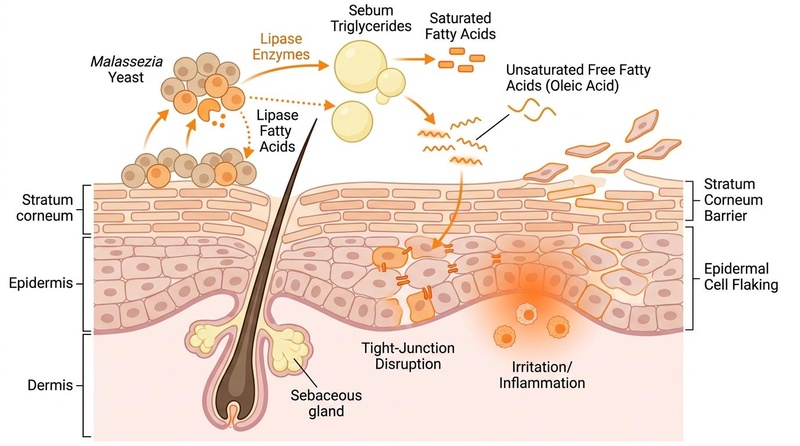
The pathogenesis of dandruff and seborrheic dermatitis relies on three obligatory, interacting components: sebaceous gland secretions, microbial metabolism, and individual host susceptibility [2:4].
¶ 1. Sebaceous Lipids as a Substrate
Sebaceous glands secrete sebum, an oily mixture composed of triglycerides (~45%), wax esters (~25%), squalene (~12%), and free fatty acids [3:2]. Sebum production is under androgenic control and peaks during puberty and early adulthood, matching the peak demographic incidence of dandruff and SD [11:2].
¶ 2. Malassezia Lipases and Carbon Chain Specificity
Malassezia species (M. globosa and M. restricta) are obligate lipophilic yeasts. Because their genomes lack fatty acid synthase genes, they cannot synthesize their own fatty acids and must acquire them from host sebum [3:3].
- Malassezia secretes extracellular lipases that hydrolyze sebum triglycerides, cleaving them into free fatty acids and glycerol [3:4].
- The yeast selectively consumes saturated fatty acids with carbon chain lengths of C11 to C24 [7:2].
- Unsaturated fatty acids, particularly oleic acid (C18:1), are left behind on the scalp surface [1:6].
¶ 3. Free Fatty Acid Penetration & Barrier Disruption
In susceptible individuals, the remaining oleic acid penetrates the stratum corneum [1:7].
- Oleic acid acts as a chemical irritant, disrupting the highly ordered lipid lamellar structure (ceramides, cholesterol, free fatty acids) of the stratum corneum [1:8].
- This physical barrier breach leads to increased transepidermal water loss (TEWL) and allows further penetration of environmental irritants [11:3].
- The host immune system responds to this barrier breach by releasing pro-inflammatory cytokines (IL-1α, IL-1β, IL-8, TNF-α), initiating a localized inflammatory cascade [2:5].
- The inflammatory signals trigger a compensatory, rapid hyperproliferation of keratinocytes, culminating in abnormal desquamation (flaking) and pruritus [1:9][11:4].
¶ 4. Squalene Peroxidation and Oxidative Stress
In addition to free fatty acids, squalene on the scalp surface undergoes peroxidation due to UV exposure and microbial activity [15]. The resulting squalene peroxides act as potent inflammatory mediators, compounding the barrier disruption and further driving the chronicity of seborrheic dermatitis [15:1].
¶ Human Evidence Snapshot
The following clinical trials represent the highest tier of peer-reviewed evidence evaluating therapeutic efficacy for dandruff and seborrheic dermatitis.
| Intervention | Typical Clinical Efficacy | Cert. | Study Details | Key Out-of-Sample Outcome Notes |
|---|---|---|---|---|
| Ketoconazole 2% | 70–85% clinical clearance or marked improvement of scaling and itching within 4 weeks. | High | Multiple RCTs; gold-standard first-line antifungal [4:8][5:2][8:4]. | Superior to 1% formulations; excellent long-term safety and low relapse rate when used weekly for maintenance [5:3][8:5]. |
| Selenium Disulfide 1% | Equivalent efficacy to Ketoconazole 2% shampoo over a 28-day treatment period. | High | Randomized, single-blind clinical trial (n=42) [3:5]. | Significantly improves scalp scaling, redness, and itching; highly effective at preventing relapse when used weekly [3:6]. |
| Ciclopirox Olamine 1.5% | Equivalent-to-superior efficacy compared to Ketoconazole 2% shampoo. | High | Randomized, comparative multi-center RCT [9:2]. | Shows higher patient satisfaction for itching relief; possesses dual antifungal and intrinsic anti-inflammatory properties [9:3]. |
| Tea Tree Oil 5% | 41% reduction in dandruff severity score vs. 11% for placebo over 4 weeks. | Mod. | Single-blind, parallel-group RCT (n=126) [16]. | Significantly reduces pruritus and grease scores; well-tolerated, but rare contact sensitization (allergic contact dermatitis) can occur [16:1]. |
| Selenium Sulfide 2.5% | Significant reduction in adherent dandruff; highly effective cytostatic agent. | High | Double-blind, placebo-controlled RCT comparing to Ketoconazole 2% [5:4]. | Equal clinical efficacy to ketoconazole, but associated with higher rates of local irritation, hair oiliness, and a distinct sulfur odor [5:5]. |
| Salicylic Acid 2% / Piroctone Olamine | Significant normalization of scalp barrier, TEWL, and microflora within 4 weeks. | Mod. | Cohort study and clinical evaluations [10:2]. | Excellent keratolytic action; helps dissolve thick adherent scales, facilitating the penetration of co-applied antifungals [10:3]. |
| Narrowband UVB (NB-UVB) | Marked clinical improvement or complete clearance in severe, refractory cases. | Mod. | Prospective clinical trial, 3x weekly up to 8 weeks [17]. | Excellent physical option for severe, extensive, or drug-resistant seborrheic dermatitis; suppresses fungal growth and dampens T-cell inflammation [17:1]. |
¶ Comprehensive Safety, Toxicology, and Side Effects
While topical scalp treatments are generally safe due to low systemic absorption, clinical application requires an understanding of potential local adverse effects and regulatory differences.
¶ 1. Local Side Effects and Tolerability
- Selenium Sulfide: Can cause scalp irritation, dryness, or conversely, a compensatory increase in hair oiliness [5:6]. It can react with hair dyes or chemical treatments, leading to hair discoloration. Complete, thorough rinsing is mandatory [5:7].
- Coal Tar: Highly effective but can cause folliculitis, local burning, contact dermatitis, and photosensitivity (increased sensitivity to sunlight) [18]. It can stain light-colored, blonde, or grey hair and has a strong, persistent coal tar odor.
- Topical Corticosteroids: Extended use on the scalp can cause skin thinning (atrophy), telangiectasia (broken capillaries), folliculitis, and local burning. Abrupt cessation after prolonged use can trigger a severe rebound flare of seborrheic dermatitis [4:9].
- Tea Tree Oil: Undiluted or poorly formulated tea tree oil can cause severe allergic contact dermatitis due to oxidized monoterpenes (such as limonene and linalool). Formulations must be kept stable and restricted to 5% concentration [16:2].
¶ 2. Regulatory and Environmental Toxicology: The EU Zinc Pyrithione Ban
Zinc Pyrithione (ZPT) was a global mainstay of anti-dandruff formulations for decades. However, effective March 1, 2022, the European Union prohibited ZPT in all cosmetic products (Regulation EU 2021/1902) [6:2].
- Reasoning: Under the European Chemicals Agency (ECHA), ZPT was reclassified as a Category 1B Reproductive Toxicant (CMR - Carcinogenic, Mutagenic, or Reprotoxic) [6:3].
- Clinical Context: The Scientific Committee on Consumer Safety (SCCS) concluded that rinse-off hair products containing up to 1% ZPT are safe for individual consumers [6:4]. However, under EU REACH regulations, because the industry could not conclusively prove that there are no viable, safer alternative anti-dandruff ingredients, a precautionary ban was enacted to minimize environmental and aquatic accumulation [6:5].
- US FDA Status: The US FDA continues to permit Zinc Pyrithione as an active ingredient in over-the-counter anti-dandruff and anti-seborrheic dermatitis shampoos at concentrations up to 2%.
¶ What Fails: Common Pitfalls and Myths
Understanding what worsens scalp health is as important as active treatments.
¶ Pitfall 1: Applying Heavy Botanical Oils (The Coconut Oil Myth)
- The Myth: Applying coconut, olive, argan, or avocado oil hydrates a dry, flaking scalp.
- The Reality: While these oils feel moisturizing, they are rich in fatty acids (like lauric acid C12 in coconut oil, and oleic acid C18 in olive oil) that fall directly into the C11-C24 carbon chain length range [7:3][14:1]. These lipids serve as a direct food source for Malassezia, accelerating fungal proliferation, barrier degradation, and flaking [1:10][7:4].
- The Solution: Use pure MCT oil (caprylic C8 and capric C10 triglycerides). Because these carbon chains are below C11, Malassezia cannot metabolize them, and caprylic acid itself exhibits mild, natural antifungal properties [14:2].
¶ Pitfall 2: Overwashing with High-Surfactant Sulfate Shampoos
- The Myth: Greasy flakes mean you must wash your hair aggressively every day with harsh clarifying shampoos.
- The Reality: Excessive washing with harsh sulfates (e.g., Sodium Lauryl Sulfate) strips the delicate scalp lipid barrier [11:5]. This strips the tight junctions of the epidermis, increasing TEWL and triggering a compensatory hyper-secretion of sebum, feeding more yeast and worsening the cycle.
¶ Pitfall 3: Inadequate Medicated Shampoo Contact Time
- The Myth: Medicated shampoos work like regular soap—lather and rinse immediately.
- The Reality: Active ingredients (ketoconazole, selenium disulfide, ciclopirox) require contact time to penetrate the lipid-rich stratum corneum and hair follicles [4:10]. Rinsing immediately results in sub-therapeutic drug concentrations on the scalp, leading to treatment failure. Shampoos must be left on for 3 to 5 minutes [4:11].
¶ Tracking and N-of-1 Protocol Optimization
Managing scalp health is highly individualized. An N-of-1 trial structure helps optimize treatment rotation.
¶ N-of-1 Scalp Optimization Protocol
- Baseline (Week 0): Document flaking, redness, and itching severity on a 1-10 visual analogue scale (VAS). Part hair in 3 standard areas (vertex, left temple, right temple) and take high-resolution baseline photographs.
- Intervention Phase (Weeks 1-4): Apply Ketoconazole 2% shampoo 3 times per week, ensuring 5 minutes of contact time. Use a gentle, sulfate-free cleanser on non-treatment days. Do not apply any heavy hair oils.
- Evaluation (Week 4): Re-assess VAS scores and repeat photographs. If flaking is resolved but mild redness/itching persists, transition to a once-weekly Ketoconazole wash and introduce a twice-weekly Ciclopirox Olamine or Salicylic Acid wash to target inflammation [9:4][10:4].
¶ Subjective & Objective Biomarker Tracking
- Trisection Pruritus Score (TPS): Rate scalp itching from 0 (none) to 3 (severe, sleep-disrupting) across the frontal, vertex, and occipital scalp zones daily.
- Adherent Flaking Score (AFS): Rate visible scalp flakes on a 0 (clear scalp) to 4 (thick, confluent, adherent plates) scale weekly.
- Transepidermal Water Loss (TEWL): In a clinical research setting, scalp barrier restoration can be tracked using a tewameter; successful therapy typically reduces scalp TEWL back to normal baseline ranges (<15 g/m²/h) [10:5].
¶ FAQs
¶ Is dandruff caused by poor hygiene?
No. Dandruff and seborrheic dermatitis are inflammatory responses to yeast metabolites and are not caused by poor hygiene [1:11][2:6]. However, infrequent washing can allow sebum and dead skin cells to accumulate, providing more substrate for Malassezia and exacerbating symptoms [3:7].
¶ Can I use tea tree oil directly on my scalp?
No. Pure, undiluted tea tree oil is highly concentrated and can cause severe chemical irritation or allergic contact dermatitis [16:3]. To use tea tree oil safely, select a pre-formulated shampoo stabilized at 5% concentration, or dilute a few drops of pure oil into a safe carrier like MCT oil (C8/C10) before application [16:4].
¶ Why does my dandruff get worse in the winter?
Winter weather is associated with low outdoor humidity and dry indoor heating, which rapidly dehydrates the stratum corneum [11:6]. This environmental dryness compromises the scalp skin barrier, making it significantly more vulnerable to irritation from Malassezia free fatty acid metabolites [1:12].
¶ Does dandruff cause permanent hair loss?
Dandruff and seborrheic dermatitis do not directly damage hair follicles or cause permanent hair loss [4:12]. However, severe, untreated inflammation and intense, chronic scratching can cause temporary hair shedding (telogen effluvium) or physical damage to the hair shaft [4:13]. Resolving the scalp inflammation fully restores normal hair growth cycles.
¶ Is apple cider vinegar effective for dandruff?
Apple cider vinegar (ACV) is a popular home remedy, but there is a lack of rigorous, peer-reviewed clinical trial data supporting its efficacy compared to standard antifungals [4:14]. While ACV's acidity may temporarily alter the scalp's pH, making it less hospitable to yeast, formulated medicated shampoos (like ketoconazole or selenium sulfide) are vastly superior and backed by high-certainty clinical evidence [3:8][5:8].
¶ References
DeAngelis YM, Gemmer CM, Kaczvinsky JR, et al. Dandruff and seborrheic dermatitis likely result from scalp barrier breach and irritation induced by Malassezia metabolites, particularly free fatty acids. Journal of the American Academy of Dermatology. 2005;52(3):P1-P8. https://www.jaad.org/article/S0190-9622(04)02982-2/fulltext ↩︎ ↩︎ ↩︎ ↩︎ ↩︎ ↩︎ ↩︎ ↩︎ ↩︎ ↩︎ ↩︎ ↩︎ ↩︎
Dawson TL Jr. Three etiologic facets of dandruff and seborrheic dermatitis: Malassezia fungi, sebaceous lipids, and individual sensitivity. Journal of Investigative Dermatology Symposium Proceedings. 2005;10(3):295-297. https://pubmed.ncbi.nlm.nih.gov/16382685/ ↩︎ ↩︎ ↩︎ ↩︎ ↩︎ ↩︎ ↩︎
Massiot P, Clavaud C, Thomas M, et al. A Comparative Randomized Clinical Study Assessing the Efficacy of a 1% Selenium Disulfide-Based Shampoo versus 2% Ketoconazole Shampoo in Subjects with Moderate to Severe Scalp Seborrheic Dermatitis. Skin Appendage Disorders. 2024;10(6):497-505. https://pmc.ncbi.nlm.nih.gov/articles/PMC11627539/ ↩︎ ↩︎ ↩︎ ↩︎ ↩︎ ↩︎ ↩︎ ↩︎ ↩︎
Sasseville D, et al. Diagnosis and Treatment of Seborrheic Dermatitis. American Family Physician (AFP). 2015;91(3):185-190. https://www.aafp.org/pubs/afp/issues/2015/0201/p185.pdf ↩︎ ↩︎ ↩︎ ↩︎ ↩︎ ↩︎ ↩︎ ↩︎ ↩︎ ↩︎ ↩︎ ↩︎ ↩︎ ↩︎ ↩︎
Danby FW, Margesson LJ, Rapeport SY. A randomized, double-blind, placebo-controlled trial of ketoconazole 2% shampoo versus selenium sulfide 2.5% shampoo in the treatment of moderate to severe dandruff. Journal of the American Academy of Dermatology. 1993;29(2 Pt 1):280-284. https://pubmed.ncbi.nlm.nih.gov/8245236/ ↩︎ ↩︎ ↩︎ ↩︎ ↩︎ ↩︎ ↩︎ ↩︎ ↩︎
Critical Catalyst. EU Prohibition of Zinc Pyrithione in Cosmetic Products. https://criticalcatalyst.com/eu-prohibition-of-zinc-pyrithione-in-cosmetic-products/ ↩︎ ↩︎ ↩︎ ↩︎ ↩︎ ↩︎
Dermazen. The Truth About Oils for Seborrheic Dermatitis, Dandruff, & Fungal Acne – What to use and avoid. https://www.dermazen.com/blogs/news/the-truth-about-oils-for-seborrheic-dermatitis-dandruff-fungal-acne-what-to-use-and-avoid ↩︎ ↩︎ ↩︎ ↩︎ ↩︎
Narayanan S, et al. Seborrheic Dermatitis Revisited: Pathophysiology, Diagnosis, and Emerging Therapies—A Narrative Review. Pharmaceuticals. 2024;17(3):324. https://pmc.ncbi.nlm.nih.gov/articles/PMC12562114/ ↩︎ ↩︎ ↩︎ ↩︎ ↩︎ ↩︎
Ratnavel RC, Squire RA, Boorman GC. Clinical efficacies of shampoos containing ciclopirox olamine (1.5%) and ketoconazole (2.0%) in the treatment of seborrhoeic dermatitis. British Journal of Dermatology. 2001;144(5):1033-1037. https://www.researchgate.net/publication/6313187_Clinical_efficacies_of_shampoos_containing_ciclopirox_olamine_15_and_ketoconazole_20_in_the_treatment_of_seborrhoeic_dermatitis ↩︎ ↩︎ ↩︎ ↩︎ ↩︎
Ge L, Liu Z, Xu S, et al. A Cohort Clinical Study on the Efficacy of Topical Salicylic Acid/Piroctone Olamine Dandruff Pre-Gel and Cleanser in Improving Symptoms of Moderate to Severe Seborrheic Dermatitis of the Scalp. Journal of Cosmetic Dermatology. 2025;24(1):e11705. https://pmc.ncbi.nlm.nih.gov/articles/PMC11705510/ ↩︎ ↩︎ ↩︎ ↩︎ ↩︎ ↩︎
Borda LJ, Wikramanayake MT. Seborrheic Dermatitis and Dandruff: A Comprehensive Review. Journal of Clinical and Investigative Dermatology. 2015;3(2):10.13188. https://pmc.ncbi.nlm.nih.gov/articles/PMC4852869/ ↩︎ ↩︎ ↩︎ ↩︎ ↩︎ ↩︎ ↩︎
Mayo Clinic. Scalp psoriasis vs. seborrheic dermatitis: What's the difference? https://www.mayoclinic.org/diseases-conditions/psoriasis/expert-answers/scalp-psoriasis/faq-20058544 ↩︎
Kibar M, Aktan S, Bilgin M. Applicability of Trichoscopy in Scalp Seborrheic Dermatitis. Dermatology Practical & Conceptual. 2019;9(2):123-131. https://pmc.ncbi.nlm.nih.gov/articles/PMC6463453/ ↩︎ ↩︎
Kim GW, et al. Dermoscopic Findings in Scalp Psoriasis and Seborrheic Dermatitis; Two New Signs; Signet Ring Vessel and Hidden Hair. Annals of Dermatology. 2015;27(1):59-65. https://pmc.ncbi.nlm.nih.gov/articles/PMC4318061/ ↩︎ ↩︎ ↩︎
Jourdain R, Mordon S, et al. Exploration of scalp surface lipids reveals squalene peroxide as a potential actor in dandruff condition. Arch Dermatol Res. 2016;308:153-163. https://pmc.ncbi.nlm.nih.gov/articles/PMC4796319/ ↩︎ ↩︎
Satchell AC, Saurajen A, Bell C, Barnetson RS. Treatment of dandruff with 5% tea tree oil shampoo. Journal of the American Academy of Dermatology. 2002;47(6):852-855. https://pubmed.ncbi.nlm.nih.gov/12451368/ ↩︎ ↩︎ ↩︎ ↩︎ ↩︎
Pirkhammer D, Seeber A, Hönigsmann H, Tanew A. Narrow-band ultraviolet B (TL-01) phototherapy is an effective and safe treatment option for patients with severe seborrhoeic dermatitis. British Journal of Dermatology. 2000;143(5):964-968. https://academic.oup.com/bjd/article-pdf/143/5/964/47490756/bjd0964.pdf ↩︎ ↩︎
DailyMed. EQUATE EXTRA STRENGTH THERAPEUTIC DANDRUFF ANTI-DANDRUFF, ANTI-SEBORRHEIC DERMATITIS, ANTI-PSORIASIS- coal tar shampoo. https://dailymed.nlm.nih.gov/dailymed/drugInfo.cfm?setid=986ac1ab-c7c3-40df-b41b-6f26cce22a43 ↩︎