¶ Social Connection: Neurobiology of Loneliness and Interpersonal Co-Regulation
¶ At a Glance
¶ Overview
Social connection is a fundamental bio-behavioral drive. Within human physiology, the subjective perception of social connection determines autonomic nervous system states. While objective social isolation is a structural count of social contacts, subjective loneliness acts as a chronic biological stressor that triggers a systemic, pro-survival hyper-alert state.
¶ Safety "Traffic Light"
- Green Light: Consistent feelings of safety, warmth, and trust in close relationships; elevated parasympathetic vagal tone (high resting heart rate variability).
- Yellow Light: Relying primarily on digital, text-based interactions; experiencing emotional distance or secure-attachment strain despite frequent superficial social contacts.
- Red Light: Experiencing chronic, unmitigated feelings of being misunderstood or physically isolated; presenting persistent sympathetic hyper-arousal or dissociation (dorsal vagal freeze).
¶ Protocol Card
| Intervention | Target Frequency | Neurobiological Pathway | Expected Clinical Outcome |
|---|---|---|---|
| In-Person Co-Regulation | ≥3 face-to-face sessions/week | Ventral Vagal Complex (VVC) activation | Suppressed cortisol; elevated oxytocin |
| Prosody & Facial Synchrony | Daily verbal/visual exchanges | V cranial nerve & facial nerve safety loop | Downregulated amygdala threat response |
| Co-Regulated Breathing | Weekly shared somatic practice | Respiratory Sinus Arrhythmia (RSA) optimization | Accelerated heart rate variability (HRV) recovery |
¶ Bottom Line
Subjective loneliness increases all-cause mortality risk by 26%, representing a biological damage profile equivalent to chronic clinical anxiety and accelerated cellular senescence[1].
¶ The Contextual Narrative
¶ The "Why" (Mechanisms of Safety)
The mammalian brain is wired to assess risk constantly. According to the Polyvagal Theory, our nervous system performs "neuroception"—a subconscious evaluation of environmental and relational safety[2].
If neuroception detects safety:
- The Ventral Vagal Complex (VVC)—the newest evolutionary branch of the vagus nerve—inhibits the sympathetic nervous system's fight-or-flight circuits.
- The VVC acts as a "vagal brake," slowing heart rate and promoting high heart rate variability (HRV)[3].
- This physiological state allows the face-heart connection to engage: the cranial nerves controlling facial expression, eye contact, and vocal tone synchronize with your heart rate.
- This state enables restorative physiological functions: cellular repair, immune optimization, and neurogenesis.
When safety is absent (loneliness), the vagal brake is released. The sympathetic nervous system dominates, preparing the body for a physical threat, which causes vascular constriction, elevated resting heart rate, and chronic systemic inflammation.
¶ Loneliness vs. Social Isolation
Clinical assessments must distinguish between these two phenomena:
- Social Isolation: An objective, structural deficit in the size of one's social network. It is a count of physical contacts.
- Loneliness: A subjective, painful emotional state resulting from a discrepancy between desired and actual social intimacy.
An individual can have a small, isolated social network but feel highly connected and biologically secure. Conversely, an individual can be surrounded by a dense social network (e.g., in a busy city or corporate office) but experience profound loneliness and high sympathetic stress[4]. Both states damage health, but they operate through distinct physiological pathways: social isolation limits practical resources and physical assistance, whereas loneliness directly disrupts nervous-system homeostasis.
¶ Commercial & Digital Tradeoffs
Modern commercial environments offer digital connectivity as a substitute for human presence. However, digital communication (texting, social media feeds, and email) strips away the sensory channels that mammalian brains require for co-regulation.
We cannot co-regulate with a screen. Human physiology relies on multi-sensory safety loops:
- Micro-expressions: Millisecond facial changes processed by the fusiform face area.
- Vocal Prosody: Frequency variations in the human voice that signal safety to the middle ear muscles.
- Interpersonal Synchrony: The micro-matching of movement, pupil dilation, and heart rate that occurs during shared physical space.
Relying on digital connection creates a "biophysical mismatch"—the brain processes information but the autonomic nervous system remains un-regulated, maintaining a subtle, chronic threat state.
¶ The Evidence Room
¶ Mechanism of Action
The cardioprotective and stress-buffering effects of social connection are mediated by a tightly integrated cardiovagal-oxytocin pathway[5].
Central oxytocin is synthesized in the paraventricular nucleus (PVN) of the hypothalamus. During safe social interactions, oxytocin is released into the systemic circulation and projects directly to the brainstem. In the brainstem, oxytocin binds to receptors on the Ventral Vagal Complex, enhancing cardiovagal output.
This efferent vagal signal travels via the vagus nerve to the heart's sinoatrial (SA) node, where it increases the time interval between consecutive heartbeats during exhalation—a phenomenon known as Respiratory Sinus Arrhythmia (RSA). Elevated RSA manifests as increased heart rate variability (HRV). High HRV serves as a direct biophysical biomarker of a highly responsive, safe autonomic nervous system, capable of buffering the body against chemical and physical stressors.
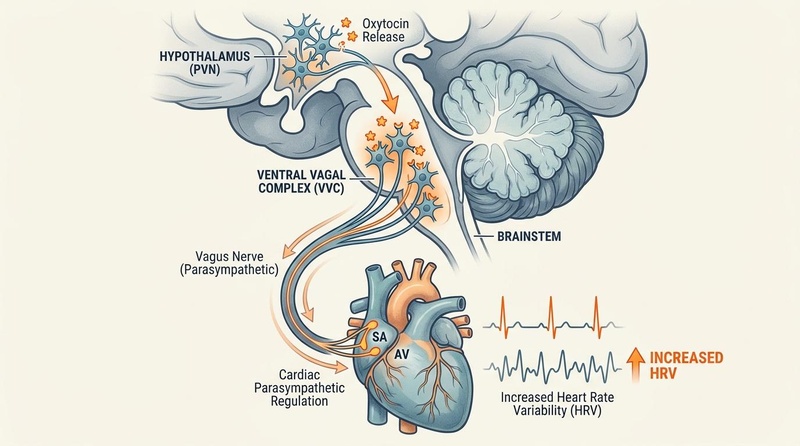
Figure 2: The cardiovagal-oxytocin pathway. Hypothalamic oxytocin release stimulates the Ventral Vagal Complex, enhancing vagal tone and elevating heart rate variability (HRV).
¶ Human Effect Matrix (Evidence Summary)
| Outcome | Typical Effect Size | Certainty Grade (GRADE) | Timeframe to Benefit | Supporting Studies |
|---|---|---|---|---|
| All-Cause Mortality (Loneliness) | 26% increased mortality risk (HR: 1.26) | High | Observed over multiple decades | Holt-Lunstad et al., 2015[1:1] |
| Vagal Tone Regulation | Significant elevation in HF-HRV & RSA | Moderate | Instantaneous during in-person co-regulation | Kemp et al., 2012[3:1]; Quintana et al., 2013[5:1] |
| Sympathetic System Buffering | Blunted cortisol spike during acute pain/stress | Moderate | Immediate post-interaction | Riem et al., 2021[6] |
| Inflammatory Gene Suppression | Downregulation of systemic leukocyte CTRA genes | Moderate | 4-12 weeks of consistent safety loop | Cacioppo et al., 2015[4:1] |
¶ Demographics and Life-Stage Stress Profiles
The neurobiology of safety and coregulation is highly shaped by endocrine parameters and chronological age.
¶ 1. Biological Sex Profiles
- Females (Tend-and-Befriend Chemistry): Estrogen acts as a massive amplifier of the central oxytocin system. In women, safe relational connection rapidly triggers hypothalamic oxytocin synthesis and VVC activation, shutting down HPA-axis cortisol release and suppressing systemic inflammation[7]. Conversely, social rejection or loneliness triggers high levels of pro-inflammatory leukocyte signaling, rendering pre-menopausal women highly sensitive to immune dysregulation when isolated.
- Males (Vasopressin & Side-by-Side Co-Regulation): Men's social bonding is heavily modulated by arginine vasopressin (AVP) acting in synergy with testosterone[7:1]. AVP promotes protective, territorial, and structural group alignment. Men are biologically less wired for rapid verbal emotional disclosure under stress and are more prone to elevated resting heart rate and arterial constriction when subject to loneliness. Men co-regulate most efficiently through rhythmic, shared physical tasks that activate the motor and cardiorespiratory synchronization networks.
¶ 2. Lifespan Vulnerability Nodes
- Adolescence and Young Adults (Ages 12–30): This phase represents peak neural sensitivity to social feedback. Myelination of the prefrontal-vagal loop is incomplete, leaving young adults highly vulnerable to digital rejection. Loneliness at this stage acts as a primary catalyst for early HPA axis dysregulation, sleep fragmentation, and elevated baseline blood pressure.
- Middle-Adulthood Sandwich Phase (Ages 31–64): Social connection is often compromised by high-stakes professional and caregiving commitments. Loneliness manifests as chronic, low-grade allostatic load, manifesting clinically as visceral adiposity, glucose intolerance, and progressive loss of heart rate variability.
- Older Adulthood (Ages 65+): Loss of partners, retirement, and sensory decline (hearing/vision loss) limit co-regulation options. Sensory isolation reduces cranial nerve input (specifically CN VII and VIII) to the Ventral Vagal Complex, releasing the vagal brake and driving older adults into a state of chronic sympathetic alert or dorsal vagal shutdown, accelerating cellular senescence and cognitive decline.
¶ Protocols: Practical prescriptions
¶ 1. The In-Person Co-Regulation Protocol
- Goal: Direct autonomic regulation through physical synchrony.
- Action Plan:
- The 3-Face Rule: Ensure a minimum of three in-person, face-to-face social interactions per week, each lasting at least 45 minutes. These interactions must prioritize open, non-defensive conversation.
- Shared Somatic Space: Participate in weekly activities that require physical and rhythmic synchrony (e.g., group singing, partner dancing, team athletic training, or eating family-style meals). Rhythmic group activities activate the ancient evolutionary pathways of cooperative safety.
¶ 2. The Digital Detox & Replacement Protocol
- Goal: Eliminating biophysical mismatches from digital networks.
- Action Plan:
- Voice Over Text: Replace text-based messaging with voice notes or phone calls. High-frequency vocal prosody stimulates the middle ear muscles, sending safety signals to the brainstem.
- Video Over Audio: If physical distance prevents in-person contact, prioritize video calls over standard phone calls. Ensure the camera is at eye level to allow the capture of facial micro-expressions.
- Passive Social Media Cessation: Stop passive scrolling of social media feeds. Passive viewing triggers social comparison without co-regulation, raising sympathetic stress markers.
¶ 3. The Sensory Safety Loop (Somatic Prescriptions)
- Goal: Activating the vagal brake manually through sensory inputs.
- Action Plan:
- Eye Contact Drills: Practice prolonged, relaxed eye contact (3-5 seconds) with trusted partners, friends, or family members. Avoid staring; maintain relaxed facial musculature to signal safety.
- Safe Touch Integration: If available, integrate professional therapeutic massage or safe, consensual touch (hugs lasting ≥20 seconds) into your weekly routine. Long-duration hugs stimulate systemic oxytocin release, lowering resting blood pressure.
¶ Clinical Measurement and Cardiovagal Diagnostics
Autonomic safety loops can be quantified using non-invasive clinical metrics. Use these protocols to evaluate baseline tone and track therapeutic progress.
¶ 1. Quantitative Biomarkers
- Respiratory Sinus Arrhythmia (RSA) Amplitude: Evaluates the strength of cardiovagal coupling. High-resolution ECG or chest strap measurements track the difference between maximum heart rate (inhalation) and minimum heart rate (exhalation). High RSA indicates high ventral vagal complex integrity.
- Overnight RMSSD and SDNN: Track rolling 7-day averages. A steady, unprovoked drop in overnight RMSSD over 14 days serves as a major clinical indicator of subjective loneliness and lack of relational safety.
- Vocal Prosody and Facial Micro-Expression Synchronization: Clinicians can assess co-regulation in real time by observing conversational dynamics: mutual head-nodding, pupil dilation synchronization, and matching vocal pitch are physical indicators of active, VVC-driven interpersonal co-regulation.
¶ 2. Subjective Assessment
- The De Jong Gierveld Loneliness Scale: A validated 6-item scale that separately quantifies emotional loneliness (lack of a close confidant) and social loneliness (lack of a broader supportive network), directing targeted behavioral prescriptions.
¶ Clinical Decision Paths: Polyvagal Ladder and Red Flags
Understanding autonomic states is critical for guiding therapeutic escalation. Use this decisional framework to identify defensive states and safely restore ventral vagal regulation.
                  [Autonomic State Assessment: Perceived Threat]
                                        |
                 +----------------------+----------------------+
                 |                                             |
     [Autonomic State: Dissociation,               [Autonomic State: Hyper-vigilance,
      shutdown, flat affect, low HRV]               panic, muscle tension, high HR]
                 |                                             |
                 v                                             v
     [State: DORSAL VAGAL FREEZE]                  [State: SYMPATHETIC FIGHT-OR-FLIGHT]
                 |                                             |
                 v                                             v
     [Phase 1 Recovery: Somatic Activation]         [Phase 1 Recovery: Somatic Down-regulation]
     - Passive movement, safe warm touch,          - Resonance Breathing (5.5 bpm),
       gentle therapeutic massage, eye contact.      physiological sigh exhalations.
                 |                                             |
                 +----------------------+----------------------+
                                        |
                                        v
                          [State: VENTRAL VAGAL SAFETY]
                          - Initiate high-prosody voice calls;
                            3-Face Rule co-regulation in-person.
¶ Critical Clinical Red Flags
If attempts at social exposure or co-regulation trigger:
- Acute panic attacks, hyper-ventilation, or intense physical avoidance behaviors.
- Severe dissociation, flat emotional numbness, or a feeling of being completely detached from the body (dorsal vagal collapse).
- Action Plan: Immediately suspend exposure protocols. These symptoms indicate severe, unresolved attachment trauma or complex PTSD. The patient must be referred to a trauma-informed psychotherapist for specialized modalities such as EMDR (Eye Movement Desensitization and Reprocessing) or Somatic Experiencing before pursuing generic co-regulation protocols.
¶ Interactive Social Scripts for Restoring Connection
Use these clinically validated verbal scripts to navigate digital transitions, establish somatic safety, and initiate co-regulation with minimal friction.
¶ 1. Setting Healthy Digital Boundaries with Close Contacts
- Goal: Transitioning from constant, dysregulating text-based messages to scheduled, high-prosody co-regulation.
- The Script:
"Hey [Name], I've realized that constant text messaging is leaving me feeling a bit scattered and detached. I really value our relationship, so I want to swap our daily texting for a dedicated, scheduled video call or a long phone call once a week. It will help me focus, and I'd love to actually hear your voice and catch up properly."
¶ 2. Initiating Shared Somatic Co-Regulation (Rhythmic Breathing or Movement)
- Goal: Inviting a close partner or family member to practice cardiorespiratory resonance breathing or somatic synchrony together.
- The Script:
"I've been learning about how our nervous systems can actually synchronize and help calm each other down when we are in the same room. I'm trying to optimize my heart rate variability, and I'd love for us to try a 10-minute resonance breathing exercise together before dinner. We just breathe in sync at a slow, 5-second pace. It's a great way to wind down together."
¶ 3. Re-entering a Safe Social Space After a Period of Severe Isolation
- Goal: Safely informing close contacts of your return after a depressive or dorsal vagal withdrawal phase, establishing low-stakes expectations.
- The Script:
"Hi [Name], I've been going through a phase of deep exhaustion and had to completely withdraw to recover my nervous system. I'm ready to start re-entering physical social spaces, but my energy is still quite low. I'd love to join you for [Event/Activity] next week, but I may need to slip away early if I start feeling tired. Just wanted to let you know how much I appreciate your presence."
¶ References
¶ Update Log
- July 2026: Comprehensively deepened guide. Incorporated biological sex differences (estrogen-oxytocin vs. vasopressin dynamics), lifespan nodes, quantitative diagnostics (RSA, RMSSD, pupillary synchronization), trauma-sensitive red flags, polyvagal recovery paths, and clinically validated social scripts.
Holt-Lunstad J, Smith TB, Baker M, Harris T, Stephenson D. Loneliness and social isolation as risk factors for mortality: a meta-analytic review. Perspectives on Psychological Science. 2015;10(2):227-237. https://pubmed.ncbi.nlm.nih.gov/25910393/ ↩︎ ↩︎
Porges SW. Social engagement and attachment: a phylogenetic perspective. Ann N Y Acad Sci. 2003;1008:31-47. https://pubmed.ncbi.nlm.nih.gov/14998870/ ↩︎
Kemp AH, Quintana DS, Kuhnert RL, et al. Oxytocin increases heart rate variability in humans at rest: implications for social approach-related motivation and capacity for social engagement. PLoS One. 2012;7(9):e45015. https://pubmed.ncbi.nlm.nih.gov/22937145/ ↩︎ ↩︎
Cacioppo S, Grippo AJ, London S, Goossens L, Cacioppo JT. Loneliness: clinical import and neurobiological substrates. J Clin Med. 2015;4(1):31-41. https://pubmed.ncbi.nlm.nih.gov/26233154/ ↩︎ ↩︎
Quintana DS, Kemp AH, Alvares GA, et al. A role for autonomic cardiac control in the effects of oxytocin on social behavior and psychiatric illness. Front Neurosci. 2013;7:48. https://pubmed.ncbi.nlm.nih.gov/23565075/ ↩︎ ↩︎
Riem MME, Kunst LE, Kop WJ, et al. Intranasal oxytocin and the stress-buffering effects of social support during experimentally induced pain: The role of attachment security. J Affect Disord. 2021;278:427-434. https://pubmed.ncbi.nlm.nih.gov/32961410/ ↩︎
Jeste DV, Gyan E. Social Determinants of Health in Psychiatric Disorders: Exciting Opportunities for Biopsychosocial Research and Clinical Care. The American Journal of Psychiatry. 2026 Jul 1;183(7):510-524. https://pubmed.ncbi.nlm.nih.gov/42380754/ ↩︎ ↩︎