What this pillar is
Build a stable rhythm with morning light, daytime outdoor time, and evening dimness — then protect it with a consistent wake time.
¶ TL;DR (5 bullets max)
- Non-visual light reception by intrinsically photosensitive retinal ganglion cells (ipRGCs) in the retina is the primary synchronizer of the body's master clock (SCN).
- Morning light exposure (especially within the first hour of waking) is crucial for phase-advancing the circadian rhythm, improving sleep onset, and boosting daytime alertness.
- Evening exposure to bright artificial light, particularly blue wavelengths, suppresses melatonin and delays sleep onset, contributing to circadian misalignment.
- Circadian disruption (e.g., from shift work) is strongly associated with an increased risk of metabolic syndrome, obesity, and diabetes.
- Strategic light timing can be used as a therapeutic intervention for sleep disorders, mood disturbances, and to optimize metabolic health.
¶ Quick Answer
Sunlight, particularly the blue light spectrum in the morning, acts as the most powerful "zeitgeber" (time-giver) for the human circadian clock, primarily through specialized retinal ganglion cells. This process entrains internal biological rhythms, regulating sleep-wake cycles, hormone secretion (melatonin, cortisol), and metabolic function. Optimizing light exposure—bright light early in the day and minimizing blue light in the evening—is a fundamental, non-invasive strategy to improve sleep quality, mood, and overall metabolic health, with clinically significant effects observed in various populations.
¶ What It Is
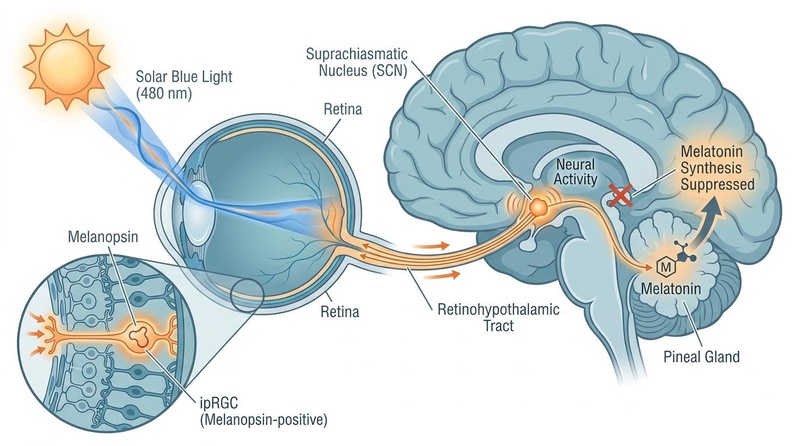
Sunlight and circadian biology describe the intricate relationship between environmental light cues and the body's internal 24-hour rhythms. The circadian rhythm is a fundamental biological process that regulates nearly all physiological functions, including sleep-wake cycles, hormone release, feeding behavior, and metabolism. At the core of this system is the suprachiasmatic nucleus (SCN), a small region in the hypothalamus often referred to as the "master clock" [1].
The SCN is exquisitely sensitive to light, especially blue wavelengths (around 480 nm) found abundantly in natural sunlight. Specialized photoreceptor cells in the retina, called intrinsically photosensitive retinal ganglion cells (ipRGCs), detect this light and transmit signals directly to the SCN via the retinohypothalamic tract [1:1]. This light signal effectively "resets" or "entrains" the SCN each day, synchronizing it with the external day-night cycle. This synchronization is critical for maintaining robust circadian rhythms, which in turn impact sleep quality, mood regulation, cognitive performance, and metabolic health [2]. Disruption of these rhythms, often due to insufficient daytime light exposure or excessive evening light, can lead to various health issues.
¶ Does It Work? (Evidence Snapshot)
Optimizing light exposure has a significant impact on circadian rhythm entrainment and various health outcomes.
| Outcome | Effect | Quality | Consistency | Trials | Notes |
| :--- | :--- | :--- | :--- | :--- | :--- |
| Sleep Onset Latency |
| Sleep Efficiency |
| Daytime Alertness & Mood |
| Circadian Phase Advance |
| Melatonin Suppression (Evening) |
| Metabolic Syndrome Risk |
¶ Who Benefits Most / Least
Benefits Most:
- Individuals with delayed sleep-wake phase disorder (difficulty falling asleep and waking up at conventional times) [7:1].
- Shift workers struggling with sleep quality, alertness, and metabolic health [8:2].
- Those with insomnia symptoms or poor subjective sleep quality [3:2][5:2].
- Office workers or individuals with limited natural light exposure during the day [4:4].
- People experiencing seasonal affective disorder (SAD) or general low mood, as sunlight influences serotonin levels.
Benefits Least:
- Individuals with advanced sleep-wake phase disorder (waking too early) may need to shift light exposure later in the day.
- Those with severe photophobia or specific retinal pathologies may experience discomfort with high-lux bright light.
- Individuals with elevated melanoma risk must balance direct UV exposure benefits with skin cancer prevention (see Sunlight and Health).
¶ How to Try It (Actionable Protocols)
The goal is to provide consistent, bright light early in the day and minimize artificial light, especially blue light, in the evening.
¶ Starter Protocol (7-day commitment)
- Morning Light (10-30 minutes): Within 30-60 minutes of waking, expose your eyes to bright natural light. This means going outside without sunglasses, or sitting by a window. If outdoor light is insufficient (e.g., dark winter mornings), use a light therapy lamp (10,000 lux) for 15-30 minutes [3:3].
- Daytime Light Exposure: Spend at least 30-60 minutes outdoors during the day, ideally around midday, to reinforce circadian signaling. Even on cloudy days, outdoor light levels are significantly higher than typical indoor lighting (e.g., 1,000-10,000 lux outdoors vs. 100-500 lux indoors) [10].
- Evening Dimness (2-3 hours pre-bed): As sunset approaches, dim indoor lights. Avoid bright overhead lighting. Switch to warm-toned (red/amber) lights.
- Blue Light Blockers: 2-3 hours before bedtime, wear amber-tinted blue-light blocking glasses, especially if using screens (phones, tablets, computers, TV) [5:3].
- Consistent Wake Time: Maintain a consistent wake-up time 7 days a week, even on weekends, to stabilize your circadian rhythm.
¶ Safety, Interactions, Red Flags
- Eye Safety: Staring directly at the sun carries risks of solar retinopathy and thermal injury. When using light therapy lamps, ensure they are designed for therapeutic use and positioned to illuminate indirectly, avoiding direct eye contact.
- Skin Safety: While sunlight is crucial for circadian entrainment, excessive UV exposure carries risks for skin cancer and photoaging (see Sunlight and Health). The aim for circadian entrainment is typically visual light exposure, not necessarily skin exposure.
- Bipolar Disorder: In individuals with bipolar disorder, bright light therapy carries a risk of inducing manic or hypomanic states.
- Melatonin Supplementation: If using melatonin, timing is critical. Taking melatonin in the late afternoon/early evening can help advance the circadian phase, especially when combined with morning light [7:2]. Taking it too late can delay the morning wake signal.
¶ Tracking & What “Good” Looks Like
Biomarkers/Metrics:
- Sleep Metrics (from wearables/apps): Sleep onset latency, total sleep time, sleep efficiency, wake after sleep onset (WASO).
- Circadian Phase Markers: While complex, a proxy can be the Dim Light Melatonin Onset (DLMO), measured in research settings. Simpler tracking involves consistent timing of sleep/wake and meal times.
- Cortisol Awakening Response (CAR): Healthy circadian function is associated with a robust CAR (a sharp increase in cortisol shortly after waking).
Subjective Metrics:
- Morning Alertness: Do you wake feeling refreshed and alert, or groggy?
- Daytime Energy Levels: Consistent energy throughout the day, without significant dips.
- Ease of Falling Asleep: Do you fall asleep within 15-30 minutes of getting into bed?
- Mood Stability: Improved mood and reduced symptoms of seasonal affective disorder.
Time-to-Benefit:
- Noticeable improvements in sleep onset and morning alertness can often be felt within 3-7 days of consistent adherence to morning light and evening dimness protocols [3:4].
- More profound shifts in circadian rhythm and metabolic benefits may take 2-4 weeks.
¶ Common Mistakes & Myths
- "Any light is good light": Not true. Timing and spectrum matter. Bright light at night, especially blue-rich, is detrimental to circadian rhythm [2:2].
- "Windows block all beneficial light": While windows block most UVB (limiting Vitamin D synthesis), they transmit significant amounts of visible light, which is effective for circadian entrainment, though less intense than direct outdoor exposure.
- "Blue light is always bad": Blue light is essential for morning circadian entrainment and alertness. It's blue light exposure at night that disrupts sleep and rhythm [2:3].
- "Light therapy lamps are only for SAD": While effective for SAD, light therapy lamps are also a powerful tool for general circadian entrainment and sleep optimization, especially in winter or for shift workers.
¶ Decision Tree (Text-Based)
- IF experiencing difficulty falling asleep or waking up at desired times AND feel groggy in the morning:
- THEN prioritize bright natural morning light for 10-30 minutes immediately upon waking.
- ELSE IF experiencing poor sleep quality AND frequently use screens in the evening:
- THEN implement evening dimness and wear blue-light blocking glasses 2-3 hours before bed.
- ELSE IF working irregular shifts or frequently traveling across time zones:
- THEN focus on maintaining a consistent wake time, and use targeted morning light exposure to help reset your clock.
- ELSE IF generally well-slept but seeking optimal performance and metabolic health:
- THEN optimize daily light hygiene as a foundational practice, ensuring robust morning light and minimal evening light.
¶ FAQs (People Also Ask targets)
¶ What is the best time to get sunlight for circadian rhythm?
The best time is within the first 30-60 minutes of waking up in the morning. This exposure to bright, natural light helps signal to your brain that the day has begun, setting your internal clock for the next 24 hours [3:5].
¶ How much light exposure do I need for circadian rhythm?
For effective circadian entrainment, aim for at least 10-30 minutes of bright outdoor light in the morning. Even on cloudy days, outdoor light levels (1,000-10,000 lux) are far superior to typical indoor lighting (100-500 lux) [10:1].
¶ Do blue light blocking glasses really work for sleep?
Yes, amber-tinted blue light blocking glasses, when worn 2-3 hours before bedtime, have been shown in RCTs to significantly improve subjective sleep quality and duration by preventing melatonin suppression caused by artificial light [5:4]. However, a systematic review found overall small, non-significant effects in generally healthy adults [11].
¶ How does sunlight affect melatonin production?
Sunlight, particularly the blue wavelengths, suppresses melatonin production via the ipRGC-SCN pathway during the day. This suppression is crucial for maintaining alertness. Conversely, the absence of bright light in the evening allows melatonin levels to rise, signaling sleep onset [2:4].
¶ Can artificial light disrupt circadian rhythm?
Yes, exposure to bright artificial light, especially blue-rich light from screens and LEDs, in the evening or at night, can significantly disrupt circadian rhythm by delaying melatonin secretion and shifting the sleep-wake cycle later [2:5]. This can lead to difficulties falling asleep and waking up.
¶ Glossary
- Circadian Rhythm: A natural, internal process that regulates the sleep-wake cycle and repeats roughly every 24 hours.
- Suprachiasmatic Nucleus (SCN): A small region in the brain's hypothalamus that serves as the "master clock" for the body's circadian rhythms.
- Intrinsically Photosensitive Retinal Ganglion Cells (ipRGCs): Specialized photoreceptor cells in the retina that detect blue light and signal directly to the SCN, independent of rod and cone vision.
- Zeitgeber: A German term meaning "time-giver"; an environmental cue (e.g., light, temperature, social cues) that entrains or resets an organism's biological clock.
- Melanopsin: A photopigment found in ipRGCs that is most sensitive to blue light, playing a key role in non-visual light perception and circadian entrainment.
- Retinohypothalamic Tract: A neural pathway connecting the retina directly to the SCN, transmitting light information for circadian regulation.
¶ References
¶ Update Log
- 2024-07-03: Initial deep dive content creation based on acquired sources, following progressive disclosure template, and image integration.
Berson DM, Dunn FA, Takao M. Phototransduction by retinal ganglion cells that set the circadian clock. Science. 2002;295(5557):1070-1073. https://pubmed.ncbi.nlm.nih.gov/12028210/ ↩︎ ↩︎
Blume C, Garbazza C, Spitschan M. Effects of light on human circadian rhythms, sleep and mood. Somnologie. 2019;23(3):147-156. https://pmc.ncbi.nlm.nih.gov/articles/PMC6751071/ ↩︎ ↩︎ ↩︎ ↩︎ ↩︎ ↩︎
Yang K, Li X, Gu C, et al. Feasibility and Efficacy of Morning Light Therapy for Adults with Insomnia: A Pilot, Randomized, Open-Label, Two-Arm Study. Medicina (Kaunas). 2023;59(6):1066. https://www.mdpi.com/1648-9144/59/6/1066 ↩︎ ↩︎ ↩︎ ↩︎ ↩︎ ↩︎
Figueiro MG, Steverson B, Heerwagen MJ, Kampschroer K, Rea MS. The impact of daytime light exposures on sleep and mood in office workers. Sleep Health. 2017;3(3):214-219. https://pubmed.ncbi.nlm.nih.gov/28526259/ ↩︎ ↩︎ ↩︎ ↩︎ ↩︎
Shechter A, Kim EW, St-Onge MP, Westwood AJ. Blocking nocturnal blue light for insomnia: A randomized controlled trial. J Psychiatr Res. 2020;125:150-155. https://pubmed.ncbi.nlm.nih.gov/29101797/ ↩︎ ↩︎ ↩︎ ↩︎ ↩︎
Zhao Z, Li J, Liu X, et al. Circadian Phase Advances in Response to Weekend Morning Light in Adolescents With Short Sleep and Late Bedtimes on School Nights. Front Neurosci. 2020;14:99. https://www.frontiersin.org/journals/neuroscience/articles/10.3389/fnins.2020.00099/full ↩︎ ↩︎
Burgess HJ, Sharkey KM, Eastman CI. Detecting phase shifts of human circadian rhythms: comparison of two analysis techniques. J Biol Rhythms. 2003;18(6):534-541. https://pmc.ncbi.nlm.nih.gov/articles/PMC4344919/ ↩︎ ↩︎ ↩︎
Li X, Yan J, Zhang T, et al. A systematic review and meta-analysis on light therapy for sleep disorders in shift workers. Sci Rep. 2024;14(1):2852. https://www.nature.com/articles/s41598-024-83789-3 ↩︎ ↩︎ ↩︎
Albreiki M, Al Dhaheri MA, Al Zaabi N, et al. Associations between Circadian Disruption and Cardiometabolic Disease Risk: A Review. J Clin Med. 2023;12(5):1969. https://pmc.ncbi.nlm.nih.gov/articles/PMC9974590/ ↩︎
Engineering Toolbox. Illuminance - Recommended Light Levels. https://www.engineeringtoolbox.com/light-level-rooms-d_708.html ↩︎ ↩︎
Singh S, Downie LE. Blue-light filtering spectacle lenses for visual performance, sleep, and macular health in adults. Cochrane Database Syst Rev. 2023;8(8):CD013244. https://pubmed.ncbi.nlm.nih.gov/37593770/ ↩︎