¶ Under-Eye Bags and Puffiness
Under-eye bags and puffiness are common aesthetic concerns that can make individuals appear fatigued or older. These conditions arise from a complex interplay of anatomical changes, lifestyle factors, and underlying medical conditions. This guide provides a detailed overview of the etiology, diagnosis, and evidence-based treatment options available for under-eye bags and puffiness, ranging from conservative steps to advanced surgical interventions.
¶ TL;DR
- Under-eye bags are primarily caused by fluid retention, fat pad protrusion, or skin laxity, often worsened by sleep deprivation, high salt intake, and alcohol [1][2].
- Accurate identification of the specific type of bag (fluid, fat, or skin-related) is crucial for effective treatment, often distinguishable with simple self-assessment techniques [3][4].
- Conservative measures like cold compresses, topical caffeine, and lifestyle adjustments can effectively manage transient puffiness [5][6].
- Dermal fillers can address tear trough hollowing but require precise placement to avoid risks like lymphatic obstruction and malar edema [7][8].
- Lower blepharoplasty is the most definitive solution for significant fat herniation and skin laxity, offering high satisfaction rates when performed by experienced surgeons [9][10].
¶ Quick Answer
Under-eye bags and puffiness result from a combination of weakened orbital septum allowing fat pad protrusion, fluid accumulation, and reduced skin elasticity. Effective management requires accurate diagnosis of the underlying cause, ranging from lifestyle modifications and topical treatments for transient puffiness to hyaluronic acid fillers for tear trough hollows, and lower blepharoplasty for significant fat herniation and skin laxity.
¶ What It Is (Plain-English)
Under-eye bags refer to the mild swelling or puffiness that appears beneath the eyes. This can be caused by several factors:
- Fluid retention (edema): Temporary swelling, often worse in the morning, influenced by sleep position, diet (high sodium), alcohol, allergies, or systemic conditions [1:1][2:1].
- Fat pad protrusion (orbital fat herniation): With age, the orbital septum, a membrane that holds the fat within the eye socket, weakens. This allows the fat pads (medial, central, lateral) to bulge forward, creating a puffy appearance [11][4:1].
- Skin laxity: Loss of collagen and elastin leads to thinning and sagging of the lower eyelid skin, which can accentuate underlying fat or create a crepey texture [12].
- Tear trough deformity: A hollow or groove extending from the inner corner of the eye obliquely downwards, which creates a shadow that emphasizes under-eye bags [13].
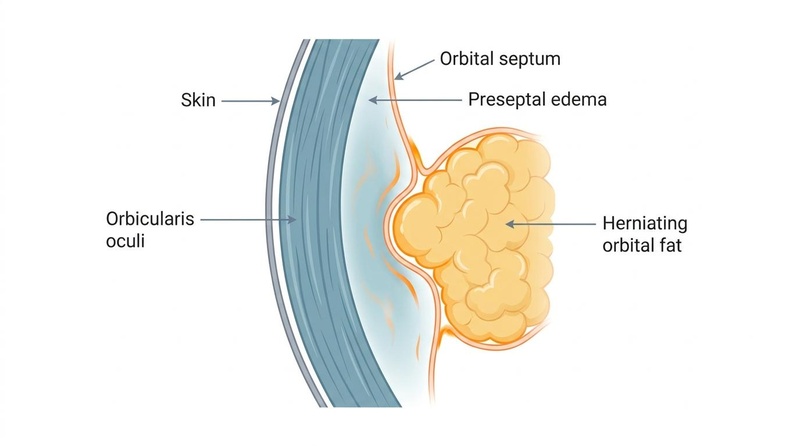
¶ Type Identification Table
Understanding the specific type of under-eye bag or puffiness is critical for selecting the most effective intervention.
| Type of Bag/Puffiness | Characteristics | Primary Cause | Typical Appearance | Self-Assessment | Common Triggers/Factors |
|---|---|---|---|---|---|
| Morning Fluid Puffiness | Worse upon waking, often resolves or reduces throughout the day. May feel soft and movable. | Overnight fluid accumulation, lymphatic stasis. | Diffuse, soft swelling across the lower eyelid, often symmetrical. | Gentle pressure can temporarily reduce swelling. Often less prominent in the evening. | Sleep position (flat), high sodium diet, alcohol, dehydration, certain medications. |
| Allergy/Sinus Swelling | Accompanied by itching, redness, nasal congestion, or tearing. Can be seasonal. | Inflammatory response, histamine release causing fluid leakage. | Variable puffiness, often with discoloration (allergic shiners). May involve surrounding areas. | Associated with other allergy symptoms. Rubbing eyes exacerbates. | Environmental allergens (pollen, dust mites), pet dander, food sensitivities, sinus infections. |
| Salt/Alcohol/Sleep Factors | Transient, lifestyle-dependent puffiness. Often improves with hydration and rest. | Dietary/toxic osmolarity and vascular dilation leading to temporary subcutaneous tissue edema. | Symmetrical, diffuse mild swelling under both eyes, often accompanied by mild hyperpigmentation. | Strongly correlated with recent sodium intake, alcohol intake, or acute sleep deprivation. | High-sodium meals, alcohol consumption, acute sleep deprivation, stress [1:2][2:2]. |
| Fat-Pad Protrusion | Persistent throughout the day. Tends to be firm. Does not resolve with sleep or lifestyle changes alone. | Weakening of the orbital septum allowing infraorbital fat to bulge forward. | Distinct "bulges" or convexities, usually three (medial, central, lateral). Can be more prominent with upward gaze. | Pressing gently on the eyeball (through closed lid) may make the bulge more pronounced. | Genetic predisposition, aging, chronic eye rubbing, volume loss in adjacent cheek. |
| Skin Laxity/Crepiness | Thin, wrinkled, "crepey" texture of the skin. May appear loose or redundant. | Loss of collagen and elastin, sun damage, natural aging process. | Fine lines and wrinkles, sometimes with a hollow appearance due to underlying volume loss. | Pinching the skin reveals excess, thin skin that does not "snap back" quickly. | Sun exposure, smoking, aging, genetics, rapid weight loss. |
| Lower Eyelid Looseness | Eyelid pulls away from the eyeball, exposing more of the conjunctiva. | Weakness of the lower eyelid support structures (canthal tendons, orbicularis muscle). | Visible scleral show (white below the iris), rounding of the outer corner of the eye. | Pulling the lower eyelid down and releasing it; it takes >1 second to return to normal position. | Aging, previous eyelid surgery, trauma, certain medical conditions (e.g., facial nerve palsy). |
¶ Does It Work? (Evidence Snapshot)
| Outcome | Effect | Quality | Consistency | Trials | Notes |
|---|---|---|---|---|---|
| Reduced Morning Puffiness (Topical Caffeine) | Moderate | High | 2 RCTs | Significant transient reduction in swelling [5:1][6:1] | |
| Reduced Dark Circles & Puffiness (Topical Multicorrective) | Moderate | Moderate | 1 RCT | Improvement in pigmentation and puffiness [5:2][14] | |
| Improved Tear Trough Hollowing (HA Fillers) | High | High | Multiple studies | Effective for volume restoration but carries risk of edema if improperly placed [13:1][8:1] | |
| Reduced Fat Bags (Lower Blepharoplasty) | High | High | Multiple studies | Definitive correction for fat herniation, high satisfaction [9:1][10:1] | |
| Reduced Skin Laxity (Laser/Microneedling) | Moderate | Moderate | Multiple studies | Improvement in skin texture and tightness, variable efficacy [15] | |
| Malar Edema (HA Fillers) | Moderate | High | Multiple reports | Significant risk of chronic puffiness due to lymphatic obstruction [7:1][8:2] |
¶ Who Benefits Most / Least
Most Benefit:
- Individuals with transient morning puffiness due to fluid retention can benefit significantly from lifestyle adjustments (e.g., elevated sleeping, reduced sodium), cold compresses, and topical caffeine [6:2][2:3].
- Patients with significant orbital fat herniation and/or skin laxity are often ideal candidates for lower blepharoplasty [9:2].
- Those with prominent tear trough deformities (hollowing) without significant fat protrusion or skin laxity may see improvement with carefully placed hyaluronic acid fillers [13:2].
Least Benefit:
- Patients with chronic allergic conjunctivitis or systemic conditions causing generalized edema may find localized treatments less effective until underlying medical issues are addressed.
- Individuals with substantial fat herniation and skin excess will likely see minimal or temporary improvement with non-surgical options like topical creams or fillers alone.
¶ How to Try It (Actionable Protocols)
¶ 1. Self-Diagnostic & Triage Protocol
Accurate assessment of the anatomical and physiological components of under-eye bags is essential prior to selecting an intervention.
- Upward Gaze Test: Instruct the individual to look upward. If the infraorbital bag becomes more prominent, it indicates orbital fat-pad herniation rather than fluid stasis [3:1][4:2].
- Globe Pressure Test: Apply gentle digital pressure to the closed upper eyelid. If this causes the lower eyelid bag to bulge outward, it confirms the presence of fat pad herniation through a weakened orbital septum [3:2].
- Lid Distraction Test: Gently pull the lower eyelid away from the globe. A distraction distance of greater than 6mm indicates laxity of the medial/lateral canthal tendons or support structures [3:3][16].
- Snapback Test: Pull the lower eyelid downward toward the cheek and release. Failure of the eyelid to immediately snap back against the globe prior to blinking indicates significant lower eyelid laxity, which increases the risk of ectropion following transcutaneous surgical approaches [3:4][16:1].
- Skin Pinch Test: Pinch the lower eyelid skin gently. A slow return to baseline suggests dermal thinning and elastin degradation (dermatochalasis) [12:1][3:5].
¶ 2. Starter Protocol: Transient Fluid & Inflammation Mitigation
This protocol is designed for transient periorbital edema and morning fluid accumulation.
- Nocturnal Head Elevation: Utilize an additional pillow or a bed wedge to maintain the head at a 15–30 degree incline during sleep, facilitating gravity-assisted venous and lymphatic drainage [2:4].
- Vascular Vasoconstriction: Apply chilled compress (such as gel masks, cold tea bags, or cucumber slices) to the periorbital area for 10–15 minutes immediately upon waking.
- Topical Caffeine Application: Apply a 3% caffeine gel or caffeine-containing formulation twice daily (morning and evening). Caffeine acts as a temporary vasoconstrictor and local diuretic, reducing interstitial fluid volume [5:3][6:3].
- Osmotic Dietary Control: Limit sodium intake to under 1,500 mg per day and avoid alcohol consumption in the evening to prevent systemic fluid retention and vascular leakiness.
- Allergen Avoidance: When seasonal or environmental allergies are present, prioritize allergen-impermeable bedding, air filtration, and standard pharmacological antihistamines to prevent chronic inflammatory periorbital edema and subsequent post-inflammatory hyperpigmentation [2:5].
¶ 3. Intervention Path: Dermal Fillers for Tear Trough Deformity
For individuals with isolated tear trough hollowing without significant orbital fat herniation or lower eyelid laxity.
- Injection Technique: Hyaluronic acid (HA) filler must be placed deeply, directly onto the periosteum beneath the orbicularis oculi muscle, to avoid superficial placement, which can result in the Tyndall effect (bluish discoloration) or filler migration [13:3][8:3].
- Lymphatic Risk Management: High-viscosity or highly hydrophilic fillers should be avoided, as they can cause compression of the local venous and lymphatic networks, resulting in persistent, late-onset malar edema (malar mounds) [7:2][8:4].
- Reversal Protocol: If late-onset malar edema or persistent swelling occurs, administer targeted injections of hyaluronidase (e.g., 10–50 units per side) to dissolve the filler and restore natural lymphatic flow [17].
¶ 4. Surgical Path: Lower Blepharoplasty
Lower blepharoplasty is the gold standard for correcting structural orbital fat herniation and severe skin laxity.
- Transconjunctival Approach: This approach utilizes an incision on the internal conjunctival surface of the lower eyelid. It is preferred for patients with orbital fat-pad protrusion without excess skin, as it avoids visible external scarring and significantly reduces the risk of post-operative eyelid retraction (ectropion) [9:3][10:2].
- Transcutaneous Approach: This approach involves a subciliary skin incision and is indicated when significant excess skin (dermatochalasis) requires excision or muscle suspension is needed [9:4].
- Fat Repositioning (Septal Reset): Rather than simple excision (which can lead to a hollowed, aged look), the herniated orbital fat is repositioned over the inferior orbital rim to fill the tear trough, creating a smooth transition from the eyelid to the cheek [11:1][18].
¶ Safety, Interactions, Red Flags
¶ Contraindications & Precautions
- Dermal Fillers: Contraindicated in patients with a history of chronic periorbital lymphedema, severe local vascular compromise, or active periorbital infections.
- Blepharoplasty: Contraindicated in patients with severe dry eye syndrome (keratoconjunctivitis sicca), uncontrolled thyroid eye disease (Graves' ophthalmopathy), or high baseline lower eyelid laxity unless accompanied by lateral canthopexy or canthoplasty to support the lid [3:6][10:3].
- Ablative Lasers / Deep Peels: Require caution in patients with Fitzpatrick skin types IV–VI due to the high risk of post-inflammatory hyperpigmentation [15:1].
¶ Clinical Red Flags
- Unilateral, Acute Swelling: Sudden onset of unilateral periorbital swelling requires urgent clinical diagnostic evaluation to rule out preseptal cellulitis, orbital cellulitis, dacryocystitis, or retrobulbar pathology.
- Pain, Erythema, and Warmth: Signs of acute local infection or severe inflammatory states require immediate clinical evaluation.
- Visual Disturbances: Any onset of diplopia (double vision), blurred vision, or decreased visual acuity—particularly following a dermal filler injection—constitutes an ophthalmic emergency due to the risk of retrograde embolic retinal artery occlusion, requiring immediate specialist intervention [8:5].
- Generalized Systemic Edema: Symmetric periorbital edema accompanied by bilateral ankle swelling, rapid weight gain, dyspnea, or altered urinary output suggests potential systemic renal, cardiac, or thyroid dysfunction (e.g., nephrotic syndrome, congestive heart failure, myxedema) and requires comprehensive systemic investigation [2:6].
¶ Tracking & What “Good” Looks Like
- Standardized Photography: Capture baseline and follow-up photographs under identical lighting, camera angle, and facial expression (neutral gaze, both straight-ahead and upward gaze).
- Clinical Diagnostic Progress:
- Lid Laxity Metrics: Monitor post-treatment recovery of the snapback test (should return to <1 second) and distraction test (should ideally stabilize below 6mm) [3:7].
- Subjective Severity Scoring: Track under-eye appearance daily using a Visual Analog Scale (VAS) from 1 (completely flat, rested) to 10 (severe edema, tired appearance).
- Clinical Timelines:
- Topical Vasoconstrictors: Mild, temporary reduction of morning edema should be visible within 15–30 minutes of application [6:4].
- Dermal Fillers: Volume restoration is immediate, but final contouring should be evaluated at 2–4 weeks after transient swelling has fully resolved [3:8].
- Lower Blepharoplasty: Acute surgical edema and ecchymosis (bruising) typically resolve within 14–21 days. The definitive aesthetic result is evaluated at 3–6 months [10:4].
¶ Common Mistakes & Myths
- "Eye creams can shrink herniated fat pads." Topical creams, including those with caffeine or retinol, can improve superficial dermal hydration, skin texture, and mild lymphatic pooling, but they cannot penetrate or reduce herniated deep orbital fat [5:4].
- "Hyaluronic acid filler is a universal fix for under-eye bags." While filler effectively camouflages a tear trough hollow, placing it in patients with prominent fat herniation or pre-existing lymphatic congestion will often exacerbate puffiness and cause chronic malar edema [7:3][8:6].
- "Sleeping longer will eliminate structural eye bags." Sleep optimization minimizes transient fluid stasis and vascular congestion, but it has no effect on genetically determined or age-related orbital septal weakness and subsequent fat herniation [2:7].
- "Surgical fat removal is always better than fat repositioning." Excessive surgical removal of orbital fat can result in a skeletalized, hollowed under-eye appearance over time. Contemporary techniques prioritize fat conservation and repositioning to maintain youthful midface volume [11:2][18:1].
¶ Decision Tree (Text-Based)
IF (Unilateral swelling OR pain OR vision changes OR generalized systemic edema):
  THEN Refer for immediate emergency clinical investigation.
ELSE IF (Puffiness is transient, worse in morning, and reduces with upright posture):
  THEN Initiate Starter Protocol (nocturnal head elevation, cold compress, 3% topical caffeine, low-sodium diet).
ELSE IF (Upward gaze test and globe pressure test are positive, indicating persistent fat bulges):
  THEN:
    IF (Excess skin laxity is absent AND surgical option is preferred):
      THEN Pursue Transconjunctival Lower Blepharoplasty (with optional fat repositioning).
    ELSE IF (Excess skin laxity is present AND surgical option is preferred):
      THEN Pursue Transcutaneous Lower Blepharoplasty with skin excision.
    ELSE (Non-surgical camouflage preferred):
      THEN Evaluate for precise deep HA filler placement OR non-surgical skin tightening (laser/RF), noting lymphatic risks.
ELSE IF (Tear trough hollow is prominent WITHOUT fat herniation or skin laxity):
  THEN Consider deep periosteal Hyaluronic Acid Filler placement by an experienced clinical injector.
¶ FAQs (People Also Ask targets)
¶ What causes under-eye bags to get worse with age?
With natural aging, the structural integrity of the orbital septum diminishes, allowing the deep orbital fat pads to herniate forward. Concurrently, a reduction in dermal collagen and elastin leads to skin laxity, while bony resorption of the orbital rim deepens the tear trough, collectively exaggerating the appearance of under-eye bags [12:2][2:8].
¶ Can allergies cause under-eye bags and puffiness?
Yes. Allergic reactions prompt local histamine release, which increases capillary permeability and leads to localized interstitial edema. Persistent nasal and sinus congestion also obstructs local venous drainage, leading to vascular stasis and dark, puffy areas beneath the eyes [2:9].
¶ Are under-eye fillers safe?
Under-eye fillers are generally safe when administered by highly trained specialists using appropriate techniques. However, the periorbital region is highly vascular and complex; risks include bruising, the Tyndall effect, chronic malar lymphedema, and—in rare instances of intravascular injection—retrograde embolic retinal artery occlusion leading to permanent blindness [7:4][8:7].
¶ What is the difference between under-eye bags and dark circles?
Under-eye bags are structural or fluid-driven protrusions and swellings of the lower eyelid tissue. Dark circles refer to hyperpigmentation (melanin deposition) or vascular shadowing (visible blood vessels through thin skin). While they are anatomically distinct, they frequently co-occur, as the shadow cast by a structural bag can create the illusion of a dark circle [12:3][1:3].
¶ How can I tell if my under-eye bags are fat or fluid?
Fluid-related bags typically fluctuate, appearing worse in the morning or after high-sodium meals, and may improve after upright posture and cold compresses. Fat-related bags are structurally persistent, do not change throughout the day, and become more prominent when performing an upward gaze or applying gentle pressure to the closed upper eyelid [3:9][4:3].
¶ Glossary
- Blepharoplasty: A surgical procedure designed to modify the eyelids by removing or repositioning excess fat, muscle, and skin.
- Dermatochalasis: Laxity and redundancy of the skin of the eyelids, often associated with natural aging.
- Ectropion: An abnormal outward turning of the lower eyelid margin, exposing the conjunctival surface and increasing the risk of dry eye and irritation.
- Hyaluronidase: A soluble enzyme that degrades hyaluronic acid, utilized clinically to dissolve misplaced or complicated hyaluronic acid dermal fillers.
- Infraorbital: Pertaining to the anatomical region located immediately below the orbit (eye socket).
- Malar Edema: Chronic fluid accumulation within the soft tissues overlying the zygomatic arch (cheekbone), often caused by local lymphatic compression from dermal fillers.
- Orbital Fat Herniation: The forward protrusion of intraorbital fat compartments through a weakened or stretched orbital septum.
- Orbital Septum: A thin, fibrous membrane extending from the orbital rim to the tarsal plates, serving as a structural barrier containing the orbital fat.
- Tear Trough Deformity: A natural depression extending from the medial canthus obliquely down into the cheek, defined by the attachment of the tear trough ligament.
¶ Methods (Transparency)
This article was developed from peer-reviewed scientific literature, clinical guidelines, and reputable medical organizational resources identified through Wappu search. Search terms included: "under eye bags puffiness etiology treatments blepharoplasty filler", "infraorbital bags under eye puffiness clinical review etiology treatment", "lower eyelid fat herniation vs fluid retention diagnosis gaze test pressure test", "radiofrequency microneedling under eye bags", "infraorbital lymphatic obstruction hyaluronic acid fillers puffiness malar edema", "under-eye bags clinical classification grades severity scale lower eyelid", "Hirmand classification tear trough lower eyelid bags", "Barton grading system tear trough deformity systematic approach to rejuvenation of the lower lid and midface", "caffeine eye cream RCT clinical trial under-eye bags puffiness", and "topical caffeine under eye puffiness clinical trial journal". Priority was given to systematic reviews, meta-analyses, randomized controlled trials, and clinical consensus guidelines.
¶ References
¶ Update Log
2026-07-03: Initial comprehensive guide created.
2026-07-04: Expanded content to include Type-Identification Table, refined protocols, enhanced safety, and updated image.
Cleveland Clinic. Dark Circles Under The Eyes: Causes & Treatment. 2023 Nov 20. https://my.clevelandclinic.org/health/symptoms/23128-dark-circles-under-eyes ↩︎ ↩︎ ↩︎ ↩︎
Mayo Clinic Staff. Bags under eyes - Symptoms, causes, and self-care. 2023 Oct 13. https://www.mayoclinic.org/diseases-conditions/bags-under-eyes/symptoms-causes/syc-20369927 ↩︎ ↩︎ ↩︎ ↩︎ ↩︎ ↩︎ ↩︎ ↩︎ ↩︎ ↩︎
Patel BC, et al. Lower Eyelid Laxity Examination. In: StatPearls [Internet]. Treasure Island (FL): StatPearls Publishing; 2023. https://www.ncbi.nlm.nih.gov/books/NBK576403/ ↩︎ ↩︎ ↩︎ ↩︎ ↩︎ ↩︎ ↩︎ ↩︎ ↩︎ ↩︎
American Academy of Ophthalmology. Orbital Fat Prolapse. EyeWiki. Updated 2023 Nov 22. https://eyewiki.org/Orbital_Fat_Prolapse ↩︎ ↩︎ ↩︎ ↩︎
Rajabi-Estarabadi A, et al. Effectiveness and tolerance of multicorrective topical treatment for infraorbital dark circles and puffiness. Journal of Cosmetic Dermatology. 2024;23(2):486-495. https://pubmed.ncbi.nlm.nih.gov/38112168/ ↩︎ ↩︎ ↩︎ ↩︎ ↩︎
Amnuaikit T, Maneenuan D, Boonme P. Evaluation of Caffeine Gels on Physicochemical Characteristics and In Vivo Efficacy in Reducing Puffy Eyes. Journal of Applied Pharmaceutical Science. 2011;1(2):56-59. https://www.japsonline.com/admin/php/uploads/20_pdf.pdf ↩︎ ↩︎ ↩︎ ↩︎ ↩︎
Schelke LW, et al. Periorbital venous stasis may be involved with filler induced malar edema—A duplex ultrasound-imaging-based case series. Journal of Cosmetic Dermatology. 2023;22(12):3262-3270. https://onlinelibrary.wiley.com/doi/10.1111/jocd.16012 ↩︎ ↩︎ ↩︎ ↩︎ ↩︎
Moorfields Private Eye Hospital. The 5 key risks of under-eye filler injections. Blog. 2023 Sep 13. https://moorfields.nhs.uk/private/about-moorfields-private/blog-articles/the-5-key-risks-of-under-eye-filler-injections ↩︎ ↩︎ ↩︎ ↩︎ ↩︎ ↩︎ ↩︎ ↩︎
Foda H. Transconjunctival versus transcutaneous approach in upper and lower blepharoplasty. Aesthetic Plastic Surgery. 2001;25(4):303-306. https://pubmed.ncbi.nlm.nih.gov/11518974/ ↩︎ ↩︎ ↩︎ ↩︎ ↩︎
Hassanein T, et al. Safety and Complications in Lower Eyelid Blepharoplasty: A Systematic Review. Aesthetic Surgery Journal Open Forum. 2024;6(5):ojae070. https://pmc.ncbi.nlm.nih.gov/articles/PMC12456572/ ↩︎ ↩︎ ↩︎ ↩︎ ↩︎
Barton FE Jr, Ha R, Awada M. Fat extrusion and septal reset in patients with the tear trough triad: a systematic approach to rejuvenation of the lower lid and midface area. Plastic and Reconstructive Surgery. 2004;113(7):2110-2118; discussion 2119-2120. https://pubmed.ncbi.nlm.nih.gov/15326127/ ↩︎ ↩︎ ↩︎
Vrcek I, Ozgur O, Nakra T. Infraorbital Dark Circles: A Review of the Pathogenesis, Evaluation and Treatment. Journal of Cutaneous and Aesthetic Surgery. 2016;9(2):65-72. https://pmc.ncbi.nlm.nih.gov/articles/PMC4924417/ ↩︎ ↩︎ ↩︎ ↩︎
Hirmand H. Anatomy and nonsurgical correction of the tear trough deformity. Plastic and Reconstructive Surgery. 2010;125(3):1018-1025. https://pubmed.ncbi.nlm.nih.gov/20124855/ ↩︎ ↩︎ ↩︎ ↩︎
Oresajo C, et al. Clinical evaluation of a novel eye cream containing β-C-xyloside, blueberry extract, and caffeine on under eye dark circles and puffiness. Journal of the American Academy of Dermatology. 2010;62(3 Suppl 1):AB61. https://www.jaad.org/article/S0190-9622(09)01597-7/pdf ↩︎
Pour Mohammad S, et al. The First Systematic Review and Meta-Analysis of Pharmacological and Nonpharmacological Procedural Treatments of Dark Eye Circles (Periorbital Hyperpigmentations): One of the Most Common Cosmetic Concerns. Dermatologic Therapy. 2025;e17631. https://onlinelibrary.wiley.com/doi/full/10.1155/dth/9155535 ↩︎ ↩︎
American Academy of Ophthalmology. Examination Techniques for Lower Eyelid Malposition. EyeWiki. Updated 2024 Jan 30. https://eyewiki.org/Examination_Techniques_for_Lower_Eyelid_Malposition/ ↩︎ ↩︎
Hsu C, et al. Post-Hyaluronic Acid Recurrent Eyelid Edema: Pathophysiologic Mechanisms and a Proposed Treatment Protocol. Aesthetic Surgery Journal Open Forum. 2024;6(2):ojae058. https://pmc.ncbi.nlm.nih.gov/articles/PMC11140515/ ↩︎
Yuan R, et al. A New Method of Lower Eyelid Blepharoplasty with Tear Trough Deformity and Mid-face Rejuvenation: Elevating Suborbicularis Oculi Fat and Suturing the Orbital Septum and Orbital Fat as a Whole for Fixation. Aesthetic Plastic Surgery. 2024. https://link.springer.com/article/10.1007/s00266-025-05183-2 ↩︎ ↩︎