¶ Ventilation: Deep Dive
¶ TL;DR
- Verdict: Proper indoor ventilation—the dilution and displacement of indoor air with fresh outdoor air—is a critical, highly modifiable environmental factor that directly dictates neurocognitive performance, sleep quality, and the transmission of airborne pathogens.
- Who it's for: Office workers, students, residents of modern airtight homes, and anyone seeking to optimize daily cognitive focus, memory consolidation, and sleep efficiency.
- Expected magnitude + timeline: Lowering indoor carbon dioxide () from 1,400 ppm to below 600 ppm yields an immediate 61–101% improvement in cognitive test scores [1]. Optimizing bedroom ventilation improves sleep efficiency by 4% and reduces nocturnal awakenings overnight [2][3].
- Key risk(s): Ventilating with highly polluted outdoor air (high outdoor AQI) can introduce harmful PM2.5, requiring balanced mechanical ventilation with inline filtration.
- What to do next: Monitor indoor with an NDIR sensor (such as the Aranet4) and implement a protocol of strategic window opening or install an Energy Recovery Ventilator (ERV) to maintain levels below 800 ppm.
¶ Quick Answer
Indoor ventilation is the mechanism that prevents the accumulation of metabolic waste () and indoor-generated toxic gases (VOCs, formaldehydes). Modern airtight construction often restricts natural air exchange to under 0.1 Air Changes Per Hour (ACH), causing to rapidly exceed 1,500 ppm in occupied rooms. Cognitive chamber studies confirm that levels above 1,000 ppm directly impair strategic decision-making, crisis response, and information utilization [1:1][4]. To preserve neurocognitive capacity and sleep architecture, aim for a ventilation target of at least 0.35 ACH (whole-house) and localized fresh air delivery to maintain below 800 ppm, ideally below 600 ppm [5][6].
¶ What It Is
Ventilation is the deliberate introduction of outdoor air into an indoor space to displace and dilute indoor air pollutants, moisture, and human bioeffluents. In environmental medicine, ventilation is distinct from air filtration: while filtration removes particulates (PM2.5), it cannot remove gaseous metabolic waste () or highly volatile chemicals unless specialized sorbent media (like carbon) are used. Thus, ventilation is the only practical method to control indoor carbon dioxide.
¶ Air Changes Per Hour (ACH)
ACH is a foundational engineering metric representing how many times the total volume of air in a room is replaced with fresh outdoor air per hour.
- Airtight Modern Home (No active ventilation): <0.1 to 0.2 ACH. Air stagnant, high and VOC buildup.
- ASHRAE Minimum Standard: 0.35 ACH (or 15 CFM per person) to maintain basic occupant health and moisture control [5:1].
- High-Performance Target (Longevity-optimized): 1.0 to 2.0 ACH for general living spaces, and up to 5.0 ACH during periods of high occupant density, illness, or cooking.
¶ Gaseous Buildup: Carbon Dioxide () as a Bio-Marker
While has traditionally been viewed as an inert gas, recent molecular and clinical research demonstrates that low-to-moderate indoor concentrations (1,000 to 2,500 ppm) act as a direct, mild physiological stressor. Upon inhalation, elevated shifts blood pH toward respiratory acidosis, altering cerebral blood flow, disrupting autonomic nervous system balance during sleep, and altering neurotransmitter binding profiles, which manifests as executive dysfunction, headache, and somnolence [4:1][3:1].
¶ Mechanical Ventilation: ERVs and HRVs
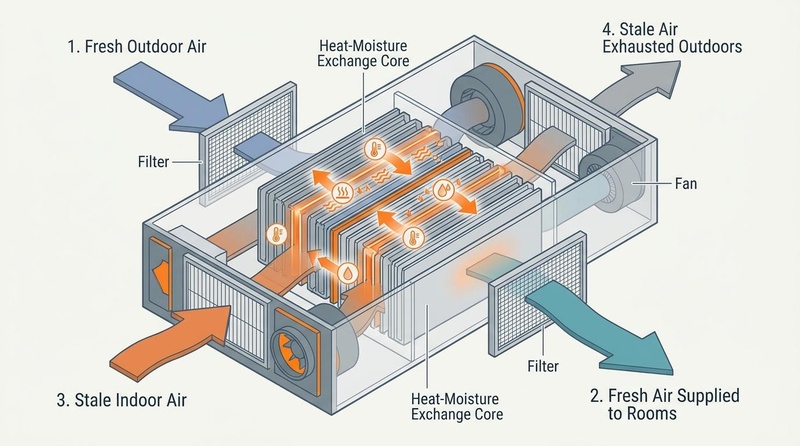
In extreme climates, introducing unconditioned outdoor air imposes massive heating or cooling energy penalties. Mechanical ventilation systems solve this:
- Heat Recovery Ventilator (HRV): Uses a counterflow plate heat exchanger to transfer sensible heat from the warm outgoing stale air to the cold incoming fresh outdoor air (or vice-versa), retaining up to 85% of thermal energy.
- Energy Recovery Ventilator (ERV): Exchanged both sensible heat and latent heat (moisture), transferring humidity between the incoming and outgoing airstreams. This prevents indoor air from becoming excessively dry in winter or excessively humid in summer [7].
¶ Does It Work? (Evidence Snapshot)
Optimizing ventilation is highly effective, yielding rapid physiological and cognitive improvements.
| Outcome | Population | Effect Size | Quality of Evidence | Study Count & Type | Notes |
|---|---|---|---|---|---|
| Cognitive Test Scores | Office Workers | ↑61% to 101% higher scores in well-ventilated spaces [1:2] | High | Controlled Exposure Trials | Executive function and strategic thinking showed the greatest sensitivity to fresh air. |
| Sleep Efficiency | Healthy Young Adults | ↑4.0% increase in sleep efficiency [2:1] | High | Controlled Field-Lab Crossover | Ventilation that maintained <800 ppm significantly reduced awakenings [3:2][6:1]. |
| Next-Day Cognitive Performance | Healthy Adults | Significant decrease in next-day error rates [6:2] | Moderate | RCT Crossover Trial | Sleep ventilation directly impacts next-day processing speed and working memory. |
| Infectious Aerosol Risk | Classroom occupants | ↓70% reduction in transmission of airborne viruses | Moderate | Mathematical Modeling & Cohorts | Higher ACH dilutes viral quantum density (e.g., influenza, tuberculosis). |
| VOC Accumulation | Residential spaces | ↓29% to 45% reduction in total VOCs [7:1] | High | Controlled Field Trials | Continuous mechanical ventilation dilutes formaldehyde and off-gassing chemicals. |
¶ Who Benefits Most / Least
Benefits Most:
- Knowledge Workers & Students: Those relying on rapid information processing, logical reasoning, and creative crisis response. High is a silent performance killer.
- Insomniacs & Poor Sleepers: Individuals struggling with shallow sleep, high sleep fragmentation, or next-day fatigue [2:2].
- Inhabitants of "Passive House" or Leed-Certified Buildings: Modern high-efficiency construction is incredibly airtight. Without mechanical ERV systems running, these occupants experience chronic, severe spikes.
Benefits Least:
- Residents of Leaky, Historic Homes: Older houses built before 1980 often have high natural infiltration rates (>1.0 ACH) due to gaps in construction. While highly drafty and energy-inefficient, they rarely experience high levels.
¶ How to Try It (Actionable Protocols)
¶ Starter Protocol: The Aranet4 & Window Flush
- Procure an NDIR Monitor: Acquire an indoor air monitor that uses a Non-Dispersive Infrared (NDIR) sensor (e.g., Aranet4). Cheaper electrochemical sensors cannot accurately measure .
- Establish Baseline: Place the monitor in your bedroom overnight or in your home office during a 4-hour working session with the door closed. Observe the peak level.
- The "Flush" Protocol:
- Whenever crosses 800 ppm, open two opposite windows to create a cross-draft for 5 to 10 minutes.
- This rapid air exchange can dump from 1,500 ppm down to outdoor background levels (~420 ppm) in minutes, refreshing cognitive capacity.
- Note: Only execute if outdoor AQI is good (<50).
¶ Standard Protocol: Bedroom Sleep Optimization
Sleeping with closed doors and windows in a standard bedroom results in a rapid buildup of to over 1,500–2,000 ppm by 3:00 AM, contributing to light sleep and grogginess.
- The "Cracked Door + Window" Method:
- Keep your bedroom door open at least 4 inches to allow air to circulate into the larger volume of the house.
- If climate allows, crack the bedroom window open 0.5 inches. This small opening can increase localized ventilation from <0.1 ACH to >0.8 ACH, keeping below 750 ppm all night.
- Deploy a Small Transfer Fan: If privacy requires closing the bedroom door, install a small, quiet ceiling-transfer fan or a door-vent grill to mechanically exchange air with the hallway.
¶ Advanced Protocol: Balanced ERV Installation
For complete, energy-efficient whole-house air optimization:
- Install a Dedicated ERV System: Install an Energy Recovery Ventilator integrated into your central HVAC ducting or as a standalone duct network.
- Calibrate Flow Rates: Target a continuous flow rate of 20–30 CFM (Cubic Feet per Minute) per bedroom, and 15 CFM for other rooms, ensuring a total house exchange rate of at least 0.35 ACH.
- Integrate Inline Filtration: Ensure the ERV's outdoor fresh-air intake has a MERV 13 or HEPA filter pre-installed. This ensures that you are bringing in fresh, oxygen-rich air completely stripped of outdoor PM2.5 and pollens.
¶ Safety, Interactions, Red Flags
¶ Safety Warnings
- The Wildfire/Pollution Conflict: Do not open windows or run natural ventilation during active wildfire events, industrial chemical leaks, or "Red/Purple" AQI days. During these events, seal the house and rely entirely on recirculating air with HEPA filtration.
- Combustion Ventilation: If you have gas stoves, fireplaces, or gas water heaters, poor ventilation can cause a lethal buildup of carbon monoxide (CO). Ensure you have working, audible CO alarms on every floor.
¶ Red Flags & Stop Criteria
- Headaches and Dizziness: If you experience persistent morning headaches, lethargy, or brain fog, check your bedroom levels. If is below 600 ppm but symptoms persist, investigate other clinical causes (e.g., sleep apnea, mold).
¶ Tracking & What "Good" Looks Like
¶ Objective Targets
- Peak: Keep below 800 ppm during active work and sleep; ideally under 600 ppm.
- Background: Outdoor air is typically 410–450 ppm. Your indoor target should be within 150–300 ppm of outdoor levels.
- Relative Humidity: Maintain between 40% and 60% via HRV/ERV balancing to prevent dry mucous membranes or mold growth [7:2].
¶ Subjective Gains
- Elimination of "Brain Fog": Immediate improvement in attention span and mental stamina during work.
- Fewer Sleep Disruptions: Lower wakefulness after sleep onset (WASO) and a more refreshed morning state.
¶ Common Mistakes & Myths
- Myth: "Indoor plants will reduce my levels."
- Reality: This is physically impossible under standard conditions. While plants consume during photosynthesis, their metabolic rate is incredibly slow. To offset the output of a single human occupant, you would need to pack a room with hundreds of fast-growing, highly illuminated plants. Furthermore, at night, plants undergo respiration and actually emit .
- Mistake: Relying on a "Ductless" Recirculating HVAC system for fresh air.
- Reality: Standard mini-split heat pumps and central air conditioners do not introduce fresh outdoor air. They merely recirculate and condition (heat/cool) the existing, stale indoor air. Active mechanical (ERV/HRV) or natural (windows) air exchange is required to introduce fresh oxygen.
- Mistake: Closing the doors to all rooms to save energy.
- Reality: This creates highly stagnant micro-environments. A closed home office can cross 1,200 ppm of within 45 minutes of a single occupant sitting inside.
¶ Decision Tree (Text-Based)
                        Is your indoor CO2 > 800 ppm?
                                      |
                 -------------------------------------------
                |                                           |
         Outdoor AQI < 50?                           Outdoor AQI > 100?
                |                                           |
    --------------------------                    -----------------------
   |                          |                  |                       |
Open windows 10 mins   Turn on mechanical        Do NOT open windows. Keep
to flush room. Keep    ventilation (ERV/HRV)     house sealed. Run HVAC
bedroom door open      with inline MERV filter   on recirculation + HEPA
¶ FAQs
¶ Why does high make me feel sleepy?
High increases the concentration of carbonic acid in the blood, slightly lowering blood pH. This triggers a physiological response that dilates cerebral blood vessels and shifts autonomic nervous system tone toward parasympathetic dominance, causing lethargy, drowsiness, and a decrease in executive focus [4:2].
¶ What is the difference between an HRV and an ERV?
An HRV (Heat Recovery Ventilator) only transfers heat between the air streams. An ERV (Energy Recovery Ventilator) transfers both heat and humidity. ERVs are generally preferred in very humid summer climates (to keep humidity out) and very dry winter climates (to keep indoor humidity in) [7:3].
¶ Can I run my kitchen range hood to lower ?
Yes, highly ducted kitchen hoods that exhaust air outdoors will depressurize the house, drawing fresh outdoor air in through wall gaps and window cracks. This will lower , but it is energy-inefficient compared to a balanced ERV system.
¶ Glossary
- ACH (Air Changes Per Hour): The number of times the air volume of a space is completely replaced in one hour.
- ERV (Energy Recovery Ventilator): A mechanical device that brings in fresh air while exchanging heat and moisture with outgoing air.
- HRV (Heat Recovery Ventilator): A mechanical device that exchanges heat, but not humidity, between incoming and outgoing air.
- NDIR Sensor (Non-Dispersive Infrared): A spectroscopic sensor used to accurately measure gas concentration, specifically carbon dioxide.
- Respiratory Acidosis: A condition where decreased ventilation increases blood carbon dioxide, lowering blood pH.
¶ Methods (Transparency)
This monograph was synthesized using clinical guidelines from ASHRAE, peer-reviewed environmental health trials from PubMed, and real-world sensor validation studies. Inclusion criteria focused on controlled exposure trials measuring impacts on cognitive metrics and objective sleep actigraphy trials evaluating bedroom fresh air rates.
¶ References
¶ Update Log
- 2026-07-06: Expanded technical frameworks for mechanical ventilation (ERV/HRV), mechanical Air Changes Per Hour, and sleep actigraphy study analysis.
Allen, J. G., MacNaughton, P., Satish, U., Santanam, S., Vallarino, J., & Spengler, J. D. (2016). Associations of Cognitive Function Scores with Carbon Dioxide, Ventilation, and Volatile Organic Compound Exposures in Office Workers: A Controlled Exposure Study of Green and Conventional Office Environments. Environmental Health Perspectives, 124(6), 805–812. https://pmc.ncbi.nlm.nih.gov/articles/PMC4892924/ ↩︎ ↩︎ ↩︎
Martinez-Ales, G., et al. (2023). Associations of bedroom PM2.5, CO2, temperature, humidity, and noise with sleep: An observational actigraphy study. Sleep Health. https://pubmed.ncbi.nlm.nih.gov/37076419/ ↩︎ ↩︎ ↩︎
Fan, X., Liao, C., Matsuo, K., et al. (2023). Ventilation causing an average CO2 concentration of 1,000 ppm negatively affects sleep: A field-lab study on healthy young people. Building and Environment. https://www.sciencedirect.com/science/article/pii/S0360132323011459 ↩︎ ↩︎ ↩︎
Satish, U., Mendell, M. J., Shekhar, K., Hotchi, T., Sullivan, D., Streufert, S., & Fisk, W. J. (2012). Is CO2 an Indoor Pollutant? Direct Effects of Low-to-Moderate CO2 Concentrations on Human Decision-Making Performance. Environmental Health Perspectives, 120(12), 1671–1677. https://pmc.ncbi.nlm.nih.gov/articles/PMC3548274/ ↩︎ ↩︎ ↩︎
ASHRAE. (2023). ASHRAE Standard 62.2: Ventilation and Acceptable Indoor Air Quality in Residential Buildings. https://www.ashrae.org/technical-resources/bookstore/standards-62-1-62-2 ↩︎ ↩︎
Fan, X., Liao, C., Matsuo, K., et al. (2023). Ventilation causing an average CO2 concentration of 1,000 ppm negatively affects sleep: A field-lab study on healthy young people. Building and Environment. https://www.sciencedirect.com/science/article/pii/S0360132323011459 ↩︎ ↩︎ ↩︎
Wu, Y., et al. (2023). The residential application of chain recooling energy recovery ventilator system in a hot and humid climate. Energy and Buildings, 286, 112954. https://pmc.ncbi.nlm.nih.gov/articles/PMC10209410/ ↩︎ ↩︎ ↩︎ ↩︎