¶ Volunteering and Longevity: Prosocial Engagement and Epigenetic Deceleration
¶ At a Glance
¶ Overview
Structured volunteering—unpaid, uncoerced prosocial engagement organized through formal institutions—is a potent behavioral modifier of human healthspan and biological aging. Providing clinical benefits that transcend simple physical activity, regular volunteering buffers the brain against cognitive decline, downregulates systemic inflammation, and slows the rate of biological aging, as measured by second-generation DNA methylation epigenetic clocks.
¶ Safety "Traffic Light"
- Green Light: Engaging in 100 to 200 hours of volunteering per year (approx. 2 to 4 hours per week) in a consistent, socially engaging community role.
- Yellow Light: Volunteering under high subjective stress (e.g., highly complex, unorganized tasks); or volunteering extensively (>300 hours/year) while juggling intensive caregiving duties.
- Red Light: Experiencing severe caregiver burnout or role-overload, where prosocial demands trigger persistent sympathetic dominance, elevated resting heart rate, and fatigue.
¶ Protocol Card
| Intervention | Target Dose | Primary Biological Mechanism | Expected Clinical Outcome |
|---|---|---|---|
| Generative Mentorship | 2 hours per week (100 hrs/year) | Epigenetic biological age deceleration | ~0.99-year biological age reduction (GrimAge/PhenoAge)[1] |
| Intergenerational Support | Weekly session (1.5-2 hours) | Frontostriatal brain preservation | Retained executive function, delayed cognitive decline |
| Altruistic Group Activity | Bi-weekly structured session | Inflammation suppression (IL-6 & CRP) | Blunted systemic cardiovascular risk profile[2] |
¶ Bottom Line
Formal volunteering in older adulthood is associated with a robust 24% to 44% reduction in all-cause mortality risk, making it one of the most effective behavioral interventions for promoting healthy longevity[3][4].
¶ The Contextual Narrative
¶ The "Why" (Prosociality and Biological Longevity)
Human beings have evolved as highly cooperative social organisms. Our neurobiology is hardwired to experience physiological rewards when we engage in prosocial, altruistic behaviors. Clinically, regular volunteering acts on our biology through three main pathways:
- Epigenetic Age Slowing: Engaging in regular volunteering slows down the biological clock. Older adults who volunteer show significantly slower epigenetic age acceleration across health-optimized DNA methylation clocks, including GrimAge, PhenoAge, and DunedinPACE[1:1].
- Cognitive Preservation: Volunteering in generative roles—such as tutoring, mentoring, or guiding younger generations—promotes neurogenesis and protects key cognitive networks. This engagement preserves frontostriatal brain volume, delaying the onset of age-related mild cognitive impairment[2:1].
- Physical Activity Up-regulation: Many formal volunteering roles inherently require physical movement (walking, standing, coordinating). This "passive exercise" increases daily step counts and interrupts prolonged sedentary behavior, improving glycemic control and musculoskeletal resilience[3:1].
¶ Reality Check: The 100-Hour Threshold
Like any therapeutic intervention, volunteering presents a clear dose-response relationship.
Clinical trials and longitudinal cohorts demonstrate a robust, non-linear threshold effect:
- The Sweet Spot (100-200 hours/year): Engaging in 2 to 4 hours of volunteering per week yields maximum biological benefits. This dose is associated with substantial decreases in chronic systemic inflammation, lower depressive symptoms, higher positive affect, and up to a 44% reduction in all-cause mortality[3:2].
- The Insufficient Zone (<50 hours/year): Engaging in occasional, ad-hoc volunteering provides psychological gratification but is insufficient to drive long-term epigenetic or cardiovascular adaptations.
- The Overload Zone (>300 hours/year): Exceeding 6 hours of volunteering per week often triggers role-fatigue, stress, and systemic burnout, neutralizing the physiological benefits of prosocial engagement.
¶ Built-Environment & Commercial Integration
Many modern retirement structures isolate older adults from meaningful societal roles, accelerating physical and cognitive decline. The "Experience Corps" model serves as a prime clinical example of built-environment and institutional design that integrates older adults as formal tutors in public elementary schools. Clinical evaluations of this model demonstrate significant, multi-systemic health improvements in participants: increased walking speed, enhanced brain connectivity, and improved metabolic markers[2:2].
¶ The Evidence Room
¶ Mechanism of Action: Prosocial Signaling and Epigenetics
The biological benefits of volunteering are driven by the neurobiology of caregiving and purpose. Prosocial engagement stimulates the hypothalamic release of oxytocin and the striatal release of dopamine, downregulating the HPA axis and suppressing sympathetic output.
This neural state directly impacts the epigenome. The rate of biological aging can be measured using epigenetic clocks, which analyze DNA methylation (DNAm) patterns at specific cytosine-phosphate-guanine (CpG) sites.
In a large-scale study of 4,011 older adults in the Health and Retirement Study (HRS), regular volunteering was associated with a significant deceleration of biological age across six distinct epigenetic clocks optimized for predicting health and mortality[1:2]:
- PhenoAge: Reflects blood-based biomarkers and physiological dysfunction.
- GrimAge: Highly sensitive to smoking, systemic inflammation, and mortality risk.
- DunedinPACE: Measures the immediate, systemic pace of biological aging.
The median biological age reduction for those volunteering ≥100 hours per year compared to non-volunteers was -0.99 years[1:3]. These epigenetic adjustments are mediated by health-relevant behaviors, showing that volunteering acts as an upstream behavioral catalyst that promotes regular movement, social regulation, and improved health habits.
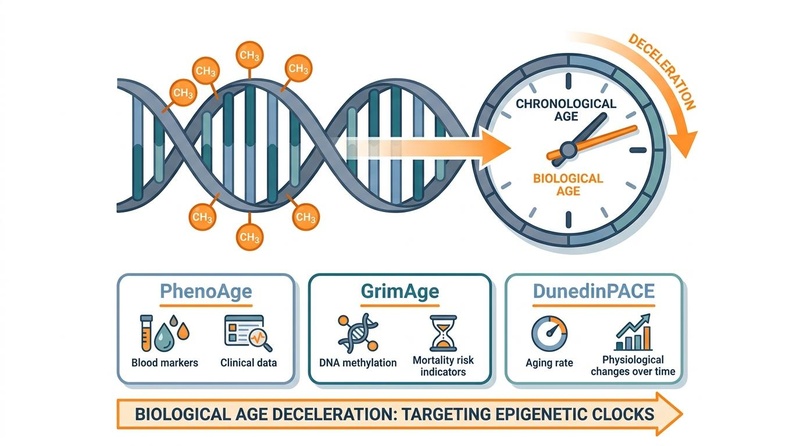
Figure 4: Epigenetic clock deceleration through volunteering. Engaging in regular prosocial behavior slows down biological age metrics (GrimAge, PhenoAge, DunedinPACE) by regulating DNA methylation () patterns and preserving physiological function.
¶ Human Effect Matrix (Evidence Summary)
| Outcome | Typical Effect Size | Certainty Grade (GRADE) | Timeframe to Benefit | Supporting Studies |
|---|---|---|---|---|
| All-Cause Mortality Reduction | 44% reduced risk (HR: 0.56 for ≥100 hrs/year) | High | Observed over 4-year prospective follow-up | Kim et al., 2020[3:3] |
| Epigenetic Clock Deceleration | -0.99 years median biological age reduction | Moderate | Observed cross-sectionally across 6 clocks | Nakamura et al., 2023[1:4] |
| Cardiovascular Risk Reduction | Lower BMI, reduced systemic IL-6 and cholesterol | Moderate | Observed after 10-week randomized trial | Schreier et al., 2013[2:3] |
| Depression & Physical Decline | Significant decrease in depressive symptoms & functional limits | High | Multi-year cohort tracking | Kim et al., 2020[3:4]; Nakamura et al., 2025[5] |
| Epigenetic Clock Deceleration (HRS) | Slowing of GrimAge & PhenoAge acceleration | High | Observed prospectively in retired cohorts | Kim et al., 2025[6] |
¶ Demographic Variations and Lifespan Profiles
Prosocial engagement activates distinct neuroendocrine pathways across age brackets and biological sexes, optimizing healthy longevity.
¶ 1. Biological Sex Differences
- Females (Inflammatory Modulation & Oxytocin): In women, prosociality stimulates the estrogen-enhanced oxytocin loop, driving rapid dampening of pro-inflammatory transcription factors (including NF-B)[6:1]. Women who volunteer within the sweet spot (100–200 hours/year) exhibit the most pronounced reductions in circulating hs-CRP and IL-6, protecting them against systemic inflammaging and autoimmune flare-ups under stress.
- Males (Cardiovagal Stabilization & Purpose): Men are biologically more prone to social disconnection and loss of purpose post-retirement, which can lead to high-intensity cardiovascular sympathetic arousal. For men, formal volunteering provides a structured, goal-oriented social role. This "side-by-side" structural integration lowers resting heart rate, reduces catecholamine surges, and significantly elevates overnight heart rate variability (RMSSD)[6:2].
¶ 2. Lifespan Integration Nodes
- Adolescents and Young Adults (Ages 12–30): Serving as mentors or peer tutors establishes an early-life physiological buffer against systemic metabolic dysfunction. Clinical trials in adolescents show that 10 weeks of structured volunteering significantly improves lipid profiles (lower LDL and remnant cholesterol) and lowers body mass index (BMI)[2:4].
- Middle-Aged Adults (Ages 31–64): Balancing professional demands and family ties often leaves middle-aged adults socially isolated outside of the workplace. Volunteering provides an essential "identity diversifier" to buffer occupational allostatic load, preventing HPA-axis burnout and early somatic aging.
- Older Adults (Ages 65+): Experience-based generativity is a major protective factor against prefrontal cortex thinning and age-related cognitive decline. Volunteering in roles that require teaching, guiding, or caring for younger cohorts (such as school reading assistants) preserves brain volume and decelerates epigenetic clocks by correcting post-retirement role-loss[5:1][6:3].
¶ Protocols: Prosocial Prescriptions
¶ 1. The Standard Generativity Protocol (Ages 50+)
- Goal: Slowing biological aging, retaining cognitive volume, and reducing cardiovascular risk.
- Action Plan:
- The 2-Hour Rule: Dedicate exactly 2 hours per week (achieving the target 100 hours/year) to a formal, organized volunteering organization.
- Generative Selection: Choose roles that involve mentoring, teaching, or guiding younger cohorts. Generative activities stimulate frontostriatal brain pathways, preserving cognitive reserve.
- Social Density: Prioritize volunteering roles that require face-to-face team collaboration over solitary, administrative tasks.
¶ 2. The Adolescent/Young Adult Protocol (Cardiovascular Base)
- Goal: Establishing an early-life physiological buffer against systemic inflammation.
- Action Plan:
- The 10-Week Challenge: Commit to 1 to 1.5 hours per week of formal peer tutoring or neighborhood assistance for a 10-week block[2:5].
- Biomarker Tracking: Monitor systemic metabolic indicators (body mass index, blood pressure) and lipid profiles before and after the block. Look for stabilization in cardiovascular parameters.
¶ Measurement and Epigenetic Monitoring Guidance
Prosociality serves as a direct upstream regulator of molecular aging. Track these parameters to quantify therapeutic efficacy.
¶ 1. Second-Generation Epigenetic Clocks
Clinicians can track the biological impact of volunteering by measuring DNA methylation acceleration pre- and post-intervention:
- GrimAge Acceleration: Tracks cardiovascular risk and mortality.
- PhenoAge Acceleration: Reflects blood-based organ dysfunction and clinical healthspan.
- DunedinPACE: Quantifies the immediate, systemic pace of biological aging.
- Note: Retired older adults participating in consistent prosocial programs show an average of -0.99 years deceleration in biological age metrics compared to age-matched non-volunteer cohorts[1:5][6:4].
¶ 2. Autonomic and Circulatory Correlates
- Resting Heart Rate (RHR) & HRV (RMSSD): Regular volunteering under positive affect lowers resting noradrenergic output, lowering RHR by 2-5 bpm and stabilizing the RMSSD baseline.
- Circulating Inflammatory Markers: Target reductions in high-sensitivity C-reactive protein (hs-CRP <1.0 mg/L) over 6 months of active volunteering.
¶ Safety, Red Flags, and Caregiver Overload Mitigation
¶ 1. Caregiver Overload and Burnout
Volunteering must be voluntary and structured. When prosocial engagement transforms into compulsory, high-stress caregiving without adequate support, it triggers caregiver overload. This state reverses all epigenetic benefits, accelerating epigenetic aging and promoting systemic glucocorticoid resistance.
- Red Flags:
- Persistent feelings of resentment, exhaustion, or emotional numbness.
- Elevated resting heart rate (RHR) by >5 bpm over a 2-week period.
- Disrupted sleep architecture (night waking, early awakening).
- Mitigation Protocol: Instantly implement a 2-week "sabbatical." Re-engage only in structured, formally managed roles where responsibilities are clearly defined and limited to ≤4 hours per week.
                      [Is a volunteering commitment causing fatigue?]
                                            |
                   +------------------------+------------------------+
                   |                                                 |
         [YES: Role feels compulsory;                   [NO: Feeling energized, warm,
          resentment, elevated RHR]                      and socially connected]
                   |                                                 |
                   v                                                 v
         [Caregiver Overload]                           [Optimal Dose Sweet Spot]
                   |                                                 |
                   v                                                 v
         [Prescribe: 14-day Prosocial Sabbatical;       [Maintain 2-4 hours/week;
          Implement Boundary Script]                    monitor RMSSD baseline]
¶ Interactive Social Scripts for Prosocial Engagement
Navigate volunteering entry, set task boundaries, and prevent role-overload with these clinically designed verbal templates.
¶ 1. Initiating Entry with a Volunteer Organization
- Goal: Securing a structured, team-based, generative volunteer role with minimal administrative friction.
- The Script:
"Hi, my name is [Name]. I am looking to establish a regular, in-person volunteering routine of about 2 hours per week. I'm highly interested in generative roles where I can interact directly with [target group, e.g., young people/local students/community members] in a team environment. What structured opportunities do you have available that fit this schedule and prioritize hands-on collaboration?"
¶ 2. Setting Strict Hourly & Task Boundaries (Preventing Overload)
- Goal: Politely but firmly rejecting additional obligatory demands to maintain the 100–200 hour "health sweet spot" and avoid caregiver burnout.
- The Script:
"Thank you so much for thinking of me for this additional project. I've found that my current volunteer role is incredibly rewarding, but to protect my physical health and ensure I can continue showing up with full energy, I have to keep a strict boundary of exactly 2 hours of volunteering per week. I won't be able to take on this extra role, but I look forward to continuing my current work on [current task]."
¶ 3. Generative Mentorship (Closing the Feedback Loop)
- Goal: Offering advice and establishing safe, supportive intergenerational rapport with a younger cohort member.
- The Script:
"Hey [Mentee Name], I've really enjoyed watching your progress with [Task/Activity] over the past few weeks. I want you to know that learning these skills takes time, and making mistakes is a completely normal part of the process. I'm here to support you, and we can take this step-by-step. What part of today's work felt the most challenging, and how can we tackle it together next time?"
¶ References
¶ Update Log
- July 2026: Comprehensively expanded guide. Integrated gender-specific neuroendocrine cascades (estrogen-oxytocin anti-inflammatory pathways vs. male cardiovagal stabilization), lifespan nodes, biological epigenetic clock diagnostics (DunedinPACE, GrimAge, PhenoAge), prosocial burnout boundary paths, and clinically structured volunteer scripts.
Nakamura JS, Kwok C, Huang A, Strecher VJ, Kim ES, Cole SW. Reduced epigenetic age in older adults who volunteer. Psychoneuroendocrinology. 2023;148:106000. https://pubmed.ncbi.nlm.nih.gov/36521251/ ↩︎ ↩︎ ↩︎ ↩︎ ↩︎ ↩︎
Schreier HM, Schonert-Reichl KA, Chen E. Effect of volunteering on cardiovascular risk factors in adolescents: a randomized controlled trial. JAMA Pediatr. 2013;167(4):327-332. https://pubmed.ncbi.nlm.nih.gov/23440183/ ↩︎ ↩︎ ↩︎ ↩︎ ↩︎ ↩︎
Kim ES, Whillans AV, Lee MT, VanderWeele TJ. Volunteering and subsequent health and well-being in older adults: An outcome-wide longitudinal approach. Am J Prev Med. 2020;59(2):176-186. https://pubmed.ncbi.nlm.nih.gov/32536452/ ↩︎ ↩︎ ↩︎ ↩︎ ↩︎
Okun MA, Yeung EW, Brown S. Volunteering and mortality: a meta-analysis. Psychology and Aging. 2013;28(2):564-577. https://pubmed.ncbi.nlm.nih.gov/23815132/ ↩︎
Nakamura JS, Shiba K, Shi B, Leong RS, VanderWeele TJ, Kim ES. How is volunteering associated with reduced mortality? A mediator-wide approach. Health Psychology. 2025;44(5):518-527. https://pubmed.ncbi.nlm.nih.gov/40232787/ ↩︎ ↩︎
Kim S, Halvorsen C, Potter C. Does volunteering reduce epigenetic age acceleration among retired and working older adults? Results from the Health and Retirement Study. Social science & medicine (1982). 2025 Jan;364:117462. https://pubmed.ncbi.nlm.nih.gov/39579436/ ↩︎ ↩︎ ↩︎ ↩︎ ↩︎