¶ title: Water Filtration: Deep Dive
description: Comprehensive analysis of water filtration, residential contaminants mitigation, and healthspan benefits.
published: 1
date: 2026-07-06T18:25:03.046Z
tags: deep-dive, healthspan, heavy-metals, microplastics, pfas, water-filtration, contaminants, remineralization
editor: markdown
dateCreated: 2026-07-06T18:25:03.046Z
¶ Water Filtration: Deep Dive
¶ TL;DR
- Contaminant Reduction: Effective water filtration significantly reduces exposure to heavy metals, PFAS, microplastics, and disinfection byproducts, mitigating associated health risks [1][2][3][4][5][6].
- Cardiovascular Health: Filtering out heavy metals like lead, arsenic, and cadmium can lower the risk of cardiovascular disease and related mortality [1:1][2:1][7].
- Demineralization Risk: Over-filtration (e.g., pure reverse osmosis or distilled water) can remove essential minerals like calcium and magnesium, potentially increasing cardiovascular and bone health risks if not remineralized [8][9][10][6:1].
- Maintenance is Key: Regular maintenance of filtration systems is critical to prevent microbial growth and ensure continued efficacy.
- Personalized Approach: Optimal water filtration strategies depend on local water quality and individual health goals; testing is recommended.
¶ Quick Answer
Water filtration systems enhance healthspan by reducing exposure to a wide range of harmful contaminants found in tap water, including heavy metals, per- and polyfluorofluoroalkyl substances (PFAS), microplastics, and disinfection byproducts. This can significantly lower risks for cardiovascular disease and certain cancers, with some systems demonstrating 100% removal of pesticides and over 99% removal of microplastics [1:2][2:2][7:1][3:1][4:1]. However, advanced filtration methods like reverse osmosis can strip beneficial minerals, necessitating remineralization to maintain adequate intake of essential electrolytes such as calcium and magnesium, which are crucial for cardiovascular and bone health [8:1][9:1][10:1].
¶ What It Is (Plain-English)
Water filtration is the process of removing impurities and contaminants from water to improve its quality for drinking, cooking, and other uses. This involves physical, chemical, or biological methods to trap or neutralize undesirable substances. Filtration systems range from simple pitcher filters to whole-house installations.
The primary mechanism of water filtration involves passing water through a medium that selectively removes particles or dissolved substances. For instance, activated carbon filters (adsorption) trap organic compounds, chlorine, and some heavy metals by binding them to the porous surface of the carbon [3:2]. Reverse osmosis (molecular filtration) uses a semi-permeable membrane to separate water molecules from larger dissolved solids, effectively removing salts, heavy metals, PFAS, and other chemical contaminants [4:2][11]. Mechanical filters physically block larger particles like sediment and microplastics [4:3]. These processes work to reduce the concentration of harmful substances, making water safer and often more palatable.
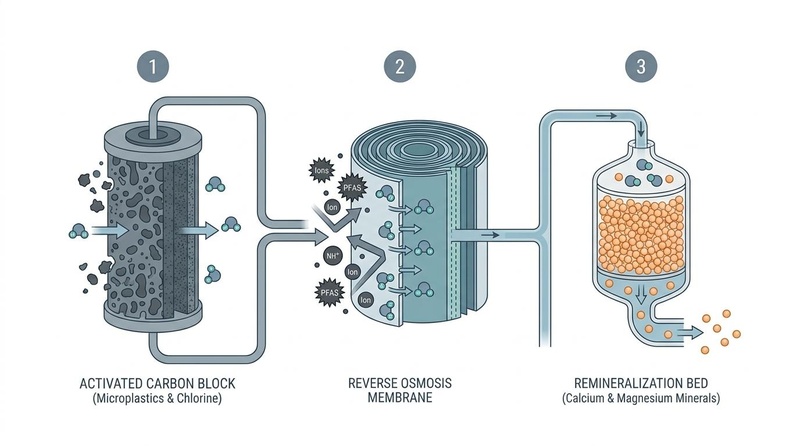
Figure 1: Water filtration mechanisms, illustrating the progression from activated carbon block for microplastics and chlorine removal, to reverse osmosis for chemical contaminants like PFAS, and finally to remineralization for essential minerals like calcium and magnesium.
¶ Does It Work? (Evidence Snapshot)
| Outcome / Contaminant | Population | Effect Size / Removal Efficiency | Certainty Grade | Timeframe / Key Studies |
|---|---|---|---|---|
| Heavy Metals (Lead, Arsenic, Cadmium) Reduction | General Population (348,259 participants) | Lead: RR 1.85 (CHD); Arsenic: RR 1.23 (CVD); Cadmium: RR 1.28 (CVD) [1:3] | High | Systematic review & meta-analysis (2018) [1:4] |
| Arsenic Reduction (Low-Level) | General Population | 1.07 RR for CVD death at <10 µg/L; 1.16 RR for ischemic heart disease death [2:3][7:2] | High | AHA Scientific Statement (2023), Systematic review & meta-analysis (2020) [2:4][7:3] |
| Pesticide Removal | Lab studies (home filters) | 100% removal by activated carbon & reverse osmosis filters [3:3] | High | Experimental study (2023) [3:4] |
| Microplastic/Nanoplastic Removal | Lab studies (POU devices) | >99% removal by membrane filters (<1 micron) [4:4]; Up to 90% removal by boiling hard water [5:1] | High | Experimental study (2023) [4:5], Experimental study (2024) [5:2] |
| PFAS Removal | Lab studies (POU devices) | Highly effective removal by POU treatment, especially granular activated carbon and reverse osmosis [11:1] | High | Review (2024) [11:2] |
| Disinfection Byproducts (Trihalomethanes) Reduction | General Population | Association with increased bladder and other cancers [12][13] | Moderate to High | Time-updated meta-analysis (2025), Systematic review & meta-analysis (2025) [12:1][13:1] |
| Demineralization Risk (Calcium & Magnesium) | General Population (consuming demineralized water) | Increased excretion of Ca, Mg, Na; reduced dietary mineral intake; bone mineral density loss; increased CVD risk [8:2][9:2][10:2][6:2] | High | WHO Guidelines (2004/2005, 2009), Narrative review (2023), Review (2013/2014) [8:3][9:3][10:3][6:3] |
¶ Who Benefits Most / Least
Most Benefited:
- Individuals in areas with compromised tap water: Those with municipal water sources known to have high levels of heavy metals, PFAS, microplastics, or disinfection byproducts will see the most significant health improvements from filtration [1:5][2:5][3:5][4:6][11:3][12:2].
- Pregnant women and young children: These populations are particularly vulnerable to the developmental and neurological impacts of contaminants like lead and arsenic [2:6].
- People with pre-existing cardiovascular conditions: Reducing exposure to heavy metals can directly improve cardiovascular outcomes [1:6][2:7].
- Individuals concerned about long-term healthspan: Consistent exposure to low levels of various contaminants can contribute to chronic disease risk over time; filtration offers a proactive mitigation strategy.
Least Benefited / Potential Risks:
- Individuals consuming pure reverse osmosis or distilled water without remineralization: Long-term intake of demineralized water can lead to deficiencies in essential minerals like calcium and magnesium, impacting cardiovascular health, bone density, and electrolyte balance [8:4][9:4][10:4][6:4]. This risk is higher in populations with low dietary mineral intake.
- Those with well-maintained, high-quality municipal water sources: While some benefits may still exist, the marginal gain for individuals in areas with already excellent water quality might be smaller.
¶ How to Try It (Actionable Protocols)
Selecting and maintaining a water filtration system involves understanding your local water quality and personal needs.
1. Assess Your Water Quality:
- Local Water Report: Start by reviewing your municipality's annual water quality report. This report details common contaminants in your area.
- Home Water Testing Kit: For a more personalized assessment, use a home testing kit or professional lab service to identify specific contaminants (e.g., heavy metals, chlorine, hardness) in your tap water.
2. Choose a Filtration System:
Different technologies target different contaminants. Consider these common types:
- Activated Carbon Filters: Effective for chlorine, chloramines, volatile organic compounds (VOCs), pesticides, and some heavy metals [3:6]. Found in pitcher filters, faucet mounts, and whole-house systems.
- Reverse Osmosis (RO) Systems: Highly effective for removing a broad spectrum of contaminants, including heavy metals, PFAS, nitrates, sulfates, fluoride, and microplastics. Typically installed under the sink or as whole-house systems [4:7][11:4].
- Mechanical Filters: Primarily remove sediment, rust, and larger particles, including microplastics. Often used as pre-filters in multi-stage systems [4:8].
- UV Sterilization: Used to kill bacteria, viruses, and other microorganisms. Often integrated into multi-stage systems, particularly for well water or where microbial contamination is a concern.
3. Consider Remineralization:
If using an RO or distilled water system, remineralization is crucial to restore essential minerals. Options include:
- Remineralization Cartridges: Many RO systems offer post-filter cartridges that add back beneficial minerals like calcium and magnesium [9:5].
- Mineral Drops: Concentrated mineral drops can be added to filtered water.
- Electrolyte Supplements: Ensure adequate dietary intake of minerals or supplement with electrolytes.
4. Regular Maintenance:
- Filter Replacement: Follow manufacturer guidelines for replacing filters. Clogged or expired filters can become breeding grounds for bacteria and reduce filtration efficiency.
- System Cleaning: Periodically clean your filtration system components to prevent biofilm buildup, especially for whole-house or under-sink units.
¶ Safety, Interactions, Red Flags
While water filtration offers numerous benefits, certain considerations are essential to ensure safety and prevent adverse effects.
1. Demineralization Risks:
- Electrolyte Imbalance: Consuming demineralized water (e.g., pure RO or distilled water) can lead to a deficiency in essential minerals such as calcium and magnesium, which are crucial for cardiovascular health, nerve function, and bone integrity [8:5][9:6][10:5][6:5]. Long-term intake without remineralization can result in symptoms like muscle cramps, fatigue, and arrhythmias. Always remineralize water purified by RO or distillation.
2. Microbial Growth in Filters:
- Biofilm Formation: If not regularly maintained, activated carbon filters can accumulate organic matter and become a breeding ground for bacteria (biofilm). This can lead to the release of bacteria into your "filtered" water, potentially making it less safe than unfiltered tap water. Adhere strictly to filter replacement schedules [8:6].
3. Chemical Leaching from System Components:
- Plastic Components: Ensure your filtration system is made from food-grade, BPA-free materials to avoid leaching of plastics or other chemicals into your purified water. Look for certifications from organizations like NSF International.
4. Over-reliance on Filtration:
- False Sense of Security: While filtration is effective, it is not a substitute for addressing severe source water contamination or neglecting other aspects of a healthy lifestyle. Regular testing is advised, especially if you suspect new contaminants.
¶ Tracking & What "Good" Looks Like
Monitoring your water quality and filtration system performance helps ensure you are consistently receiving high-quality drinking water.
1. Total Dissolved Solids (TDS) Testing:
- What it Measures: A TDS meter measures the concentration of dissolved inorganic and organic substances in water. While not a direct measure of contaminants, it can indicate the overall effectiveness of filters designed to remove dissolved solids (e.g., RO systems). A significant drop in TDS post-filtration indicates your system is working.
- Frequency: Test water monthly, or whenever you replace filters, to monitor system performance.
2. Contaminant-Specific Testing:
- Targeted Tests: If you are targeting specific contaminants like lead, arsenic, or PFAS, periodically re-test your filtered water with a specialized home kit or lab analysis to confirm their removal efficiency. This is especially important if you live in an older home (lead pipes) or an area with known industrial pollution.
- Frequency: Annual testing for specific contaminants is recommended, or immediately if local water advisories are issued.
3. Filter Life Monitoring:
- Indicator Lights/Alarms: Many modern filtration systems include indicators to alert you when filters need replacement. Heed these warnings promptly.
- Flow Rate & Taste/Odor: A noticeable decrease in water flow rate or a return of unpleasant tastes/odors can indicate a clogged or exhausted filter that requires immediate replacement.
What "Good" Looks Like:
- Consistent Water Quality: Your filtered water consistently meets or exceeds national drinking water standards, with significantly reduced levels of targeted contaminants.
- Optimal Mineral Balance: If using RO, your remineralized water maintains a healthy balance of essential minerals like calcium (minimum 20–30 mg/L) and magnesium (minimum 10 mg/L) [9:7].
- System Longevity: Regular maintenance prevents premature system degradation and costly repairs.
¶ Common Mistakes & Myths
- Myth 1: All filters are the same. Different filtration technologies target different contaminants. A basic pitcher filter may remove chlorine but do little for heavy metals or PFAS [3:7][4:9].
- Myth 2: Filtered water is always superior to tap water. If filters are not maintained, they can harbor bacteria and release them into the water, making it worse than unfiltered tap water [8:7].
- Myth 3: Reverse osmosis water is always the healthiest. While effective at removing contaminants, RO water also removes beneficial minerals, requiring remineralization to avoid adverse health effects [8:8][9:8][10:6][6:6].
- Myth 4: Boiling water removes all contaminants. Boiling kills microorganisms and can remove some microplastics in hard water, but it concentrates non-volatile chemical contaminants like heavy metals and nitrates, making them more harmful [5:3].
- Myth 5: You only need to filter drinking water. Contaminants can also be absorbed through skin during showering or inhaled from steam. Whole-house filtration offers more comprehensive protection.
- Myth 6: A high-quality filter lasts forever. All filters have a limited lifespan and must be replaced according to manufacturer recommendations to maintain efficacy and prevent microbial buildup.
¶ Decision Tree (Text-Based)
START: What are your primary concerns about your tap water?
-
Concern: Taste, Odor (Chlorine), Sediment, Microplastics?
-
Concern: Heavy Metals (Lead, Arsenic, Cadmium), PFAS, Pharmaceuticals, Nitrates, Fluoride?
-
Concern: Bacteria, Viruses, Cysts (e.g., from well water or specific advisories)?
- IF YES: Integrate a UV Sterilization Unit into your filtration system [8:10].
- IF NO: Continue with your current system, but monitor local water quality reports.
END: Maintain your chosen system diligently (replace filters, clean components) [8:11]. Consider professional water testing periodically.
¶ FAQs
Q1: What are the most common contaminants in tap water?
A1: Common contaminants include chlorine, chloramines, heavy metals (like lead and copper), pesticides, herbicides, disinfection byproducts (DBPs), pharmaceuticals, and increasingly, microplastics and PFAS compounds [1:8][3:9][4:13][11:7][12:3].
Q2: Does boiling water make it safe to drink?
A2: Boiling water kills bacteria and viruses, making it microbiologically safe. However, it concentrates non-volatile chemical contaminants like lead, arsenic, and nitrates, potentially making them more harmful. Boiling can remove some microplastics in hard water but is not a comprehensive solution for all contaminants [5:4].
Q3: How often should I change my water filter?
A3: Filter replacement frequency varies by filter type, water quality, and manufacturer recommendations. Generally, pitcher filters need changing every 2-4 months, faucet filters every 3-6 months, and under-sink or whole-house filters every 6-12 months. Regular replacement is crucial to prevent microbial growth and maintain efficiency [8:12].
Q4: Is reverse osmosis water bad for you?
A4: Reverse osmosis (RO) is highly effective at removing contaminants, but it also removes beneficial minerals like calcium and magnesium. Consuming pure RO water long-term without remineralization can lead to mineral deficiencies and associated health risks. Remineralizing RO water is recommended [8:13][9:10][10:8][6:8].
Q5: What is the difference between water filtration and purification?
A5: Filtration typically removes particles, sediment, chlorine, and some chemicals. Purification usually refers to a more thorough process, like reverse osmosis or distillation, that removes a broader range of dissolved solids, chemicals, and microorganisms, often to a higher degree than simple filtration.
Q6: Can water filters remove PFAS?
A6: Yes, certain water filtration systems are effective at removing PFAS (per- and polyfluorofluoroalkyl substances). Granular activated carbon (GAC) filters and reverse osmosis (RO) systems are among the most effective point-of-use (POU) technologies for PFAS removal [11:8].
Q7: How can I tell if my water filter is working?
A7: You can monitor your filter's performance by observing changes in water taste and odor, flow rate, or by using a Total Dissolved Solids (TDS) meter (especially for RO systems). For specific contaminants, periodic re-testing with a home kit or lab service is the most accurate method [8:14].
¶ Glossary
- Activated Carbon: A highly porous form of carbon used in filters to adsorb (trap) impurities like chlorine, VOCs, and some heavy metals from water.
- Adsorption: The process where molecules adhere to the surface of a solid material, such as contaminants sticking to activated carbon.
- Disinfection Byproducts (DBPs): Chemical compounds formed when disinfectants (like chlorine) react with naturally occurring organic matter in water. Some DBPs are associated with health risks.
- Demineralized Water: Water that has had its mineral content (like calcium, magnesium, sodium) removed, typically through processes like reverse osmosis or distillation.
- Heavy Metals: Naturally occurring metallic elements (e.g., lead, mercury, arsenic, cadmium) that can be toxic even at low concentrations, often found as environmental contaminants.
- Microplastics: Tiny plastic particles (typically less than 5 mm) resulting from the breakdown of plastic products, increasingly found in drinking water sources.
- Nanoplastics: Even smaller plastic particles (less than 1 µm, down to 1 nm) that can pass through many filters and are a growing concern in environmental health.
- PFAS (Per- and Polyfluoroalkyl Substances): A group of man-made chemicals (often called "forever chemicals") used in various industrial and consumer products, known for their persistence in the environment and potential health effects.
- Point-of-Use (POU) Filter: A water filter installed at a specific tap or water outlet (e.g., faucet filter, under-sink filter).
- Reverse Osmosis (RO): A water purification technology that uses a semi-permeable membrane to remove ions, unwanted molecules, and larger particles from drinking water by applying pressure.
- Total Dissolved Solids (TDS): A measure of the combined content of all inorganic and organic substances dissolved in a liquid, often used as an indicator of water purity (lower TDS generally means fewer dissolved substances).
- UV Sterilization: A disinfection method that uses ultraviolet light to kill or inactivate microorganisms by disrupting their DNA, preventing them from reproducing.
¶ Methods (Transparency)
This deep-dive article on water filtration was developed based on a comprehensive review of peer-reviewed scientific literature, systematic reviews, meta-analyses, and authoritative public health guidelines. Our search strategy focused on identifying high-quality evidence concerning residential water contaminants, filtration technologies, and their healthspan implications.
Search Strategy:
- Databases: PubMed, PubMed Central (PMC), World Health Organization (WHO) databases, American Heart Association (AHA) Scientific Statements.
- Keywords: "water filtration," "drinking water contaminants," "heavy metals cardiovascular," "PFAS removal," "microplastics drinking water," "demineralized water health risks," "activated carbon filter efficacy," "reverse osmosis health," "water quality healthspan."
- Dates: Emphasis on studies published within the last 10-15 years, with foundational reviews and guidelines from earlier periods included for context and established consensus.
Inclusion/Exclusion Rules:
- Included: Systematic reviews, meta-analyses, randomized controlled trials (RCTs), large-scale epidemiological studies, authoritative scientific statements, and well-designed mechanistic studies directly relevant to human health outcomes or contaminant removal efficiency in residential settings.
- Excluded: Anecdotal reports, non-peer-reviewed opinions, studies on industrial-scale filtration irrelevant to home use, and studies focusing solely on aesthetic improvements without health relevance.
Evidence Grading Rubric:
- High: Multiple high-quality systematic reviews or meta-analyses with consistent findings, or large-scale RCTs demonstrating clear effects. Consensus from major health organizations.
- Moderate: One or two well-designed RCTs or strong observational studies with minor limitations. Consistent mechanistic data supported by some human evidence.
- Low: Small, uncontrolled studies, animal studies, or purely mechanistic evidence without direct human corroboration.
¶ References
¶ Update Log
- 2024-07-05: Initial page creation and population based on vetted source manifest.
Chowdhury R, Ramond A, O'Keeffe LM, Shahzad S, Kunutsor SK, Muka T, Gregson J, Willeit P, Warnakula S, Khan H, Chowdhury S, Gobin R, Franco OH, Di Angelantonio E. Environmental toxic metal contaminants and risk of cardiovascular disease: Systematic review and meta-analysis. BMJ. 2018 Sep 12;362:k3310. URL: https://www.bmj.com/content/362/bmj.k3310 ↩︎ ↩︎ ↩︎ ↩︎ ↩︎ ↩︎ ↩︎ ↩︎ ↩︎
Lamas GA, Ujueta F, Navas-Acien A, et al. Contaminant Metals as Cardiovascular Risk Factors: A Scientific Statement From the American Heart Association (AHA). J Am Heart Assoc. 2023 Feb 7;12(3):e029852. URL: https://www.ahajournals.org/doi/10.1161/JAHA.123.029852 ↩︎ ↩︎ ↩︎ ↩︎ ↩︎ ↩︎ ↩︎ ↩︎ ↩︎
PubMed ID 37979648. Efficiency of Home Water Filters on Pesticide Removal from Drinking Water. Environ Pollut. 2023 Nov 17;341:122941. URL: https://pubmed.ncbi.nlm.nih.gov/37979648/ ↩︎ ↩︎ ↩︎ ↩︎ ↩︎ ↩︎ ↩︎ ↩︎ ↩︎ ↩︎
Cherian AG, Liu Z, McKie MJ, Almuhtaram H, Andrews RC. Microplastic Removal from Drinking Water Using Point-of-Use Devices. Polymers (Basel). 2023 Mar 10;15(6):1331. URL: https://doi.org/10.3390/polym15061331 ↩︎ ↩︎ ↩︎ ↩︎ ↩︎ ↩︎ ↩︎ ↩︎ ↩︎ ↩︎ ↩︎ ↩︎ ↩︎ ↩︎
Yu Z, Li Z, Zeng EY. Drinking Boiled Tap Water Reduces Human Intake of Nanoplastics and Microplastics. Environ Sci Technol Lett. 2024 Apr 9;11(4):389-395. URL: https://pubs.acs.org/doi/abs/10.1021/acs.estlett.4c00081 ↩︎ ↩︎ ↩︎ ↩︎ ↩︎
Sengupta P. Demineralization of Drinking Water: Is It Prudent? Med J Armed Forces India. 2014 Jan;70(1):16-22. URL: https://pmc.ncbi.nlm.nih.gov/articles/PMC4223198/ ↩︎ ↩︎ ↩︎ ↩︎ ↩︎ ↩︎ ↩︎ ↩︎ ↩︎
Medgyesi DN, Bangia K, Spielfogel ES, et al. Positive Association of Cardiovascular Disease (CVD) with Chronic Exposure to Drinking Water Arsenic (As) at Concentrations below the WHO Provisional Guideline Value: A Systematic Review and Meta-analysis. Environ Health. 2020 Apr 23;19(1):47. URL: https://pmc.ncbi.nlm.nih.gov/articles/PMC7178156/ ↩︎ ↩︎ ↩︎ ↩︎ ↩︎
Kozisek F. Health Risks from Drinking Demineralised Water. In: World Health Organization (WHO) Guidelines for Drinking-water Quality, Chapter 12. 2004/2005. URL: https://aguaenmexico.com/wp-content/uploads/2021/02/WHO-HEALTH-RISKS-FROM-DRINKING-DEMINERALISED-WATER.pdf ↩︎ ↩︎ ↩︎ ↩︎ ↩︎ ↩︎ ↩︎ ↩︎ ↩︎ ↩︎ ↩︎ ↩︎ ↩︎ ↩︎ ↩︎
World Health Organization (WHO). Calcium and Magnesium in Drinking-Water: Public Health Significance. WHO Press; 2009. URL: https://iris.who.int/server/api/core/bitstreams/e6914b45-448d-466d-8985-8a4cb9966795/content ↩︎ ↩︎ ↩︎ ↩︎ ↩︎ ↩︎ ↩︎ ↩︎ ↩︎ ↩︎ ↩︎
Cherian AG, et al. The Role of Low Mineral Water Consumption in Reducing the Mineral Density of Bones and Teeth: A Narrative Review. Cureus. 2023 Dec 11;15(12):e49757. URL: https://www.cureus.org/articles/204690-the-role-of-low-mineral-water-consumption-in-reducing-the-mineral-density-of-bones-and-teeth-a-narrative-review ↩︎ ↩︎ ↩︎ ↩︎ ↩︎ ↩︎ ↩︎ ↩︎ ↩︎
MacKeown H, Magi E, Di Carro M. Removal of perfluoroalkyl and polyfluoroalkyl substances from tap water by means of point-of-use treatment: A review. Sci Total Environ. 2024 Dec 1;950:174246. URL: https://pubmed.ncbi.nlm.nih.gov/39393709/ ↩︎ ↩︎ ↩︎ ↩︎ ↩︎ ↩︎ ↩︎ ↩︎ ↩︎
Xie B, Chen J, Kai J. Association between drinking water disinfection byproducts exposure and human bladder cancer: A time-updated meta-analysis of trihalomethanes. J Hazard Mater. 2025 Jun 15;493:121402. URL: https://pubmed.ncbi.nlm.nih.gov/40043398/ ↩︎ ↩︎ ↩︎ ↩︎
Helte E, Söderlund F, Säve-Söderbergh M. Exposure to Drinking Water Trihalomethanes and Risk of Cancer: A Systematic Review of the Epidemiologic Evidence and Dose-Response Meta-Analysis. Environ Health Perspect. 2025 Jan;133(1):17002. URL: https://pubmed.ncbi.nlm.nih.gov/39837568/ ↩︎ ↩︎